Cycling Trainers
Wahoo KICKR V5 Long-Term Review: 18 Months of Riding Without Manual Calibration
After 18 months of hard indoor training on Zwift and TrainerRoad, we look at how the KICKR V5 has held up for durability, noise, ride feel, and power accuracy.
Introduction
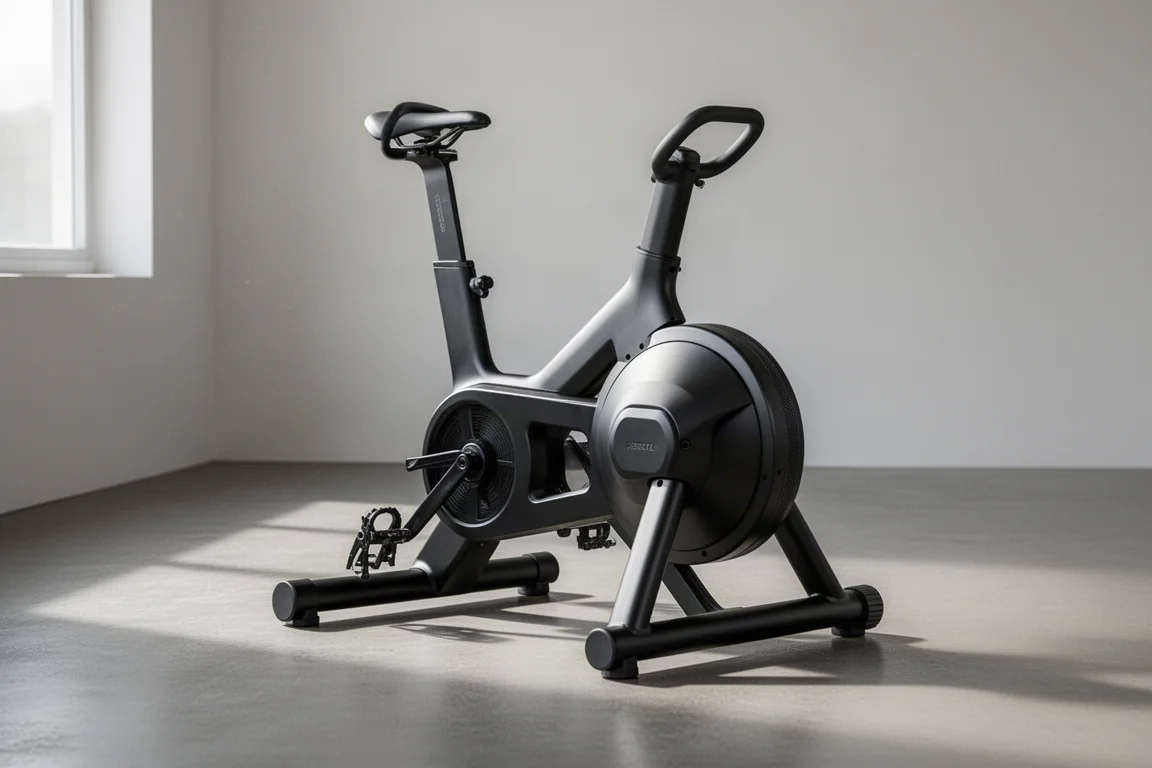
The Wahoo KICKR V5 has been in regular service here for well over a year and a half, logging serious mileage on Zwift, TrainerRoad, and Wahoo’s own training system. This long-term look covers the questions that matter most after extended use: does it stay accurate without manual calibration, how does it hold up against sweat and hard riding, and is it still a trainer worth shortlisting.
The headline feature of the V5 is automatic calibration. There is no spindown routine, no setup ritual, nothing to remember before a workout. The trainer simply calibrates itself silently in the background. Over 18 months, not a single manual calibration has been performed, and the accuracy results speak for themselves later in this review.
Design and Features: Refined, Not Reinvented
Wahoo has kept the overall KICKR design stable for many generations, and the V5 is close to the previous V4. It carries a 16-pound flywheel, delivers up to 2,200 watts of resistance, simulates inclines up to 20 percent, and measures cadence virtually without a separate sensor. Connectivity is generous, with multiple concurrent Bluetooth connections plus ANT+ FE-C and Bluetooth FTMS, so it works with essentially any training platform and device.
Compatibility is broad as well. It supports 130 and 135 mm quick-release axles and 12x142 and 12x148 thru-axles, and the adjustable blue bar at the bottom covers wheel sizes from 24-inch all the way up to 29-inch, 700c, 27.5, and 650b. The rotating rear axle also means it pairs with climbing accessories like the Wahoo KICKR CLIMB or the Elite Rizer.
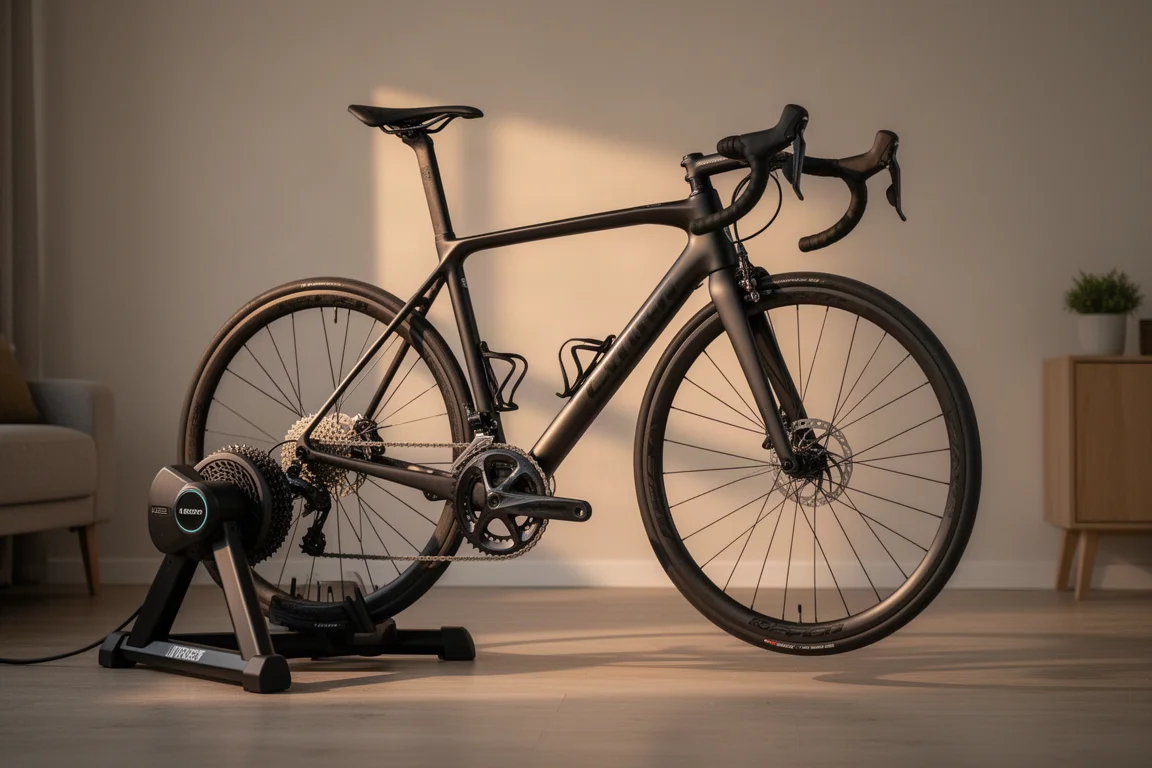
The V5 refines claimed power accuracy to about plus or minus 1 percent, down from plus or minus 2 percent on the V4. It also introduces two new hardware additions: the AXIS Action Feet and a rear port for a direct connect accessory.
The AXIS Action Feet are designed to add a small amount of side-to-side movement and reduce vibration, and they ship with three softness levels. They are also available as an upgrade kit for V4 owners. In practice, the difference is subtle. On a hard floor like concrete there is some perceptible movement, but on a trainer mat, which many riders already use, the cushioning of the mat makes the effect harder to notice.
The direct connect port lets you hardwire the trainer into your home network to prevent dropouts if your training space suffers from wireless interference. The accessory itself arrived about six months after the trainer launched, and app support rolled out gradually, with TrainerRoad and Wahoo’s own Sufferfest early and Zwift joining later. Most major platforms now support it. It costs 100 dollars, which is not cheap, but the quick-disconnect design at least means tripping over the cable safely detaches it rather than damaging the port. For riders who experience frequent dropouts, that could be money well spent. Anyone without connectivity problems can simply rely on the trainer’s strong wireless options.
Noise and the Included Cassette
One of the best traits carried over from earlier generations is how quiet this trainer is. Beyond the sound of your own drivetrain and the normal freewheel click when coasting, there is very little to hear, and after 18 months it remains exactly as quiet as the day it arrived. Few trainers at any price are this unobtrusive.
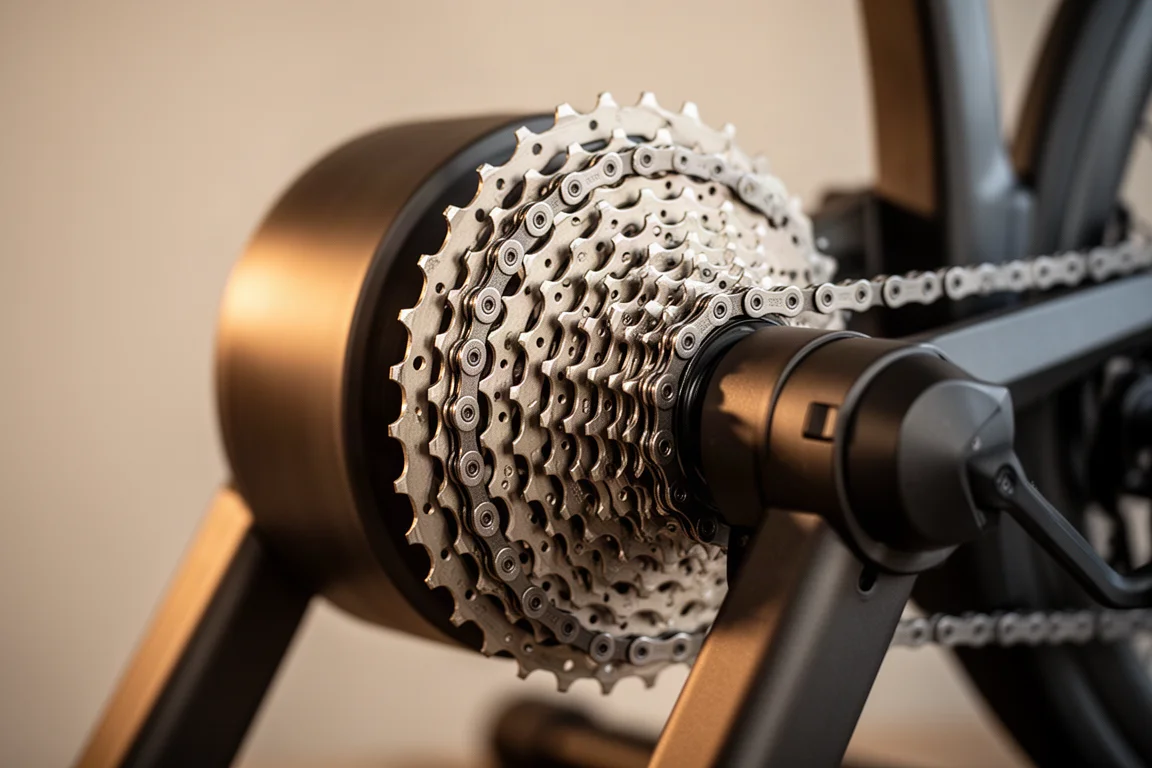
The V5 ships with a pre-installed 11-speed 11-28 cassette. The unit tested here came with a SunRace cassette rather than a Shimano or SRAM unit, and it has performed without issue. A Shimano cassette may be fractionally smoother and quieter, but that is splitting hairs; this one shifts and runs just fine.
Ride Feel and Responsiveness
Ride feel largely comes down to flywheel inertia, and the 16-pound flywheel does a convincing job. Acceleration and coasting feel close to what you experience outdoors, which is exactly what you want from a high-end direct drive trainer.
Responsiveness is also solid. In simulation apps like Zwift, grade changes show up in what you feel within roughly a second, so the screen and the trainer stay in sync. In erg mode, resistance changes take about two to three seconds and arrive smoothly rather than as a sudden wall.
Virtual cadence estimation works well too, even through sections of rapid cadence change. When it drifts, it is typically only off by about 2 to 3 RPM, which is negligible for training purposes.
Durability After 18 Months of Sweat
Indoor trainers take a beating from sweat, and grime builds up fast. After a good wipe-down with a damp cloth, the KICKR V5’s finish still looks essentially new, which speaks well of the coating quality Wahoo used here.
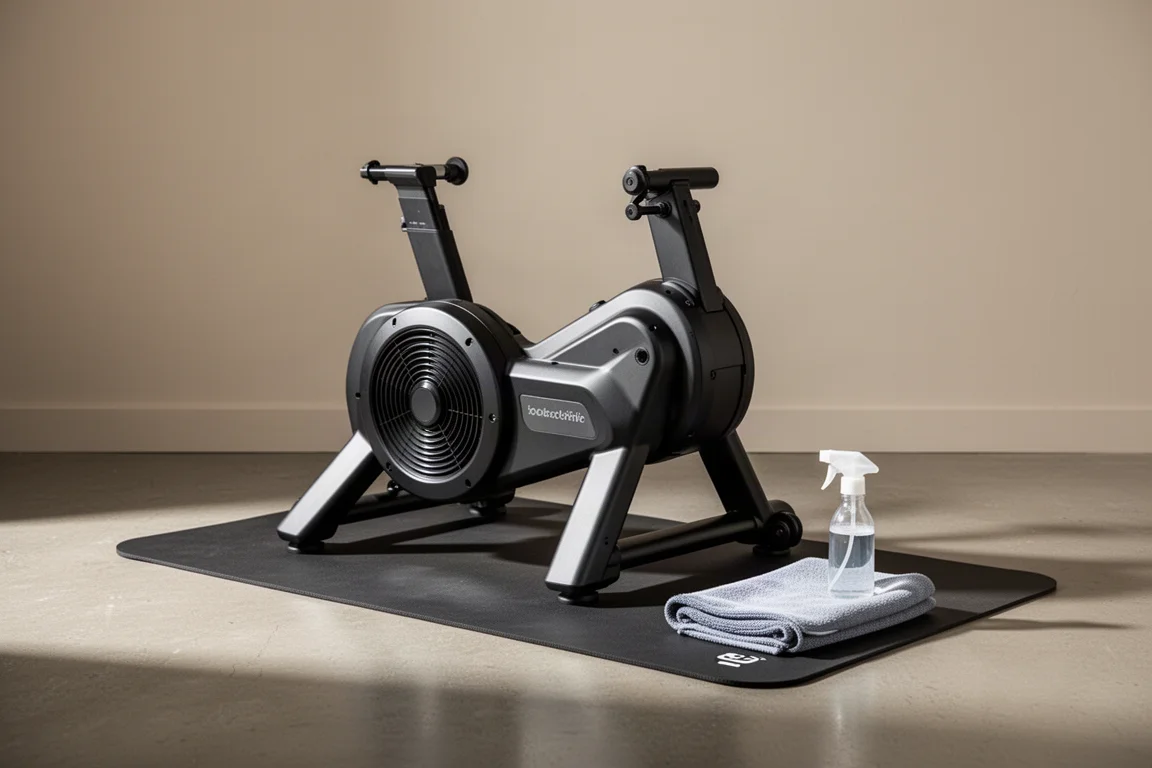
One small blemish did appear: the knob used to adjust the wheel size shows a bit of corrosion from sweat. It is an odd isolated case and the only visible wear found, but it is worth mentioning for anyone who sweats heavily indoors.
Power Accuracy After 18 Months
This is the core of any long-term trainer review, and the results here are impressive. Over 18 months of use with zero manual calibration, the KICKR V5 has stayed true to its plus or minus 1 percent claim.
In a recent erg mode workout on TrainerRoad, the KICKR was compared against Wahoo’s own Powerlink pedals, which are exceptionally accurate pedal-based meters. The average power across the entire workout differed by just 0.13 watts, and the traces were essentially a mirror image of each other. One interval dipped slightly low and another spiked ever so slightly, but nothing worth worrying about.
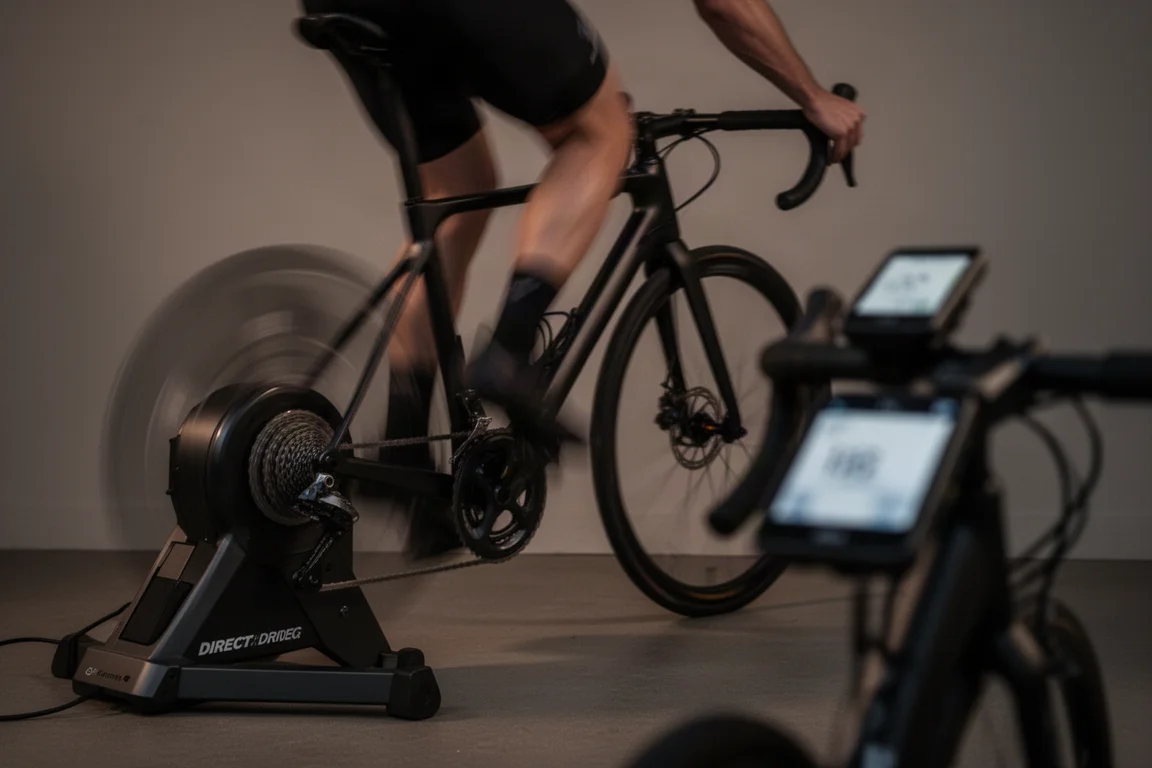
A recent Zwift ride compared against Favero Assioma Duo pedals showed a slightly larger gap, but still within expected range once drivetrain loss is considered, since pedal power readings sit closest to the rider and will generally read highest. Sprints looked good throughout, with one nailed almost perfectly and only minor variance on the others. Testing across a wide range of flywheel speeds and gearing combinations also showed consistent results. Early units had some accuracy issues at low flywheel speeds with high power output, but recent firmware updates appear to have resolved that.
Buying Advice
After 18 months, the KICKR V5 remains easy to recommend for serious indoor training. It is virtually silent, the multiple Bluetooth connections are genuinely handy for running multiple devices, the built-in carry handle makes moving it around simple, and above all it has stayed accurate over countless hours without any manual calibration. That last point also makes it a trustworthy reference when testing other power meters.
If you frequently battle dropouts in a wireless-crowded space, factor the 100-dollar direct connect accessory into your budget. If not, the trainer’s wireless connectivity alone will cover nearly every setup.
Conclusion
The Wahoo KICKR V5 has aged remarkably well. Power accuracy has held within its claimed tolerance for a year and a half without a single manual calibration, the finish shrugs off sweat with a simple wipe-down, and the quiet operation and broad app compatibility have not faded. For riders who want a high-end direct drive trainer they can set up once and forget about, this one has earned its place.
Product link
View more details for Wahoo KICKR V5
This product is mentioned in the review. Check the specifications, options, and compatibility before buying.
View more details for Wahoo KICKR V5Further reading
Related Reviews
Cycling Components
AliExpress Race Bike Build Review: What 20,000 Miles Revealed
A long-term look at a budget race bike build, covering an Elves Falath Pro frame, a Sensah Empire Pro groupset, Elite Wheels carbon rims, and Continental GP5000 tires.
Indoor Cycling Tech
Apple TV 4K Review: A Simple Route to Big-Screen Zwift
A practical look at using the Apple TV 4K as the brain of an indoor cycling setup, what it does well, and what you still need around it.
Indoor Cycling Tech
Apple TV 4K for Zwift: The Simplest Route to a Big-Screen Setup
A practical look at the Apple TV 4K as a Zwift device, covering what it does well, how it fits into an indoor cycling setup, and what to weigh before buying.