Road Bikes
Time VXRS vs Pinarello Dogma F: A 2005 Legend Against a Modern Race Bike
A genuine 2005 team bike and a current flagship race bike compared on construction, ride feel, and stopwatch results at the same power output.
Introduction
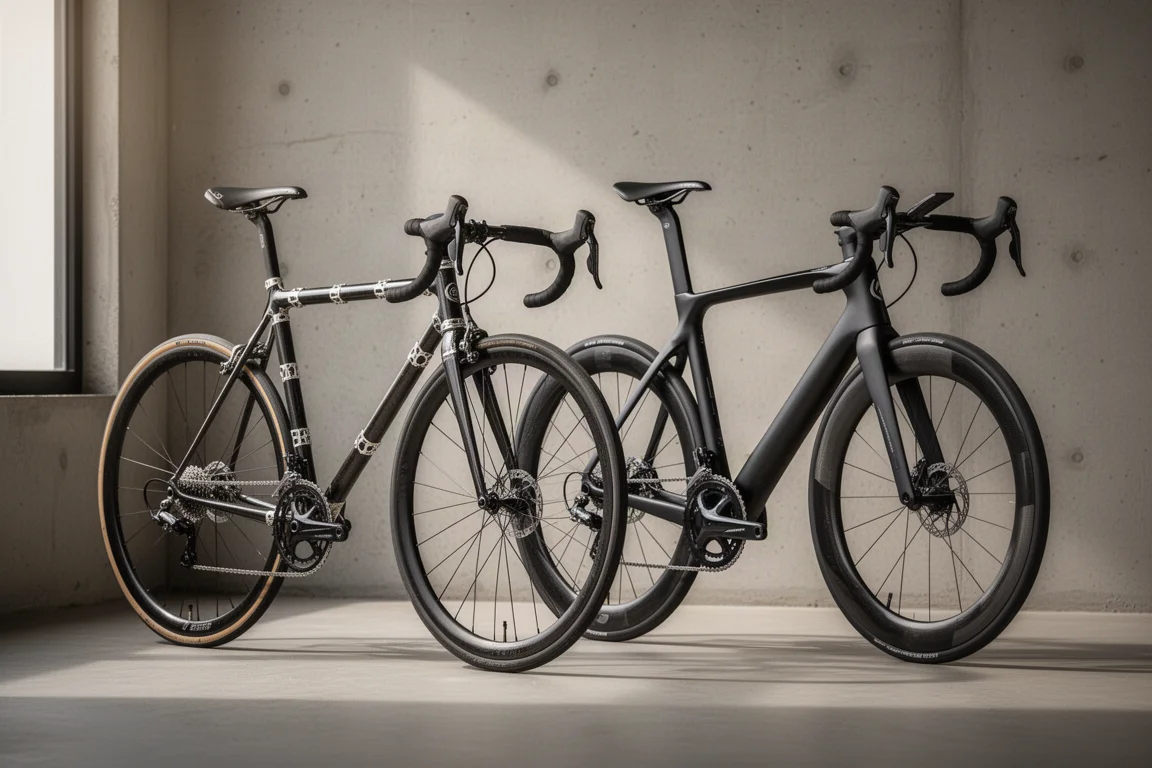
Twenty years separate these two road bikes, and they could hardly look more different. One is a Time VXRS, a genuine team bike from the 2005 Quickstep squad, a machine from a season that produced victories at the Tour of Flanders, the road World Championships, Il Lombardia and stages of the Tour de France. This particular frame also carries two stages of the Tour of Britain in its history.
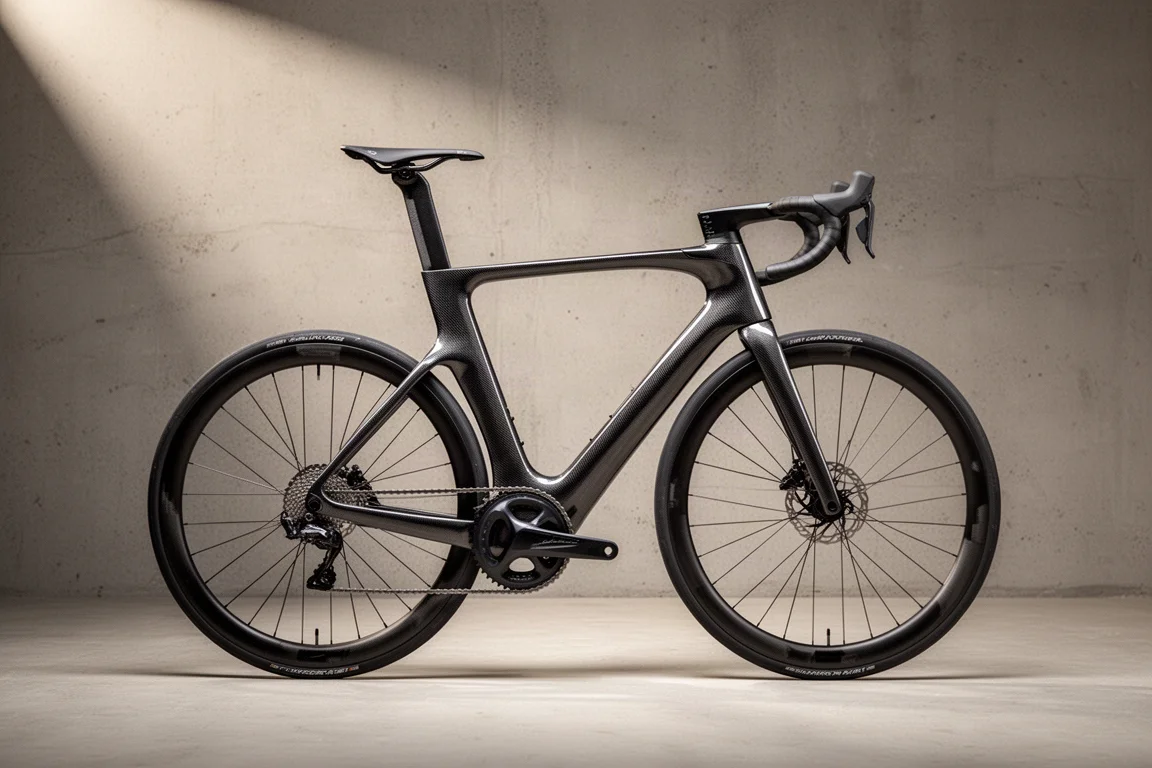
The other is a Pinarello Dogma F, a current flagship race bike with a win list long enough to fill a page and a build centred on Shimano Dura-Ace, Vision wheels and Pirelli tires.
Riding them back to back raises two separate questions. Does the older bike deserve the legendary status that has grown around it, and how much faster is a modern race bike at the same power output? The answers turned out to be more interesting than a simple stopwatch number.
How These Two Bikes Compare
Both bikes were ridden as complete, period-correct systems rather than as bare frames with modern parts bolted on. That matters, because tires, wheels, handlebar width, gearing and rider position all influence how a bike feels and how fast it goes.
You could not buy 36 cm handlebars in 2005, and turning up to a start line with 30 mm tires in that era would have raised eyebrows. A 2005 race bike is therefore judged with its own wheels, its own narrow tubular tires and its own mechanical groupset, and a 2025 race bike is judged with everything that has replaced them.
That approach frustrates anyone looking for a clean single-variable test, but it is also the honest way to answer the question. Nobody rides a frame in isolation. They ride a system, and the differences between two eras of systems are exactly what this comparison sets out to measure.
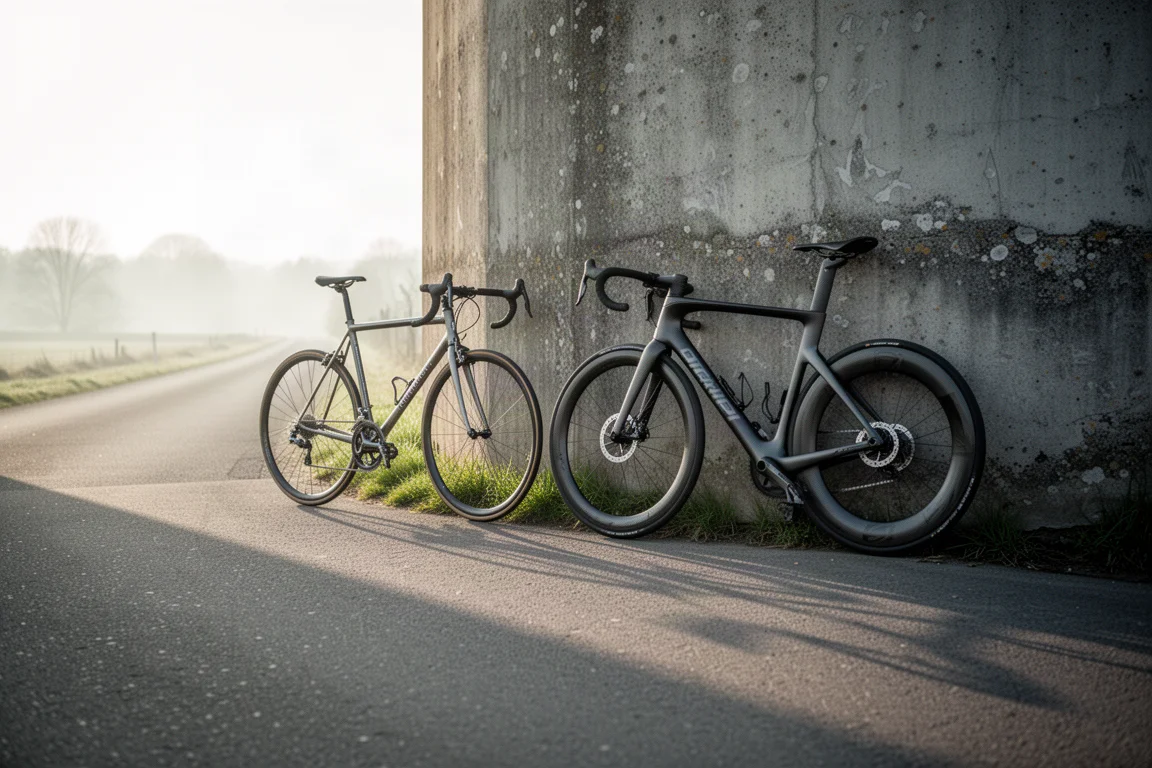
To keep things comparable, both bikes were ridden over the same 5 km segment at a target of roughly 300 W, with a power meter fitted so the effort could be held steady. Rider position could not be matched exactly, and that limitation is acknowledged up front.
Time VXRS: The 2005 Team Bike
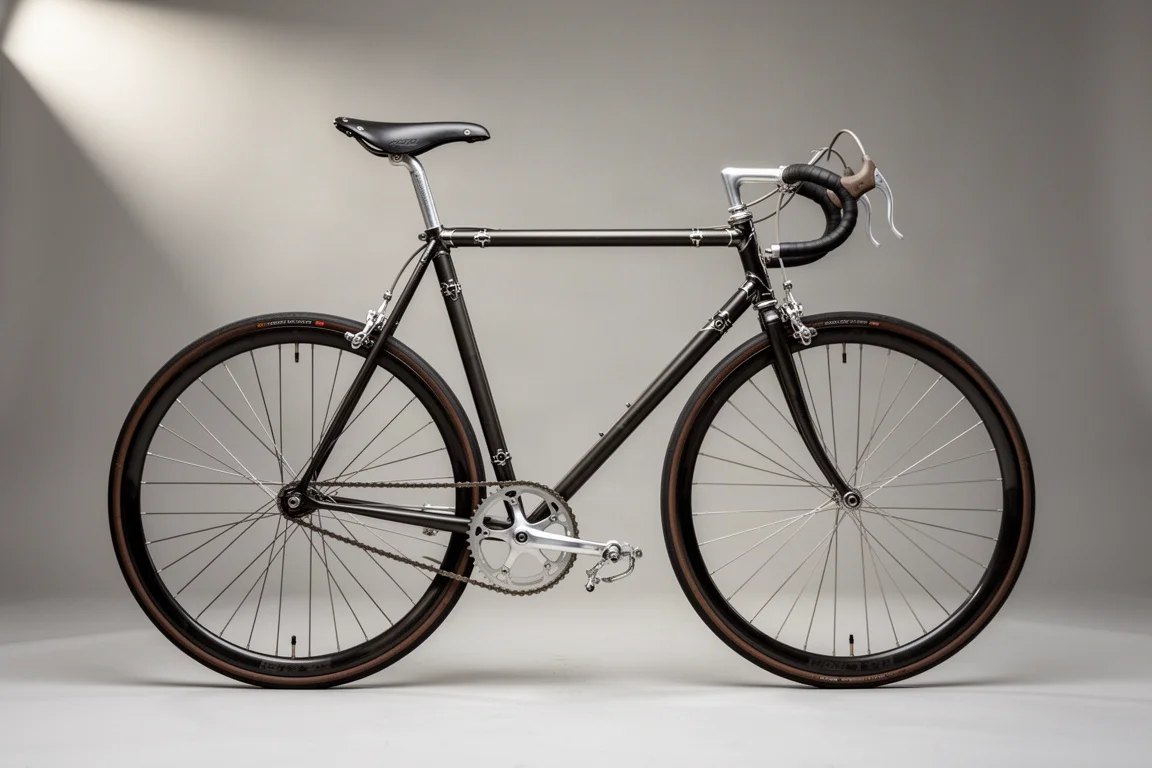
Time built frames in a way that set the brand apart. Rather than cutting carbon sheets into swatches and laying them into a mould, the company wove carbon fibers into a three-dimensional sock, injected resin at high pressure and cured the result into tubes. Those tubes were then bonded into carbon fiber lugs, and on the VXRS the joints where tube meets lug are plainly visible.
The brand has French origins and started out in 1987 with a clipless pedal used by some of the biggest names of the era, moving into frame manufacturing in 1993. Its frame facility was located in Lyon, a city with a long weaving heritage that suited the production method. Time frames became a common sight in the professional peloton of the late 1990s and early 2000s with several teams before the brand was priced out of the sponsorship game.
At just over 1,000 g the VXRS frame was competitive for its day, though it is not especially light by current standards. It is ride quality, not weight, that built the frame’s near-mythical reputation. Genuine team frames of this era also used non-replaceable derailleur hangers, a small detail that helps identify a real team bike.
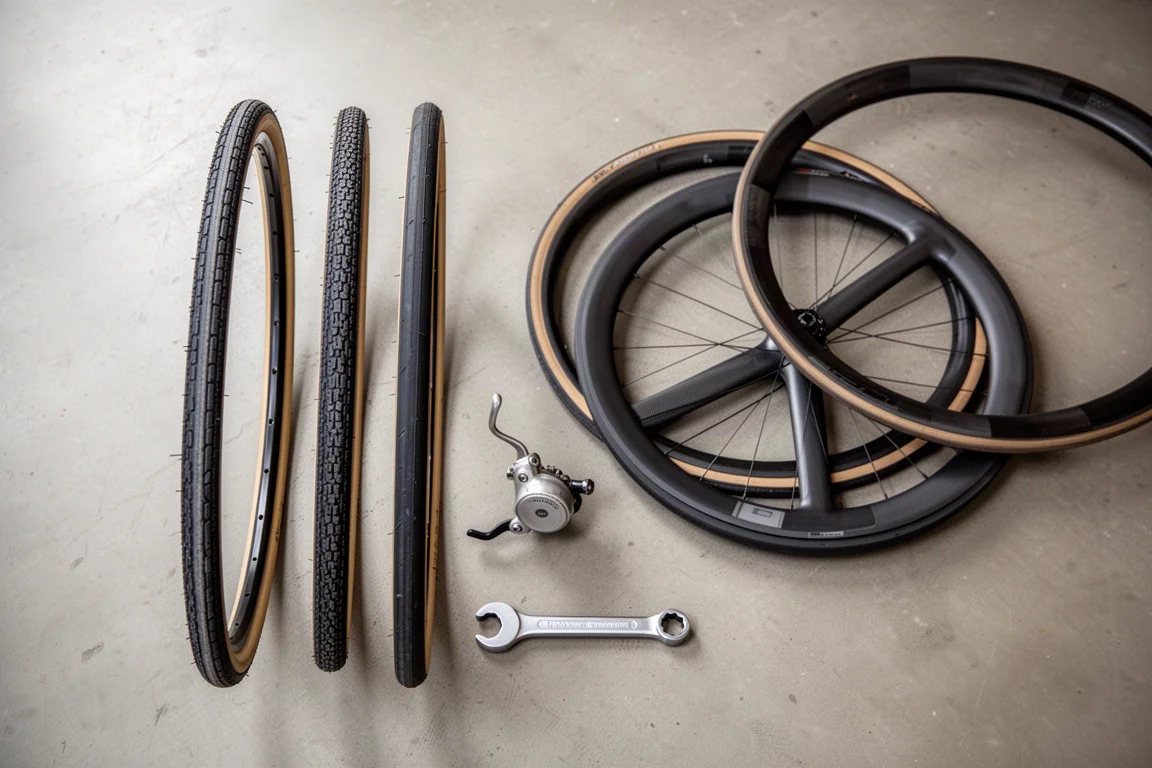
The build here is unmistakably of its time: Campagnolo 10-speed mechanical shifting, 22 mm tubular tires, vintage Fulcrum carbon wheels and a handlebar that is actually a touch wider than the racing norm of the period.
Time VXRS on the Road
The overriding impression is quietness. The ride quality is muted, the bike feels planted and steady on the road, and it holds speed well on climbs, descents and flat roads alike. Curiously, the complete bike is lighter than the modern machine it was compared against, yet it still feels heavier and more stately beneath the rider.
What it never does is feel fast. The effort going in and the pace coming out stay stubbornly in proportion, with no sense that the bike is adding anything. That is not a criticism of a twenty-year-old race bike so much as a description of where the modern performance gap actually lives.
The mechanical Campagnolo shifting is a genuine pleasure, satisfying in a way that has little to do with speed. On a 7 percent climb, though, the 39x23 gearing ran out of ratios quickly, and the rider had to push above the target power simply to keep the pedals turning comfortably. The brake levers are also set up the opposite way round to what most riders now expect, which is worth remembering on the first descent.
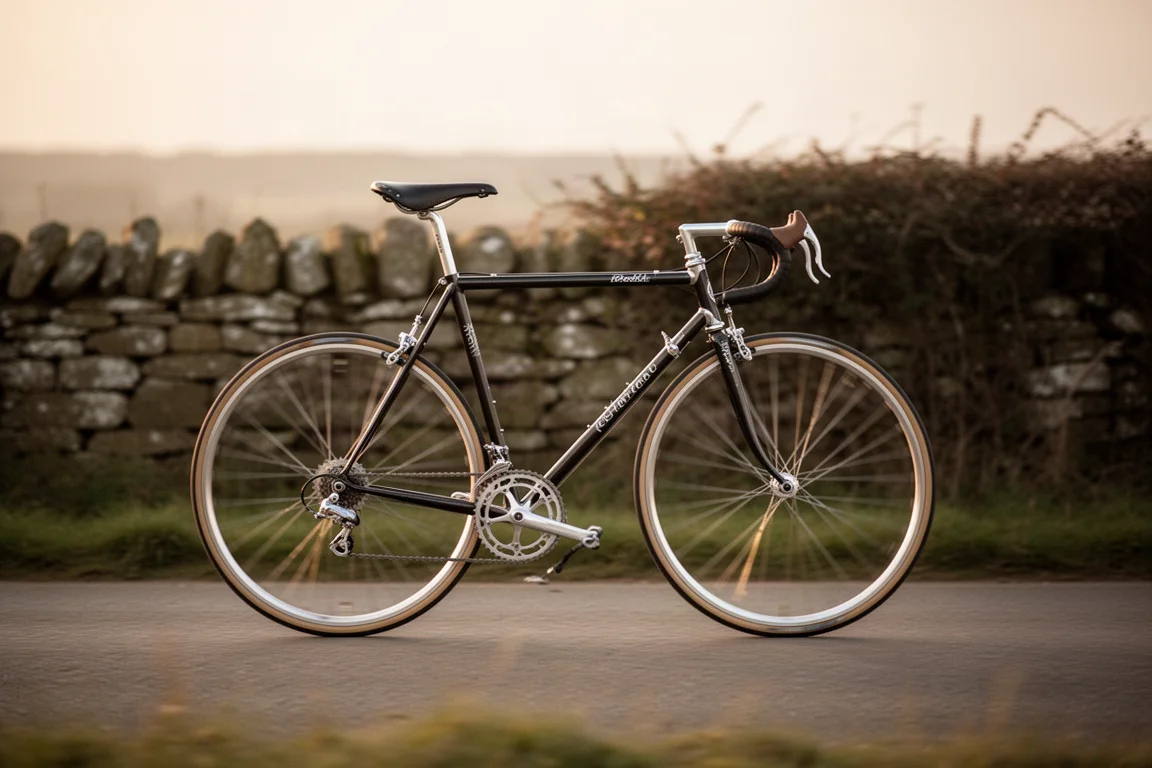
The frame here is on the small side for most riders, and the resulting position is not outrageous but is clearly not tailored to a taller rider. That is simply part of buying a frame built for someone else.
Pinarello Dogma F: The Modern Race Machine
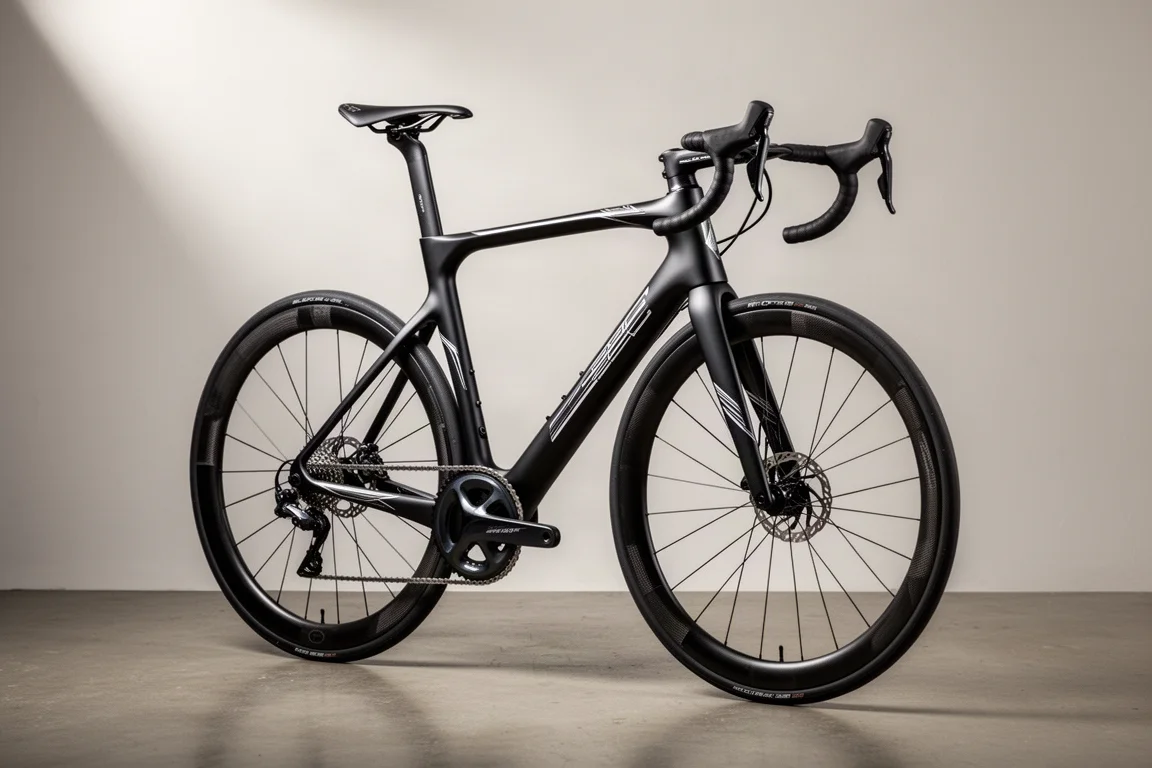
The Dogma F is the opposite proposition in almost every respect. It carries a long competition record and arrives with the current generation of componentry: Shimano Dura-Ace shifting, Vision wheels and Pirelli tires, wrapped around a frame designed with two decades of aerodynamic and carbon layup development behind it.
Everything about the contact points is narrower, lower and more integrated than on the older bike. The handlebars are noticeably narrower, the tires are wider and faster, and the shifting and braking are more precise. On the road the difference is immediate and unmistakable, and it is felt rather than measured.
Pinarello Dogma F on the Road
From the first pedal stroke the modern bike feels quicker. Three hundred watts still feels like three hundred watts in the legs, but the speed that comes out of it is a different story, and the gap is obvious even without looking down at a computer.
The front end is where the two bikes diverge most in character. The narrow bars and turned-in levers that define current race positions did not suit every rider in this comparison, and one tester found the hand position genuinely uncomfortable, wanting the hands a couple of centimetres further apart. Modern geometry and ergonomics have moved a long way from 2005, and not every change suits every body.
What is not in dispute is the sharpness. The modern bike feels more precise, more refined and more responsive in every input, from steering to braking to shifting. It is a bike that rewards hard efforts, and it is the machine that would be chosen for a fast group ride every single time.
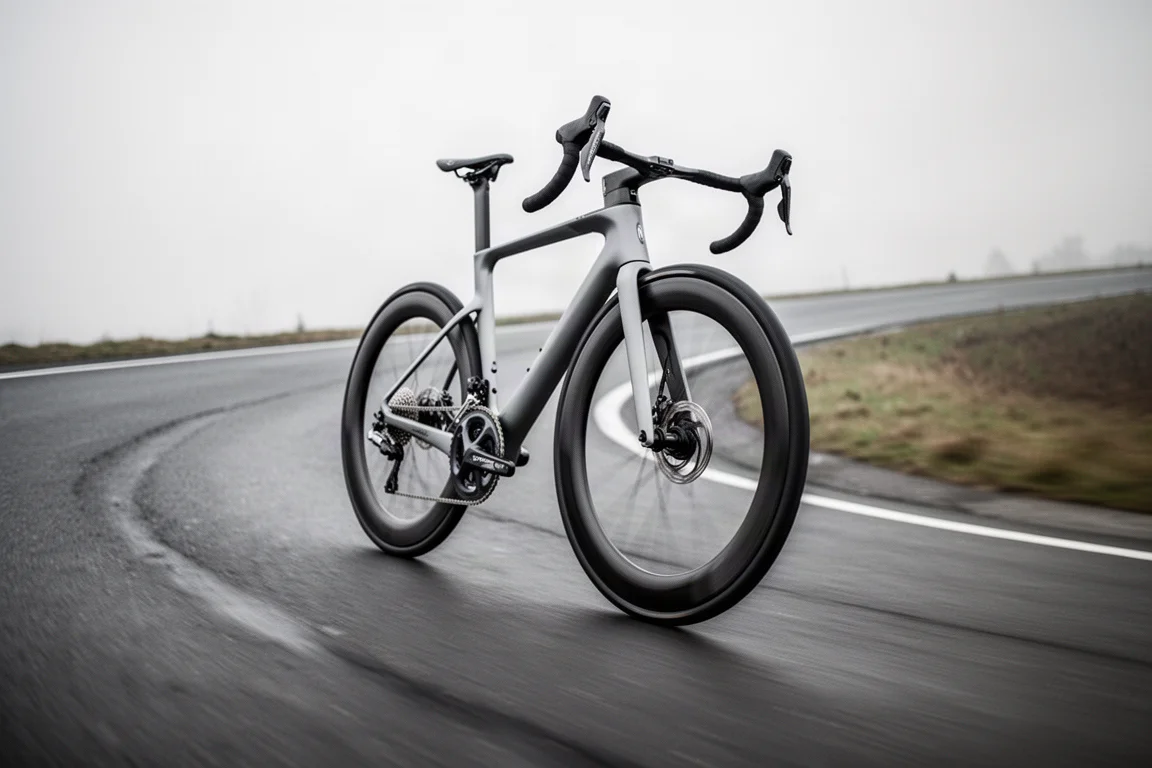
It is also, importantly, comfortable rather than harsh. The road surface in this test was bumpy in places, and the modern bike smoothed it out while still feeling direct.
Head to Head: The Stopwatch Results
Over the same 5 km segment at a steady 300 W, the twenty-year-old Time VXRS was 23 seconds slower for one rider and 19 seconds slower for the other. Extrapolated to a full hour at the same power, that works out at more than two minutes in favour of the modern bike. At race speeds the percentage difference would grow further still.
Whether that counts as a little or a lot depends entirely on perspective. For most riders it is a modest margin. For anyone who cares about equipment at a detailed level, it is significant, and it is the clearest illustration of how a long list of small changes accumulates into a real performance difference.
The margin cannot be credited to one component. Narrower handlebars, faster tires, deeper wheels, stiffer frame junctions and a more efficient rider position all contribute, and no single item accounts for the whole result. It is worth noting that in this comparison the rider on the older bike was also putting out slightly more power, which makes the time gap a conservative estimate rather than a flattering one.
Buying Advice
The Time VXRS deserves its legendary status, but the reason is historical rather than mechanical. It earned that reputation through the riders who used it and the races they won with it. As a ride it is genuinely pleasant, quiet and steady, but it is not demonstrably better than other well-regarded bikes of its era.
That shapes who should buy one. Collectors, riders drawn to period-correct builds, and anyone who wants a beautiful machine for steady coffee-ride miles will find a lot to love. Buyers should check for the non-replaceable derailleur hangers that genuine team frames used, confirm the frame size carefully, and expect the gear range and reversed brake lever layout of the period.
The Dogma F is the straightforward choice for performance. Riders who want to go fast, brake hard, shift quickly and feel every watt translate into speed will get more out of it, and the narrower cockpit and modern geometry are worth testing for fit before committing.
If both are options, they do not really compete. A vintage team bike is a bike you choose deliberately for a certain kind of ride. A modern race bike is the one you choose when the ride is the point.
Conclusion
The Time VXRS is a special machine with a real history, and it holds up far better than its age suggests. It is quiet, planted and enjoyable, and it still rolls along beautifully two decades on.
The Pinarello Dogma F is faster, sharper and more refined, and over an hour at the same power the gap is more than two minutes. That is the honest measure of twenty years of development, and it is the reason the modern bike remains the one most riders would reach for when they want to ride hard.
Buy the legend for what it is. Buy the modern bike for what it does.
Further reading
Related Reviews

Road Bikes
10 New Road Bikes Worth Watching: Aero, Titanium, Steel and Endurance Standouts
A practical roundup of 10 new road bikes, from aero flagships chasing single-watt gains to titanium, steel and endurance platforms built for real roads.
Road Bikes
2026 Tour de France Road Bikes: Six Race Machines Worth a Closer Look
Six race bikes from the 2026 Tour de France grid, reviewed for paint, silhouette, wheels and the specification details that matter to buyers.
Road Bikes
3T Strada Italia Review: A Radical Aero Road Bike That Rides Smooth
A made in Italy carbon aero road bike with a deep head tube, wide tire clearance and a genuinely comfortable ride. Here is what to know before buying.