Sound Bars
Sonos Arc Review: A Sound Bar Built for Television, Not for Music
The Sonos Arc transforms television sound with clear dialogue, punchy bass and deep low-end extension, but music stays pinned beneath the screen. Here is what to weigh before buying.
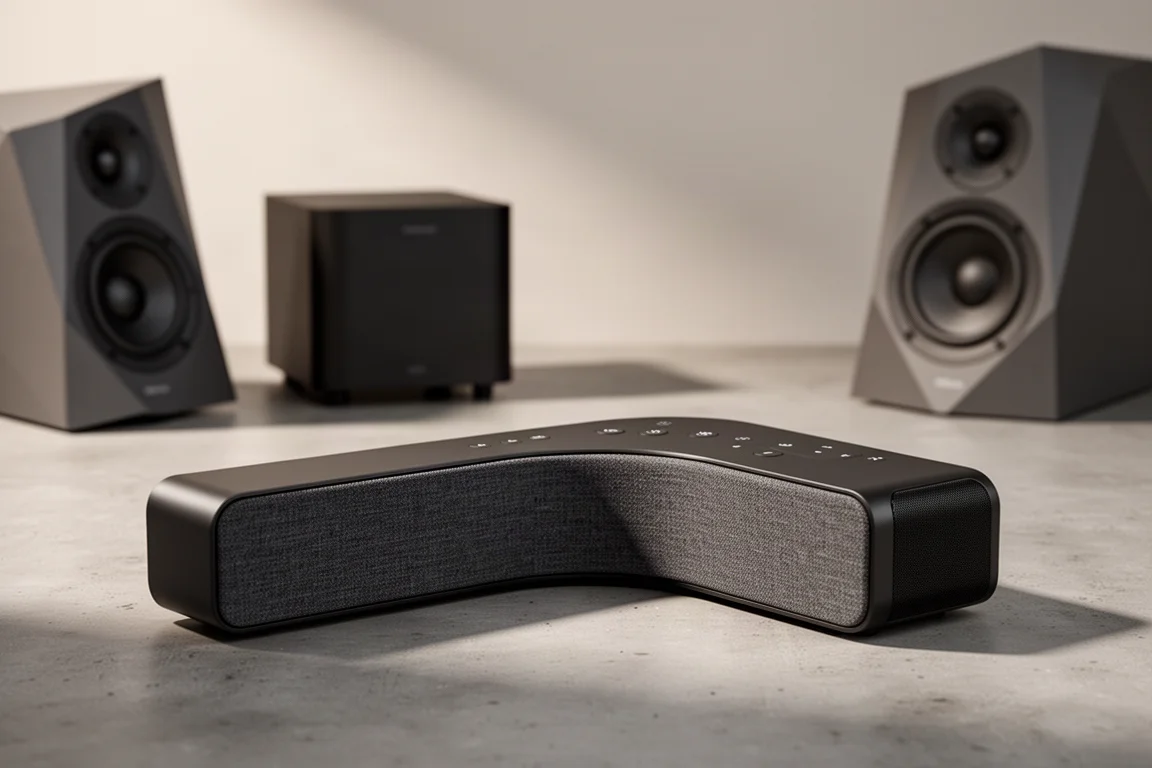
Introduction
The Sonos Arc is a sound bar, which is to say a long, tube-shaped enclosure packed with drivers and aimed at the space directly beneath a television. It exists because the speakers built into most televisions are a compromise, and it sits well above the entry-level end of the sound bar market.
Its appeal is easy to understand. Behind the non-removable grille sit 11 drivers, each powered by its own internal amplifier: eight oval bass drivers, arranged along the front, across the top and firing out of each end, plus three silk dome tweeters at the front, two of which angle diagonally outward. The result, for television and film, is a substantial step up from a flat panel’s own audio.

That step up is what most buyers are paying for. The question worth answering before purchase is whether the same money might do more elsewhere, particularly for anyone who listens to music as much as they watch.
Who this product is for
The Arc makes most sense for people who want better television sound from a device with a low physical footprint and a simple connection. It sits under a screen, takes up almost no depth, and improves dialogue clarity and bass weight without the clutter of separate speakers, stands, an amplifier and a digital converter.
It also suits listeners who play music occasionally rather than as the main event. Streaming works the way it does on other Sonos speakers, and the Sonos app is one of the few third-party apps that integrates Apple Music properly. Roon users can also stream to any Sonos speaker, which makes the bar a reasonable all-rounder in a multi-room setup.
It is a harder recommendation for anyone whose priority is two-channel music listening. That is the group this sound bar struggles to satisfy, and the sections below explain why.
Main strengths
Clear dialogue and punchy bass for television
For television viewing the Arc is very good. Dialogue arrives with real clarity and bass is plenty punchy, which is exactly the combination that makes streamed drama and film soundtracks work at normal listening levels. Against the speakers built into a typical television, the improvement is obvious rather than subtle.
Dynamics are a strength too. The bar handles the swings between quiet dialogue and loud effects well, which is what allows a film soundtrack to keep its drama. Deep bass extension is notable for a bar of this size; the low end reaches lower than the enclosure suggests, and that foundation supports the rhythmic drive of bass-led music.

The bar also keeps its composure as volume rises, which matters when the television is the centre of an evening’s entertainment rather than background noise.
Streaming support and simple controls
Music streaming is handled the same way as on any other Sonos loudspeaker, and the app’s Apple Music integration is a genuine convenience. Touch-sensitive controls sit on top of the bar for play, pause, volume up and volume down, so basic operation does not require a phone.
The app is useful for confirming that the bar is receiving a Dolby Atmos signal and for adjusting the virtualized height of the sound when it does. That combination of streaming support and straightforward control makes the Arc easy to live with day to day.
Things to consider before buying
Dolby Atmos is virtualized, not true surround sound
The Arc supports Dolby Atmos, but the implementation is virtualized. A true Atmos system places speakers in the ceiling and behind the listener; the Arc is a single bar in front of the listener and has to simulate the rest. In practice, music rarely escapes the physical boundaries of the bar, and the presentation feels standoffish rather than enveloping. Occasional effects do fire left and right beyond the ends of the enclosure, but those moments are few and far between, and there is no sense of sound wrapping around the room.

Height is more convincing than width. On some Atmos tracks the extra vertical dimension is clearly audible and instruments separate more distinctly than in the stereo version of the same recording. Even so, the effect varies a great deal from track to track.
Spatial audio availability and playback quirks
Getting Atmos music into the bar is more involved than streaming a normal track. The Sonos app’s Apple Music integration does not support Dolby Atmos content, so the signal has to arrive over HDMI eARC, which means a chain such as an Apple TV 4K running Apple Music into the television and then into the bar. Netflix Atmos soundtracks, meanwhile, require the top subscription tier.
Content is also thin on the ground. Spatial audio releases are far fewer than even hi-res releases, and albums are often only partly encoded; on one album a single track carried an Atmos mix while the rest stayed stereo.
Playback behaviour needs checking too. An Atmos-encoded continuous DJ mix did not play back gaplessly, while the stereo version of the same mix did. Skipping between Atmos tracks also revealed a short ramp-up as the bar registered and decoded the signal, which can swallow the opening moment of a song that begins with a hard hit.
Music stays close to the bar
Even with stereo content, music is where the Arc is least convincing. It is crisp, clean and reasonably transparent, and it can sound marginally more transparent than a comparably priced two-channel system, but it also sounds rigid, uptight and coated in a metallic sheen. Acoustic recordings suffer most: voices and instruments that sound organic through a pair of speakers sound artificial through the bar. TruePlay room compensation does not close that gap.
A side-by-side comparison with a two-channel system costing about the same money makes the difference plain. That system, built around a pair of Dali Spektor 2 stand-mounted speakers, a Rotel A11 Tribute amplifier and a Topping E30 digital converter connected to the television over Toslink, does not reach as low as the Arc, and its speakers bottom out around the mid-50s hertz. What it does instead is step the sound into the room. It is wider, taller and deeper, and it meets the listener halfway even against the Arc with Atmos engaged. A continuous DJ mix that sounded boxed in and distant through the bar sounded larger in every direction through the two-channel setup.
Buying advice
Buy the Arc as a television upgrade. In that role it delivers clear dialogue, punchy bass and genuine low-frequency extension from a device that takes up almost no space and connects simply, and it is a clear improvement on the audio built into most televisions. Its streaming support and app integration make it easy to use for occasional music as well.

If music is the main reason for the purchase, a two-channel system at a similar price is the more rewarding path. Separate speakers, an amplifier and a digital converter demand more space and more setup effort, and the bass will not reach as deep, but the presentation is fundamentally larger and more natural. The Arc is sold with a 100-day money-back return window, which makes it reasonable to try in your own room and decide from there.
Conclusion
The Sonos Arc is an effective sound bar and a modest music player. For television and film it is a clear win over built-in speakers, with strong dialogue clarity, good dynamics and deep bass for its size. For music it stays pinned beneath the screen, and a similarly priced two-channel system will sound substantially bigger and more natural. If the television comes first, the Arc is an easy recommendation; if music does, the money is better spent on separates.
Product link
View more details for Sonos Arc
This product is mentioned in the review. Check the specifications, options, and compatibility before buying.
View more details for Sonos ArcFurther reading
Related Reviews
Sound Bars
Best JBL Sound Bars 2026: Bar 500, Bar 700, Bar 1000, and Bar 1300X Compared
A practical look at JBL's latest sound bar lineup, from the budget Bar 500 to the flagship Bar 1300X, and how to match each model to the room you actually have.
Sound Bars
Klipsch Heritage Theater Bar Review: A Passive Sound Bar Built to Last
A passive three-channel sound bar with heritage-grade drivers, outstanding dialogue clarity, and a firm requirement for a receiver, room correction, and a subwoofer.
Sound Bars
Roku Streambar Pro Review: A $179 Sound Bar That Grows Into Wireless 5.1
The Roku Streambar Pro pairs a 4K HDR streamer with a $179 sound bar, and the Roku Wireless Subwoofer and Wireless Speakers can grow it into a wireless 5.1 system for under $660.