Road Bike Groupsets
Shimano Ultegra Di2 R8100 vs SRAM Force AXS: Which Electronic Road Groupset Wins?
A close comparison of Shimano Ultegra Di2 R8100 and SRAM Force AXS, covering battery design, app features, shifting, gearing, braking, weight and price.
Introduction
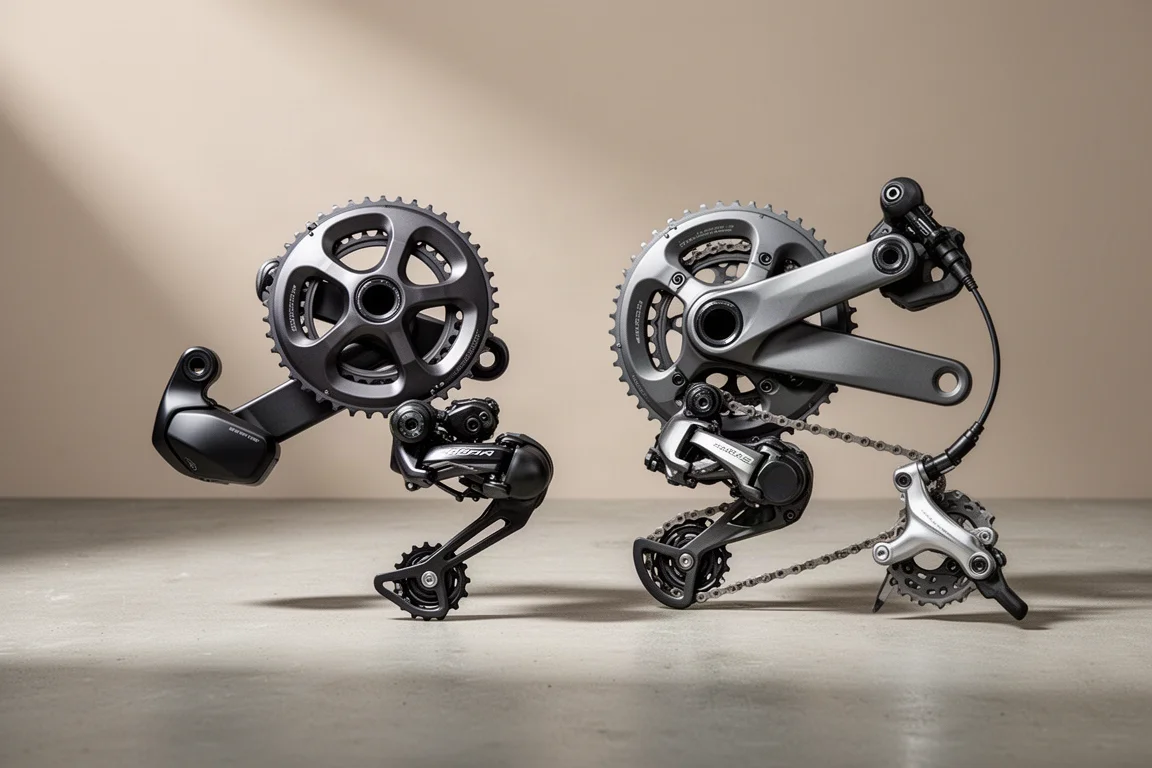
Shimano Ultegra Di2 R8100 and SRAM Force AXS sit in the same tier of the road bike market. They are the second-tier electronic groupsets from the two biggest names in the sport, both updated in recent years, and both carry shifting and braking technology that would once have been reserved for flagship groupsets such as Shimano Dura-Ace or SRAM Red. The appeal is straightforward: near-top-tier electronic performance at a slightly more reasonable price.
Both systems are fully electronic and both use hydraulic disc brakes, so the choice comes down to design philosophy rather than basic capability. Battery arrangement, app features, gearing spread, braking feel and price all differ, and each difference matters more to some riders than others.
Extended time on both groupsets makes one thing clear: the gap between them is small. SRAM Force AXS takes the overall win by a slim margin, but Shimano Ultegra Di2 R8100 answers back with noticeably better braking, a whisker of an advantage on weight, and a dominant position on complete bikes, where pricing and choice often push the decision the other way.
Shimano Ultegra Di2 R8100: The Core Package
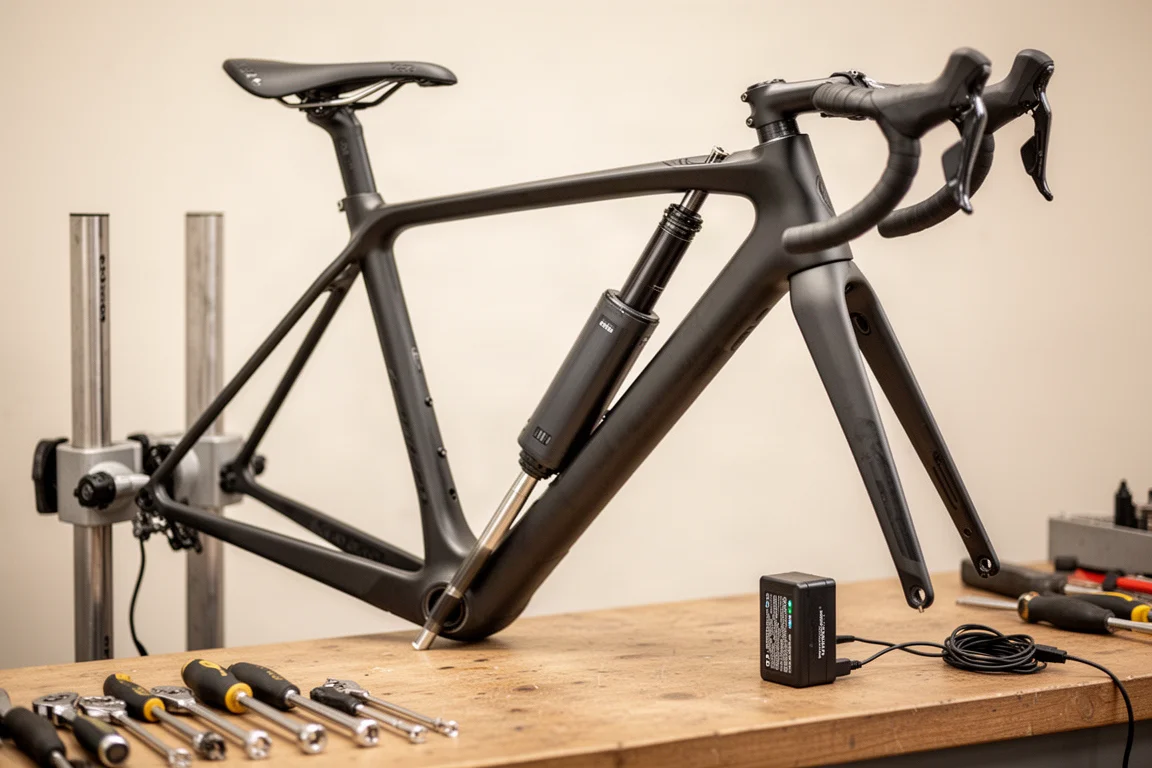
Ultegra Di2 R8100 keeps a central battery, usually housed in the seatpost, with both derailleurs wired to it. The shifters themselves are wireless, so there are no cables running from the handlebar into the frame, which tidies up the front end of the bike considerably. Installation still involves at least a couple of wires, whether the bike is assembled at home or in a workshop.
The upside of a single larger battery is that the individual derailleurs can be smaller and sleeker than fully wireless designs. Charging has moved to the rear derailleur, which is intended to make topping up easier, although the included charge cable is only 150 cm long, which can be awkward when the nearest socket sits at workbench height and the bike has to go on a stand to reach it. Shimano states that a Di2 system holds enough charge for roughly 1,000 km of riding.
Setup, adjustments and firmware updates run through the E-Tube app, and Bluetooth connectivity no longer requires a separate accessory unit, something few bike brands ever specced as stock anyway. The app remains focused on configuration rather than ride analysis.
SRAM Force AXS: The Core Package
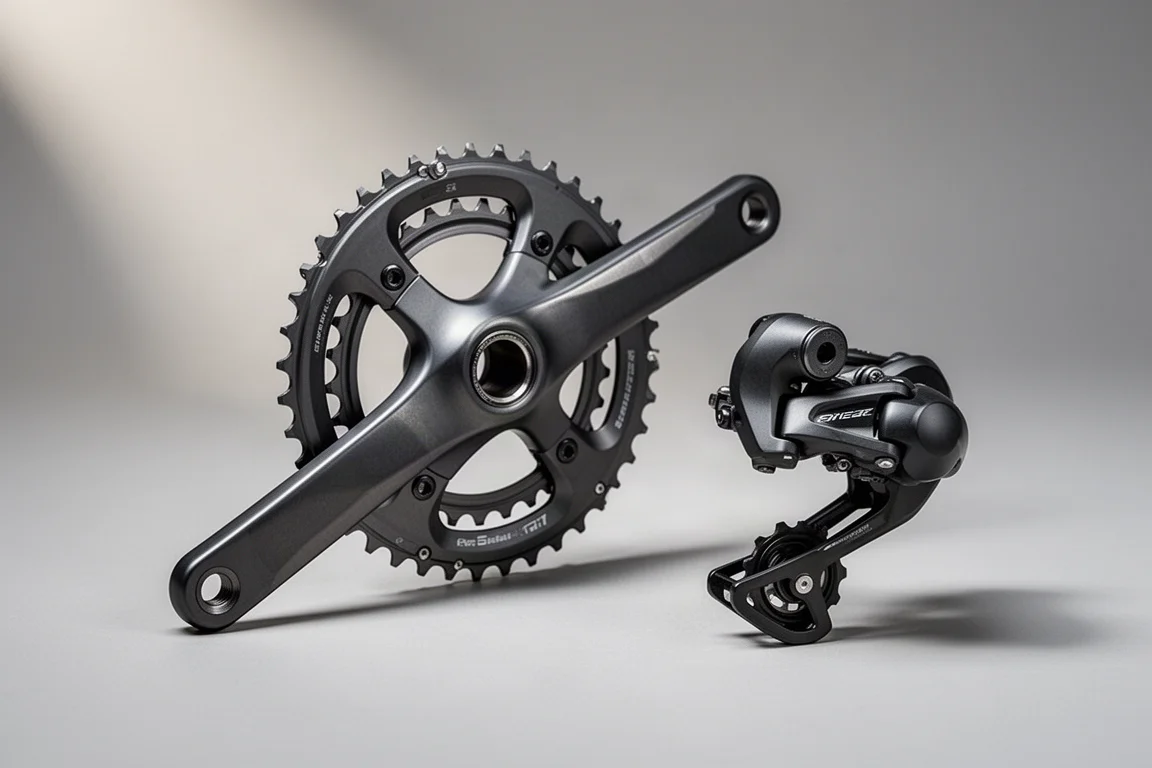
SRAM Force AXS has been fully wireless from the start. There is no internal cable routing to plan and no small wires to pinch or disconnect. Each derailleur carries its own battery, which clips on and off in seconds, so a charged spare can be rotated in at the end of a ride and the groupset never runs flat mid-route. SRAM states around 60 hours of riding per battery.
The AXS app is the more developed of the two ecosystems. It handles setup and firmware, but it also records a wealth of ride data, including which gears are being used, GPS information, and numbers coming in from connected devices such as a power meter or a heart rate monitor. If you like reviewing your data after a ride, this is a meaningful head start.
Design and Setup: Wireless vs Wired
The design difference is the first thing you notice when building a bike. SRAM Force AXS removes internal routing entirely and gives every derailleur its own external battery, which makes both assembly and day-to-day charging simpler. Swapping batteries takes seconds, and the system is effectively self-sufficient as long as one charged battery is on hand.
Shimano takes a different route. The wireless shifters eliminate handlebar-to-frame cables, but someone still has to deal with a couple of wires to connect the derailleurs to the central battery. In exchange, the derailleurs are smaller and cleaner looking, and there is only one battery to think about rather than two.
Charging convenience tilts to SRAM. The rear-derailleur charge port on the Shimano system is a sensible idea, but a 150 cm cable is short for real garages, and a longer lead would make the whole routine far easier.
Verdict: SRAM Force AXS.
Connectivity and App Features
Both groupsets communicate wirelessly with smart devices over Bluetooth, but the maturity gap is obvious. SRAM has been doing this for far longer, and the AXS app reflects that with gear-use tracking, GPS logging and support for incoming data from power meters and heart rate monitors. It turns the groupset into part of a broader training picture.
Shimano has closed a long-standing gap by building Bluetooth into the system without an extra accessory, which is a genuine improvement over older Di2 setups. The E-Tube app is excellent at what it does, covering setup, settings changes and firmware updates, but it does not attempt to be a ride-data platform. Riders who want analysis will look elsewhere.
Verdict: SRAM Force AXS.
Shifting Performance and Drivetrain Behavior
Both brands state that shifting has been sped up at both ends of the groupset, but the previous generations were already very quick, so dramatic improvements are hard to detect, particularly at the rear. What matters more is that shifting from both systems is excellent, and neither will leave a rider wanting.
SRAM made geometry changes to the front derailleur for this generation, and it now sits essentially on par with Shimano’s class-leading front shifting. There is a subtle difference in the act itself: a SRAM front shift requires pressing two shifter buttons rather than one, which can make it feel fractionally slower even though the shift is near instantaneous once the buttons are pressed.
The more tangible difference is the clutch on the SRAM rear derailleur, which the Ultegra derailleur does not have. On rough ground the SRAM system stays quieter and more composed. Neither groupset is a gravel groupset, but road bikes now accept wider tyres and riders venture onto looser surfaces more often, and that is where the fluid damper earns its place. Chain drops and missed shifts have not been an issue with Ultegra Di2, but it is noticeably noisier over the same terrain.

Verdict: a draw.
Gearing Options and Range
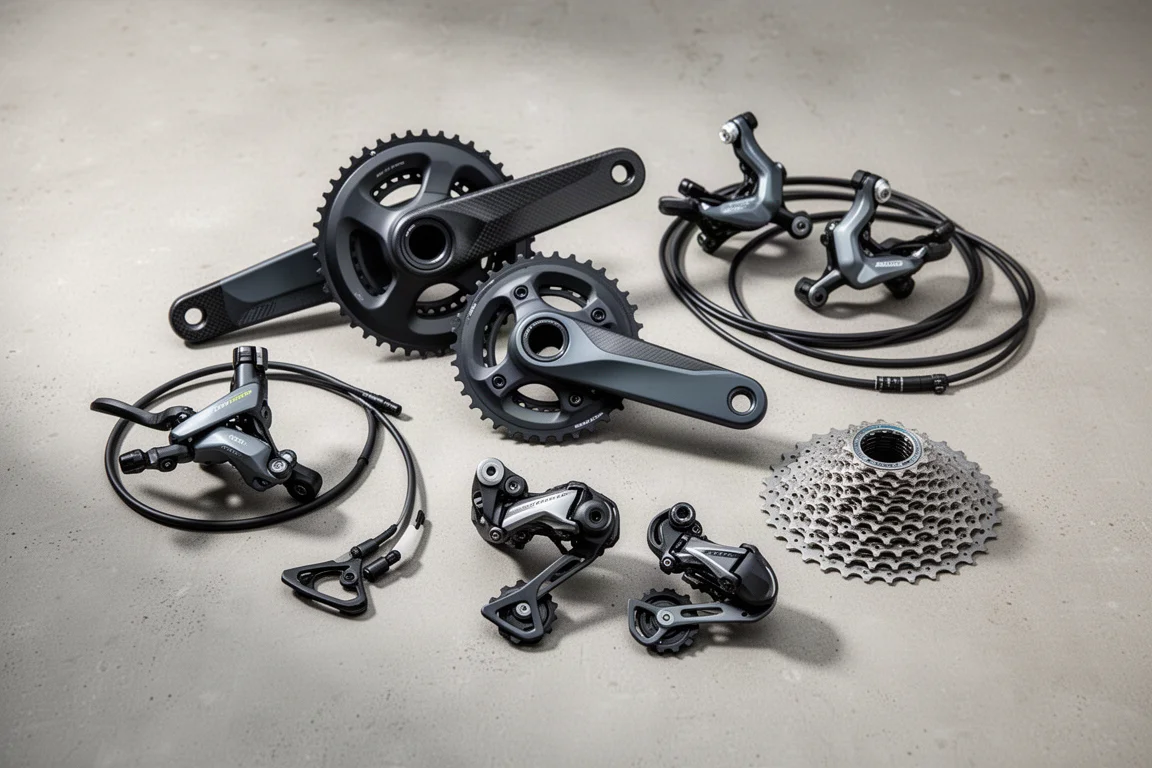
Shimano sticks with traditional ratios. Ultegra Di2 R8100 offers semi-compact 52/36 and compact 50/34 chainrings, and the standard 53/39 option has disappeared at this level, so riders who want those ratios need third-party chainrings or the 54/40 Dura-Ace crankset. Cassettes max out at 34 teeth, with a tighter 11-30 option for riders who prefer small jumps. Shimano has also reworked sprocket progression to be less linear, with tighter spacing at the low end and wider gaps at the top.
SRAM takes a more progressive approach. Force AXS cassettes come in 10-28, 10-30, 10-33 and 10-36, and the 10-tooth smallest sprocket stretches overall range. That is paired with smaller, more tightly spaced chainrings using a 13-tooth jump between rings rather than 16 teeth on an Ultegra set. With a 48/35 crank, the top gear is marginally bigger than a 52/11, while the 35/36 combination gives an easier climbing gear than a 34/34. A 46/33 crank set is available for easier overall gearing, a 50/37 version for bigger gears, and a tighter cassette remains an option for riders who like small steps between ratios.
Smaller cogs and chainrings can marginally increase drivetrain friction, though this is not something that registers out on the road. Taken as a whole, SRAM offers more flexibility at both extremes.
Verdict: SRAM Force AXS.
Braking Performance
This is where Shimano has made the biggest stride. Servo Wave speeds up initial pad travel when the lever is pulled and then increases braking power in the later phase of the stroke. Combined with a new lever shape and increased pad clearance, it delivers some of the best braking available on a road bike.
The standout benefit is braking from the hoods, where riders naturally have less leverage than in the drops. Since that is where most hands spend most of a ride, the improvement is genuinely useful rather than a spec-sheet talking point.
SRAM’s latest Force hydraulic disc brakes have taken fewer technological leaps, but they still impress. Power and modulation remain excellent, and the new calipers use a two-piece construction rather than one-piece, which improves alignment with the rotor and reduces the chance of sticky pistons. The result is quieter, more consistent braking than the previous Force brakes and less rotor scrape in wet, mucky conditions. SRAM brakes do not fall short in performance, but Shimano has pushed the benchmark further here.
Verdict: Shimano Ultegra Di2 R8100.
Weight and Pricing: The Numbers
Weight depends on the exact specification chosen. A SRAM Force AXS test group with 48/35 chainrings, a 10-33 cassette and the integrated Force AXS power meter spider, which uses well-regarded Quarq internals, weighed 2,922 g. An Ultegra Di2 R8100 group with 52/36 chainrings and an 11-34 cassette weighed 2,824 g, and that build did not include Shimano’s single-sided power meter.
Shimano’s updated power meter adds a claimed 58 g over the standard version, and its quality is still unproven at this stage. Once that 58 g is factored in, the difference between the two groupsets is a mere 40 g.
Weight verdict: Shimano Ultegra Di2 R8100, but only by a whisker.
Pricing is where the two diverge more sharply. At recommended retail, SRAM Force AXS costs £1,728 or $2,176, with a power meter crank version offered at a higher price. Shimano Ultegra Di2 R8100 costs £2,328 or $2,400 without the power meter crank, and adding the power meter takes the total to £3,328 or $3,691. Buying a standalone groupset, SRAM is clearly the cheaper option.
Real-world prices move around, and complete bikes can flip the picture. Complete bikes with Ultegra Di2 R8100 are often priced the same as, or below, bikes with SRAM Force AXS, largely thanks to Shimano’s strong position in the original equipment market.
Pricing verdict: a draw.
Which Groupset Should You Buy?
If you are buying a groupset to build a custom bike, SRAM Force AXS is the easier recommendation. The lower price, the progressive gearing options and the fully wireless design all point the same way, and the app ecosystem adds value for riders who track their data.
If you are buying a complete bike, the calculation changes. Ultegra Di2 R8100 is a superb system in its own right, with the best braking here, a slight weight advantage and pricing on complete bikes that is consistently competitive. There is also far more choice, since practically every brand offers Shimano builds, which makes it likely that the right bike for you comes with Ultegra Di2 already fitted.

Riders who ride a lot on looser surfaces may lean towards the SRAM clutch derailleur for its quieter, more composed behavior. Riders who value braking feel above all else, particularly from the hoods, will find the Shimano system hard to beat.
Conclusion
These two groupsets are far closer than their reputations suggest. SRAM Force AXS wins overall by a slim margin on the strength of its fully wireless design, richer app features, broader gearing options and lower standalone price. Shimano Ultegra Di2 R8100 takes clear wins in braking and weight, and remains the more likely companion on a complete bike.
Neither choice is a compromise. Pick SRAM Force AXS for a custom build or if wireless convenience and gearing range matter most. Pick Shimano Ultegra Di2 R8100 if braking performance and complete-bike value sit at the top of your list. Either way, you get a fast, precise, thoroughly modern electronic road groupset.
Further reading
Related Reviews
Road Bike Groupsets
Campagnolo Record 13 and Super Record 13 Review: Wireless 13-Speed, Two Ways
Campagnolo's new wireless 13-speed groupsets answer the criticism of the previous generation. Here is how Record 13 and Super Record 13 differ, and which one suits your riding.
Road Bike Groupsets
Campagnolo Record 13 vs Super Record 13: Which 13-Speed Wireless Groupset Is Worth It?
A practical look at Campagnolo's new 13-speed wireless groupsets, what separates Record 13 from Super Record 13, and which one suits your build.
Road Bike Groupsets
Campagnolo Super Record 13 Review: Wireless 2x13 With the Thumb Shifter Back
Campagnolo's first 2x13-speed wireless groupset brings back the thumb shifter, adds a wider gear range, and lands at a price that finally lines up with Shimano and SRAM.