Floorstanding Speakers
RBH Sound SFTR AX Review: An Active Tower Tuned for Difficult Rooms
The RBH Sound SFTR AX is a three-way active floorstanding tower with side-firing 12-inch woofers, tri-amplified power, and DSP tuning that can push through room problems a passive speaker cannot.
Introduction
Active loudspeakers have quietly become one of the most interesting corners of high-end audio, and the RBH Sound SFTR AX is one of the clearest examples of why. The model name stands for Signature Freestanding Tower Reference, Active version. It is a three-way floorstanding tower with no analog crossover networks anywhere in the signal path. Each driver group gets its own amplification and its own digital crossover, which means the speaker can be adapted to the room instead of the listener having to work around the speaker.
The appeal becomes obvious once you have lived with a difficult space. A room with a deep response dip between roughly 30 and 40 Hz will simply reproduce that dip through a conventional passive tower. An active tower with generous amplifier headroom and a capable digital signal processor can push through it, and that is precisely the problem this model was designed to solve.
The result behaves less like a fixed component and more like a system you tune. Bass extension, tonal balance, and even how tightly the sound focuses across the seating area can all be adjusted, and the factory ships a set of preset profiles so buyers are not starting from a blank page.
What the SFTR AX Brings to a Room
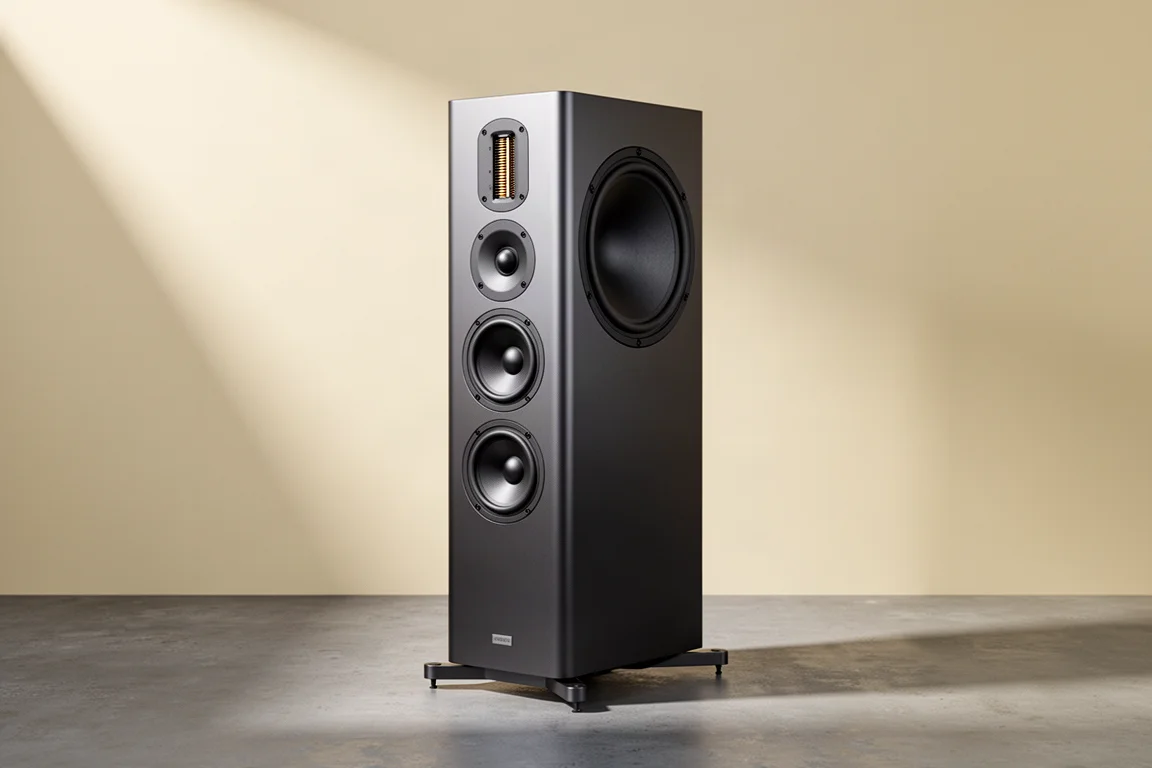
The driver complement is substantial for a tower of this footprint. Two 12-inch woofers fire from the sides of the cabinet, two 8-inch drivers handle the midrange, and an AMT tweeter covers the top end. The midrange driver is a newer design with more extended bandwidth and a shorting ring that lowers inductance, so it does not roll off as early at the top of its range. The trade-off is a shorter voice coil than the alternative driver, which is not needed in an 8-inch unit doing primarily midrange work.
The side-firing woofers are deliberately offset from one another, and that choice does two jobs. It allows both drivers to fit without making the enclosure noticeably wider, and it places the two bass sources at slightly different positions from one side of the tower to the other, which reduces modal density. The arrangement also helps cancel vibrational modes inside the cabinet.
The enclosure itself uses a patent-pending approach RBH calls the Granular Acoustic Damping System. A granular material mass-loads the structure to damp panel vibration, and because the material is porous with trapped air inside it, small inlets let it also function as an acoustic absorber. The consequence is a genuinely heavy cabinet. Each module weighs roughly 80 pounds, putting a complete tower close to 160 pounds. The design is modular, with the sections strapped together at the rear, and outrigger feet give the assembly a stable footprint.
Who This Speaker Is For
This is a speaker for listeners whose room has defeated other speakers. If you have tried a well-regarded passive tower in a space with an awkward low-frequency dip and never quite reached satisfying bass, the SFTR AX is aimed squarely at that situation. The combination of an active subwoofer section, substantial amplifier power, and DSP correction gives you tools that a passive design simply does not have.
It also suits buyers who want deep bass without adding separate subwoofers and the extra floor space they demand. Because the low-frequency drivers live in the tower itself, the system keeps a two-box footprint while still reaching well below what a typical passive tower can manage.
Finally, it rewards owners who enjoy adjusting the sound. Presets cover the common cases, but the underlying processing allows for more bass, a more forward presentation, tighter focus at the main seat, or a wider spread across a larger listening area. Buyers who prefer to set a system once and never touch it again will still be well served, but the flexibility is wasted on them.
Main Strengths
Three qualities separate this tower from the passive floorstanders it competes with: the active crossover architecture, the amplifier package behind it, and the bass behaviour that results.
Active Crossovers, DSP, and Tri-Amplified Power
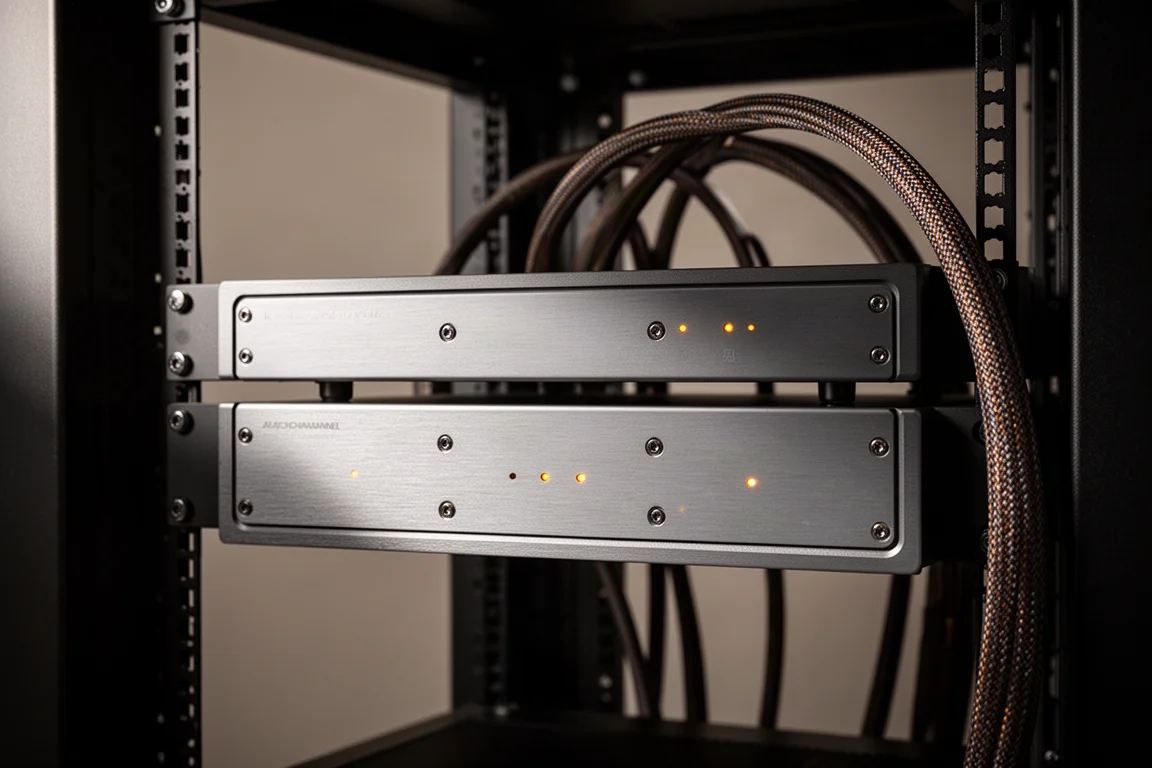
The system pairs a Marani digital signal processor with a six-channel amplifier, and the speaker is tri-amplified, meaning the subwoofers, midrange drivers, and tweeter each get their own dedicated amplification. Output has been measured at roughly 2,000 watts per channel for the subwoofer section, about 400 watts into 4 ohms for the midrange, and around 200 watts for the tweeter. The subwoofer amplifiers are bridged, and the hardware is designed to run on 220 volts as well as 120 volts. Higher mains voltage adds further dynamic range and capability.
The processor includes a high-quality digital-to-analog converter built around Burr-Brown chips, which is a meaningful part of the package rather than an afterthought.
Filtering is where the architecture earns its keep. The system can apply steep-order FIR filters with linear phase characteristics, which sharpens focus at the primary listening position. Off-axis seats benefit less from that mode, but listening tests found it did no harm anywhere in the room, and switching it on simply added a level of precision that passive crossovers cannot match.
Deep Bass From a Sealed, Modular Cabinet
The cabinet is sealed rather than ported. That was a deliberate choice to keep the tower compact, since there is no practical way to vent an enclosure that small around two 12-inch drivers. The woofers themselves work well in either a vented or sealed alignment, and the resulting system Q is right around 0.7, just a hair under it, which delivers strong transient behaviour and well-damped low-frequency response.
The payoff in a challenging room is considerable. In the space used for the initial setup, the system reached a 3 dB point at 10 Hz, where a previous passive tower rolled off sharply around 25 Hz. The same room has a pronounced dip between roughly 30 and 40 Hz, and DSP correction produced a linear bass response across the entire three-seat couch rather than only at the centre position. Bass stays tight, fast, and deep even away from the sweet spot.
Things to Consider Before Buying
The most important caveat is setup. This much control cuts both ways, and a poorly configured DSP can make a system sound worse than a passive alternative. The factory presets, including a maximum-extension mode and a maximum-linearity mode that aims for the flattest possible response, provide a safe starting point, but reaching the full potential of the speaker takes experience.
Physical handling is worth planning for. Two roughly 80-pound modules per tower add up to a cabinet approaching 160 pounds, and although the modular design makes transport and assembly easier, this is not a speaker you move alone.
Cost is the other consideration. The fully active configuration sits at the top of the range, and even the entry configuration is a serious investment. Buyers should also understand that a sealed active design ties its bass extension to the electronics package, so the sound quality you get is inseparable from the amplification and processing you pay for.
Buying Advice and Configuration Options
There are two ways into the SFTR AX, and the choice comes down to budget and how much tuning you want.
The base configuration starts in the $15,000 to $16,000 range. It includes a powered bottom section with a built-in amplifier, so you get active subwoofers regardless of which version you choose, paired with a passive top satellite that uses a passive crossover and can be driven by any amplifier you already own. For a listener who wants the low-frequency capability and the two-box footprint without the full processing package, this is the sensible entry point. It is readily available now.
The top configuration runs around $30,000 per pair and adds the complete active package: the Marani DSP and the six-channel amplifier driving all three sections independently. On this version the factory includes setup support, with the system’s designer travelling to fine-tune the installation as part of the purchase. RBH also provides training to its dealer network so that installers can configure the speaker properly rather than leaving the buyer to guess.
Whichever version you choose, the presets cover maximum extension and maximum linearity along with several other profiles, and the system can be pushed further in either direction from there. Buyers who want the full benefit of that flexibility should plan on working with an experienced installer, or on learning the processor carefully.
Conclusion
The RBH Sound SFTR AX is not a speaker that asks you to accept your room as it is. It is a three-way active tower with side-firing 12-inch woofers, roughly 2,000 watts per channel on the low end, and enough processing to correct the kind of low-frequency dip that passive designs cannot touch. In the room it was set up in, that combination produced usable output down to a 10 Hz point and even bass across an entire couch.
The trade-offs are real. It is heavy, the top configuration is expensive, and it demands more setup knowledge than a passive tower ever will. For listeners with a difficult space and the budget to address it properly, those are reasonable prices to pay for bass that finally behaves.
Product link
View more details for RBH Sound SFTR AX
This product is mentioned in the review. Check the specifications, options, and compatibility before buying.
View more details for RBH Sound SFTR AXFurther reading
Related Reviews
Floorstanding Speakers
Acoustic Energy AE109 Mark II Review: A Refined Floorstander at £699
The Acoustic Energy AE109 Mark II is a slim, warm sounding floorstander that delivers clarity, midrange body and strong imaging in small to medium rooms.
Floorstanding Speakers
Acoustic Energy AE509 Review: A Slim Floorstander With Deep, Defined Bass
A practical look at the Acoustic Energy AE509, a slim floorstanding speaker with carbon fibre drivers, deep and well-defined bass, and an easy-going character that rewards careful system matching.
Floorstanding Speakers
Arendal 1528 Tower 8 Review: Reference Neutrality With Real Demands
A close look at the Arendal 1528 Tower 8, a nearly five-foot, 200-pound floorstander that rewards generous space, serious power, and high listening levels with reference-grade neutrality.