Floorstanding Speakers
PMC Prophecy 5 Review: Compact Transmission Line Floorstanders for Smaller Rooms
A close look at the PMC Prophecy 5, a slim transmission line floorstander with a Laminair X aluminium base, 40 Hz bass extension, and clear placement and amplifier requirements.
Introduction
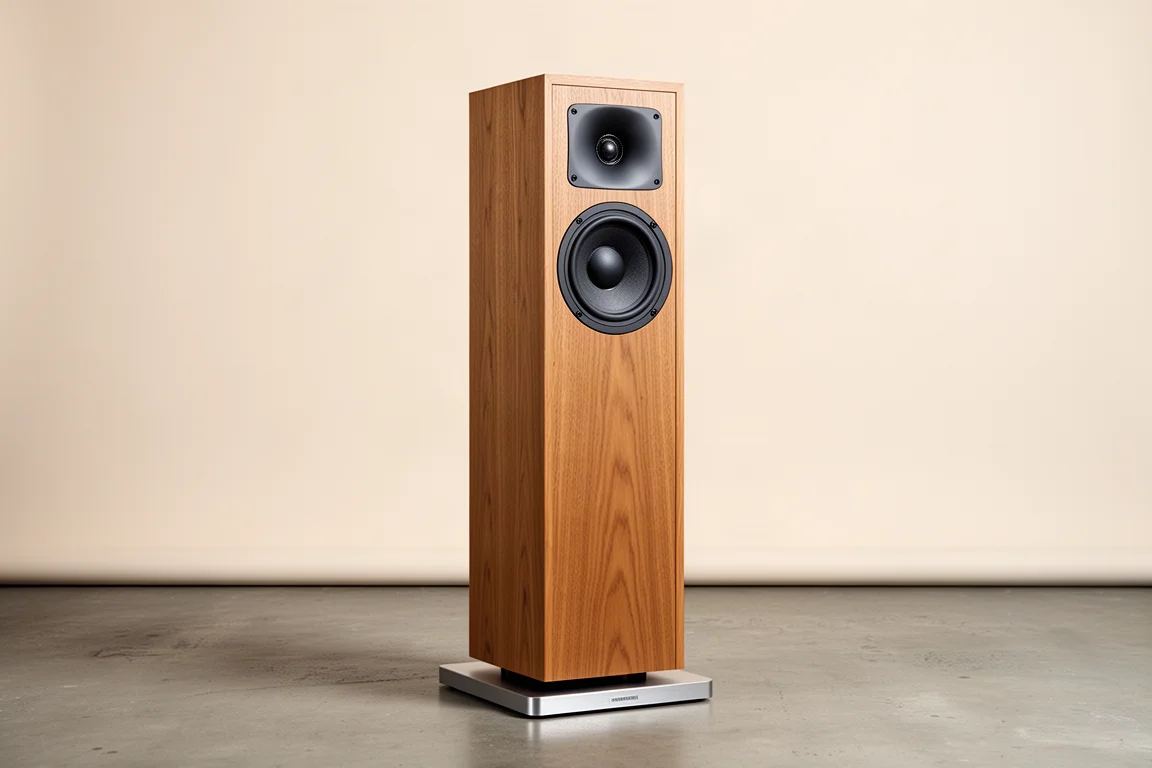
PMC’s Prophecy range arrived at the end of 2024 with a stand mount, a centre channel and three floorstanders, replacing the company’s 25i series. The Prophecy 5 is the most compact of the three floorstanders, and it is both smaller and cheaper than the 25.23i it succeeds. PMC states that the reduction in bass extension is minimal and that the new model works better in small to medium sized rooms, which is the central argument for buyers who want the brand’s transmission line approach without a large cabinet footprint.
The Prophecy 5 is priced at £4,575 per pair.
Who the PMC Prophecy 5 Is For
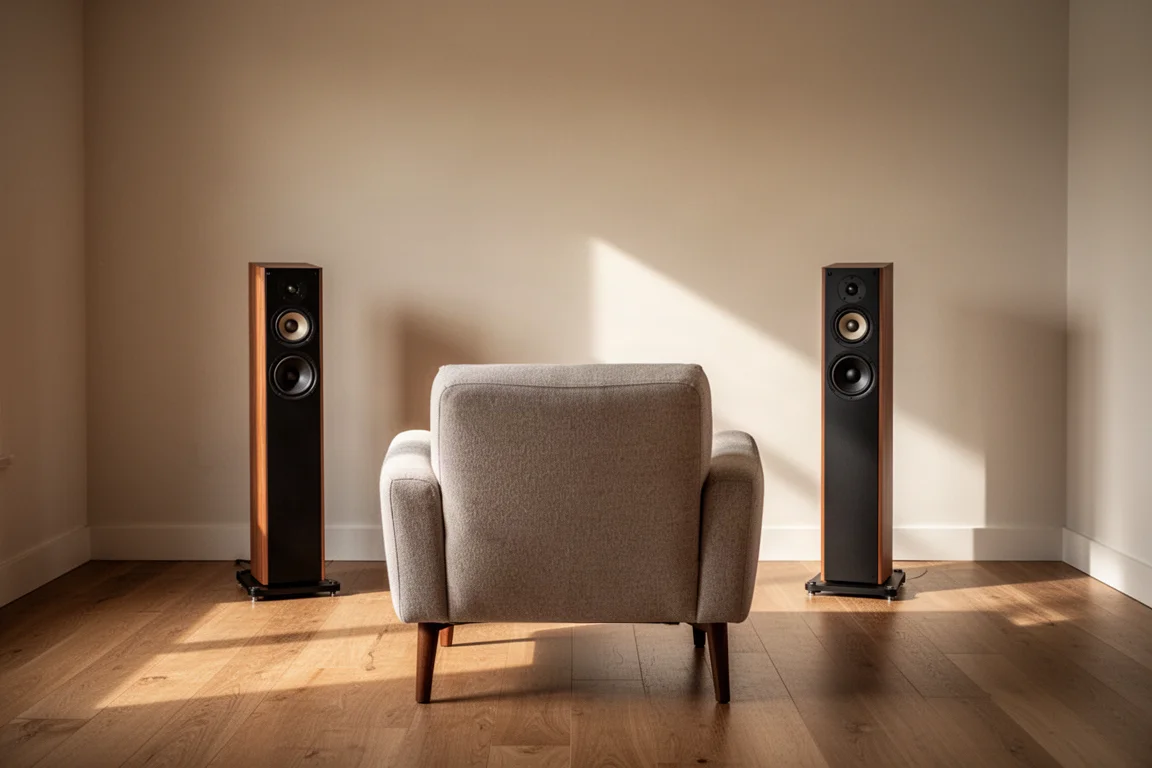
These are floorstanders for listeners who value balance, clarity and imaging more than sheer low-frequency output, and whose room cannot comfortably absorb a large tower. Each cabinet measures 900 by 165 by 260 mm and weighs 17.7 kg. That narrow 165 mm width is the practical part of the story: in a modest room, the Prophecy 5 takes up less visual space than many large stand mounts.
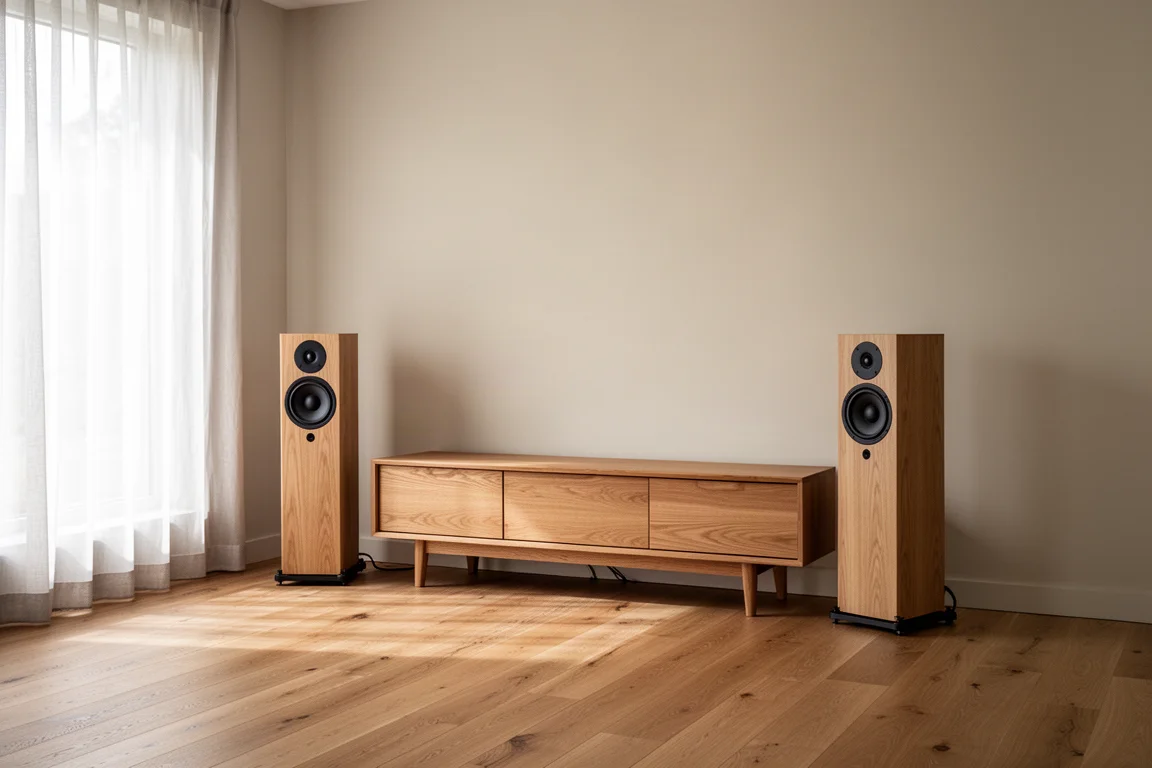
Three engineered wood finishes are offered, black walnut, natural walnut and medium oak, the last of which PMC frames as a nod to sustainability. Buyers chasing maximum bass weight, or planning to drive the speakers with a low power tube amplifier, are better served looking elsewhere in this market.
Main Strengths
Transmission Line Bass and the Laminair X Base
PMC’s association with transmission line loading goes back to the company’s founding in 1990, and the approach is central to how the Prophecy 5 makes its bass. The design takes the back energy from the drivers and funnels it down a tube that is folded into a labyrinth and packed with damping material, so unwanted frequencies do not exit the line. Done well, that yields crisp leading edge notes alongside bass extension and clarity that most ported designs struggle to match. PMC calls its implementation an advanced transmission line, or ATL. Bass extends down to 40 Hz at the minus 3 dB point.
The base of the cabinet is where the newest thinking shows. The previous generation used a grille at the exit of the line, and the Prophecy 5 replaces it with a solid piece of extruded aluminium that forms the entire base, a part PMC calls Laminair X. It lowers the centre of mass, improves airflow, and, per PMC, reduces turbulence and harmonic distortion by up to 3 dB.
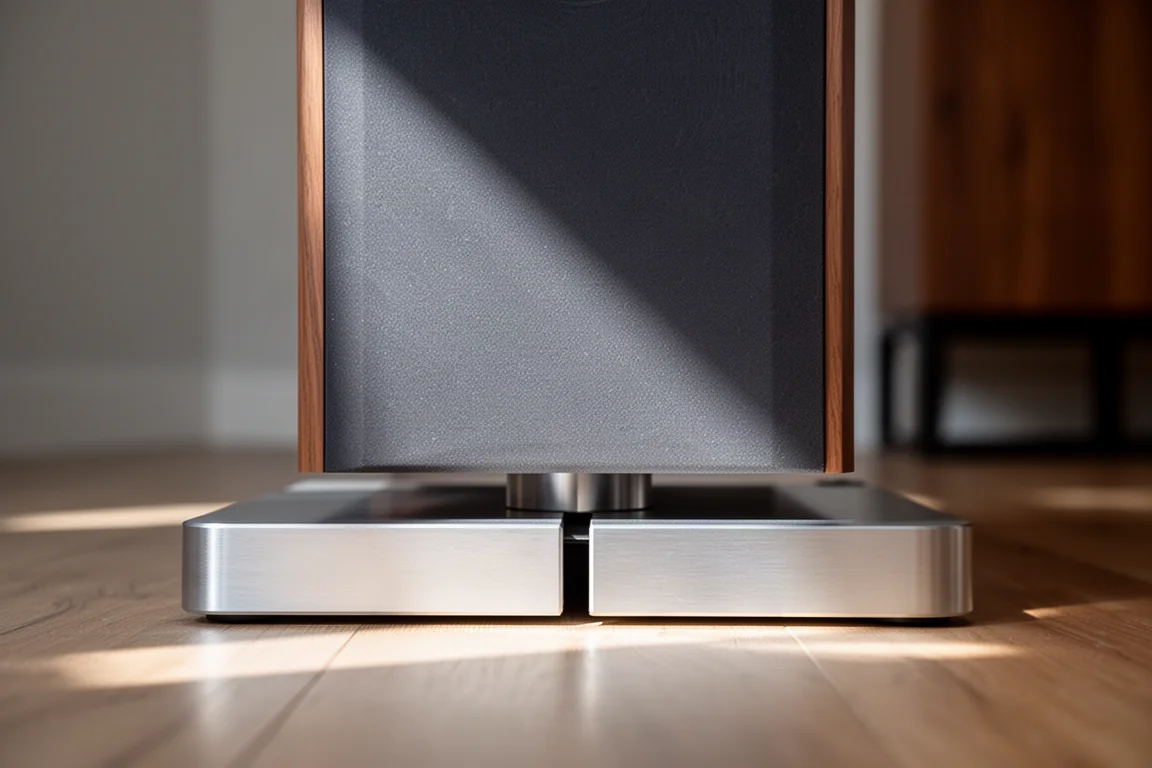
In listening terms the low end is defined rather than inflated. Against the similarly sized Scansonic MB 2.5 B, which produces more bass weight, the Prophecy 5 is the tighter of the two, and its bass keeps its shape when a track gets busy.
Driver and Crossover Design
A 27 mm soft dome tweeter sits in a waveguide and is covered with a grille to aid dispersion. A 125 mm mineral cone mid-woofer takes over at 1,600 Hz. The tweeter can play lower than usual thanks to its size and the waveguide acting as an acoustic amplifier, and that lets PMC move the crossover away from the 2,000 to 3,000 Hz band, where hearing is most sensitive and where most two-way designs cross over.
The crossover uses high-order slopes and good quality capacitors, with an air-core inductor on the tweeter network and an iron-core inductor on the mid-woofer. The circuit board is described as military grade, with thick copper tracks and gold plating. Around the back there is one set of heavy duty speaker binding posts. Sensitivity is 87 dB into a nominal 6 ohm load, and the drivers are customised variants of units used in PMC’s professional studio monitors.
A Balanced, Uncolored Presentation
The mid-range is not as open as a three-way design such as the Quadral Vela 2, but it is more accurate. Several rivals carry a slight recess in the presence region between 2,000 and 4,000 Hz, which flatters bright recordings but gives away accuracy, and the PMC does not take that route. Vocals come through with clear separation from reverb-heavy guitar and bass lines, and the rhythmic drive holds together well.
Directivity is the other differentiator. The Prophecy 5 is a controlled directivity design, so the central listening area is wide and sound is distributed fairly evenly around the room. Speakers that are far less forgiving away from the middle seat ask more discipline of the listener.
Things to Consider Before Buying
Placement and Room Size
The Prophecy 5 can be placed reasonably close to a wall, but its full potential in sound staging, imaging and clarity, particularly in the bass, appears when it is pulled out into the room. A moderate amount of toe-in, aimed wide of the listening position, works well as a starting point. The distances that suit one room will not suit another, so expect to spend time adjusting rather than settling on the first position.
Amplifier Matching
The Prophecy 5 was not a good match for a Bryston 3B, where the bass turned woolly, and low power tube amplifiers with close to single digit power ratings are best avoided. A solid state amplifier with around 75 W per channel and a decent power supply is a sensible starting point, and the Exposure 2510 is a strong option at roughly £2,000. Power helps here: an amplifier with 150 W per channel, a high damping factor and plenty of current gave the most successful result, its extra grip and control letting the dynamics and clarity of the transmission line design come through.
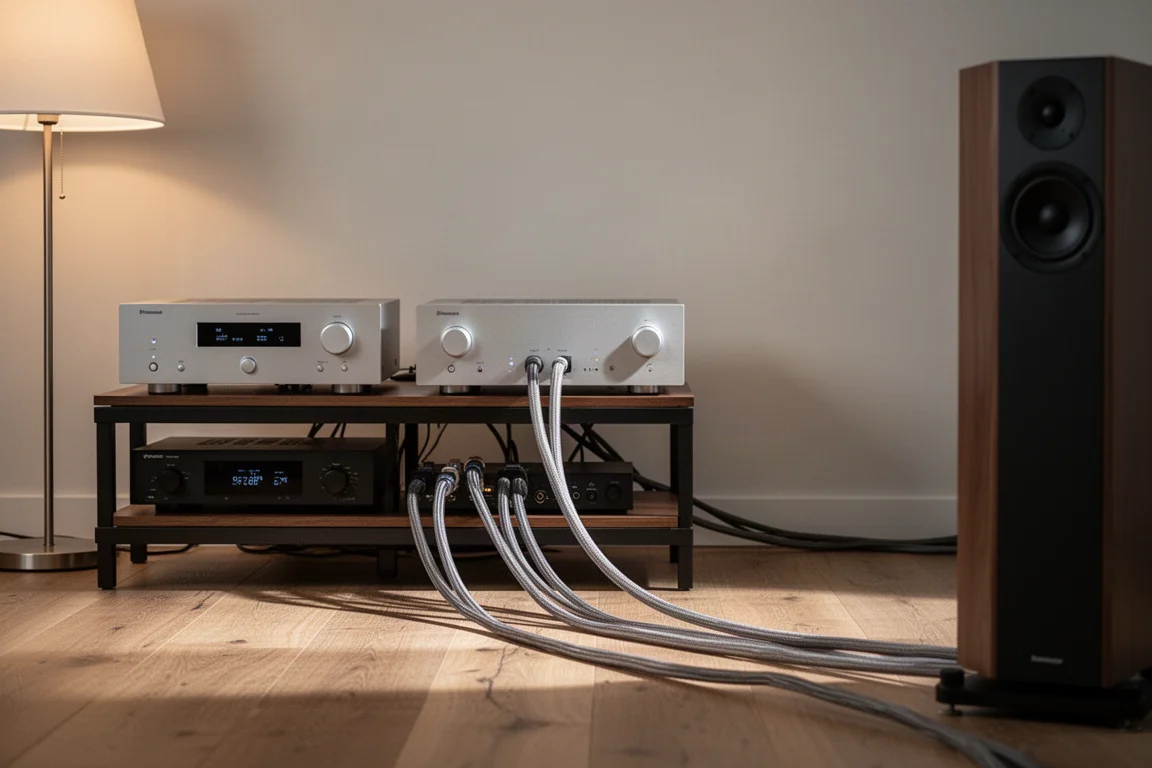
The broader lesson is that these speakers reward refinement and control rather than a strong sonic signature of their own. An amplifier with a softer, warmer balance can open up the mid-range but will also loosen the bass, which is the opposite of what a transmission line cabinet wants.
How the PMC Prophecy 5 Compares
The Scansonic MB 2.5 B, at £3,750 per pair, is a two-and-a-half-way design with an extra driver covering 500 Hz and below, and it produces more bass weight. Mid-range resolution is close between the two, but the PMC has the tighter bass and avoids the slight upper mid-range dip that gives the Scansonic a polite presentation. The Quadral Vela 2, at £3,499 per pair, offers a more open mid-range thanks to its three-way layout and excellent value for money, but it wants a bigger room for its bass not to become too prominent. The Prodigy 5, at just under £2,000 per pair, remains outstanding value, and the Prophecy 5 is a clear step up in clarity over it.
The Neat Elite Classic, at £3,499 per pair, is similarly well balanced with comparable mid-range fidelity. The PMCs add bass heft and definition from the transmission line, while the Neats offer a touch more treble insight through their ribbon tweeter. The larger difference is distribution: the Prophecy 5 has a much wider central sweet spot and more even coverage around the room.
Above this level, the ATC SCM50 stand mounts at £5,000 resolve more across the entire frequency range, though the equivalent ATC floorstander costs around nine thousand, roughly double the PMC. The Pearl Acoustics Sibelius, now called Model 1, at €8,250 plus shipping and taxes, delivers cleaner bass and crisper mid-range transients from a hand-built enclosure with premium materials, with high frequencies that are a little rolled off.
Buying Advice
At £4,575 per pair, the Prophecy 5 sits in a crowded part of the floorstanding market. It makes the most sense for a buyer who wants a compact tower for a small to medium room, prioritises neutrality and imaging, and owns or intends to own a solid state amplifier with at least around 75 W per channel. Budget for the amplifier as part of the purchase rather than an afterthought, and plan the room layout as well, since a wall-hugging position will not show what the speakers can do.
If maximum bass weight or a brighter treble presentation matters more to you than balance, some rivals at lower prices may satisfy you sooner. If you want a speaker that stays out of the way of the music in a modest space, this is a well judged package.
Conclusion
The Prophecy 5 improves the value proposition of PMC’s mid-tier transmission line speakers by shrinking the cabinet and adding engineered wood finishes. The Laminair X aluminium base replaces the old grille, improving airflow and stability, and PMC states the resulting reduction in distortion of up to 3 dB is significant next to the 25i series. The result is one of the most well balanced speakers available below £5,000: clean, dynamic and uncolored, giving up only a little fidelity to the best stand mounts at the price. Give them space to breathe and an amplifier with real power, and they reward the effort.
Product link
View more details for PMC Prophecy 5
This product is mentioned in the review. Check the specifications, options, and compatibility before buying.
View more details for PMC Prophecy 5Further reading
Related Reviews
Floorstanding Speakers
Acoustic Energy AE109 Mark II Review: A Refined Floorstander at £699
The Acoustic Energy AE109 Mark II is a slim, warm sounding floorstander that delivers clarity, midrange body and strong imaging in small to medium rooms.
Floorstanding Speakers
Acoustic Energy AE509 Review: A Slim Floorstander With Deep, Defined Bass
A practical look at the Acoustic Energy AE509, a slim floorstanding speaker with carbon fibre drivers, deep and well-defined bass, and an easy-going character that rewards careful system matching.
Floorstanding Speakers
Arendal 1528 Tower 8 Review: Reference Neutrality With Real Demands
A close look at the Arendal 1528 Tower 8, a nearly five-foot, 200-pound floorstander that rewards generous space, serious power, and high listening levels with reference-grade neutrality.