Speaker Kits
Parts Express Orian Speaker Kit Review: A DIY Dipole Stand Mount With Serious Bass
A three-way DIY stand mount kit with a coaxial midrange, an open-backed dipole midrange section, and bass extension down to 30 Hz without a subwoofer.
Introduction
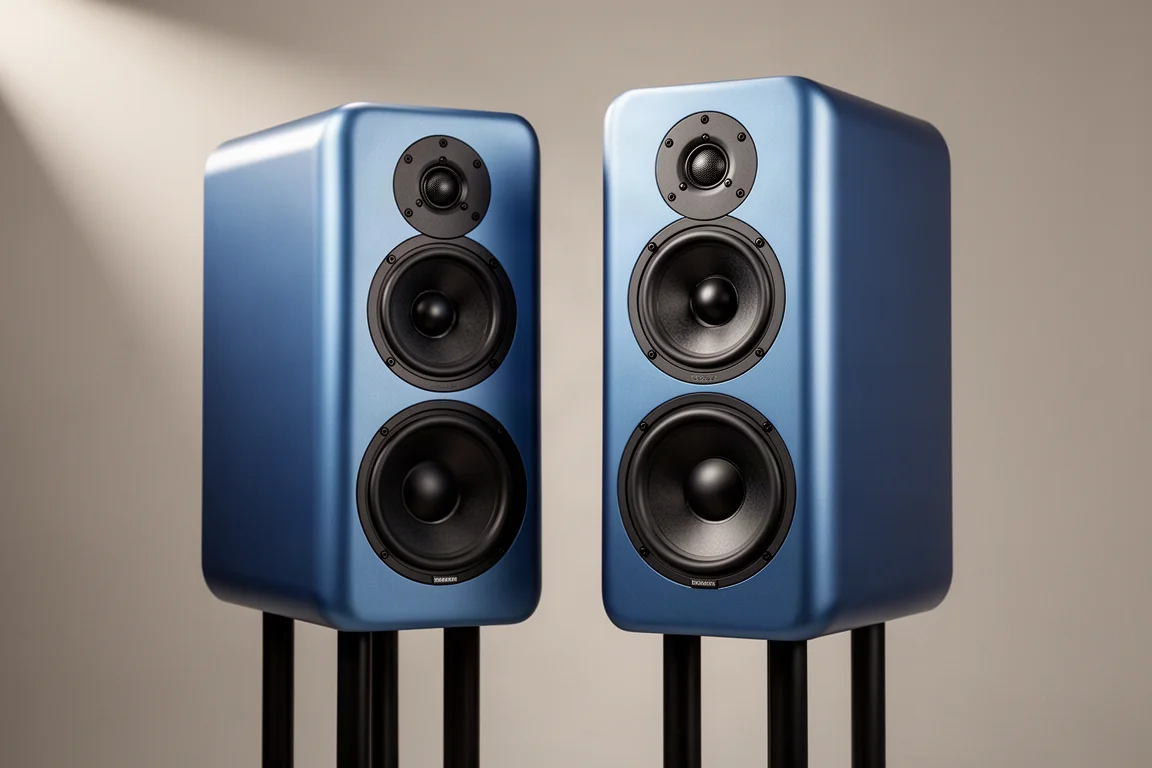
Parts Express Orian is a loudspeaker you build rather than buy. The kit arrives as a collection of parts: drivers, crossover components, a pre-drilled crossover board, port tubes, acoustic damping material, and flat-pack MDF panels for the cabinet. The builder glues the enclosure together, assembles the crossovers, mounts the drivers, wires everything up, and then paints the finished cabinet. It is a project rather than a plug-and-play purchase, and for the right listener that is precisely the appeal.
The design itself is unusual. It is a three-way stand mount built around a coaxial midrange: a 5-inch midrange driver with a 1-inch dome tweeter mounted at its center. Below it sits an 8-inch bass driver with a long excursion figure, just under 10 mm. The rear of the cabinet is open behind the midrange, so the speaker behaves as a dipole through the midrange band. Damping material is included, which lets the builder decide how much of that rear output to keep.
Who This Kit Is For
This kit suits listeners who want full-range sound from a stand-mounted cabinet without adding a subwoofer, and who are comfortable spending evenings with wood glue and clamps. It also makes sense for anyone curious about how a loudspeaker is actually put together.
The assembly manual is a genuine advantage. Many kits supply a parts list and a crossover schematic and leave the rest to the builder. Here, every stage is documented step by step, clearly enough that a first-time builder can follow it from cabinet assembly through crossover work to the final wiring.
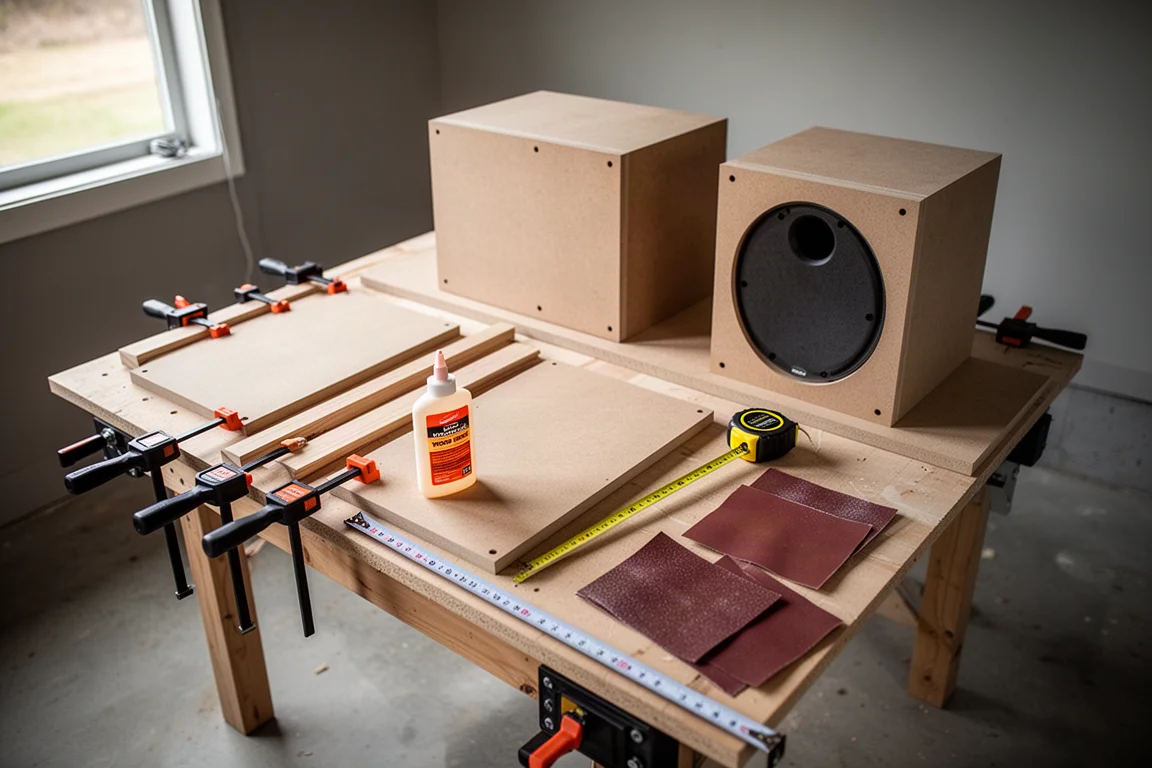
Time is the real entry fee. Enclosure assembly, driver mounting, and crossover work can take about a week of evenings on a first build. Finishing takes longer. Primer, sanding, paint, and drying between coats can stretch to roughly three weeks if you want a clean result. A novice can complete the project, but the schedule is measured in weeks rather than a weekend.
It also fits rooms where floor space is tight. These are large stand mounts rather than compact bookshelf speakers, yet they deliver bass that would normally require a tower.
What Arrives in the Box
Everything needed for sound is included: drivers, crossover parts, a large crossover circuit board, port tubes for each cabinet, acoustic damping material, and the MDF panels. Paint and feet are not included, since both come down to personal taste.
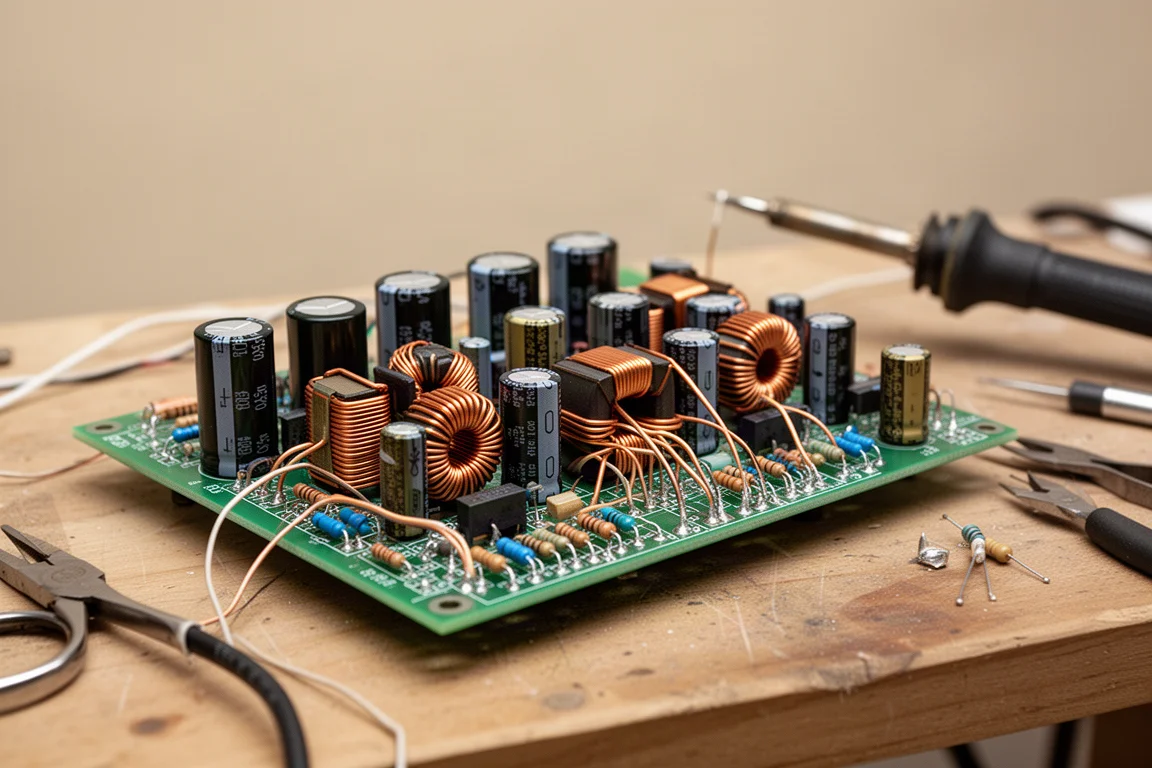
The crossover board deserves special mention. Component values and positions are marked on the board itself, so the builder populates and solders it in place rather than working out a layout from scratch. That single inclusion makes an otherwise advanced kit approachable.
Assembly: Tools, Time, and Finish
You will need wood glue, several clamps, a hot glue gun, and basic hand tools. The cabinet panels do not arrive with rounded edges, so a corner plane or router is required if you want that look. A corner plane runs around $30.
Small details matter as much as the big ones. Wires inside the cabinet need to be secured so they cannot knock against the port, and damping material should be positioned so it stays where it is placed.
Finishing is where the calendar disappears. Primer goes on, gets sanded, then paint goes on in thin coats with drying and sanding between each one. Cold weather slows that process considerably, because every coat needs to cure before the next. Satin colors suit this cabinet particularly well, and a satin blue finish flatters the rounded edges without the glare of a high gloss.
Measured Performance
Outdoor measurements, taken to minimize room interaction, show a midrange that is very flat from about 1 kHz to 5 kHz. That is the band where human hearing is most sensitive, and it is the strongest part of the design.
Above 5 kHz the treble is somewhat attenuated, which gives the speaker a slightly warm balance. The bass region runs roughly 2 dB above neutral on average, with usable extension down to 30 Hz.
Sensitivity is rated at 83 dB for 1 watt at 1 meter. That convention understates 4-ohm designs. Expressed on a voltage basis, the figure lands closer to 85 dB. Nominal impedance is 4 ohms. The impedance minimum stays above the 3.2-ohm recommendation that applies to 4-ohm speakers, the saddle points are symmetric, and the phase angles stay tame. A typical AVR will drive the speaker comfortably. A very cheap amplifier pushed hard for hours is a poor match.
Sound Character and Placement Flexibility
The overall balance is warm and easy. Bass is a touch elevated, treble a touch relaxed, and the midrange sits neutral between them. Long listening sessions feel comfortable rather than fatiguing, which is the whole point of this voicing.

Because the midrange is open at the back, the speaker throws a large, spacious image. Pinpoint, laser-focused imaging is not the goal here. A big, room-filling presentation is. Adding the supplied damping to the rear opening reduces that rear output by about 6 dB and tightens the image if you prefer a more controlled sound.
The coaxial layout brings practical benefits. The drivers sum close together, so the speaker can be used as a near-field monitor at roughly half a meter without the sound falling apart. It can also be laid on its side, since vertical and horizontal response are broadly similar. That opens up placement options a conventional two-way or three-way does not allow.
Off-axis listening is forgiving. Twenty degrees off center still sounds fine, with a possible narrow notch near 8 kHz. If the treble feels too relaxed, a 2 dB boost through a tone control or a shelving filter brings it in line with the midrange.
Trade-Offs to Weigh Before You Buy
The obvious cost is time and equipment. Glue, clamps, a hot glue gun, finishing supplies, and a corner plane add to the kit price, and the build itself can occupy weeks of evenings.
Finishing is effectively irreversible. Once panels are glued and painted, the kit is no longer in factory condition, so it pays to settle on a color and a level of finish before the first clamp goes on.
The cabinets are also large for stand mounts. They need sturdy stands or generous shelf space, and they are not the discreet option in a small room.
This is a 4-ohm speaker, so amplification quality matters more than it would with an 8-ohm design. Any mainstream receiver will handle it, but a cheap amplifier driven hard for hours is not a sensible pairing.
Finally, the imaging character is a matter of taste. If you want tightly focused stereo imaging, a dipole midrange works against that goal. Damping the rear opening narrows the gap, but the design still leans toward spaciousness.
Buying Advice and Value
The kit retails around $670 and has been available on sale for about $540. Factor in paint, clamps, and a corner plane, and the total still lands well below what a finished speaker with comparable bass extension and driver quality would cost.

That value only materializes if you enjoy the process. If gluing, soldering, sanding, and painting sounds appealing, the Orian is a rewarding project that ends with a genuinely capable speaker. If you would rather unbox and listen, a finished pair makes more sense, even at a higher price.
It is also worth considering as a first serious build. The labeled crossover board and the detailed manual lower the barrier considerably, and the coaxial driver plus dipole loading mean the finished speaker does something most finished designs at this price do not.
Conclusion
Parts Express Orian is a stand mount that behaves like a small tower: bass down to 30 Hz, a neutral midrange, and a warm, non-fatiguing top end. Its coaxial driver makes placement unusually flexible, and its open-backed midrange trades pinpoint imaging for a big, spacious presentation.
The catch is the calendar. This is a weeks-long project that asks for tools, patience, and a willingness to learn. For listeners who want that experience and the pride of ownership that comes with it, the Orian is excellent value. For everyone else, the kit format is the wrong place to start.
Product link
View more details for Parts Express Orian Speaker Kit
This product is mentioned in the review. Check the specifications, options, and compatibility before buying.
View more details for Parts Express Orian Speaker KitFurther reading
Related Reviews

Speaker Kits
CSS Audio Torii Review: The Most Affordable CSS Audio Speaker Kit
The CSS Audio Torii is a compact two-way speaker kit with a labelled crossover board, an optional CNC flat pack, and bass that belies its cabinet size.
Speaker Kits
Deposition Sound FDM 5 Review: A 3D Printed Speaker Kit Worth Building
A close look at the Deposition Sound FDM 5, a 3D printed two-way bookshelf speaker kit with punchy bass, a very neutral mid-range, and a few clear trade-offs.
Speaker Kits
GR Research X-LS Encore Review: Deep Soundstage for Under $1,000
A kit speaker that pairs a smooth, non-fatiguing tone with a soundstage that punches well above its price, provided you are ready for a more demanding build.