Hiking Backpacks
Mountain Hardware JMT 35 L Backpack Review: A Smart, Comfortable Daypack
A detailed look at the Mountain Hardware JMT 35 L backpack, covering its clamshell design, materials, comfort, removable mesh panel, and the trade-offs worth knowing before you buy.
Introduction
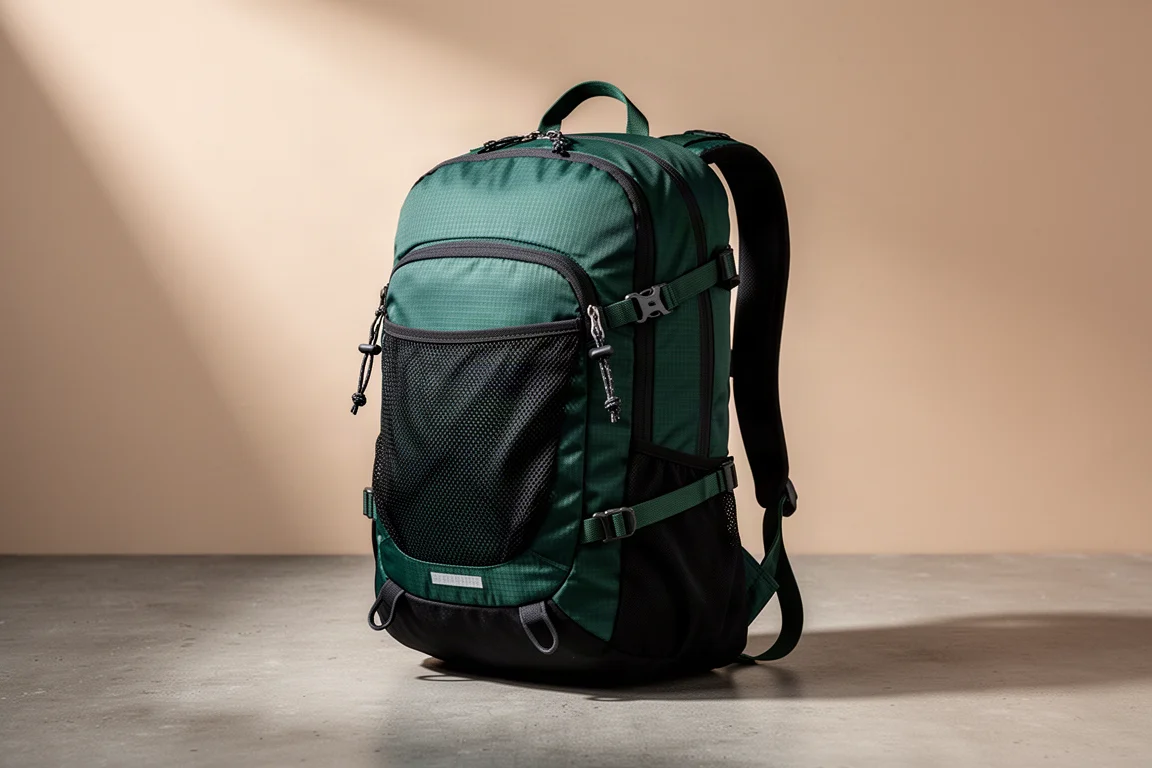
The Mountain Hardware JMT 35 L is a compact hiking backpack built around a clamshell opening and a materials package that leans toward long-term durability. It sits in the daypack category for most hikers, though it can stretch into an overnight role if the load is kept genuinely minimal. It is available in a 25 L and a 35 L version, in men’s and women’s fits, and in two colours: black and a green the brand calls spruce.
Who This Backpack Is For
At 35 litres, this is not a large pack. For most people it is a daypack, and a well-judged one at that. The size becomes especially useful as the seasons turn colder, when thicker jackets and extra layers take up noticeably more room than a summer kit. Riders of the minimal overnight trip can make it work, but only with small, lightweight gear and disciplined packing.
Fit options are reasonably broad. The pack comes in a small to medium size that suits torsos from 16 to 19 inches, and a medium to large size for torsos from 18 to 21 inches. The small to medium waist belt fits 28 to 47 inches, while the medium to large fits 30 to 48 inches. Choosing the right size matters more than the colour, since the shoulder harness itself slides up and down so you can dial in the torso length.

If your torso sits near the boundary between the two sizes, it is worth measuring rather than guessing, because the harness adjustment gives you room to fine-tune but not to change the fundamental size of the pack.
Design, Materials, and Fit
The construction is the strongest argument for this pack. The shell uses 210 denier ripstop fabric, with a 420 denier Cordura base where the pack takes the most abrasion. Zippers come from YKK, buckles from ITW, and the frame is steel. The small to medium version weighs 2 lb 10 oz on a scale, which is reasonable for a framed 35 L pack.
The main compartment opens like a clamshell thanks to two-way zippers, so you can lay the pack flat and see everything inside rather than digging from the top. All zippers carry cord pulls. Inside there are two hydration ports, a clip to hold a bladder, and a sleeve for the bladder, with no further internal pockets.
Externally, the layout is clean. There is a large front grab handle and a smaller rear one, a single top zipper that gives access to the lid, and two loops beside it for attaching extra gear. Above the front mesh panel sit tie-off points for trekking poles, with matching loops below. Colours are black or spruce, with small accent details such as yellow on the trekking pole attachments.
Main Strengths
Comfort and Load Control
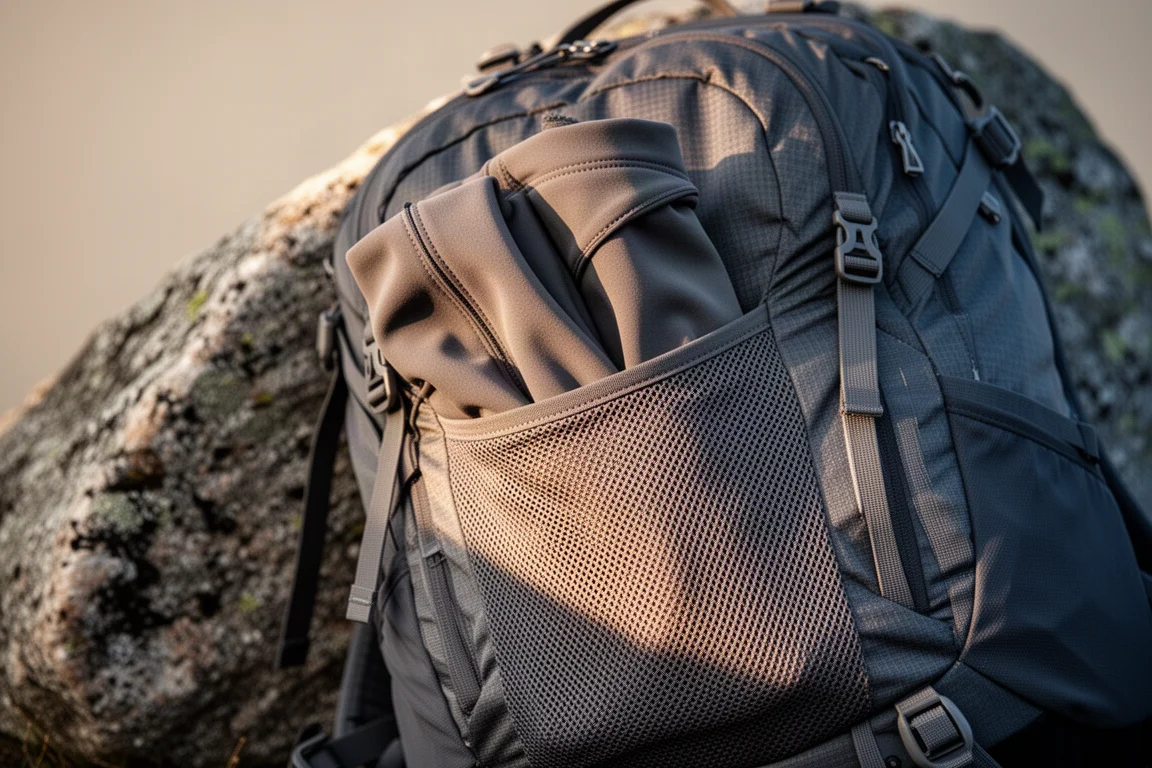
Comfort is where this pack quietly excels. Because the pack is small and the harness and suspension are well designed, it sits directly against the back and effectively becomes part of you. It does not flop around, and the compression straps let you pull the load in tight, so there is very little movement even when the terrain gets rough.
The back panel includes load lifters at the top, stretchable loops on each side, an adjustable sternum strap, and additional loops lower down. A safety whistle is built into the sternum strap, a small detail that costs nothing and is genuinely useful.
That stability is what makes the pack feel larger than its volume in practice. A load that stays locked in place is easier to carry than a heavier one that shifts with every step, and this design leans hard into that principle.
External Storage and the Removable Mesh Panel
The front mesh panel is the standout feature. It works as a stow pocket for a jacket you have just taken off, and it is equally suited to wet gear. A damp tent fly or rain-soaked layer can ride on the outside of the pack, dripping onto the trail instead of soaking everything inside.
The panel is removable. It detaches, stows in a dedicated pocket at the base of the pack, and reattaches when you need it again. It is worth noting that this feature is easy to miss: the stow pocket looks like a seam at the bottom of the pack, and it is not obvious that anything is there.
The side storage is generous too. Each side has a stretchy hydration pocket that is both deep and wide, large enough for multiple bottles, a bottle plus a small tripod, or soft gear such as a tarp. Two compression straps run down each side, one of them buckled, and the front strap terminates in a fabric wing that wraps around and cradles whatever you have attached, holding a tripod or bottle more securely in combination with the strap tension.
Things to Consider Before Buying
Ventilation and Sweat Management
Ventilation is adequate rather than impressive. The back of the pack is completely flat, with no recessed channels, no raised sections and no lumbar support. On a hot day, with effort involved, you will sweat, and that sweat will not dry until you take the pack off.
This is a design consequence rather than a defect, and it is the price paid for a back panel that sits so closely and so stably against the body. If you hike mostly in cool conditions or on shorter outings, it will rarely register. If you regularly push hard in summer heat, it is the single most important thing to weigh.
Waist Belt, Straps, and Pack Noise
The waist belt is deliberately simple. It is essentially mesh with no padding at all, which is manageable on a pack this size because you are unlikely to carry enough weight for it to hurt, but a little padding would have been welcome. Storage on the belt is asymmetric: a mesh pocket on the left side, and a stretchable mesh sleeve on the right that is not especially useful beyond holding a bar or similar small item. Two full-size pockets would be more practical.
The straps are long and the pack does not include strap keepers, so you will need to improvise with rubber bands or similar. There is also no rain cover in the box, which is a notable omission at this price point, so budget for one that fits. Finally, when the pack is loaded to its maximum, the steel frame can creak slightly against the fabric as you walk. It is not loud or constant, but it is audible from time to time.
Buying Advice
The JMT 35 L is priced at $160, which is very much the going rate for a 35 L pack right now. Comparable packs currently sit in the $150 to $200 range, and finding a new 35 L pack below $150 generally means military surplus, a used pack, or a budget import. Judged against that market, the price is fair rather than inflated, and what you get for it is excellent materials, excellent construction, and a feature set that has clearly been thought through.
The sensible way to decide is to match the pack to your habits. If you want a durable daypack that carries comfortably, handles wet gear outside the main compartment, and will hold up over years of use, this one makes a strong case. If maximum back ventilation is a priority, or you need padded waist belt storage for long, heavy days, look at designs built specifically around those needs.
Conclusion
The Mountain Hardware JMT 35 L is a genuinely well-made daypack with a smart clamshell layout, strong materials, and a level of comfort that comes from a harness designed to keep the load close and quiet. The removable mesh panel is a standout, the side pockets are unusually roomy, and the build quality leaves little to criticise. The trade-offs are clear and specific: limited ventilation, a bare waist belt, no rain cover, and long straps without keepers. None of them are deal-breakers for day hiking and minimal overnight use, and for the right buyer this is a pack worth keeping for a long time.
Product link
View more details for Mountain Hardware JMT 35 L Backpack
This product is mentioned in the review. Check the specifications, options, and compatibility before buying.
View more details for Mountain Hardware JMT 35 L BackpackFurther reading
Related Reviews
Hiking Backpacks
Decathlon MT 900 70+10 Backpack Review: Big Capacity, Heavy Weight, High Price
A feature-dense 80-liter hiking backpack with excellent build quality, ten pockets, and dual loading, held back by a six-pound weight and a $210 price.
Hiking Backpacks
Martingtop 65L MOLLE Hiking Backpack Review: Capacity and Value, Undone by Hardware
A 65-liter tactical-style internal frame pack with MOLLE webbing, an adjustable torso, and a rain cover, held back by slipping hardware and a flexible frame.
Hiking Backpacks
Osprey Rook 65L First Look: Osprey's Most Affordable 65L Backpack
A detailed first look at the Osprey Rook 65L, the least expensive 65-litre pack Osprey makes at $190, covering its suspension, storage layout, weight, materials, and the trade-offs to weigh before buying.