Floorstanding Speakers
Monitor Audio Hyphn Review: A 50th Anniversary Flagship Loudspeaker
A detailed look at the Monitor Audio Hyphn flagship: its acrylic-stone cabinets, seven-transducer M-Array, sound character, and the serious amplification it demands.
Introduction
The Monitor Audio Hyphn is the British company’s flagship loudspeaker, developed to mark its 50th anniversary in 2023. It was first shown as a prototype at the 2021 Munich Hi-Fi Show under the name Concept 50, and after listening feedback at that event Monitor Audio made a series of small refinements and renamed the design Hyphn.
Monitor Audio was founded in 1972 just outside Cambridge, England, and has since relocated to Rayleigh, a short distance east of London near the country’s east coast. Because the company is privately owned, its owners were able to give engineers and designers unusually free rein over the anniversary project instead of steering it around cost targets. The brief was deliberately forward-looking rather than nostalgic: the goal was a loudspeaker built without preconceptions about what a loudspeaker should be.
That freedom is visible in the result. The Hyphn is a statement product in the truest sense: two towers, a bridge-mounted driver array, and a cabinet material that is as much a piece of craft furniture as it is an acoustic decision.
Who the Monitor Audio Hyphn Is For
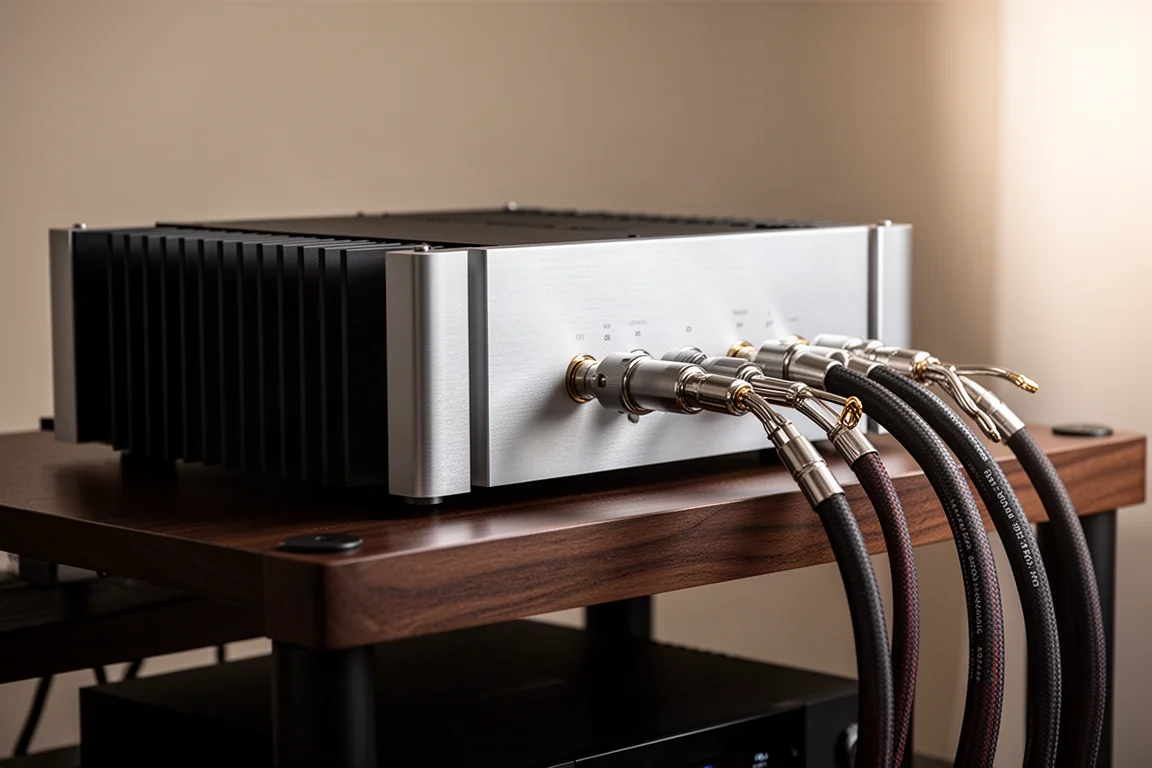
The Hyphn suits listeners who have both the room and the amplification to support a flagship system. Sensitivity is rated at 86 dB, and the design team recommends power amplifiers up to 1,600 watts per channel, so this is not a loudspeaker that flatters modest electronics.
It is also a speaker for people who value imaging over sheer physical scale. Rather than a two-metre tower firing a wall of bass drivers at the listener, the Hyphn takes a more restrained physical approach and lets the music step forward instead.
Finally, it is for buyers who treat a pair of speakers as a long-term centrepiece. This is a hand-finished, very heavy product offered in a small palette of colours, and it is positioned and priced as a flagship.
Design and Cabinet Construction
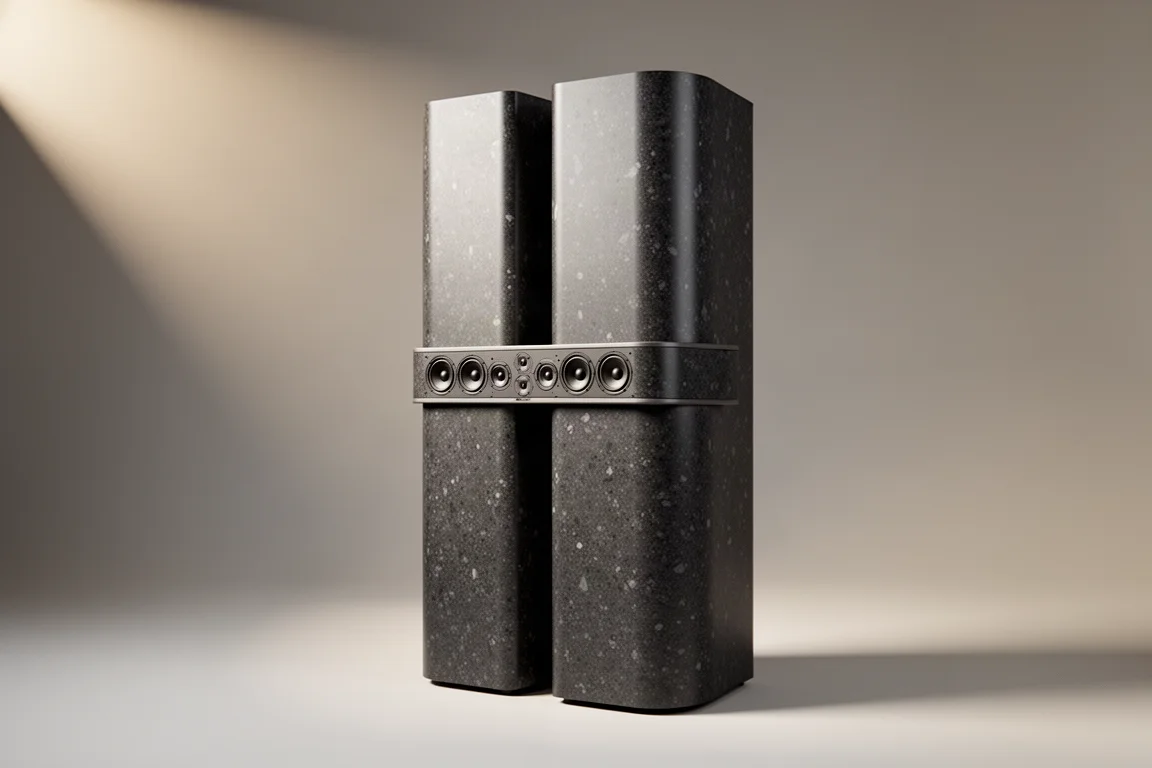
Physically, the Hyphn is made up of two towers with a central array, called the M-Array, housed on a bridge that spans the front of the speaker. The split-cabinet look is not decoration: it comes directly from the force-cancelled bass drivers and the way they are mounted.
Monitor Audio uses a material it calls acrylic stone, a composite of acrylic minerals and natural pigments. Panels are machine cut and then hand polished into the curved shapes that support the Hyphn’s components. The mineral content is very high, which makes the cabinets extremely heavy: the speaker stands 55 inches tall and weighs 235 pounds. That mass is the point, because it makes the structure rigid and inert, with no unwanted vibrations colouring the sound.
The material also behaves differently from MDF in the design process. Because acrylic stone is rigid enough to be used a little thinner, the engineers recovered internal air volume, which allowed a relatively small loudspeaker for its category even though it remains large next to conventional home speakers.
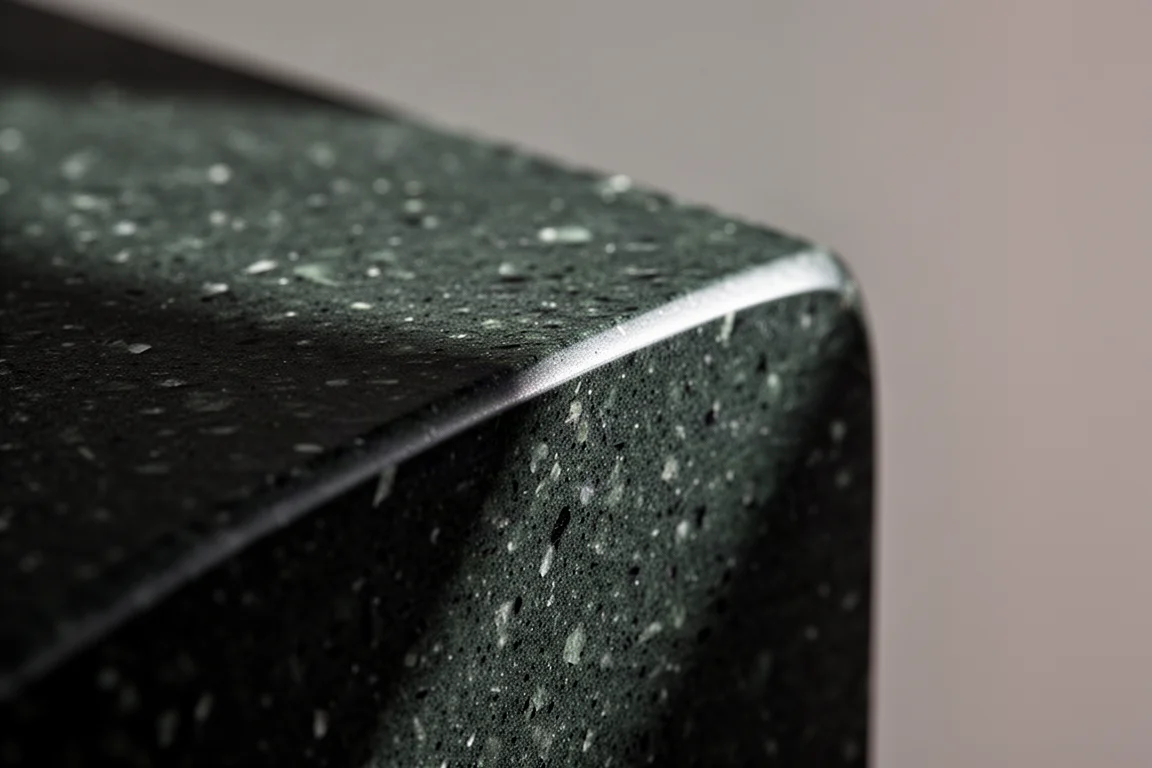
Finish options are white, black, and green. All three are striking, though the palette is narrow for a product this visually distinctive, and buyers who need the Hyphn to sit within a particular interior scheme will find the choice limited.
The M-Array and Driver Configuration
The M-Array is the heart of the design. It consists of seven transducers: six 2-inch mid-range drivers and the third generation of Monitor Audio’s MPD, or micro pleated diaphragm, tweeter. The small mid-range units are tightly packed with very small gaps between them, and their surfaces are flat, so the tweeter effectively sees a flat baffle. The arrangement is intended to behave as a single point source rather than a moving piston.
The bass drivers are force-cancelled and work in opposite directions, one moving inward as the other moves outward. By inverting them, the design team was able to bring the bass units much closer to the mid-range and tweeter than a conventional layout allows, which tightens the point-source behaviour further.
On paper, the third-generation MPD tweeter extends to 60,000 Hz and delivers lower distortion than any previous version. In-room response reaches down to 18 Hz.
Main Strengths: Sound Quality
The Hyphn’s most obvious strength is its soundstage. It is very wide and accurate, and the speakers themselves effectively disappear, leaving a three-dimensional field that places instruments with unusual precision. That field feels roughly five feet tall and extends well beyond the outer edges of the cabinets.
Voices and strings come across as effortless, floating without any sense of strain. Percussive cymbal attacks flow easily through the top end. Bass is fast, tight, and deep, and it integrates cleanly with the upper frequencies rather than sitting apart from them.
Point-source coherence is the thread that ties these qualities together. Because the drivers are brought close together and the baffle is flat around the array, the loudspeaker holds together as a single source, which is why the imaging feels so stable rather than smeared.
Things to Consider Before Buying
Amplification is the first practical hurdle. With a sensitivity rating of 86 dB and a manufacturer recommendation of up to 1,600 watts per channel, the Hyphn needs serious power to come alive. The demonstration system used 850-watt mono power amplifiers into the speaker’s 4-ohm load, which is a useful indication of the class of electronics involved.
Second, consider the physical reality. Two towers, 55 inches tall and 235 pounds, need floor space, structural confidence, and a room that can accommodate them without crowding the listening position.
Third, deep bass output depends on the room. In a very large space, the lowest bass attack can feel slightly held back; in a normal domestic room, that aspect should be considerably more developed.
Finally, there is cost. The Hyphn is an expensive flagship, and the finish options are limited to white, black, and green.
Buying Advice
If you are considering the Hyphn, budget for the whole system rather than the speakers alone. A pair at this level will only show what it can do with high-current amplification and a room that gives the towers space to breathe.
Match the finish to the room early, since the three available options are bold and the cabinets are not something you will move casually. Buyers who want a loudspeaker that recedes visually into the background may prefer a more conventional design, while those who want a genuine statement piece will find the Hyphn delivers on that intent.
Planned around properly, the Hyphn stands as the most ambitious loudspeaker Monitor Audio has produced, and by a wide margin.
Conclusion
The Monitor Audio Hyphn is a genuine flagship: a two-tower, point-source design built from a heavy acrylic-stone composite, with a seven-transducer M-Array and a third-generation MPD tweeter extending to 60,000 Hz. It images superbly, disappears in the room, and pairs fast, deep bass with an effortless mid-range and top end.
The trade-offs are equally clear. It needs substantial amplification, it is very heavy and very large, it comes in three finishes, and it is expensive. For listeners with the room and the electronics to support it, the Hyphn is one of the most compelling loudspeakers available today.
Product link
View more details for Monitor Audio Hyphn
This product is mentioned in the review. Check the specifications, options, and compatibility before buying.
View more details for Monitor Audio HyphnFurther reading
Related Reviews
Floorstanding Speakers
Acoustic Energy AE109 Mark II Review: A Refined Floorstander at £699
The Acoustic Energy AE109 Mark II is a slim, warm sounding floorstander that delivers clarity, midrange body and strong imaging in small to medium rooms.
Floorstanding Speakers
Acoustic Energy AE509 Review: A Slim Floorstander With Deep, Defined Bass
A practical look at the Acoustic Energy AE509, a slim floorstanding speaker with carbon fibre drivers, deep and well-defined bass, and an easy-going character that rewards careful system matching.
Floorstanding Speakers
Arendal 1528 Tower 8 Review: Reference Neutrality With Real Demands
A close look at the Arendal 1528 Tower 8, a nearly five-foot, 200-pound floorstander that rewards generous space, serious power, and high listening levels with reference-grade neutrality.