Tower Speakers
Martin Logan Foundation F2 Review: A Lively Tower With Real Low-End Muscle
The Foundation F2 is Martin Logan's most affordable tower, pairing deep bass and explosive dynamics with a forward top end and a cabinet that gives up some fine detail.
Introduction
The Martin Logan Foundation line is the brand’s most affordable speaker family to date, and the Foundation F2 is the largest tower in it. Alongside the F2, the series includes a second, smaller tower, two stand-mount models, and a center channel, which gives buyers a straightforward path from a two-channel setup to a full surround system.
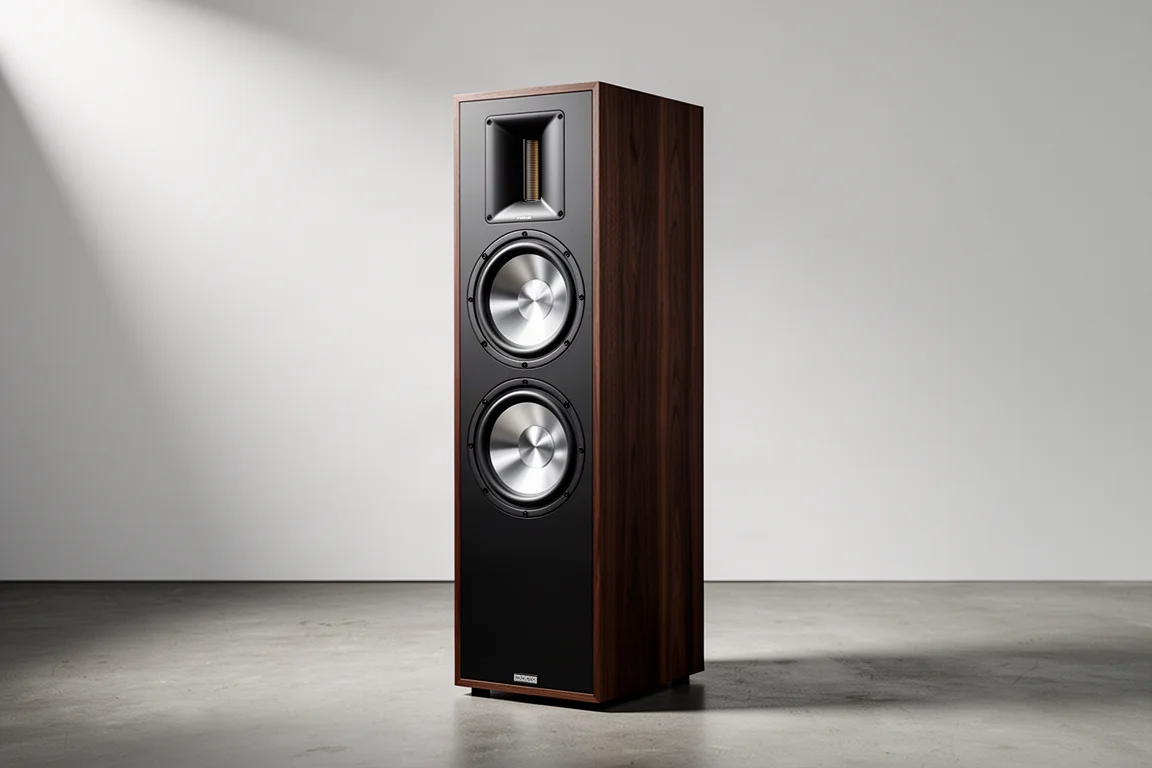
The F2’s driver complement is generous for the money: three 6.5-inch aluminum woofers, a 5.5-inch aluminum midrange driver, and a folded motion tweeter of roughly one inch set into a horn-like waveguide. Two rear ports handle the low-frequency output. Martin Logan rates the speaker at 36 Hz to 23 kHz with 92 dB sensitivity and a 4-ohm impedance, which means it is not especially difficult to drive and works with a wide range of amplifiers.
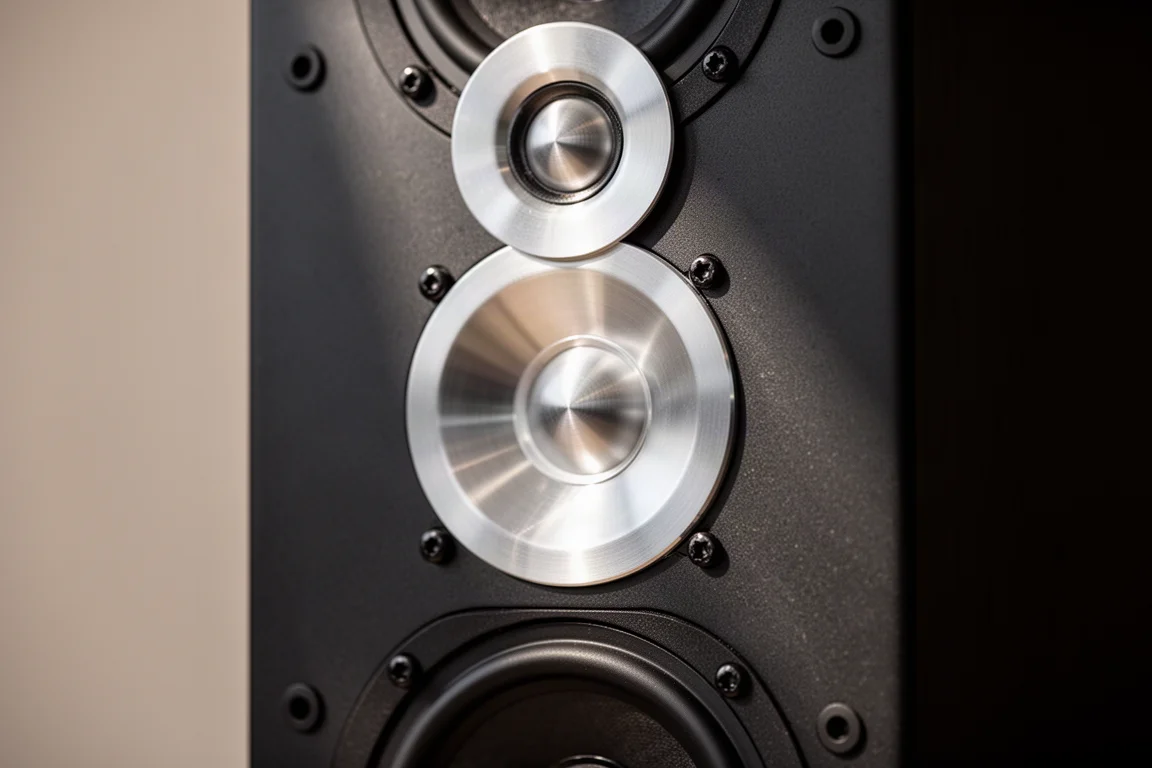
That combination of a large woofer array and high sensitivity is the heart of the F2’s character. It is a tower that aims to deliver scale and impact first, and it does so at a price that puts it directly against the Polk R700 and the Klipsch RP-8000F Mark II, with the Q Acoustics 5040 and the KEF Q750 also in the conversation.
Who This Speaker Is For
The F2 makes the most sense for listeners who want a lively, engaging sound rather than a strictly neutral one. Its low end is the headline: there is enough output and weight here that many buyers will not feel the need to add a subwoofer, which changes the total cost of a system considerably.
It also suits people who listen at moderate levels. The F2 stays snappy and detailed at roughly 40 to 55 dB and comes alive above that, so it does not demand high volume to sound interesting. Home theater buyers should take note too: with a hint of toe-in, the pair produces a strong, locked-in center image that borders on center-channel-like focus, which makes a phantom-center setup a genuinely viable option.
Placement and Setup
Getting the F2 dialed in is mostly about patience. A pair positioned roughly two feet from the front wall and about ten feet apart, with the listening seat around eleven feet back, produces a nicely balanced response. There is a clear rise in bass energy, and how close the towers sit to a wall or a corner will change how pronounced that is. Toe-in does something similar for the high frequencies.
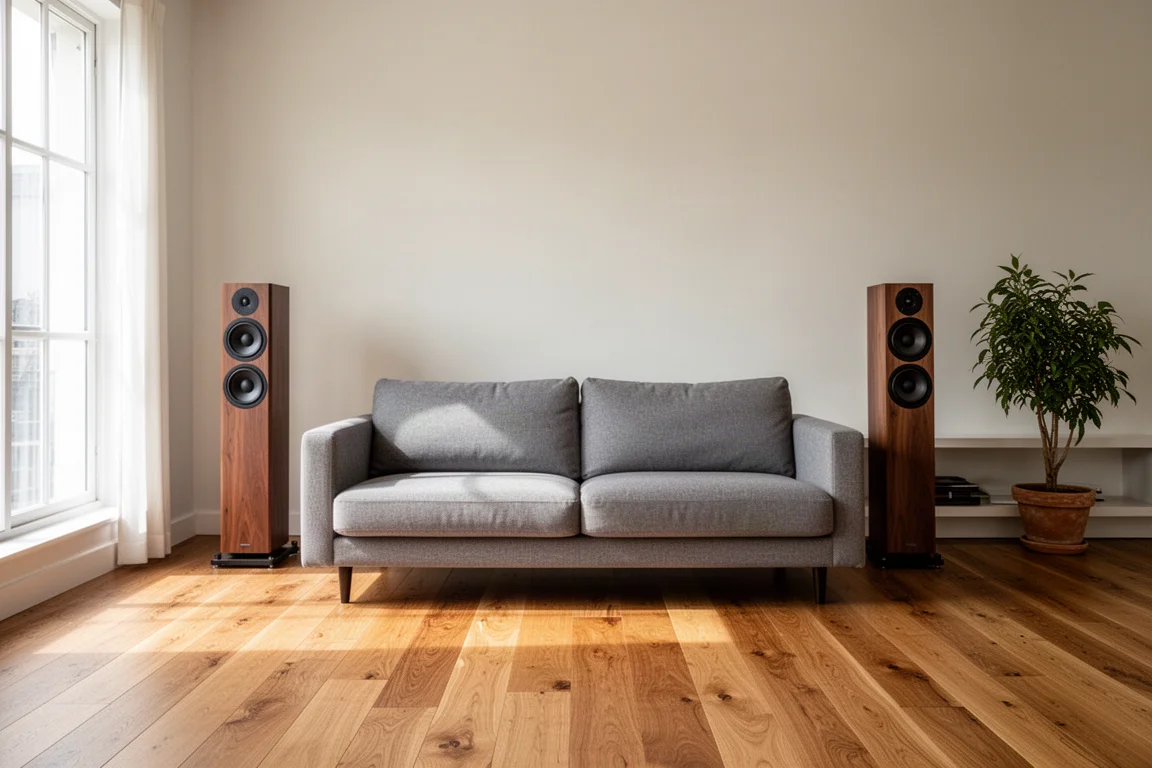
Because rooms differ so much, experimentation is worth the effort. Small changes in distance from the front wall and in the angle of the cabinets can shift the balance noticeably, and the F2 rewards the time spent.
Main Strengths
The F2’s strongest asset is its bass. Kick drums land with weight and a sense of air being pushed, and the speaker sounds genuinely huge for its price. It also scales well: the swell and broad grunt of a film score translate into real impact, and the speaker’s ability to grow with a demanding soundtrack is impressive.
Build and finish are another area where the F2 holds up well against its closest rivals. It is available in matte black, satin white, and walnut. The walnut finish is not a real wood veneer, but the grain is convincing from a normal listening distance, with a wider pattern and slightly thicker texture that reads as furniture-grade rather than budget. The round push-pin grilles cover the individual drivers rather than spanning the whole baffle, which keeps the front of the speaker looking clean.
With 92 dB sensitivity, the F2 also comes alive with modest electronics. That is a meaningful advantage for buyers who would rather not invest in a high-powered amplifier.
Bass, Dynamics, and Soundstage
Where the F2 gives up ground is in the finest layers of bass detail. Larger cues come through without being skipped, but the subtle texture of a mallet strike and the decay that follows it are harder to pick out than they are on the more expensive Motion XT F100. The cabinet is the likely reason, and the gap is real but not dramatic: if the XT F100 earns top marks on those tracks, the F2 still lands comfortably in the upper range.
Dynamics are where the F2 pulls ahead of some rivals. It is explosive in comparison to the Polk R700 and comes alive even with modest amplification, while the Polk needs both power and volume before it shows everything it can do. Against the Klipsch RP-8000F Mark II the dynamic gap is much smaller, but the F2’s bass feels faster than the Polk’s and weightier than the Klipsch’s.
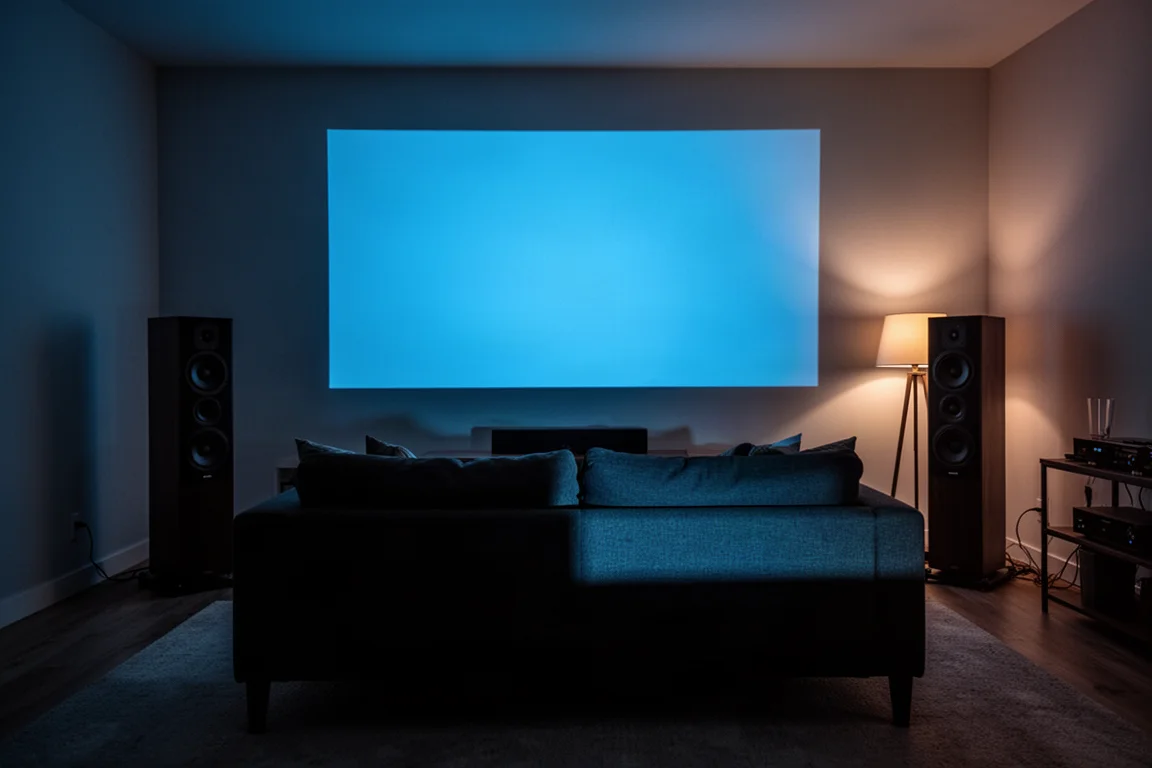
Imaging between the speakers is rock solid, and the center image is very strong. The soundstage does not extend as far beyond the outer edges of the cabinets as the Polk’s does, and it lands on par with the Klipsch rather than beyond it. Paired with its matching center channel, the Foundation series makes for a capable home theater package, though the center itself is the weaker link in the set.
Things to Consider Before Buying
The treble is the F2’s most opinionated trait. Its folded motion tweeter is smaller than the one in the XT F100, so it crosses over higher, which makes the speaker sound more forward. At the absolute extremes it is a little less refined. It is never brittle or fatiguing, but the added presence is noticeable, showing up as extra emphasis on vocal inflections and on treble-leaning instruments.
There is also a lift in the midrange that appears around 200 to 300 Hz. In practice this adds body to deeper male vocals, particularly in the tenor and baritone range, even though that extra warmth is not in the recording. It does not hurt intelligibility, but it is worth hearing before you commit.
Buyers who want the matching center channel should manage expectations as well. A two-way center with two smaller drivers cannot match the scale of a tower with three 6.5-inch aluminum woofers, so dialogue can sound slightly constrained by comparison. Running the towers as a phantom center produced better dialogue clarity, and stepping up to a Motion XT center is the alternative if you need a dedicated speaker below the screen. The Foundation series offers one center option.
Finally, the competition is strong. The Polk R700 remains the more refined and ultimately more capable tower when it is given enough power and the space to play loudly. The Q Acoustics 5040 costs less and produces a wider soundstage with a smoother, less forward presentation, though its bass cannot compete, so a subwoofer may become part of the budget. The KEF Q750 sounds far more neutral and even a little subdued next to the F2.
Buying Advice
At just under $2,000 for the pair, the F2 sits right in the middle of a crowded and talented field. The case for it is straightforward: it combines the dynamic fun of the Klipsch RP-8000F Mark II with much of the bass strength and easygoing nature that make the Polk R700 so appealing, and it looks more expensive than its price suggests.
Choose the F2 if you want a speaker that is captivating and lively, that plays well with modest electronics, and that can carry a system without a subwoofer. Choose the Polk R700 if you have the amplification and the room to let a more refined speaker stretch out. Choose the Q Acoustics 5040 if soundstage width matters most and you already own a subwoofer. Choose the KEF Q750 if a neutral, understated balance is your preference. Anyone who finds the Polk’s top end too polite should make a point of hearing the F2, because its extra treble presence may be exactly the correction they are looking for.
Conclusion
The Foundation F2 is a strong entry point into the Martin Logan range and a genuine alternative to the established favorites around its price. It gives up some fine detail and a little soundstage width, and its treble deserves a listening session before you buy. In exchange it delivers deep, weighty bass, explosive dynamics, a solid center image, and a build and finish that hold their own against anything nearby. It captures most of what makes the brand’s more expensive towers special at a fraction of the cost, and for a lot of rooms that will be more than enough.
Product link
View more details for Martin Logan Foundation F2
This product is mentioned in the review. Check the specifications, options, and compatibility before buying.
View more details for Martin Logan Foundation F2Further reading
Related Reviews
Tower Speakers
Arendal 1610 Tower 8 vs MoFi SourcePoint 888 vs MoFi V10: Three Tower Speakers Compared
A close look at three large tower speakers in a similar price bracket, from the punchy, heavy-built Arendal 1610 Tower 8 to the coaxial MoFi SourcePoint 888 and the high-output MoFi V10.
Tower Speakers
Definitive Technology BP9020 Review: A Powered Tower With Real Bass and a Few Quirks
A slim tower speaker that hides a powered 8-inch subwoofer inside the cabinet, delivering deep bass and a wide stage alongside some clearly defined trade-offs.
Tower Speakers
Emotiva XT1 Tower Speakers Review: Serious Clarity Under $1,000
The Emotiva XT1 brings three woofers, a dedicated midrange and an AMT tweeter to the sub-$1,000 tower market. Here is where it delivers and what to weigh first.