Tower Speakers
Definitive Technology BP9020 Review: A Powered Tower With Real Bass and a Few Quirks
A slim tower speaker that hides a powered 8-inch subwoofer inside the cabinet, delivering deep bass and a wide stage alongside some clearly defined trade-offs.
Introduction
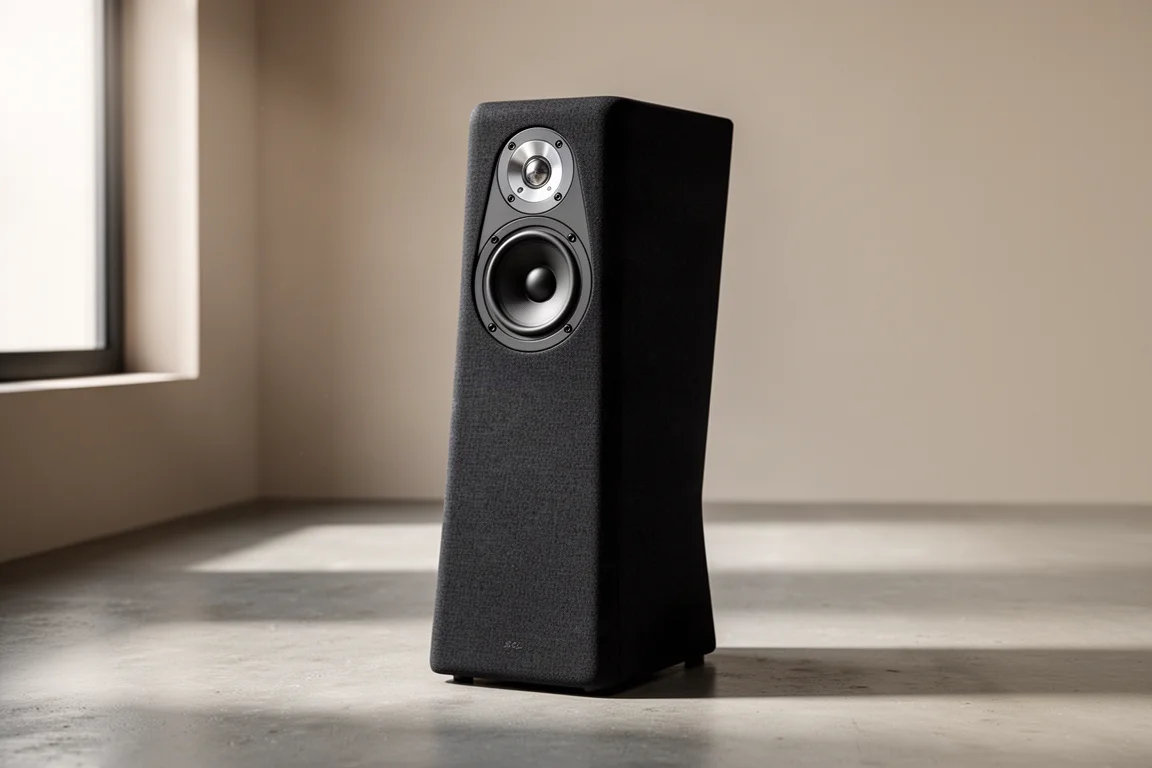
The Definitive Technology BP9020 is a tower speaker with an unusual trick built into it. Inside the cabinet sits a powered 8-inch subwoofer driver, fired out to the side of the speaker and driven by its own 150-watt Class D amplifier. Everything above that behaves like a conventional passive tower, fed by ordinary speaker cable, with the internal crossover routing signal to the bass amplifier on its own.
That combination is rare at this price. The BP9020 sells for around $250 each on Amazon, or roughly $500 a pair, and most towers in that range expect you to add a separate subwoofer if you want genuine low-frequency output. This one tries to solve the problem inside a single cabinet that stands about three feet tall.
Who the BP9020 Is Built For
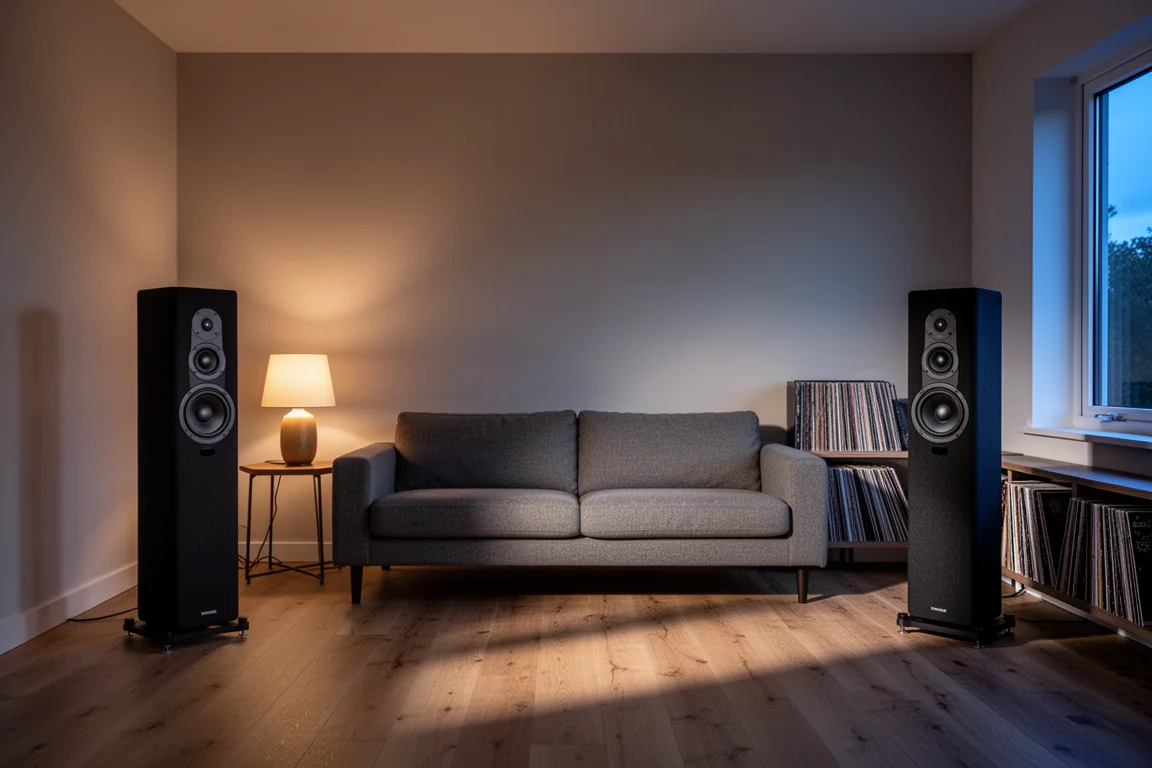
This is a speaker for listeners who want a compact, self-contained tower that reaches genuinely low without a second box in the room. You connect it with standard speaker-level cable and the cabinet handles the rest, so there is no subwoofer cable to run, no external crossover to configure, and no extra power outlet to find.
It is also aimed at listeners who value a wide, spacious soundstage more than pinpoint imaging. The design deliberately trades some precision for a more diffuse, room-filling presentation, and that is a matter of taste as much as engineering.
Finally, it suits anyone who is comfortable applying a little equalisation. A small amount of parametric correction addresses the speaker’s two most noticeable colourations, and the result is a considerably more balanced tower.
Main Strengths: Powered Bass and a Wide Soundstage
The headline strength is low-frequency output. The powered 8-inch driver reaches down to roughly 30 Hz in room, with an F3 near 35 Hz and an F10 around 29 Hz. Once it rolls off it rolls off quickly, almost like a brick wall, but across its working range the bass stays fairly flat and hits hard at moderate listening levels. For a tower at this price, that is a substantial achievement.
The front baffle uses an MTM layout: a 1-inch aluminium dome tweeter with two 3.5-inch midrange drivers positioned above and below it. Sensitivity measures about 87.7 dB, roughly 88 dB rounded, which is reasonable for a cabinet of this size.
Horizontally, the speaker throws a wide stage, and the rear-mounted midrange is the reason. It radiates toward the wall behind the cabinet and adds a sense of space that a purely front-firing design would not produce. The effect is distinctive, and for listeners who enjoy an enveloping presentation it is genuinely appealing.
Where the Treble and Imaging Fall Short
There are two clear trade-offs here, and both are worth understanding before buying.
The first is a lift in the lower treble, roughly between 4 and 6 kHz. That is the sibilance region, and it makes “s” sounds noticeably sharper than neutral. Directivity in that band is well controlled, which sounds like an advantage but works against the listener in this case: the on-axis and off-axis responses line up, so room reflections reinforce the direct sound and the emphasis stacks up. Toeing the speakers in or out shifts the high treble energy but does not really remove the sibilance, because the room keeps feeding the same band back.
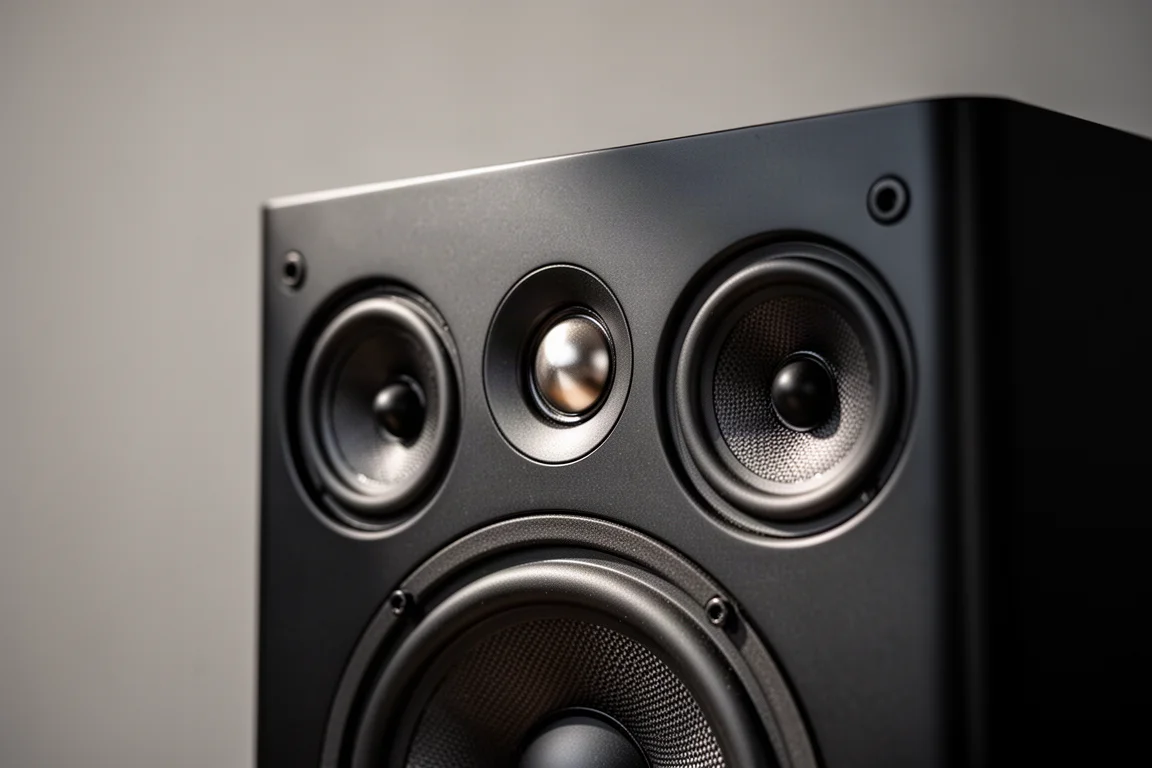
The second is imaging precision. The rear midrange adds spaciousness, but it also radiates the same signal from a second point, and the reflection from the wall behind the speaker arrives almost immediately. The result is a more diffuse stage and a less focused image. Vocals can sound chesty, with an emphasis noted around 200 to 300 Hz, and the lower midrange sounds a little bloomy relative to the middle of the band. The rear driver’s contribution concentrates in the region from roughly 500 Hz to 1 kHz rather than across the whole midrange.
For listeners sensitive to sibilance, this is the speaker’s biggest flaw. Two bands of parametric EQ make a real difference: bringing the 4 to 6 kHz region down by around 2 dB and the 200 to 300 Hz region down by roughly 1 dB removes most of the problem and leaves the spacious character intact.
Placement, Setup, and the Rear Midrange
Vertical placement matters more than usual here. Because of the driver layout there is lobing and cancellation above and below the tweeter axis, so your ears need to sit close to the tweeter line, within roughly 20 degrees above or below it. The cabinet is only about three feet tall, so in a typical chair you may end up a few inches above the tweeter. Slouching down noticeably improved focus and tonality.
On the back panel there are standard speaker-level inputs, a separate LF input that the manual advises against using, and a gain knob for the powered bass driver. The knob has a blue dot marking its midpoint. Just below that midpoint turned out to be the best setting in a room that already reinforced the lower bass, because at the midpoint the low end sounded bloated. That is a room interaction rather than a fault in the speaker, but it is worth planning for.
How Volume Changes the Sound
The powered subwoofer includes a limiter, and it changes the balance as you turn things up. At lower levels a 30 Hz thump or a 50 Hz kick drum comes through strongly. Push the volume higher and that low-frequency output tapers off, along with some of the lower midbass and subbass, because the limiter is reducing output to keep distortion in check. The midrange compresses as well.
Measured distortion is good at 86 dB and rises at 96 dB, staying at roughly 3 percent or below. Multi-tone distortion below -30 dB reads as adequate. In practice, at a listening distance of about 2 to 3 metres, standard levels around 85 dB with peaks near 95 dB are realistic. This is not a speaker for very loud playback, even with the built-in subwoofer on board.
What the Measurements Suggest
The on-axis and listening-window response shows the low-frequency extension described above, a slight dip caused by the rear midrange, and the lifted treble. The estimated in-room response shows a chesty region around 200 to 300 Hz and a boosted high frequency.
Horizontal contour is less tidy, which means a sound intended for one point in the stage may sit elsewhere at a different frequency. That is the measurement side of the imaging trade-off. Harmonic distortion is well controlled at 86 dB and still reasonable at 96 dB, and the overall data compares favourably with other affordable towers in this bracket.
Buying Advice
At around $250 each, the BP9020 is a genuinely interesting option for anyone who wants a tower with real bass and does not want to add a separate subwoofer. The measurements hold up reasonably well, and the powered bass driver delivers output that most passive towers at this price cannot match. For roughly $500 a pair, the overall performance is impressive.
The caveats are specific and manageable. Plan for a listening position close to the tweeter axis. Expect some sibilance in the 4 to 6 kHz range, and be ready to apply parametric EQ if that bothers you. Accept that imaging is spacious rather than precise, and that the low end tapers as volume climbs.
If those trade-offs sound acceptable, this is a speaker worth trying in your own room, particularly given how straightforward it is to send back if the presentation does not suit your space.
Conclusion
The Definitive Technology BP9020 is an unusual design that solves a real problem: it puts a powered subwoofer inside a slim tower and lets you run the whole thing from ordinary speaker cable. Its bass is the standout, its spaciousness is distinctive, and its sibilance and imaging are the compromises you accept in return. For roughly $500 a pair, that is a fair trade for the right listener.
Product link
View more details for Definitive Technology BP9020
This product is mentioned in the review. Check the specifications, options, and compatibility before buying.
View more details for Definitive Technology BP9020Further reading
Related Reviews
Tower Speakers
Arendal 1610 Tower 8 vs MoFi SourcePoint 888 vs MoFi V10: Three Tower Speakers Compared
A close look at three large tower speakers in a similar price bracket, from the punchy, heavy-built Arendal 1610 Tower 8 to the coaxial MoFi SourcePoint 888 and the high-output MoFi V10.
Tower Speakers
Emotiva XT1 Tower Speakers Review: Serious Clarity Under $1,000
The Emotiva XT1 brings three woofers, a dedicated midrange and an AMT tweeter to the sub-$1,000 tower market. Here is where it delivers and what to weigh first.
Tower Speakers
Heco Aurora 1000 Review: A German Tower That Outperforms Its Parts List
Heco's flagship Aurora tower pairs a modest parts list with genuinely strong measured performance. Here is what $1,600 a pair buys, and where the compromises sit.