Work Lights
Makita DML812 vs Milwaukee 2354-20: Two Cordless Search Lights That Are Almost Too Close to Call
Two 18V search lights with matching 1,500-lumen output, very different ergonomics and beam colors, and a price tag around $100 to $120 each.
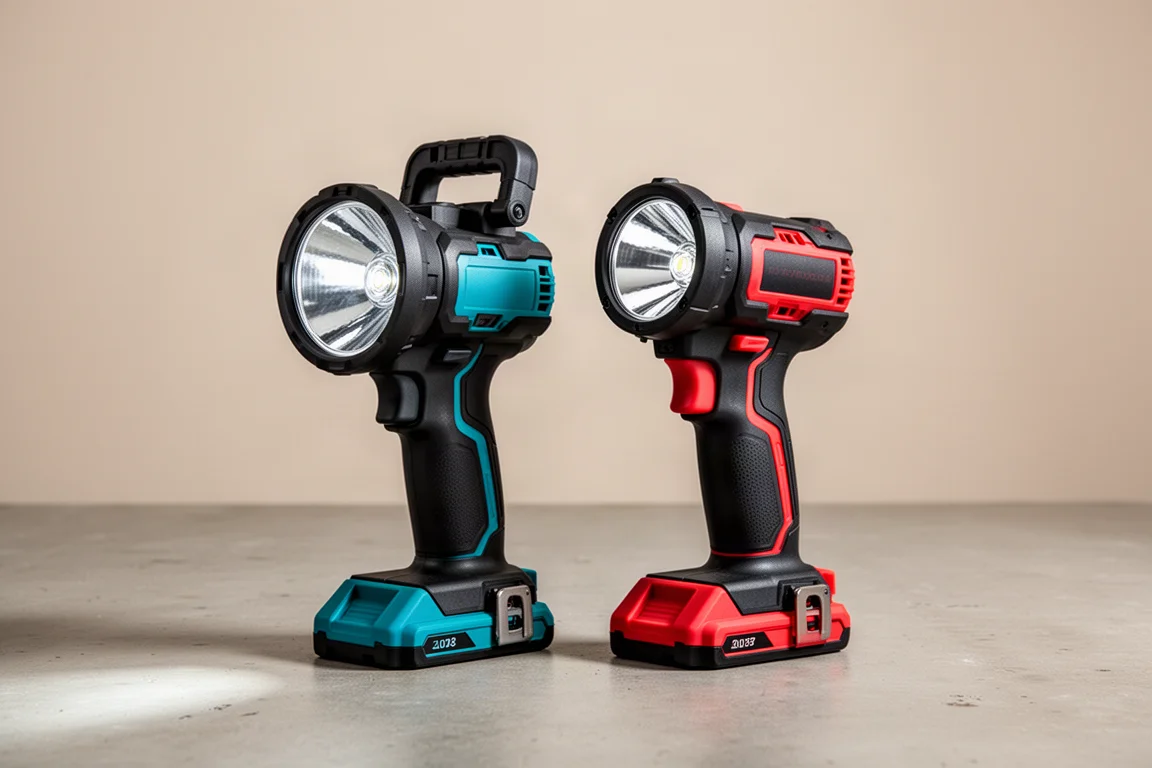
Introduction
Makita and Milwaukee both make genuinely good cordless lighting, and their 18V search lights are among the closest head-to-head we have tested. The Makita DML812 and the Milwaukee 2354-20 match each other almost exactly on output, sit within the same general price band of roughly $100 to $120 depending on where you buy, and cover the same search light and flood light duties on the job site or around the property.
So what actually separates them? A handful of design choices, one noticeably whiter beam, and a weight difference that is bigger than you might expect. This comparison breaks down where each light wins, so you can pick the one that fits your hands and your battery platform.
Light Output and Beam Character
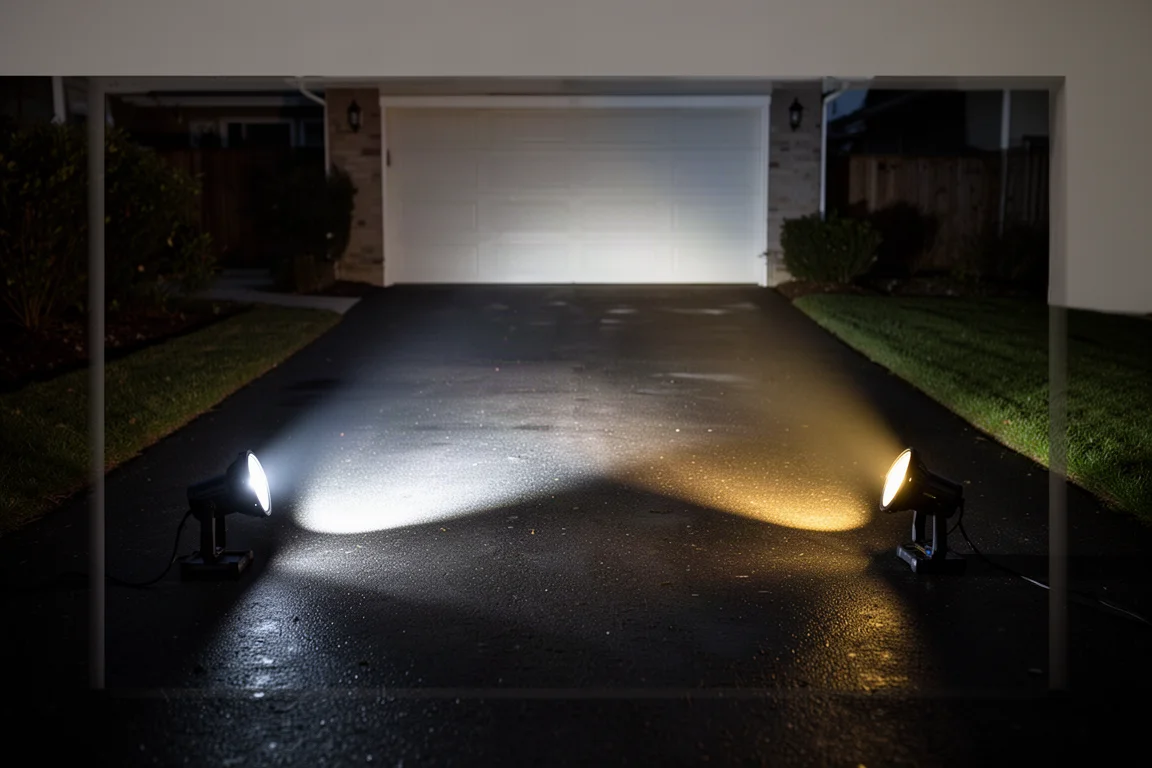
On paper, this fight is a draw. Both lights deliver 1,500 lumens in their search/spotlight and flood modes, and side by side at night the overall brightness feels nearly identical. If you only look at lumen numbers, you would be forgiven for thinking these are the same light with different badges.
The real difference shows up in the color of the light. The Makita produces a much whiter beam, which makes it noticeably easier to identify colors and fine detail at a distance. At roughly 40 feet, a truck lit by the Makita reads clearly as its actual color; under the Milwaukee’s yellower, lower-color-temperature LEDs, that same truck is harder to place. Within the output itself, the Milwaukee’s spotlight reaches a bit farther, with roughly 5 to 10 percent more throw, while the Makita’s flood pattern is similarly 5 to 10 percent stronger. Neither advantage is dramatic, but both are real.
Design and Ergonomics
This is where the Milwaukee 2354-20 pulls ahead. The mode and power buttons sit together at the top, so you can switch between flood, search, and both modes with one hand. The Makita DML812 puts the mode button down at the base, which means using a second hand to make the same adjustment. Both lights offer the same mode set, but the Milwaukee’s layout is simply more convenient.
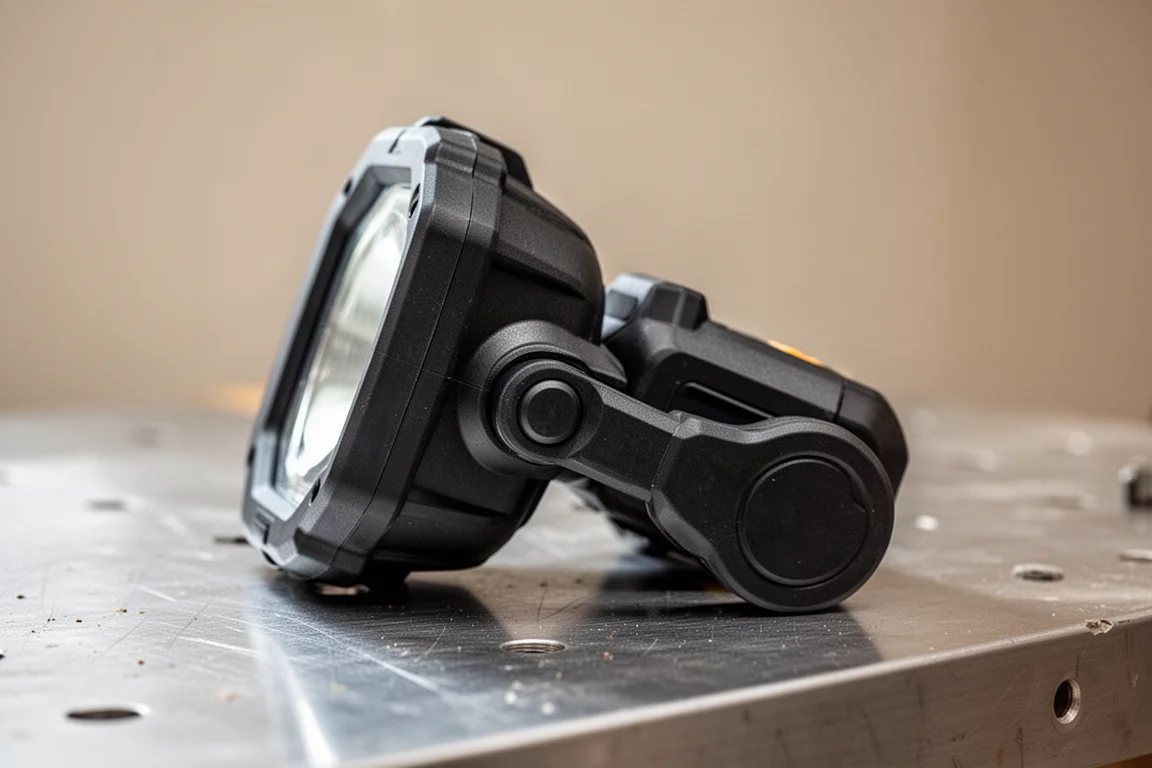
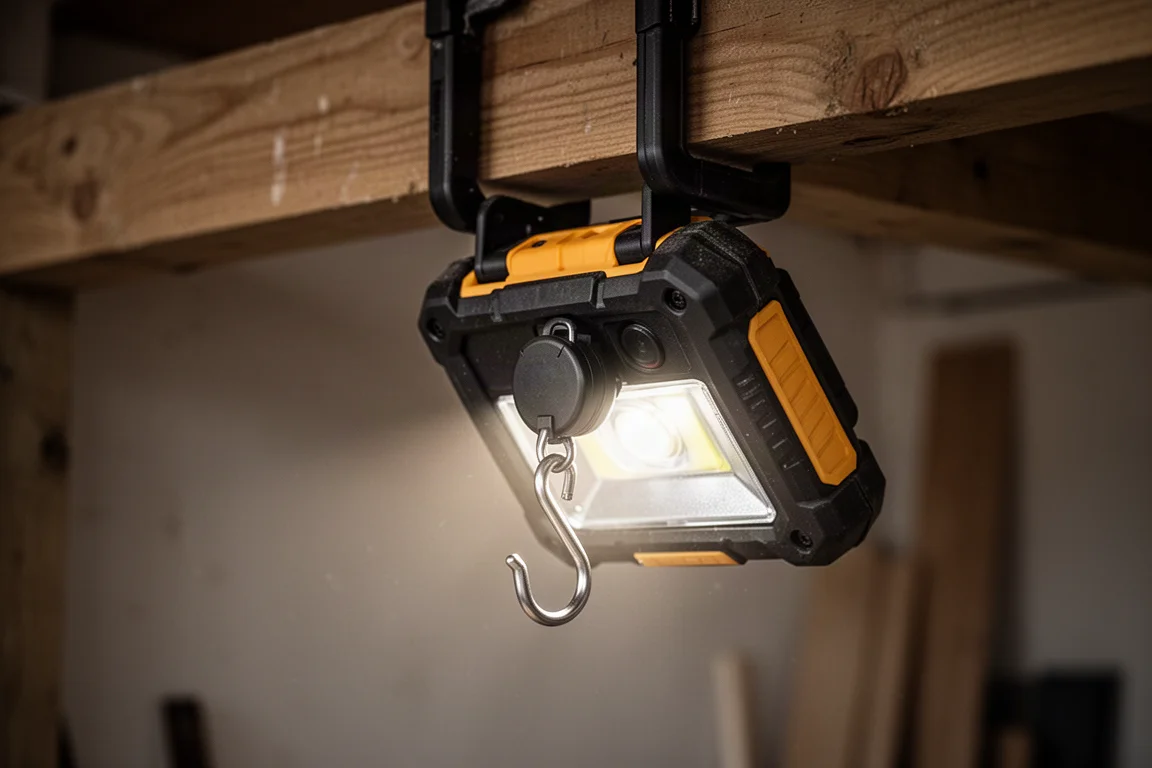
Form factor is another Milwaukee win. It stands stable on its own base, while the Makita is a little less confident sitting upright, even with a bumper around the body. The Milwaukee head also rotates backwards roughly 190 degrees, letting you angle the beam in ways the Makita cannot. The Makita fights back with two retractable hooks on the rear that pull out so you can hang the light somewhere, a nice practical touch the Milwaukee does not match in the same way.
Weight and Battery Runtime
Without batteries, the Makita DML812 comes in at about 1 pound 15.4 ounces, while the Milwaukee 2354-20 is already heavier bare at about 3 pounds 2.1 ounces. Add a 4Ah battery to each and the gap widens: the Makita reaches around 3 pounds 4.8 ounces, while the Milwaukee climbs to roughly 4 pounds 11.9 ounces. The Milwaukee is noticeably heavier in the hand, which matters if you are holding it for extended periods.
Runtime is not a concern for either light with a 4Ah battery on board. A 4Ah pack gives plenty of run time for typical search light tasks, and since these are low-draw tools, they are forgiving with smaller or older batteries as well.
Durability, Ratings and Warranty
Milwaukee publishes an IP54 rating for the 2354-20, which tells you exactly what dust and water protection to expect. Makita does not follow the IP standard on this light, instead citing its XPT, or Extreme Protection Technology, without disclosing a specific IP equivalent. That leaves you trusting the brand’s word rather than a defined spec.
Makita backs the DML812 with a five-year warranty along with a three-year LED warranty, while Milwaukee advertises a lifetime warranty on the LEDs. That lifetime LED claim is worth treating with some skepticism, since such warranty programs can carry conditions and asterisks that make actual claims less straightforward than the marketing suggests. Both are otherwise rugged, job-site-ready tools, and there is a sense that Makita has paid a bit more attention to the LEDs themselves, which shows in the beam quality.
Pricing and Battery Platform Considerations
Both lights sell for roughly $100 to $120 depending on the retailer, with the Milwaukee typically a little cheaper than the Makita. If you are already invested in one battery platform, that alone may decide this for you. Staying with your existing batteries keeps the true cost of the light down and avoids adapter workarounds.
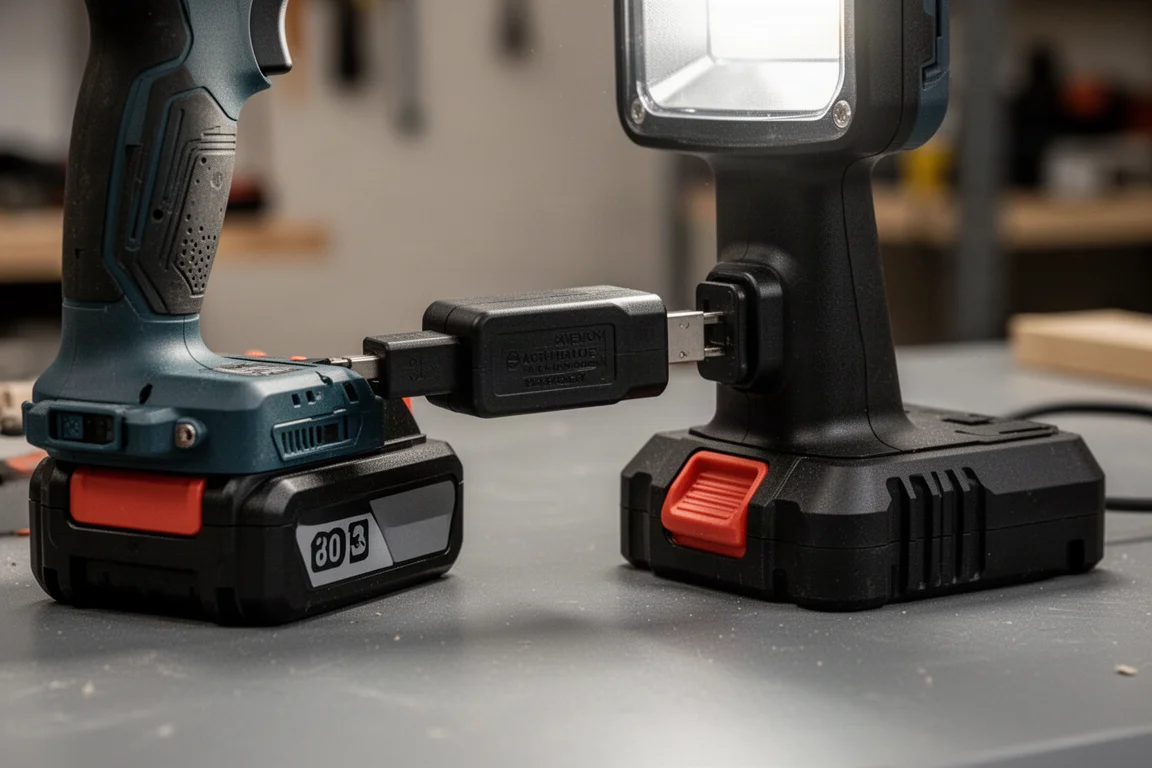
That said, lights are exactly the kind of tool where cross-platform adapters make sense. They are low-draw tools, so a simple battery adapter lets you run a Milwaukee light on Makita batteries or vice versa, and adapters are cheap. If the light you want is on a different platform from your tools, an adapter can open up both options without forcing you to buy new batteries.
Buying Advice
The honest verdict is that these two lights score almost identically as lights. The Milwaukee 2354-20 edges ahead slightly thanks to a better one-handed control layout, a more stable form factor, head rotation past 180 degrees, a stronger spotlight, an IP54 rating, and a usually lower price. The Makita DML812 counters with a cleaner whiter beam that reveals color and detail better at distance, a stronger flood mode, a lighter body, retractable hanging hooks, and a longer published warranty structure.
The simplest decision path: if you are on the Milwaukee platform, buy the Milwaukee; if you are on Makita batteries, buy the Makita. If you are platform-agnostic and open to adapters, the Milwaukee’s slightly better ergonomics and price make it the narrow overall pick, but the Makita’s whiter light is genuinely the better choice if you need to identify detail and color in the dark. Neither is an overwhelming winner, and both will do the job very well.
Conclusion
This is about as close as a head-to-head comparison gets. Both lights match at 1,500 lumens, both cost in the same general range, and both are well-built search lights from brands with strong lighting lineups. The Milwaukee wins on design, ergonomics and spot throw; the Makita wins on beam color, detail rendering and weight. Pick based on your battery platform first, and on whether a whiter flood-heavy beam or a longer-reaching spot matters more for your work.
Product link
View more details for Makita DML812
This product is mentioned in the review. Check the specifications, options, and compatibility before buying.
View more details for Makita DML812Further reading
Related Reviews

Work Lights
Milwaukee M12 Rover Review: A Compact Work Light That Goes Where You Do
The Milwaukee M12 Rover is a compact, versatile work light with three brightness levels, multiple mounting options, and USB-C charging for your devices.
Work Lights
Best Folding Work Lights Compared: Budget Picks to Tool Truck Tough
Seven folding work lights tested for real lumen output, runtime, charging, and drop durability, from a $20 Amazon seller to Snap-on.
Work Lights
Best Hinged Work Lights: 7 Options for Aiming Light Exactly Where You Need It
From classic Maglite designs to modern dual-hinged stick lights, seven work lights that make it easy to aim a beam into tight spaces.