Phono Preamps
Luxman E-07 Review: A Flagship Solid-State Phono Stage for Serious Vinyl Collections
The Luxman E-07 replaces a discontinued tube flagship with a zero-feedback solid-state design. Here is what its controls, cartridge flexibility and sound mean for vinyl owners.
Introduction
The Luxman E-07 is a solid-state phono preamplifier built around a zero-feedback circuit, and it now leads the company’s phono range. It replaces the Luxman EQ-500, a tube design that has been discontinued, which makes the E-07 the current flagship rather than one option among several. The launch also arrives in a significant year for the brand, with Luxman marking its 100th anniversary in 2025.
In the United States the E-07 is priced at $7,995. That places it firmly in flagship territory, so the practical question is not whether it is affordable but whether its approach to vinyl playback matches the way you listen.
Who This Phono Stage Is For
Most listeners who consider a phono preamplifier at this level already own a substantial record collection. The arithmetic is easy to follow. A library of 1,000 LPs bought at an average of $15 each represents roughly $15,000 of music, and a collection of 2,000 records doubles that figure. Owners of libraries at that scale usually have a capable turntable and cartridge as well, which means the phono stage is the final link in a chain that has already received serious investment.
The E-07 also suits listeners who run more than one cartridge. Three inputs are available, one of them a balanced XLR connection, so a moving magnet cartridge and one or two moving coil cartridges can remain permanently connected.

Listeners who mostly stream, or who own a small collection and an entry-level turntable, will find far less value here. This is a component that rewards a front end already capable of resolving detail.
Design, Build Quality, and Controls
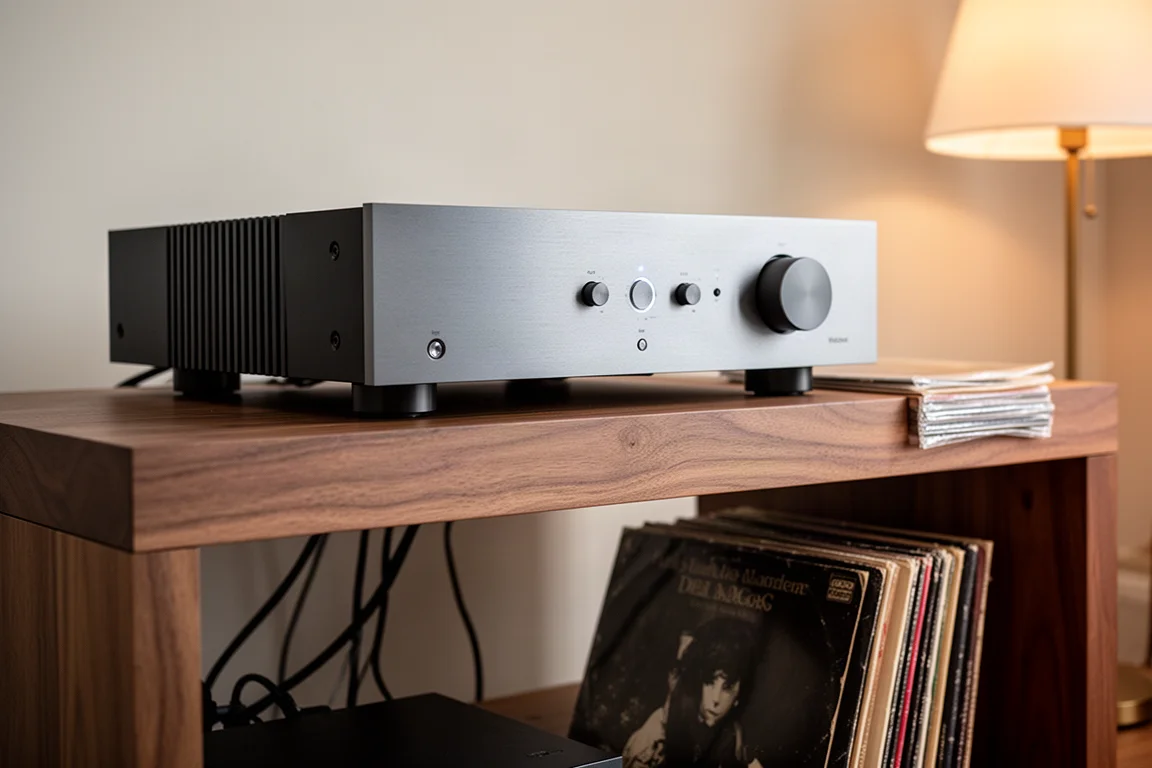
The E-07 looks and feels like a luxury component. It is made in Japan and weighs 29 lb, which is more than a number of 200 watt per channel Class D power amplifiers. That mass is worth planning for if your rack has shallow shelves or limited clearance.
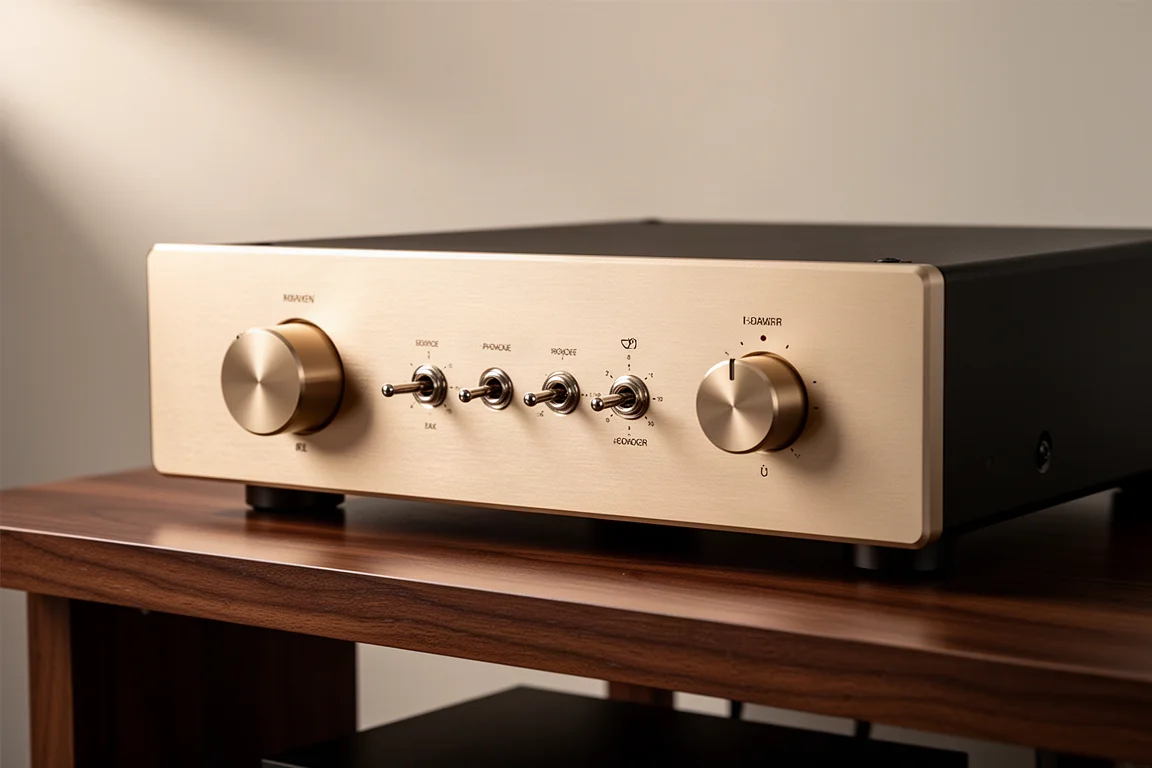
The front panel runs from left to right. A large rotary knob on the left selects the output, offering unbalanced RCA or balanced XLR. Next come four metal toggle switches: phase invert, the articulator function, a low cut filter, and the moving coil impedance selector. The articulator is a moving coil cartridge demagnetizer that runs for about 30 seconds. The low cut filter handles low frequencies and works as a rumble filter. The impedance selector offers six settings at 4.7, 10, 40, 100, 300 and 1k ohms. On the far right sits the input selector, with positions for three cartridges, the third being the balanced XLR input. Around the back, impedance and capacitive loading options are provided for moving magnet cartridges.
Main Strengths
The first quality that stands out is noise. The E-07 is exceptionally quiet in use, and it stayed dead silent through headphones, which matters for anyone running sensitive headphones or high efficiency speakers. A very low noise floor is not a minor detail: it is what keeps small dynamic and spatial cues in the groove audible.
The second is restraint. The E-07 does not add character of its own. With a Nagaoka MP-700 moving permalloy cartridge, a design that is naturally reserved and rich in harmonic density rather than hyped or aggressive, the phono stage simply extended those qualities. A live Janis Joplin concert recording from the late 1960s came through with the force of the performance intact.
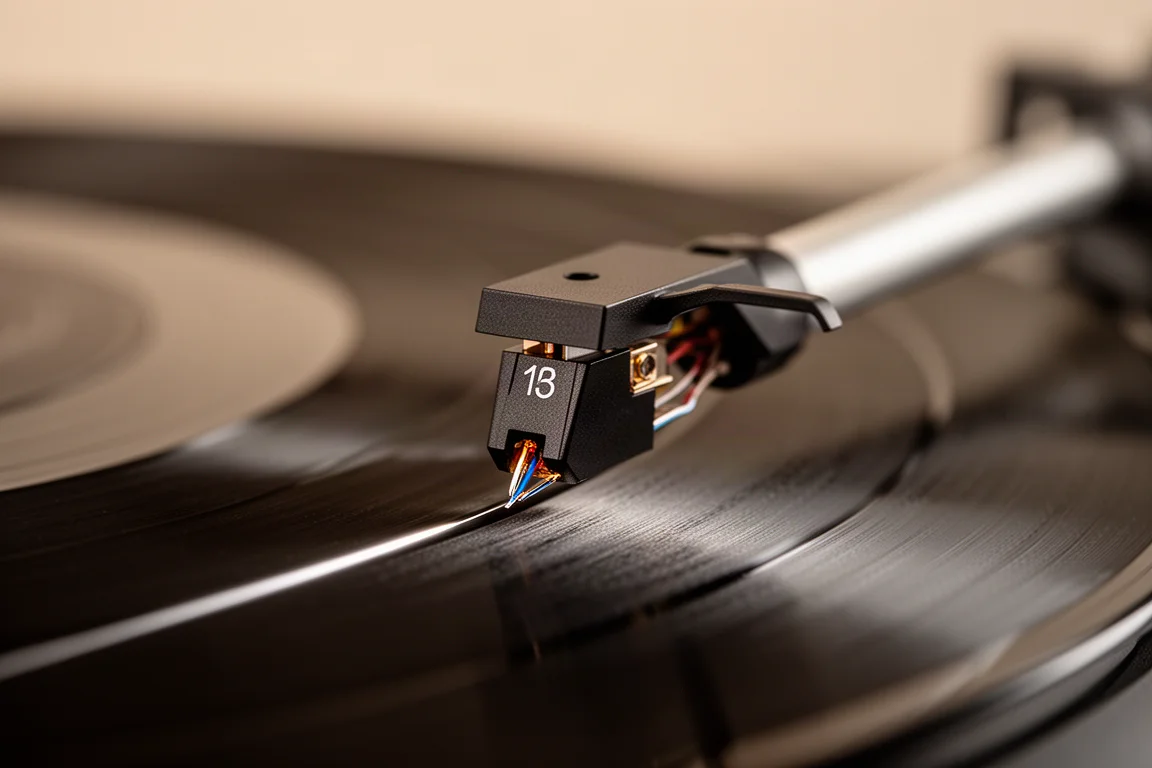
With a Grado Epoch 3 cartridge and pressings of the Beatles’ Revolver, including a recent remaster and an older Japanese edition, the same pattern held. In a side-by-side comparison with the Parasound JC3 Plus, another solid-state phono preamplifier, the E-07 delivered the clearer and better defined version of the recording, while the JC3 Plus softened it noticeably. Leading edges were more incisive through the E-07, bass lines carried more detail, and the contrast between quiet and loud passages was wider. The JC3 Plus, which costs roughly half as much, remains a genuinely capable phono stage on its own terms, and the difference becomes obvious mainly in direct comparison.
A low output moving coil cartridge confirmed the same impression. With an Ortofon Cadenza Blue and a record that is not an audiophile pressing, the music still came through with an ease that made the recording’s limitations easy to overlook. That combination of silence, transparency and musical flow is the core of what the E-07 offers.
Cartridge Loading and Input Options
The moving coil impedance selector covers a wide range, from 4.7 ohms up to 1k ohms, which makes it straightforward to match a broad spread of low output cartridges. Moving magnet users get impedance and capacitive loading options on the rear panel. Three inputs, one of them balanced, mean a multi-cartridge setup can stay wired and ready.
The most interesting flexibility is the choice between the internal moving coil stage and an external step-up transformer. Running a low output Ortofon Cadenza Blue through an external Ortofon ST-90 transformer into the moving magnet input produced more weight and low frequency presence. Going straight into the moving coil input at the 40 ohm setting traded some of that fullness for greater dynamics, life, soundstage, dimensionality and spaciousness. Neither route is wrong. The two paths simply shift the balance, and having both available is a real advantage for anyone who enjoys experimenting.
Things to Consider Before Buying
At $7,995 in the United States, the E-07 sits at the top of the Luxman phono range. It replaces the EQ-500, which used a tube design and is no longer in production, so buyers moving from that model are stepping into a different technology rather than a like-for-like update.
The articulator demagnetizer is worth understanding before purchase. The cycle takes about 30 seconds, and in testing it produced no audible change. It is a feature to appreciate as part of the package rather than a reason to buy.
The E-07 also does not flatter recordings. Because it resolves detail rather than softening it, the character of your cartridge and the quality of your pressings will be more apparent than they would be through a warmer, more forgiving phono stage. That is an advantage in a well matched system, and something to weigh if you play a lot of worn or compressed records.
Nothing in that list is unusual for a flagship phono stage, but the combination of price, transparency and physical bulk means the E-07 is easiest to live with when the rest of the system is already settled.
Matching the E-07 to the Rest of Your System
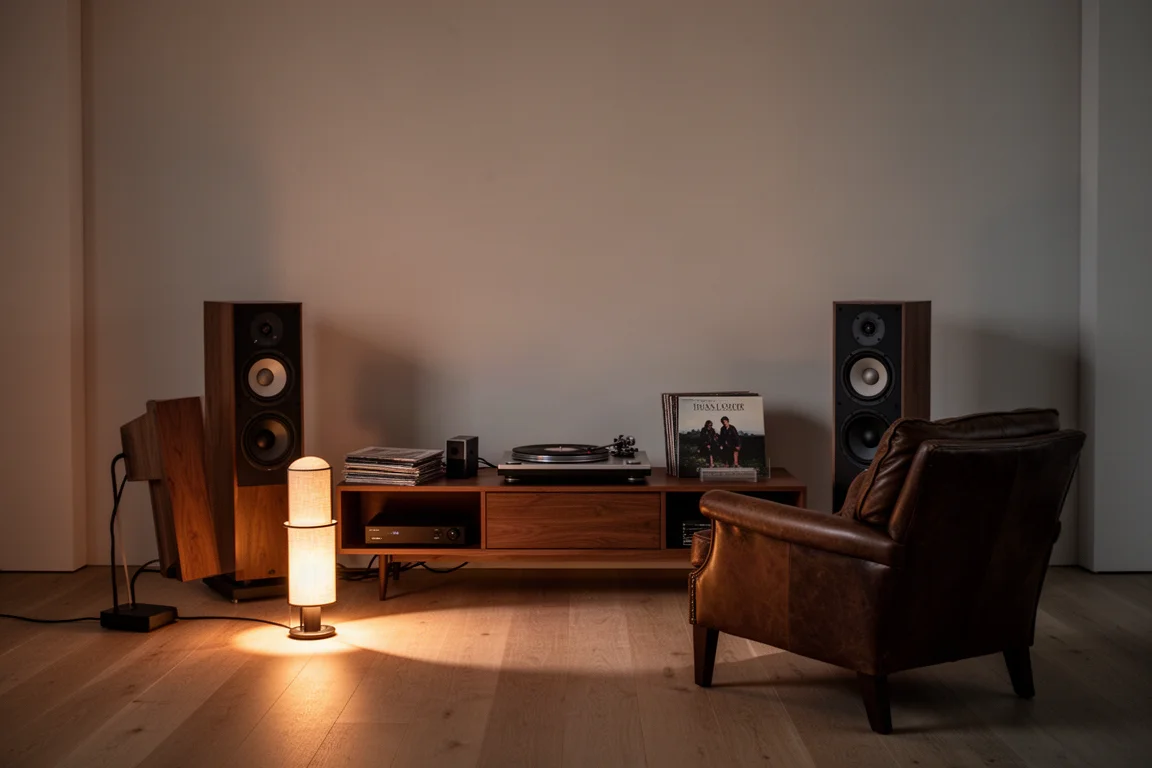
A phono stage at this level makes most sense with a turntable and cartridge that can already retrieve fine detail. If the front end is the limiting factor, the extra clarity of the E-07 will be harder to hear.
Cartridge loading is the setting to get right first. With six moving coil impedance options available, loading can be tailored to the cartridge in use rather than fixed, and the range extends high enough to cover a wide variety of designs.
Output connection is the next decision. The E-07 offers both unbalanced RCA and balanced XLR outputs, so the choice can simply follow whatever input your preamplifier or integrated amplifier handles best.
Headphone listeners get a particular benefit from the low noise floor, since hiss is far more obvious through headphones than through speakers. Anyone who splits listening time between speakers and headphones will notice the difference immediately. Finally, three inputs make it practical to keep several cartridges connected at once, which is useful if you alternate between moving magnet and moving coil designs or between stereo and mono pressings.
Buying Advice
The E-07 is the right purchase for a specific listener: someone with a large record collection, a turntable and cartridge already capable of resolving detail, and an interest in hearing what is actually in the groove without added warmth or coloration. The six moving coil impedance settings, three inputs and balanced XLR connection add practical value for anyone running more than one cartridge.
If the budget is fixed, the case is less clear. A solid-state phono stage at roughly half the price, such as the Parasound JC3 Plus, remains a fine performer on its own, and the gap between the two shows up mainly in direct comparison. Buyers who want the last measure of clarity, the lowest noise floor and the widest sense of dynamic contrast will find the E-07 delivers it. Buyers who prefer a warmer presentation and a lower outlay have good options elsewhere.
Before committing, confirm three practical details: the loading range suits your cartridge, the input count matches how many cartridges you want connected at once, and the shelf can take a heavy full width component. Once those are settled, the E-07 is a straightforward piece of equipment to live with.
Conclusion
The Luxman E-07 is a flagship solid-state phono preamplifier that earns its position through silence, transparency and flexibility rather than through added character. Its zero-feedback design, six moving coil impedance settings, three inputs and balanced XLR connection cover the practical needs of a serious vinyl listener, and its noise floor is low enough to disappear entirely. At $7,995 in the United States it is a significant investment, and it makes the most sense for listeners whose record collections and front end hardware have already reached a similar level. For that audience, the E-07 is a convincing answer to the question of what a phono stage should add to a system: ideally, nothing at all.
Product link
View more details for Luxman E-07
This product is mentioned in the review. Check the specifications, options, and compatibility before buying.
View more details for Luxman E-07Further reading
Related Reviews
Phono Preamps
Ampapa A1 Review: A $130 Tube Phono Preamp With Tone Controls
A compact tube phono preamp with bass and treble controls, a headphone output, and a design-origin claim worth reading carefully.
Phono Preamps
Three Phono Preamps Worth Considering: Budget, Detail, and Flexibility
Three phono preamps at three price points, compared by sound, adjustability, and cartridge compatibility so you can pick the right one for your vinyl setup.
Phono Preamps
Duke Audio T4 Plus vs Andover Phono Preamp: Which One Suits Your Turntable?
A tube phono preamp at around $100 against a $250 model with an extra analog input: how the Duke Audio T4 Plus and the Andover Phono Preamp differ in sound, features, and value.