Camping Shelters
Liteway PyraOmm Tarp and Half Inner Mesh Review: Under 750 g of Four-Season Shelter
A practical look at the Liteway PyraOmm tarp and half inner mesh, a sub-750 g trekking pole shelter built for alpine weather and long-distance hiking.
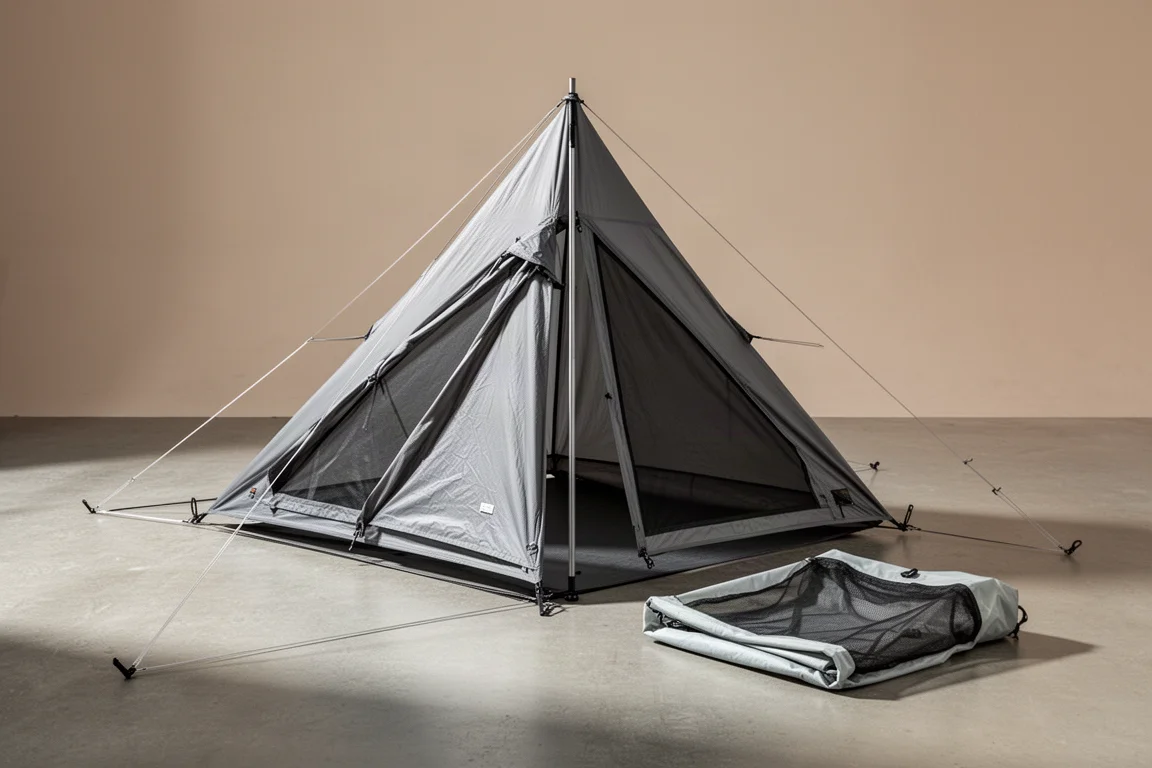
Introduction
The Liteway PyraOmm is a pyramid-shaped tarp shelter from a company based in Ukraine, and it is designed to be pitched with a trekking pole instead of a dedicated frame. Paired with the matching half inner mesh, the whole setup packs into a small stuff sack and comes in at under 750 g, which is the kind of number that gets long-distance hikers interested.
That low weight does not come from cutting corners on weather protection. The combination is intended for four-season use in exposed alpine conditions, and it is available in more than one size, so buyers can trade interior space against packed weight.
This review covers both parts of the system: the PyraOmm tarp itself and the PyraOmm half inner mesh. It looks at how the shelter pitches, how it behaves in wind and rain, how the fabric is likely to hold up over time, and who should consider it instead of a conventional double-wall tent.
Design and Setup: How the PyraOmm Goes Up
The first thing to understand about the PyraOmm is that there are no poles in the bag. Support comes from a trekking pole placed under the apex, or from a suitable tree branch if one happens to be within reach. In practice, natural supports are rarely convenient, so a trekking pole is effectively part of the kit.
Setup starts by loosely staking the four corners, with a fifth and sixth stake handling the main entrance. Six stakes is a realistic minimum. Once the corners are in, the pole goes under the apex and the shelter takes shape almost immediately, though the corners usually need a second pass of adjustment to get the footprint square and the tension even across all the stakes.
Tensioning is handled by a simple and smart system: a length of paracord threaded through a small plastic toggle that bites down on the cord and grips it against itself. It is quick to learn and easy to fine-tune as conditions change.
Trekking pole length matters more than most buyers expect. A 129 cm pole was not quite enough to get full height out of the shelter, and propping the pole up on a nearby rock added the extra five to eight centimetres needed. The company also offers an add-on top adapter that is intended to move the pole position off centre, which would solve the main ergonomic complaint of the design.
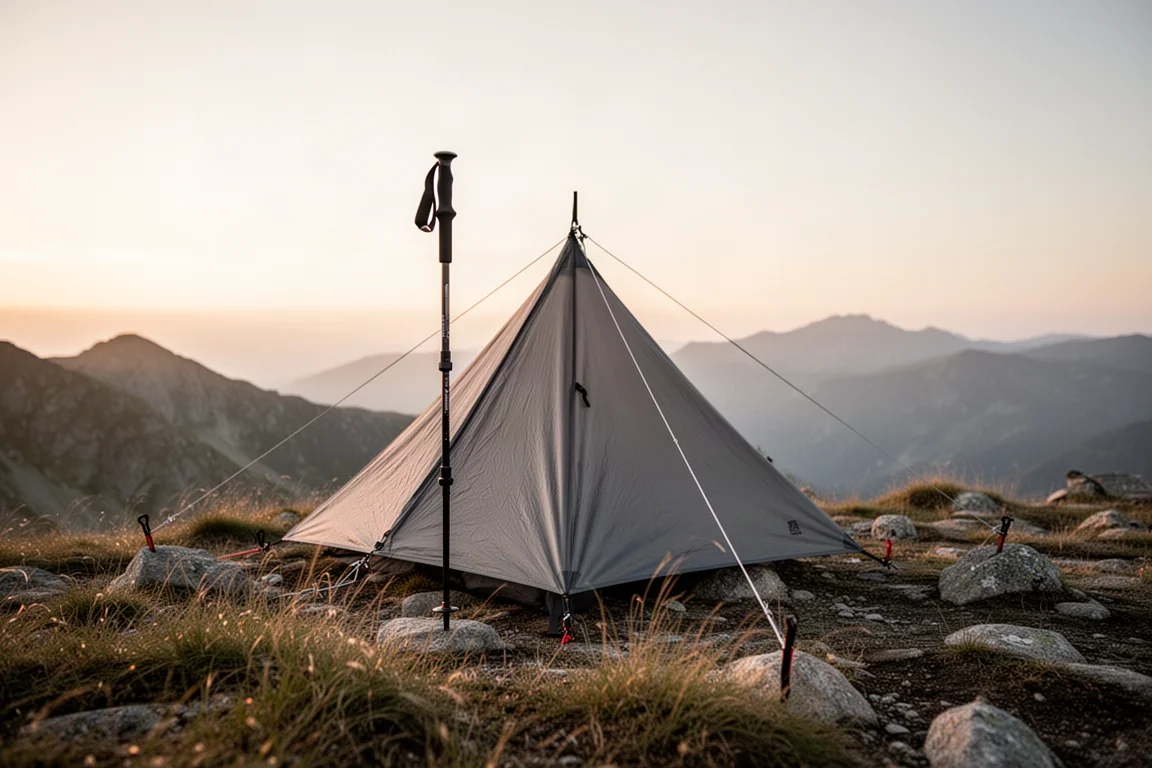
Both doors can be folded fully open, which leaves a very simple open structure and explains much of the low weight. In warm alpine summer conditions, the tarp alone makes a pleasant place to sit out a long afternoon.
Liteway PyraOmm Tarp: Space, Ventilation, and Weather Protection
Pitched properly, the shelter offers roughly four square metres of floor: about 164 cm across one axis and 272 cm along the other, with a peak height of around 130 cm. That is comfortable for a solo hiker of average height, and the size options mean taller users or two-person trips can move up.
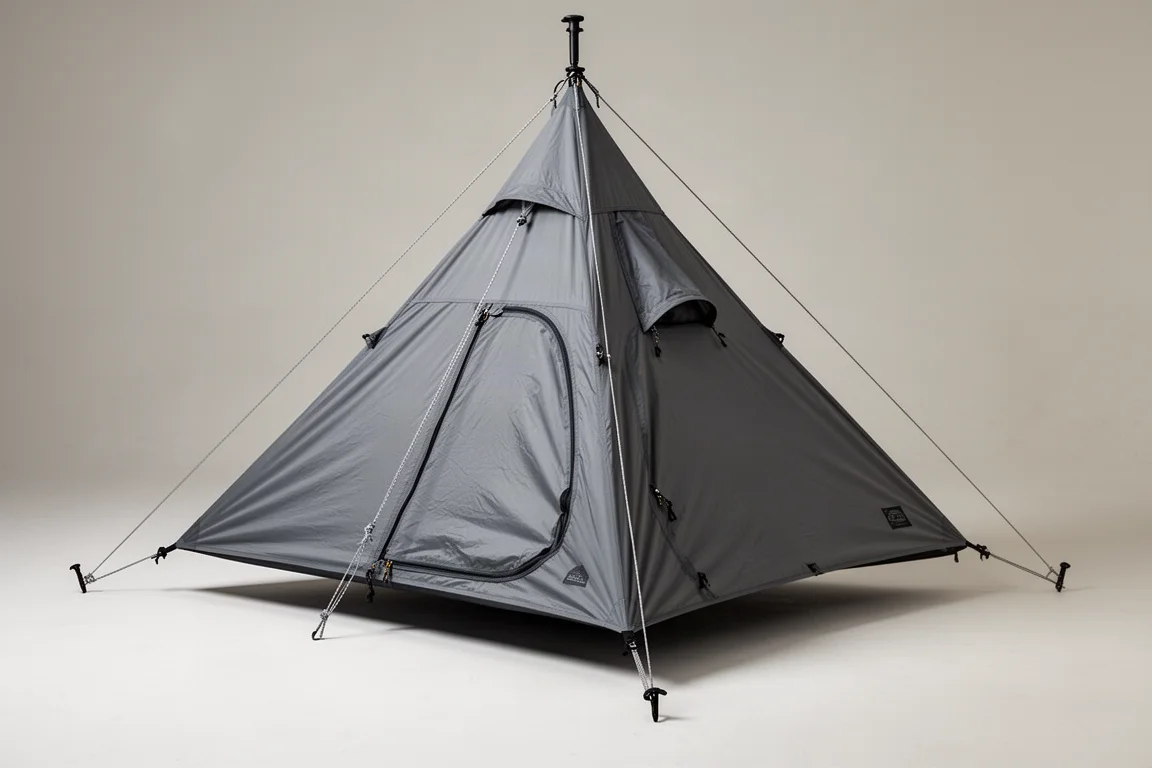
Two doors are a genuine advantage. They give a choice of entry depending on wind direction, and they open up cross ventilation when both are used. Each side also has a vent that can be left open in rain or closed with a velcro tab when conditions demand it.
Ten guy lines are supplied, made from the same paracord with reflective tape woven in so they can be seen at night, along with line lock clips for quick adjustment. Extra tabs and line locks around the outside of the shelter allow the walls to be pulled out further on uneven ground. A grey colourway blends in well with alpine terrain for discreet camping.
Fabric, Materials, and Build Quality
The tarp is made from a 20 denier ripstop nylon in a silicone double coating, using 1.1 oz polyester, with a silicone PU layer on each side. The fabric carries a 2,000 mm hydrostatic rating, so it is waterproof, but it is not breathable in the way a membrane is, which is the trade-off that comes with a single-wall design.
The two entrances use YKK zips with an AquaGuard treatment on the outside to stop water working through the closure. At the apex, a patch of HDPE gridstop reinforces the point where the trekking pole presses into the fabric, which is exactly where a shelter of this type tends to wear first.
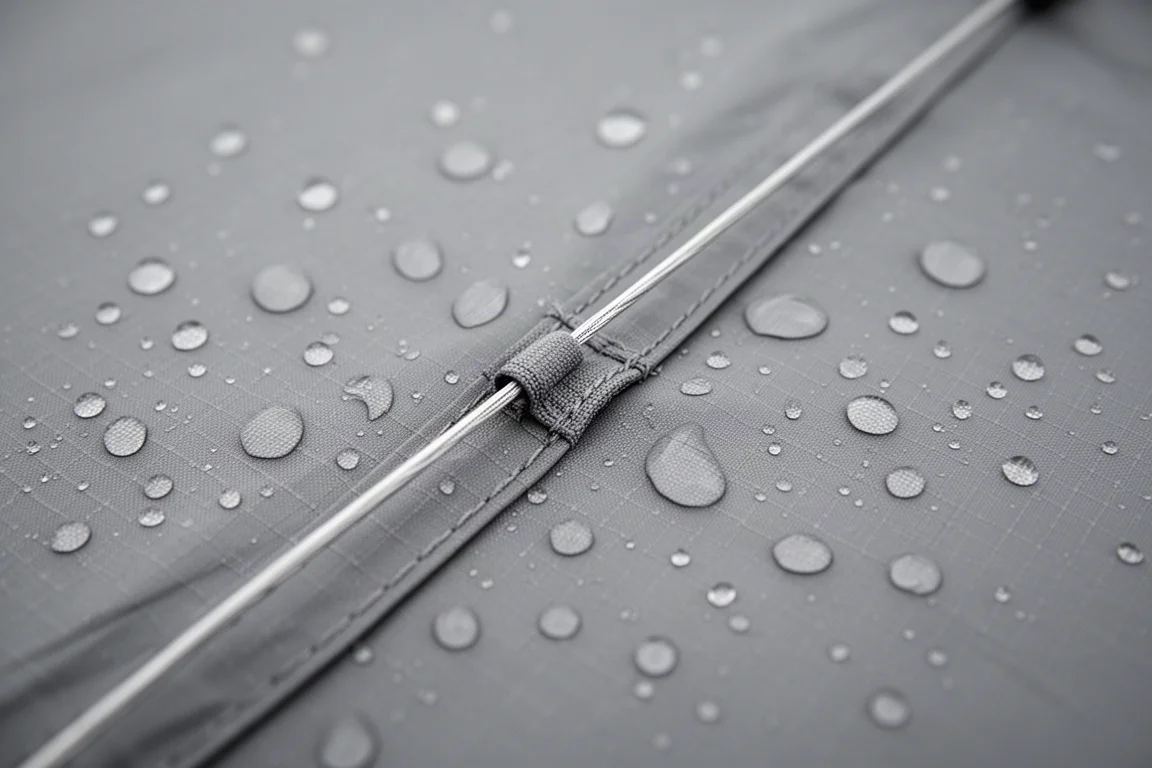
Build quality is good, and the design decisions are deliberate rather than accidental. Every gram saved comes from removing structure, not from removing the parts that matter.
Liteway PyraOmm Half Inner Mesh: Interior Comfort and Vestibule Space
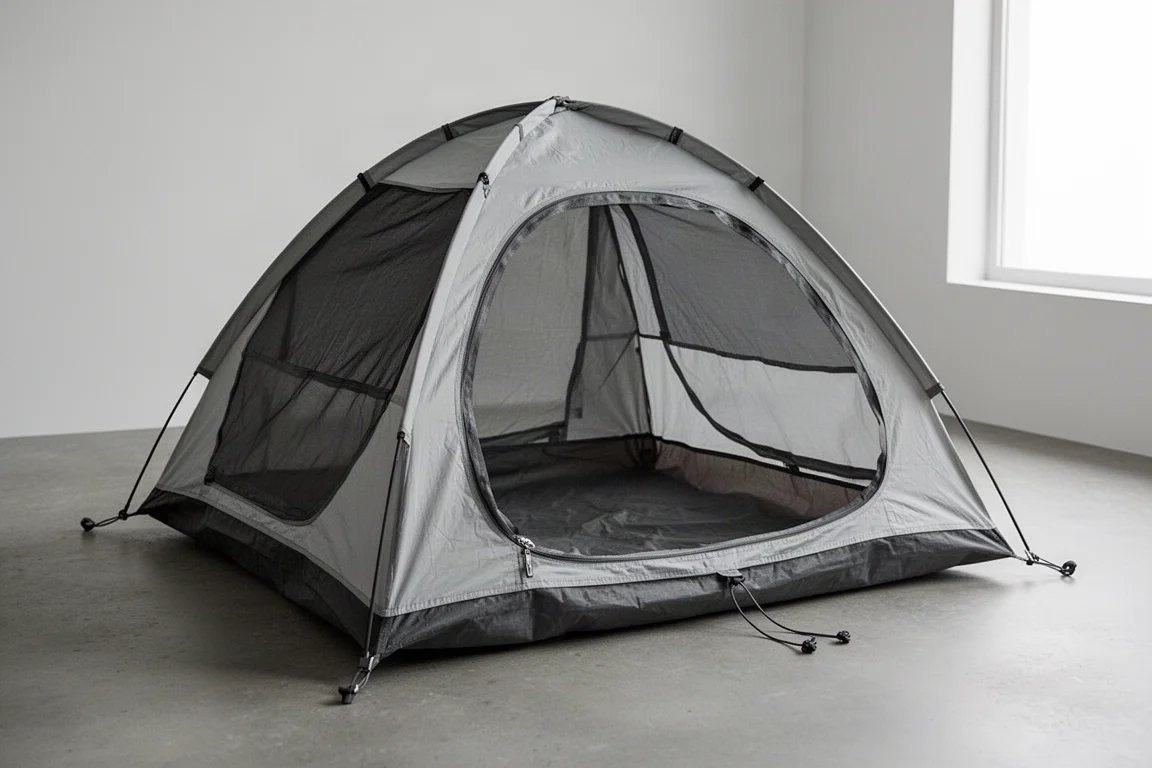
The half inner mesh attaches inside the tarp with clips on short bungee cords at all four corners and a further clip at the apex, so it hangs under the trekking pole rather than resting against it. Alignment is easy: the mesh has a single door, so it can be laid out to face whichever tarp door suits the pitch.
The half version covers a little more than half of the interior floor, which leaves the remainder as vestibule space. That split works well for solo trips, where cooking gear, wet clothing, and a pack can stay outside the sleeping area while still being sheltered. The bathtub floor rises roughly eight to ten centimetres at the edges, which helps keep a sleeping bag and loose items dry and organised. A small mesh pocket near the top is handy for keys, a phone, or other small items.
The mesh itself is very fine, and light weight was clearly the priority. It is reasonably strong, but it is worth being careful with zips, since a snag can pull a small hole in the panel. Buyers who want full interior coverage should look at the full mesh version, with the caveat that it uses up almost all of the vestibule space and leaves very little room outside the sleeping area.
Condensation, Rain, and Where This Shelter Works Best
Condensation is the honest limitation of any single-wall shelter, and the PyraOmm is no exception. For one person it is rarely a problem. With two people inside, the walls sit close enough that sleeping bags can brush against them, and that is when moisture becomes noticeable.
Single-wall shelters tend to perform at their best in cold, dry alpine environments where rain is occasional and the air is not heavy with humidity. In regions that see persistent rain, such as Scotland, Ireland, Tasmania, or the Pacific Northwest, a double-wall tent generally handles moisture and long wet spells with less fuss. That is not a criticism of the PyraOmm specifically, it is a characteristic of the category.
In real use the shelter has kept its occupants dry through wet weather and has held up well in wind. The silicone-coated fabric absorbs a small amount of moisture, but water mostly beads and runs off, and the shelter dries quickly once shaken out and left in the sun for ten minutes. A DCF version would avoid that slight absorbency and shed weight, though it would cost considerably more.
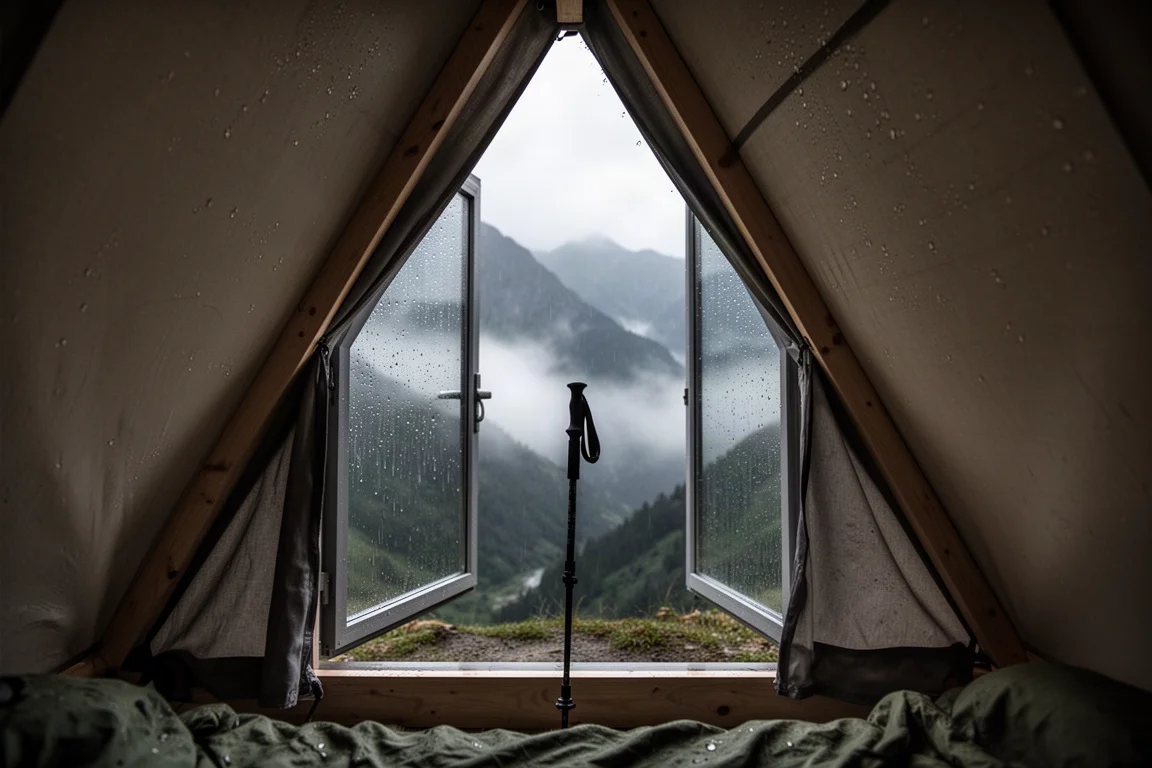
Across a 30-day thru-hike in the Pyrenees, the shelter proved reliable in coastal, alpine, and rainy conditions, and it also works as a roomy weekend shelter for two.
Trekking Pole Length, Stakes, and Setup Practicalities
Anyone coming from a freestanding tent should plan for a slightly different routine. A minimum of six stakes is needed, and more if you want to use the extra guy lines in exposed pitches. The trekking pole needs to be long enough to reach the apex comfortably; if it falls short, the shelter loses usable height and the walls sit closer to the ground.
Adjustment is an ongoing part of ownership rather than a one-time task. Closing a door can shift tension across the pitch, and a quick pass around the corner lines usually restores a taut, square shape. The toggle-and-paracord tensioners make this fast, and the line locks around the perimeter help when the ground is uneven and a wall needs to be pulled out further.
The optional top adapter is worth considering if the pole running through the centre of the interior is likely to bother you. It repositions the pole support toward the side, which frees up the middle of the floor.
Durability and Care: What 20D Fabric Demands
A 20 denier fabric is abrasion resistant to a degree, but it is not a material to treat casually. Throwing the shelter down on rock or gravel will shorten its life, and careful handling during setup and packing pays off over a season of use.
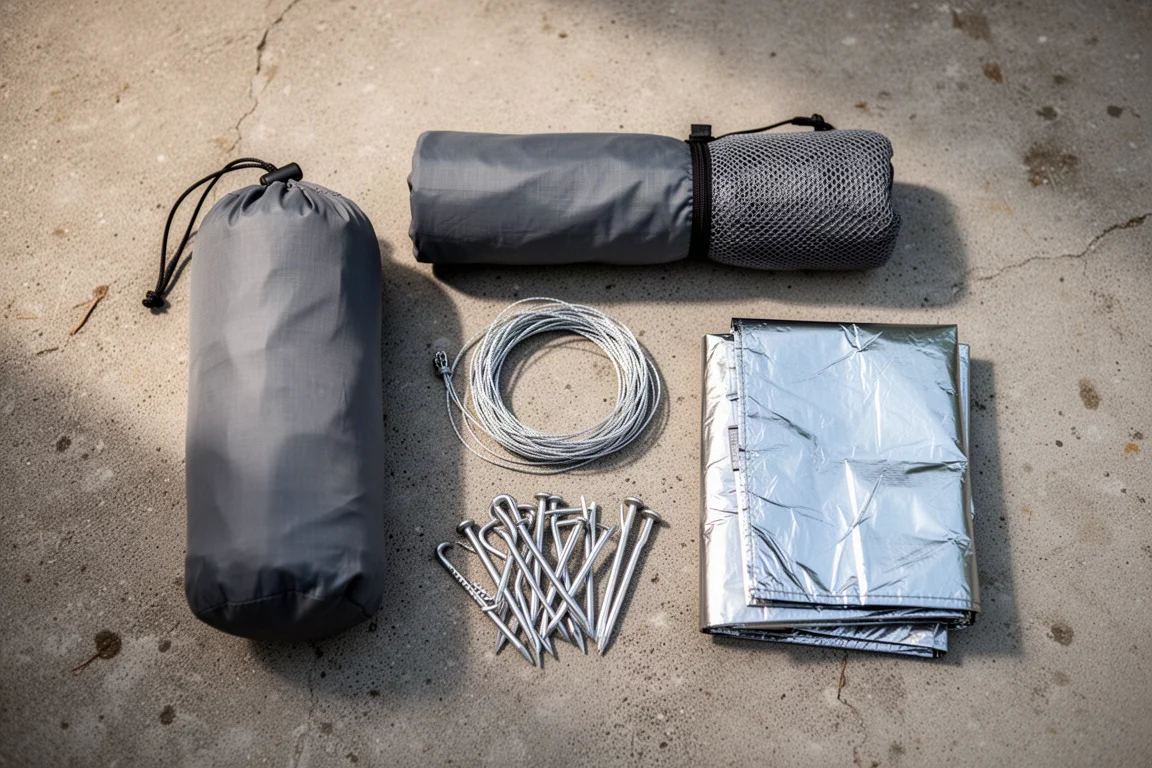
A lightweight groundsheet is a sensible addition. Tyvek is a good option because it is light, durable, and inexpensive, and it protects the thin floor of the inner mesh from punctures. A simple emergency blanket placed underneath also adds a layer of protection, and it may contribute a small amount of thermal insulation under the sleeping area.
The mesh floor is strong for its weight, but it is thin. Avoiding repairs is far easier than making them, so a little protection under the floor is money well spent.
Buying Advice: Is the PyraOmm Shelter Right for You?
The PyraOmm makes the most sense for hikers who count grams and are comfortable with trekking pole shelters. Thru-hikers, fast-and-light backpackers, and anyone covering long distances solo will appreciate a complete shelter and inner that stays under 750 g and packs down small.
It also works as a two-person weekend shelter thanks to the two doors, the generous ventilation, and the roughly four square metre footprint, provided both occupants are realistic about condensation in a single-wall design.
Buyers should decide on size first, then on the inner. The half mesh suits solo use and keeps vestibule space for gear. The full mesh offers more complete interior coverage but uses up almost all of that outside space. If moisture absorption and weight are both high priorities and the budget allows, the DCF version is the one to watch.
Price and shipping are worth checking carefully depending on where you live. For buyers in Europe, the shelter is competitively priced against comparable ultralight options that have to be imported from the United States, where shipping costs can quickly outweigh the gear itself. Buyers in the United States should compare landed cost before deciding.
If the shelter is going to be your primary home for months at a time, the combination of low weight, quick pitching, and proven weather performance is a strong argument. If most of your camping happens in persistent heavy rain, a double-wall tent remains the more comfortable choice.
Conclusion
The Liteway PyraOmm tarp and half inner mesh deliver a genuinely light four-season shelter without asking the buyer to accept fragile construction. The trekking pole through the middle of the interior is the one real annoyance, and condensation is the one real limitation of the single-wall format.
For hikers who want a small, light package that pitches fast, handles alpine weather, and leaves room for gear, the PyraOmm is easy to recommend. Match the size and the inner to your trips, add a groundsheet, and it should serve as a dependable shelter for years of long-distance walking.
Further reading
Related Reviews
Camping Shelters
Alps Mountaineering Stealth 1 Bivy Review: A Waterproof Claim That Does Not Hold Up
The Alps Mountaineering Stealth 1 Bivy carries a 2,000 mm hydrostatic head rating and a waterproof claim, but sustained rain exposure and build quality concerns make it difficult to recommend.
Camping Shelters
AquaQuest Safari Hybrid 20 ft x 13 ft Tarp Review: Two Years Under a Very Large Roof
A long-term look at the AquaQuest Safari Hybrid 20 x 13 tarp, covering build quality, weather protection, setup realities, and who should buy one.
Camping Shelters
Backcountry Light Mesa 3 Hot Tent and Floor SL Tarp Review
A practical look at the Backcountry Light Mesa 3 four-season hot tent and its optional Floor SL Tarp, covering materials, stove jack design, packed weight, pricing, and the trade-offs to weigh before buying.