Speakers
KLH Model 3 Review: A Smaller Stand-Mount With Model 5 DNA
The KLH Model 3 brings the Model 5's midrange clarity and expansive imaging into a sealed two-way stand-mount, with bass that benefits from a subwoofer in larger rooms.
Introduction
KLH took one of the most talked-about speakers of recent years, the Model 5, and scaled it down into something smaller and more affordable. The result is the Model 3, a two-way stand-mounted loudspeaker that borrows heavily from its bigger sibling.
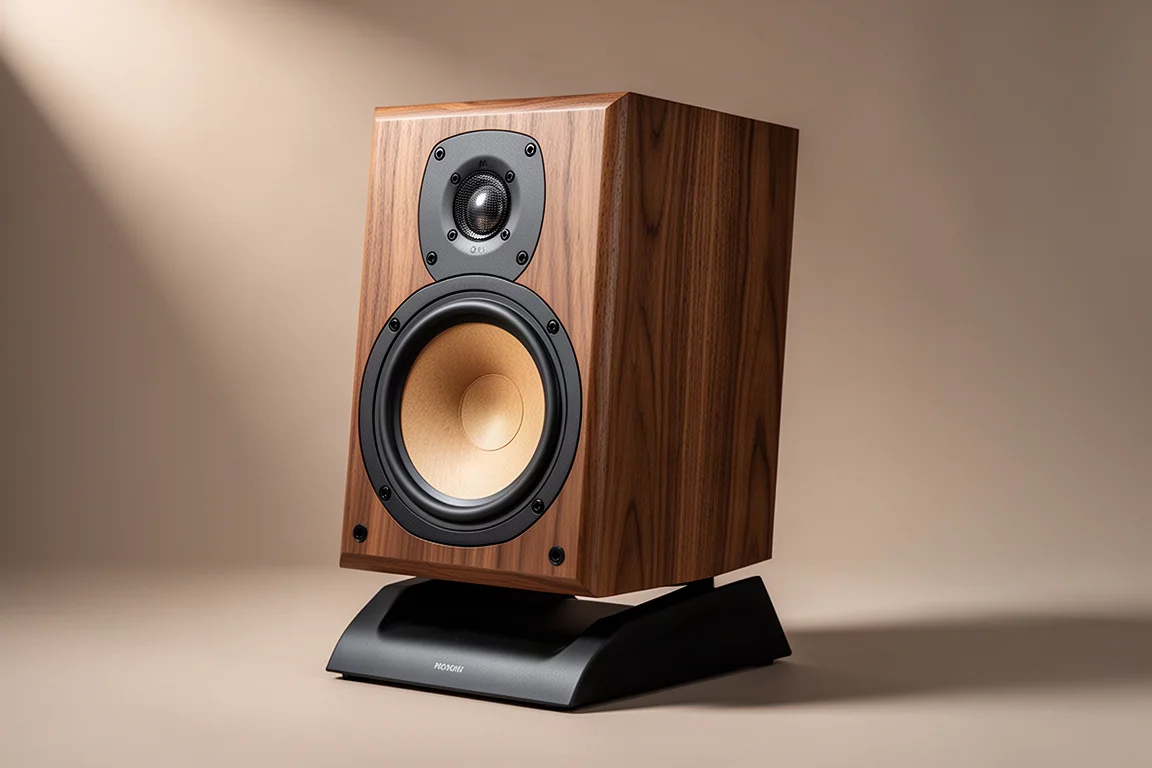
Like the Model 5, the Model 3 is an acoustic suspension design, which means a sealed cabinet rather than a ported one. It pairs an 8-inch paper-based woofer with a 1-inch aluminum dome tweeter. KLH reports a frequency response of 46 Hz to 20 kHz, with low-frequency extension reaching as low as 35 Hz at a -10 dB caveat. In-room sensitivity is rated at 88 dB with a nominal impedance of 6 ohms, dipping as low as 3.7 ohms.
That impedance curve is worth noting. The Model 3 is not an outright difficult speaker to drive, but it responds very favorably to power.
Who the KLH Model 3 Is For
KLH positions the Model 3 as a solution for music enthusiasts with smaller listening spaces, which makes sense on paper. In physical terms, though, the story is more nuanced. Placed side by side, the Model 3 takes up nearly as much floor space as the Model 5, really only saving you in the height department. Anyone hoping to downsize their footprint while keeping the Model 5 sound should keep that in mind.
What the Model 3 genuinely suits is a listener who values midrange and treble clarity above all else, listens at moderate levels, and either has a modest room or is willing to add a subwoofer later.
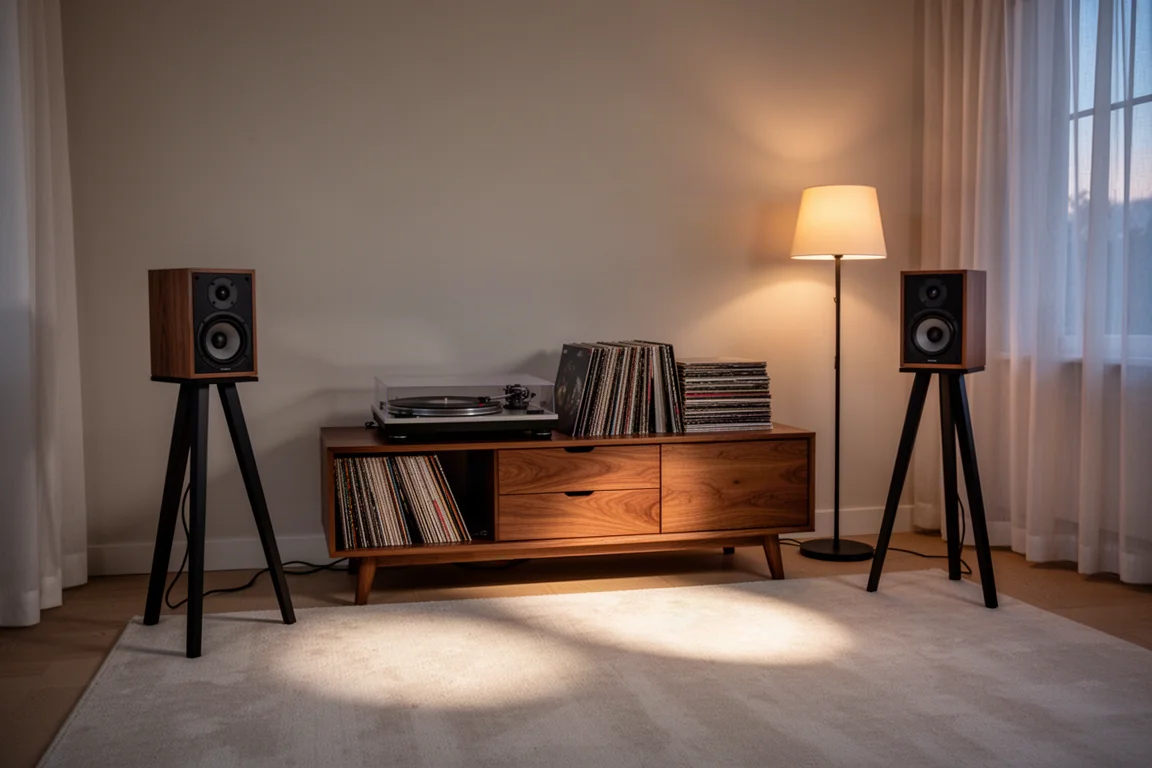
Because the speakers are sold individually, buying a single unit for center channel duty or building a multichannel system piece by piece is straightforward.
Design, Finishes, and the Stands
The cabinet is built from MDF and comes in the same finish options as the Model 5: African mahogany and English walnut. The magnetic grille ships in stonewashed linen, and old world linen or black can be purchased separately if you want a different look.
Both the Model 3 and the Model 5 include matte black slanted stands that raise the speaker eight inches off the ground. The stands are not identical between the two models. The risers for the Model 3 are narrower and carry more of an upward tilt than the Model 5’s. That slight lean is not an accident. It is integral to how the speaker sounds.
The Model 3 is also deceptively large, bigger than most two-way monitors. It is designed to sit on its own stand, and it looks out of place on third-party stands, even substantial ones. Build quality and finish match the Model 5 standard, so the main question is proportion rather than construction. On its stand the Model 3 has a squat, bulldog-like stance that will appeal to some listeners more than others.
Midrange and Treble Clarity
The midrange is the headline here. Clarity is the name of the game, and the Model 3 resolves the finest details locked inside a recording with ease while staying effortless rather than showy. There is no trace of cabinet coloration altering the timbre of instruments or performers, so both sound as they should with no editorializing from the speaker.
Intelligibility is very high, for vocals and for dialogue alike. The speaker is enjoyable across the widest range of music genres, yet it is not so benign as to sound vague or romanticized.
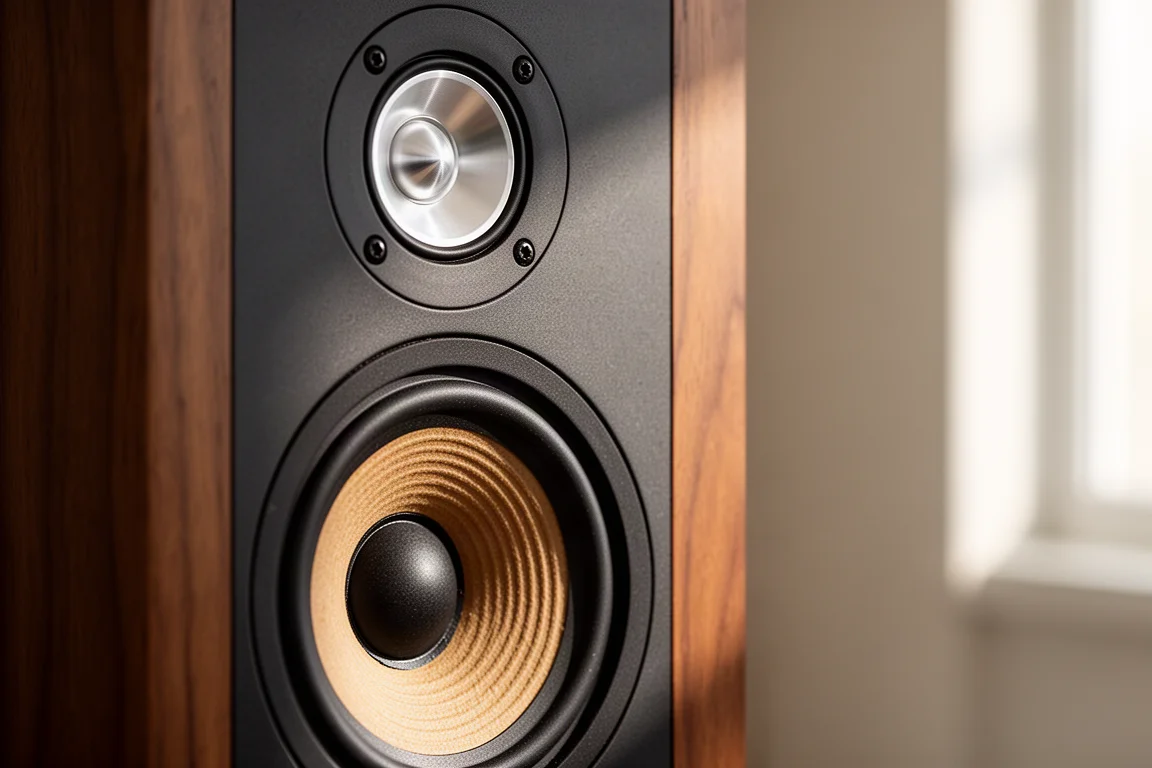
The treble carries a little more character. Because the bass is lighter than the Model 5’s, the Model 3 can come across as slightly more treble-forward. In its neutral setting, labeled high, there is some top-end energy present, and that is part of what earns the speaker its detailed character. Below roughly 90 dB the aluminum dome tweeter rarely becomes an issue, but at very high volumes some listeners may find it encroaching on bright territory.
That is where the control on the back of the cabinet helps. A single pair of high-quality binding posts sits alongside a three-position acoustic balance control that attenuates everything above 400 Hz rather than boosting anything. Despite the low, mid, and high labeling, high is the neutral setting, mid lowers the treble by 1.5 dB, and low cuts it by 3 dB. Listeners with bright or reflective rooms will find those adjustments useful. Those who play a lot of rock, or whose music collection is not uniformly high quality, may prefer the mid or low setting regardless of the room. The Model 3 is not a speaker that gives every recording a helping hand in the treble.
Bass Performance and Room Size
The low end is where the Model 3 diverges most clearly from the Model 5. The Model 5 is a true three-way design and stays linear from bass through to treble. In a neutral room, the Model 3 can seem to try a little harder to impress, coming across as mildly boosted around the 40 Hz region to deliver a fuller, more full-range presentation than its cabinet suggests.
The character of that bass is genuinely impressive. The speaker plays low with a solid amount of detail and control. The problem appears with scale and volume. In a larger room, as the level rises, the bass scales appropriately until it does not, falling apart into something more bloated and overbearing than agile and accurate. On bass-heavy material at volumes approaching 85 dB or higher, the low-end grunt is there but the outright resolution is not.
If your room is larger than roughly 13 by 17 feet, or you listen loudly to bass-heavy music, plan on a subwoofer. Pairing the Model 3 with a compact subwoofer crossed over at around 60 Hz blends seamlessly, takes load off the amplifier, and opens up the speaker’s dynamics dramatically. The trade-off is budget: adding a capable subwoofer pushes the total spend above the cost of a pair of Model 5s.
Soundstage, Dynamics, and Power Requirements
The Model 3 is among the easiest speakers to place in a room in a long while. It is simply not picky about toe-in, and it images like a champion, with epic center imaging and dispersion that is off the charts. Its overall soundstage is a touch more forward than some alternatives and seems to prefer width to depth. Coming from a more laid-back speaker, the Model 3 will sound more forward, though it never projects or sounds shouty. Attenuating the tweeter has a mild effect on soundstage presence, but the fundamental character remains.
Dynamically, the Model 3 is equally impressive, with arguably better dynamic snap than the Model 5, even if it is not quite as full-range or as weighty down low. It responds well to power, and while it is possible to drive it on a very low-wattage amplifier, that is not a pairing worth recommending. The speaker is far more confident with a capable integrated amplifier, and it thrives with more current on tap.
If you enjoy big dynamic swings, listen to large orchestral works, or plan to use the Model 3 in a home theater rig, do not skimp on amplification. Plan for at least 50 watts per channel, and 75 watts or more if your budget allows.
Home Theater and Center Channel Use
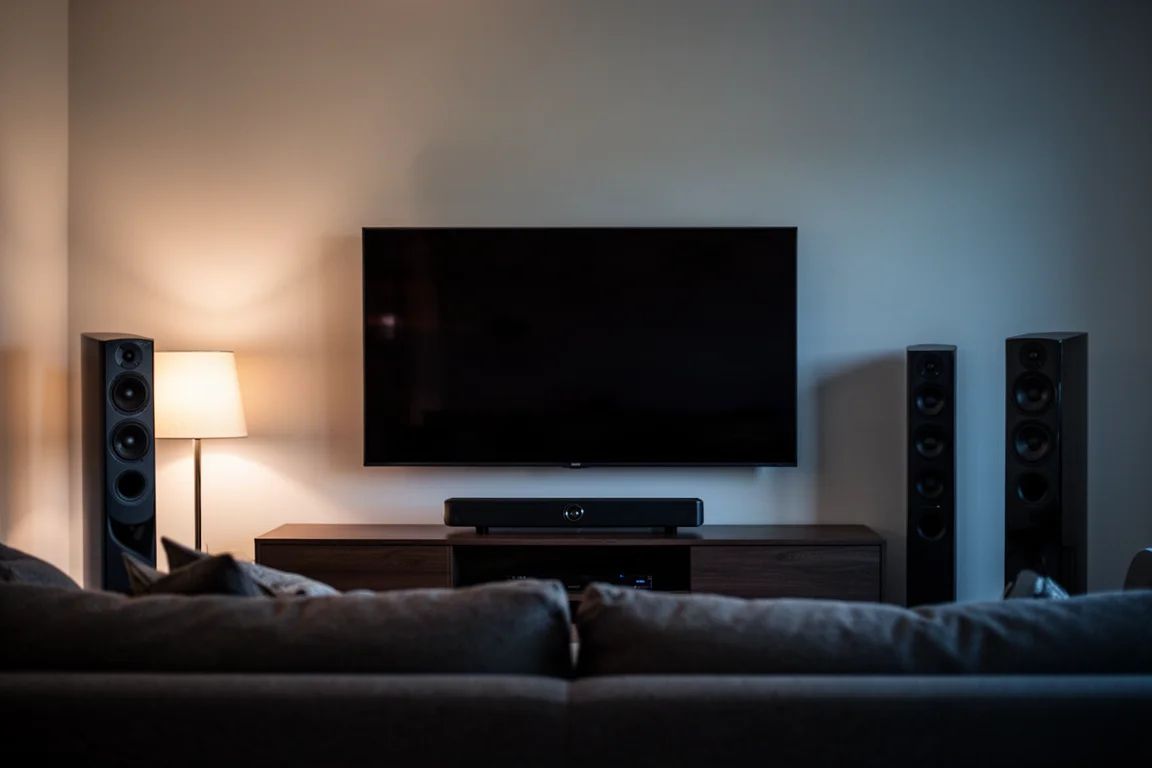
Because the speakers are sold individually, the Model 3 can be drafted into multichannel duty without buying a pair you do not need. Used as a center channel alongside a pair of Model 5s as left and right mains, it excels. Horizontal placement is not ideal and not what KLH intended, but it still works, with intelligibility and detail sitting high on the Model 3’s list of attributes.
Dialogue in films is very discernible and carries terrific presence when the speaker is driven by a capable AV receiver, even at liberal volumes. The front stage across the Model 5 and Model 3 blends seamlessly. For anyone building a home theater setup with a vintage-inspired look, this combination is easy to recommend.
How the Model 3 Compares
Against other compact reinterpretations of classic designs, the Model 3 holds its own. The JBL L82 follows a broadly similar recipe, a two-way design with a paper driver and an aluminum tweeter, and it costs considerably more, by the numbers here roughly an extra thousand dollars. The L82 has the more striking stand-mounted look and its foam grille is a genuine statement piece, but on sound the Model 3 is every bit its equal, which makes the price gap hard to justify.
The Wharfedale Linton is more directly comparable to the Model 5 while costing about what the Model 3 does, and the Wharfedale Denton sits below the Model 3 in the hierarchy, a legitimate alternative rather than an equal. The Model 3 deserves to be mentioned alongside higher-end stand-mounts rather than only against budget options.
Things to Consider Before Buying
- The Model 3 is not a true space-saving design. Next to the Model 5 it occupies nearly the same floor area and saves mainly in height.
- Its proportions divide opinion. The cabinet looks squat on its stand, and the supplied risers look narrower and more tilted than the Model 5’s.
- Bass needs help in larger rooms or at loud volumes, which means budgeting for a subwoofer.
- The speaker is not forgiving of poor recordings in the treble, so uneven libraries may benefit from the mid or low attenuation setting.
- It is more power-hungry than the Model 5, so amplifier headroom matters.
Buying Advice
The Model 3 is only about $700 less than a pair of Model 5s at current pricing. In medium to large rooms it realistically needs a subwoofer to hold up above roughly 80 dB, and once a subwoofer is added, the total can exceed the cost of a pair of Model 5s, which do not automatically feel like they need one. The Model 3 also asks more of an amplifier than its bigger sibling. That is the honest math, and it explains why the Model 5 remains the stronger value in KLH’s throwback lineup.
None of that diminishes what the Model 3 is. If your room is modest, your listening levels are moderate, or you simply prefer a slightly more forward speaker with lighter bass and a lighter footprint in your budget, the Model 3 is an easy recommendation. It fills a real gap in the lineup and delivers the qualities that make the Model 5 special in a smaller, less expensive package. Listeners who favor pop and electronic music in particular may find they prefer it outright.
Conclusion
The KLH Model 3 is another win for KLH. Its midrange clarity, imaging, and placement flexibility are remarkable, and its acoustic balance control gives it a practical advantage in rooms that are less than ideal. Its limitations are specific rather than general: bass composure at high volume, a footprint that is not as small as it appears, and a need for more amplifier power.
Buy it if your room and listening habits align with its strengths. Step up to the Model 5, or budget for a subwoofer, if you listen loud, listen big, or want the low end to stay composed when the volume climbs.
Product link
View more details for KLH Model 3
This product is mentioned in the review. Check the specifications, options, and compatibility before buying.
View more details for KLH Model 3Further reading
Related Reviews
Speakers
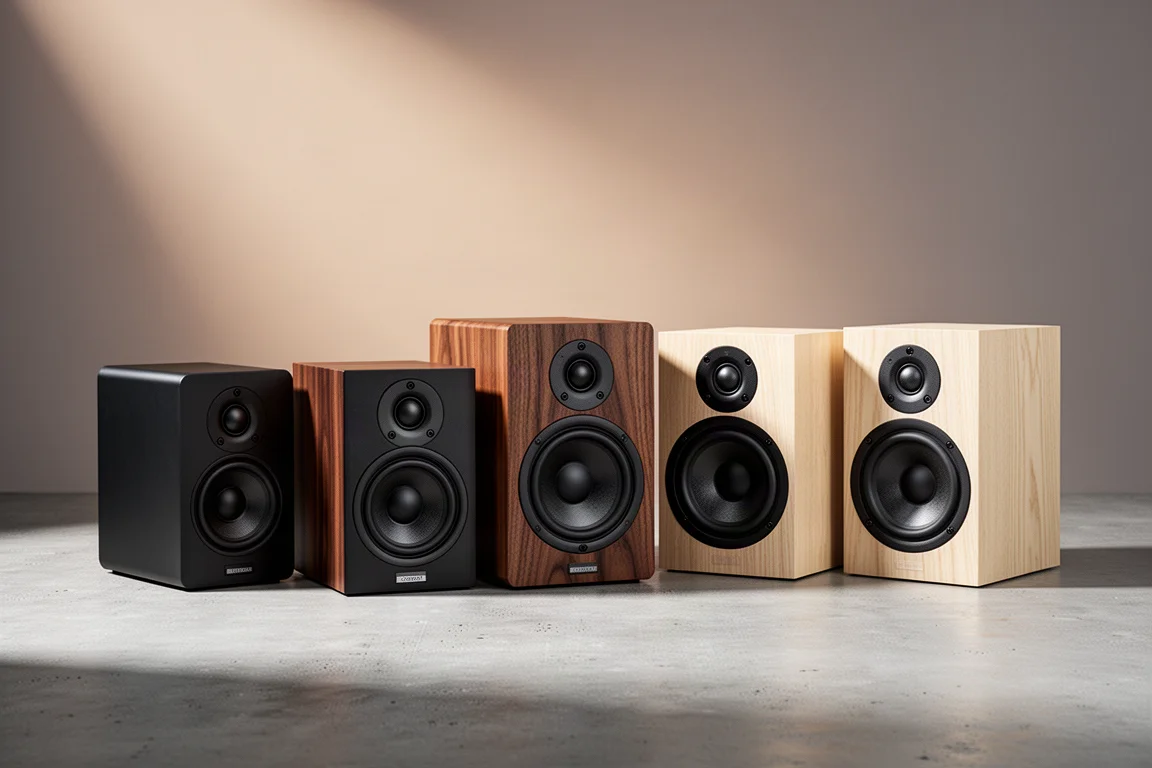
13 Under-the-Radar Speakers Still Worth Buying
Thirteen speakers that quietly stayed in production while newer models took the spotlight, from budget bookshelf pairs to a full-size tower.
Speakers
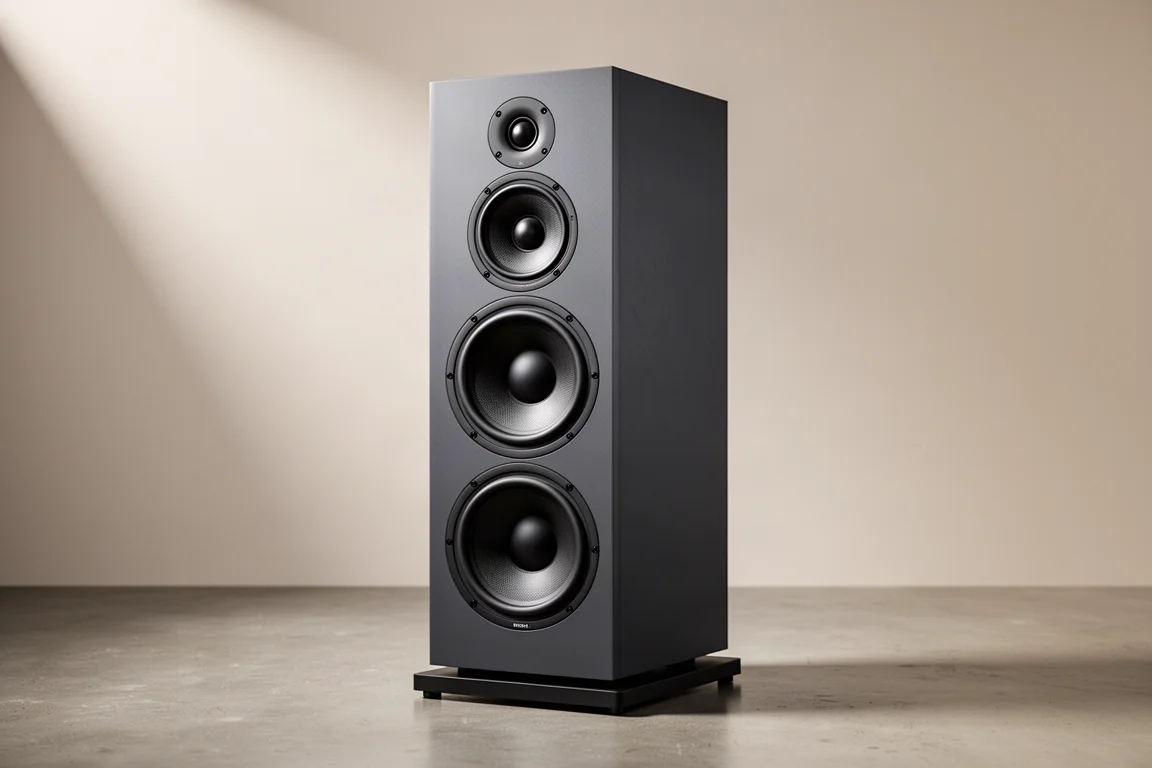
Arendal 1528 Monitor 8 Review: A Three-Way Standmount With Serious Dynamic Headroom
A three-way standmount speaker with extremely low distortion, high output capability, and deep bass for its size, plus the setup details worth knowing before buying.
Speakers
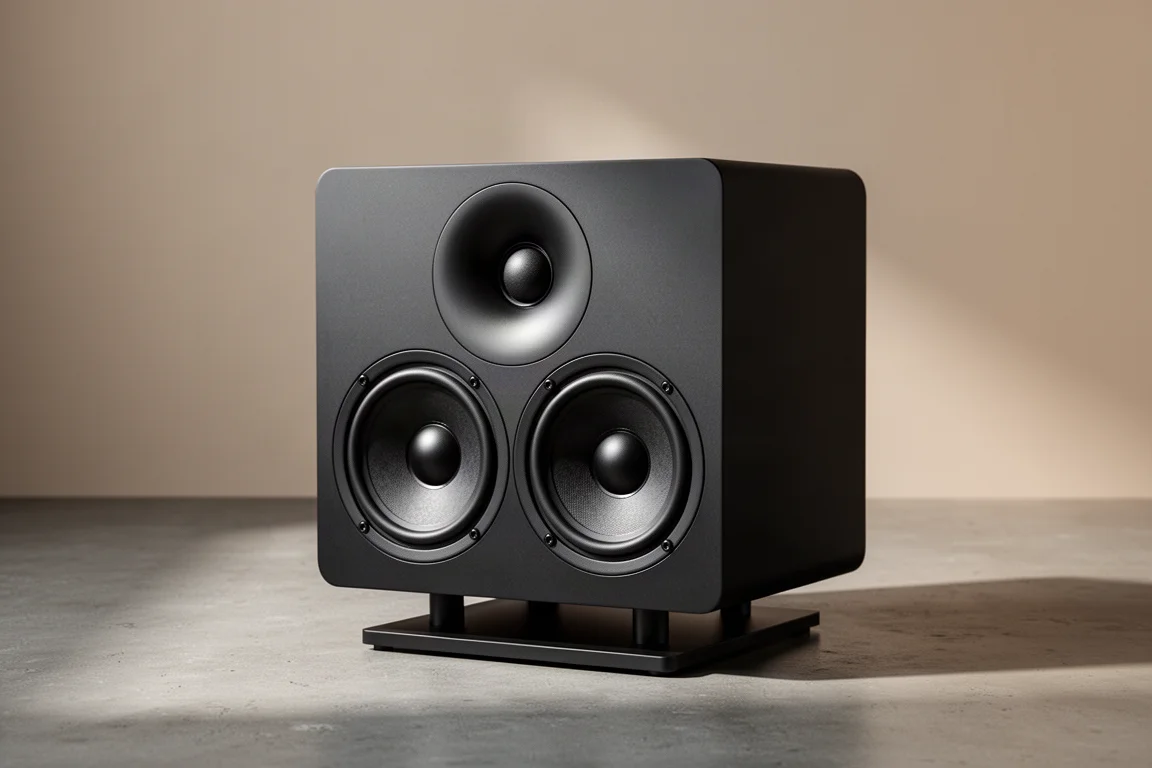
Arendal 1723 Monitor S Review: A Compact Monitor With Serious Ambition
A close look at the Arendal 1723 Monitor S, a compact MTM monitor with a waveguide-loaded tweeter, an HDF cabinet, and flexible ported or sealed operation for music and home theater.