Aquarium Lighting
Kessil A500X Review: A 185-Watt LED Built for Deep, High-Contrast Reef Tanks
A 185-watt reef LED with a wide 130-degree lens, optional narrow lenses, and a spectrum that tracks the hobby's reference blue. Here is who it suits and what to weigh before buying.
Introduction
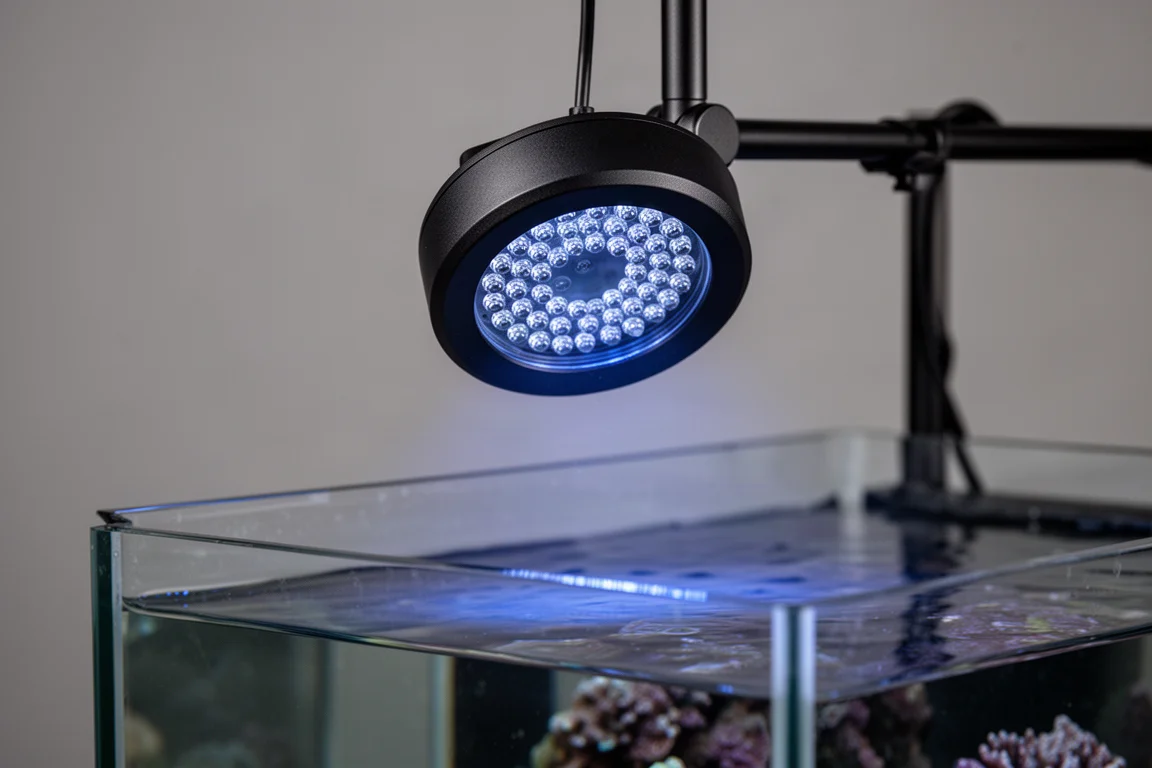
The Kessil A500X is a 185-watt reef LED, roughly double the output of the A360 in the same family. At $739 it is not trying to be everything to every tank. Its strengths cluster around three jobs: deep aquariums, fixtures that need to sit well above the water, and mixed reefs where strong contrast between lit and shadowed areas is part of the look you are after.
Judged on usable output rather than raw channel count, the fixture works out to roughly $2.82 per usable PAR in a two-foot cube, based on a 36-point average of 262 PAR at six inches of depth. That figure only means something in context, so this review covers the context: coverage, spectrum, mounting height, shadow behaviour, and the extras that change the total cost of ownership.
Who the Kessil A500X Is For
Three groups of reefers get the most from this light. Owners of deep tanks benefit from the extra wattage and the narrow lens options, which push usable light further down the water column. Anyone who has to mount a fixture high above the tank benefits from the narrowest lens, which holds coverage at a 22-inch mounting height. And mixed reef keepers who want a high-contrast look get a fixture that can hold a 300 PAR zone and a 75 PAR zone in the same tank at the same time.
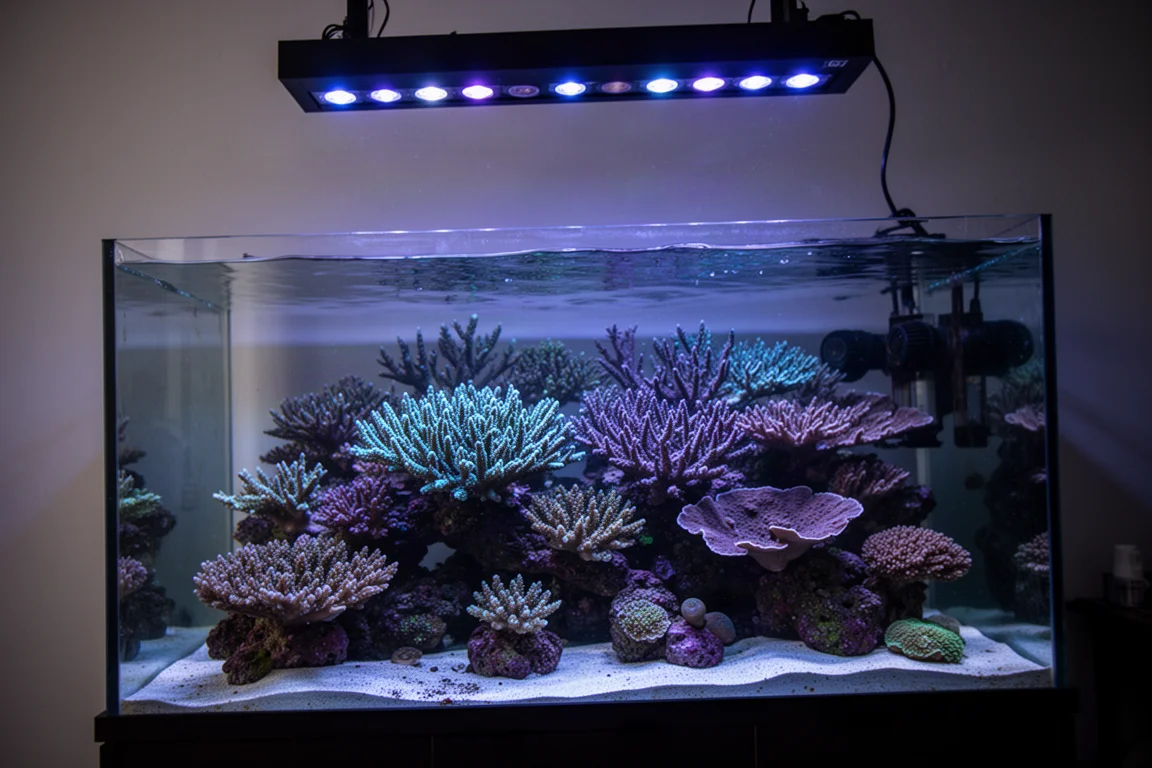
There are also two situations where a different light makes more sense. In an LPS-only tank, running the A500X at 30 percent intensity to land in the 75 to 150 PAR range spends money on headroom you will never use, and the considerably less expensive A360 sits naturally in that range. And in a wall-to-wall SPS tank where large colonies fill the rockwork, the A500X will need fill light from T5 strips or LED bars to flatten the coverage and remove shadowing.
Main Strengths
Mounting Flexibility and Lens Options
The fixture ships with a 130-degree lens, a wide dome that spreads light very evenly. Optimal mounting height with that lens measures nine inches above the water, where the drop from the centre six-inch square out to the full 24-inch span is only about 36 percent. Very few 185-watt fixtures can sit that low without losing evenness, and it matters because most reefers do not want a large light hanging far above the tank.
The 55-degree lens is a separate add-on and moves the optimal mounting height to roughly 12 inches, which helps when a hood or canopy limits how high you can go. It focuses the beam and improves penetration into the tank, at the cost of evenness: falloff from the centre to the outer edges rises to about 67 percent.
The 35-degree lens is the narrowest option and is suggested for tanks up to four feet deep. It allows the fixture to be mounted as high as 22 inches above the water while still landing around 52 percent falloff, which is roughly what an average-performing fixture manages at a normal height. It also delivers the most punch for light that has to reach the bottom of a deep tank. Being able to swap the optics is unusual, and it turns mounting height into a deliberate choice rather than a compromise.
Output and Coral Coverage
Coverage was measured in a two-foot cube with 108 sample points, 36 each at six, 12 and 18 inches of depth, using a spectrum you would actually run. At full intensity, 74 of those 108 points landed inside the 200 to 350 PAR range that suits SPS corals, which is 69 percent against a 70 percent target. That puts the A500X right at the edge of SPS capability, which is exactly where a mixed-reef fixture wants to sit.
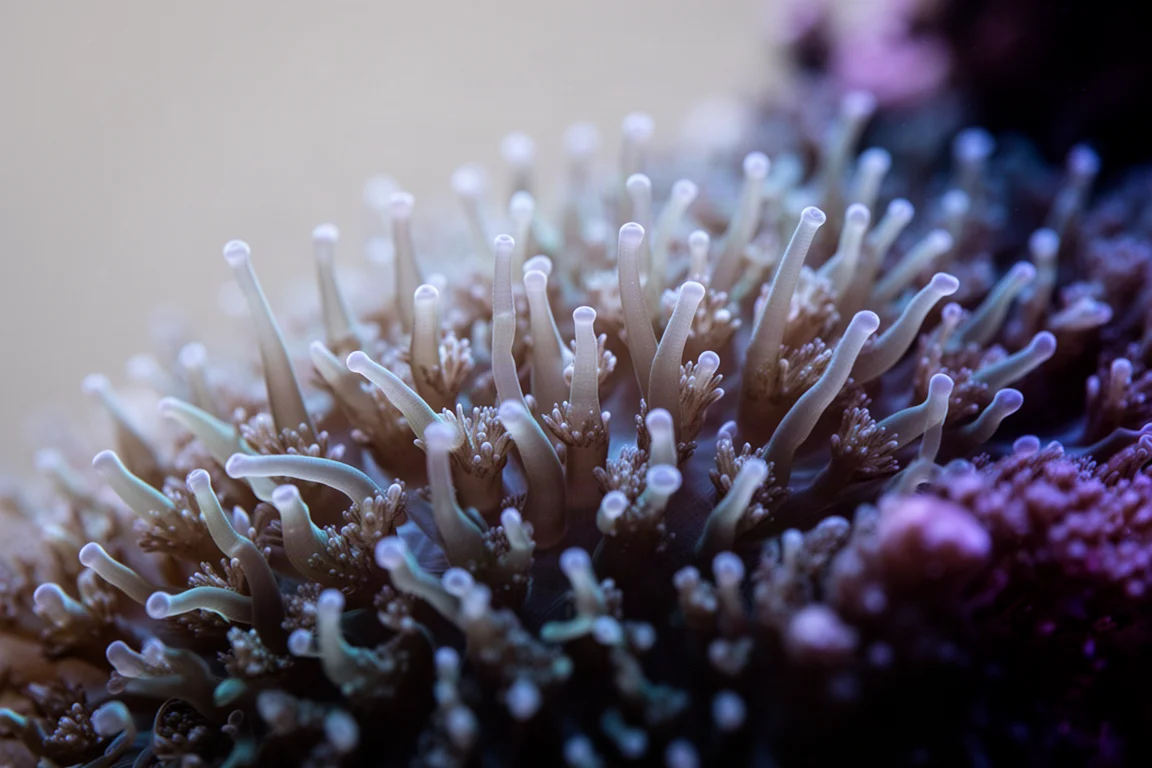
Turned down to 30 percent intensity, 91 of the 108 points fell inside the 75 to 150 PAR range for LPS corals, or 85 percent against the same 70 percent target. The light has the range to cover both ends of a mixed reef, and the question for most buyers is simply whether they want to pay for the upper end of that range.
Spectrum and Color Blending
The custom blend used for testing runs at 30 percent colour, full intensity, 75 percent violet and 40 percent red. The blue peak is wider than on most LED fixtures and tracks the ATI Blue Plus reference closely, without the teal cast that bulb is known for adding to a tank. Around 380 nanometres, in the violet and near-UV region, it delivers slightly more than the reference.
The red channel sits near 440 nanometres, between orange and red rather than in the deeper 660 region many LEDs use. That is the band that makes orange and red fish and coral tissue read as vivid rather than muted.
Blending is handled optically. All of the emitters sit beneath a single lens roughly the size of a quarter, so colours mix before they leave the fixture instead of overlapping in separate cones across the tank. A spectrometer reading taken under water ripples shows only tiny shifts between samples, which is about as clean as LED blending gets. Just as important, the spectrum is easy to get right: the fixture is tuned so that colour changes stay within a range corals can use, which means there is very little room to set it up badly.
Shadows, Contrast, and Shimmer
A single point source produces hard light: sharp-edged shadows with real depth, and shimmer lines that ripple and shift with surface movement. In side-by-side comparisons the effect reads closer to a metal halide than to a broad bank of fluorescent tubes, which wrap rockwork in flat, nearly shadowless light.
That behaviour cuts both ways. Shadows protect low-light corals in a mixed tank, and they are the reason one fixture can hold a 300 PAR colony and a 75 PAR colony at the same time. They also mean less light reaches coral sitting behind or beneath other coral, so placement matters more than it does under diffuse light.
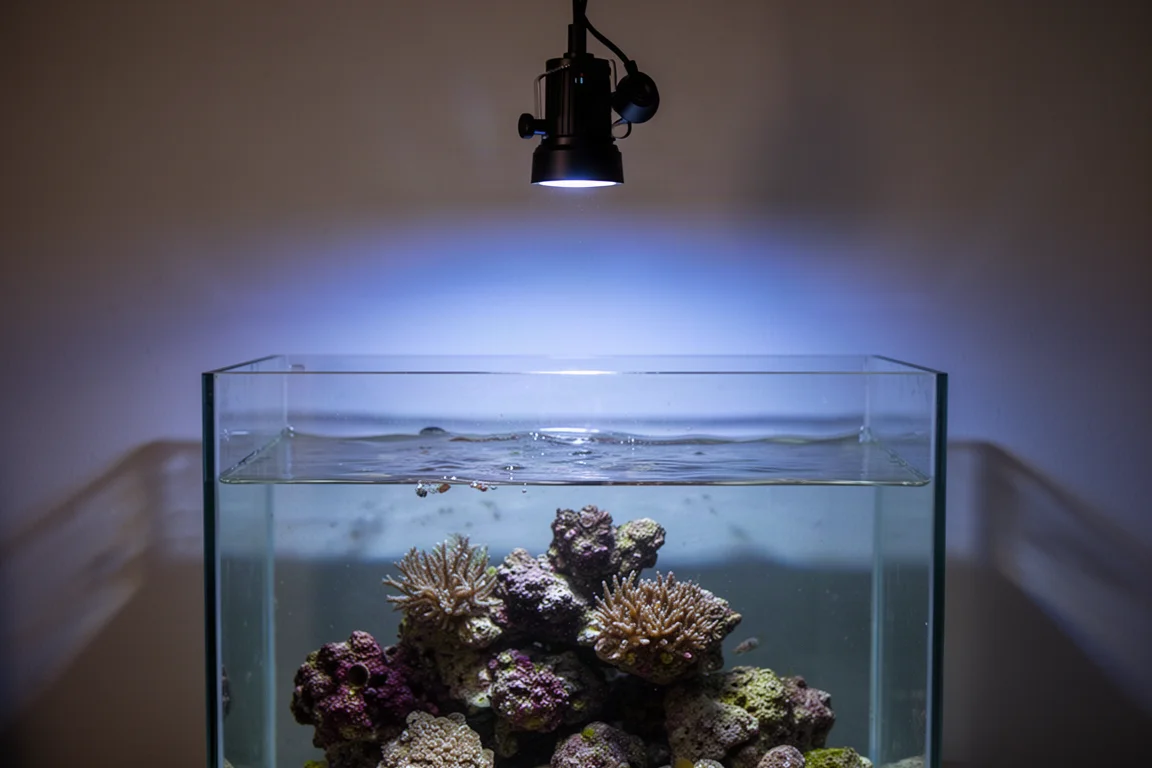
For a wall-to-wall SPS tank with large colonies, that shadowing becomes a limitation rather than a feature, and adding fill light from T5 strips or LED bars along the sides is the straightforward fix. With fill light, the fixture keeps its punch while the coverage flattens out. On the practical side, the single-fixture look is clean and the tank stays easy to reach, which counts for a lot over years of maintenance.
Things to Consider Before Buying
In a two-foot cube at six inches of depth, usable output averages 262 PAR across 36 points, which works out to about $2.82 per usable PAR at $739. A wider group of fixtures measured around $2.10 per PAR, but those numbers came from running every channel at full output, a spectrum most reefers would never use, so the comparison flatters the cheaper lights. Treat $2.82 as a reference point for value rather than a verdict.
The 130-degree lens is included. The 55-degree and 35-degree lenses, the Wi-Fi dongle for app control, the wired controller, and the extension kit for stands are all separate purchases, and each one changes the total. Mounting hardware matters too: the A-series arm is the recommended option, while the gooseneck is harder to align consistently across multiple fixtures and does not allow the cable to be routed through it.
Narrower lenses buy mounting height and penetration but cost evenness, so the widest option is usually the better choice unless you have a specific reason to raise the fixture or reach deeper. Finally, if you keep an LPS-dominated tank with no plans to change it, this is more light than the job requires.
Buying Advice
The A500X makes sense when you can name the reason you need it. A tank deeper than the usual 24 inches, a fixture that has to sit well above the water, or a mixed reef where contrast is the point all justify the price. Choose the lens by the mounting height you can actually achieve: the included 130-degree lens at about nine inches, the 55-degree lens at about 12 inches, and the 35-degree lens when the fixture needs to sit as high as 22 inches.
If you are setting up an LPS-dominated tank and have no plans to change it, the A360 covers that range for less. If you are on a path toward SPS or a mixed reef within the next year or so, the headroom here is worth paying for once rather than twice.
Conclusion
The Kessil A500X is a specialised tool. It produces enough usable light to support SPS corals across most of a two-foot cube, it holds its coverage at unusually low mounting heights, and its lens options let you trade evenness for reach. Its wide blue band and optical blending put its spectrum in the same conversation as the hobby’s long-standing reference bulb. Its shadows and high contrast are the reason to buy it in a mixed reef and the reason to add fill light in a wall-to-wall SPS tank. Buy it for a deep tank, a high mount, or a mixed reef, and it does precisely what it was built to do.
Product link
View more details for Kessil A500X
This product is mentioned in the review. Check the specifications, options, and compatibility before buying.
View more details for Kessil A500XFurther reading
Related Reviews
Aquarium Lighting
AI Blade LED Lights Review: A Versatile Strip Light for Reef Tanks
A practical look at the AI Blade LED line, including the value-focused Grow spectrum, mounting options, app control and PAR performance.
Aquarium Lighting
AI Hydra 32 and Hydra 64 Setup Guide: Mounting Heights, Spacing, and Add-On Lighting
A practical reef lighting guide covering optimal mounting heights for the AI Hydra 32 and Hydra 64, spacing for even coverage, and when add-on lighting is worth it.
Aquarium Lighting
AI Prime Review: A Compact Reef Light That Grows With Your Tank
A small, modular reef aquarium LED that reaches LPS and soft coral PAR levels over a 60-gallon cube, plus the spacing, mounting height, and control habits that make it work.