Floorstanding Speakers
JBL Studio 698 Review: A Three-Way Tower With Real Value
A close look at the JBL Studio 698 floorstanding tower: wide radiation, low distortion, a mid-bass lift worth managing, and how it stacks up against the HDI 3800.
Introduction
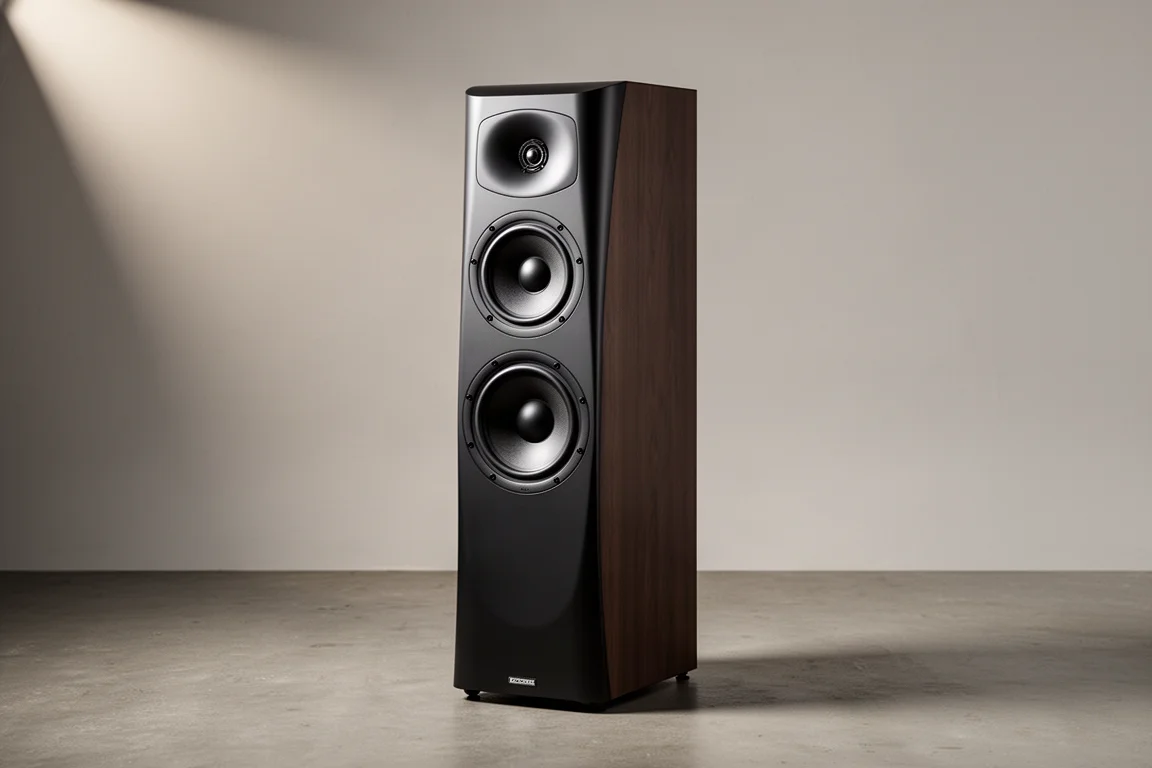
The JBL Studio 698 is a three-way floorstanding tower that carries much of the visual and engineering character of JBL’s premium HDI line at a fraction of the price. Each cabinet houses dual 8-inch woofers, a 6-inch midrange, and a 1-inch compression driver loaded into a waveguide, with two rear-firing ports completing the bass tuning.
At around $1,700 per pair, the Studio 698 sits well below the HDI 3800, which costs roughly two to three times as much. That gap makes the 698 an appealing option for anyone assembling a home theater system or a two-channel setup on a fixed budget, especially since the money saved can go toward subwoofers and room correction.
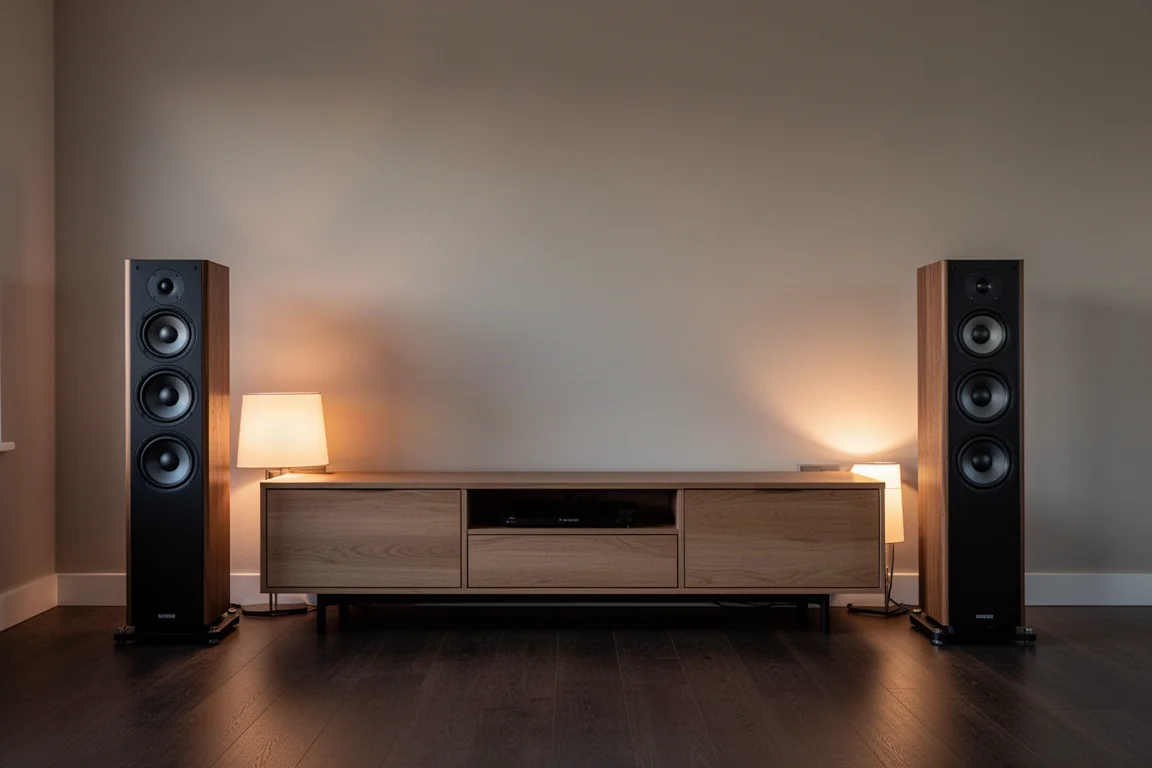
It is not the most linear speaker on the market, and it is not the final word in absolute refinement. What it offers instead is strong output capability, a wide and stable soundstage, and genuinely low distortion for the price, along with a short list of predictable trade-offs that are easy to work with.
Who This Speaker Is For
The Studio 698 makes the most sense for listeners who plan to run subwoofers and expect to use equalization. Its output capability and wide horizontal radiation suit home theater use, where a broad listening area matters more than one perfect seat.
It is also a reasonable choice for two-channel listeners who want a large, dynamic tower without stretching to HDI pricing, and who are comfortable applying a small mid-bass cut.
It is less suitable for anyone who wants a ruler-flat response straight out of the box with no EQ, or for a room where the speakers have to sit close to the wall behind them.
Main Strengths: Where the JBL Studio 698 Delivers
A Three-Way Design With a Wide, Stable Image
The driver complement is the heart of the design: a 1-inch compression driver in a waveguide, a 6-inch midrange, and a pair of 8-inch woofers. Because the waveguide is matched to the midrange directly below it, the handoff from mid-bass through midrange is smooth and continuous. Instruments stay anchored where they belong across the stage rather than shifting or collapsing as the crossover transitions.
Horizontal radiation measures about plus or minus 65 degrees, a wide window that keeps the room involved in a natural way. Measured on-axis response averages 90 dB SPL, right on the rated specification, and the listening window and 30-degree horizontal curves track the on-axis response closely, which is a good indication that reflected sound will resemble the direct sound.
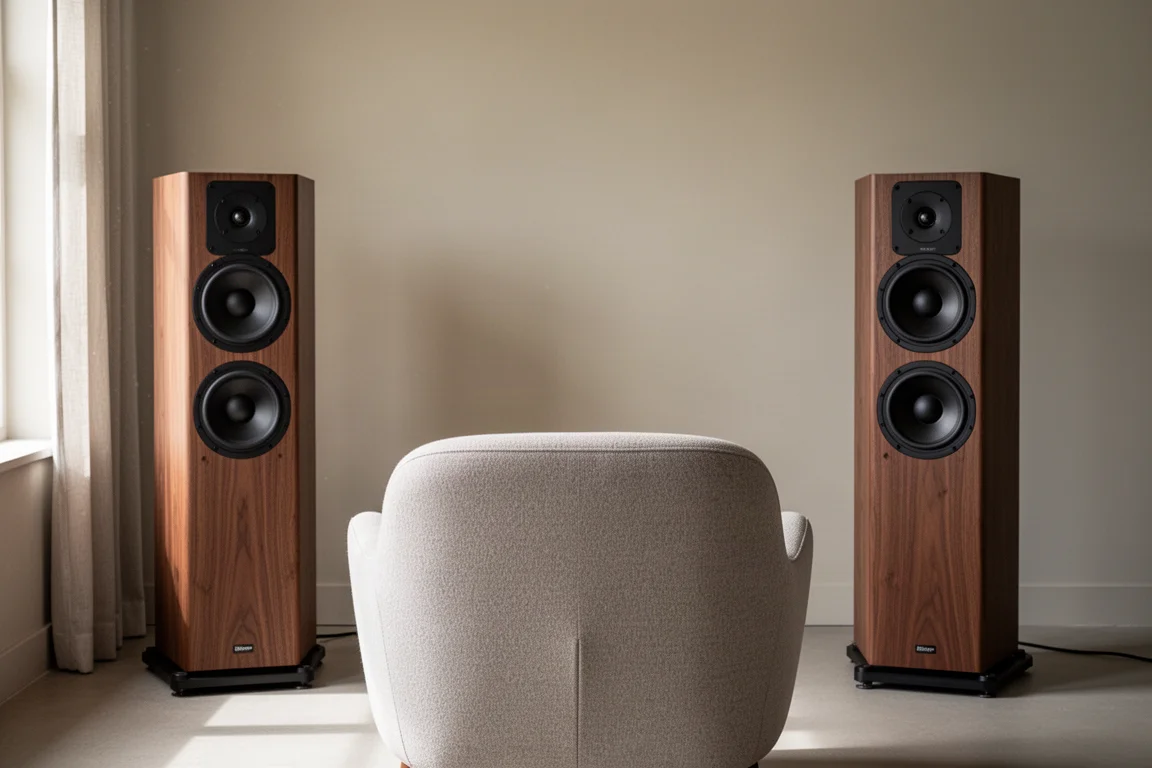
Bass extension is respectable for a tower, with an F3 of 53 Hz and an F10 of 34 Hz. That is enough to make most music sound full, though output below roughly 50 Hz still benefits from a dedicated subwoofer.
Output, Dynamics, and Low Distortion
Two 8-inch woofers give the Studio 698 real dynamic range, and power handling is rated at up to 250 watts per speaker. Harmonic distortion stays clean at both 86 dB and 96 dB, and multi-tone distortion remains below 3 percent across the full 20 Hz to 20 kHz range, which is the threshold that matters most for perceived clarity.
Push the speaker to extreme levels, around 102 dB, and some compression begins to appear in the lower frequencies, along with a degree of compression through the crossover region at high output. Crossing the speaker over above roughly 50 to 60 Hz keeps it comfortably within its limits, and an 80 Hz crossover still leaves plenty of output capability on tap.
The cabinet details are thoughtful as well. The magnetic grille is removable and curved to match the baffle, and each speaker weighs just under 80 pounds, so it is worth having a second person on hand when lifting them out of the box.
Things to Consider Before Buying
The Mid-Bass Bump and Room Placement
The most consistent characteristic is a pronounced rise around 70 to 80 Hz, which was clearly audible at both 6 feet and 10 feet. Depending on the room, that can read as welcome punch or as boom, and it is worth knowing that many rooms naturally dip in that same region, so the bump can offset a room’s own behavior as easily as it can exaggerate it.
Placement has a large effect. Keeping the back of the speaker at least 3 feet from the wall behind it produced the best balance, and moving the speakers closer to the wall made the mid-bass too prominent. Because the cabinet uses two rear-firing ports, giving it room to breathe matters. If the bump is too much, cutting it with EQ is straightforward and preferable to trying to boost a response dip, since room nulls cannot be fixed with equalization alone.
Treble Air and the Top Octave
Above roughly 10 kHz the response rolls off, and on some material that shows up as a lack of air and shimmer, particularly on cymbals and similar instruments. The speaker also narrows slightly at the very top, though less than a typical dome tweeter because of the waveguide loading.
The good news is that this region takes well to equalization. High-frequency distortion is very low, so adding a decibel or two up top is reasonably safe and smooths the response out nicely as long as the listener is seated on the tweeter axis. There is also a slight dip around 2 kHz and a small peak near 3 kHz in the estimated in-room response, both subtle enough to be a minor consideration rather than a deal breaker.
Aiming plays a role here too. Pointing the speakers directly at the listening position, or just slightly off axis, produced the best top end. Lining them up with the wall behind them and firing 30 degrees out into the room costs noticeably more treble energy than it is worth.
Vertical Window and Listening Height
Vertically, the speaker is more particular. The best response axis is right at the tweeter, and moving more than about 20 degrees above or below that point changes the overall timbre noticeably. In a single-row setup this is a non-issue, but in a home theater with a second row of seats, listeners further back may fall outside that window. Horizontally, the speaker is far more forgiving.
How the JBL Studio 698 Compares
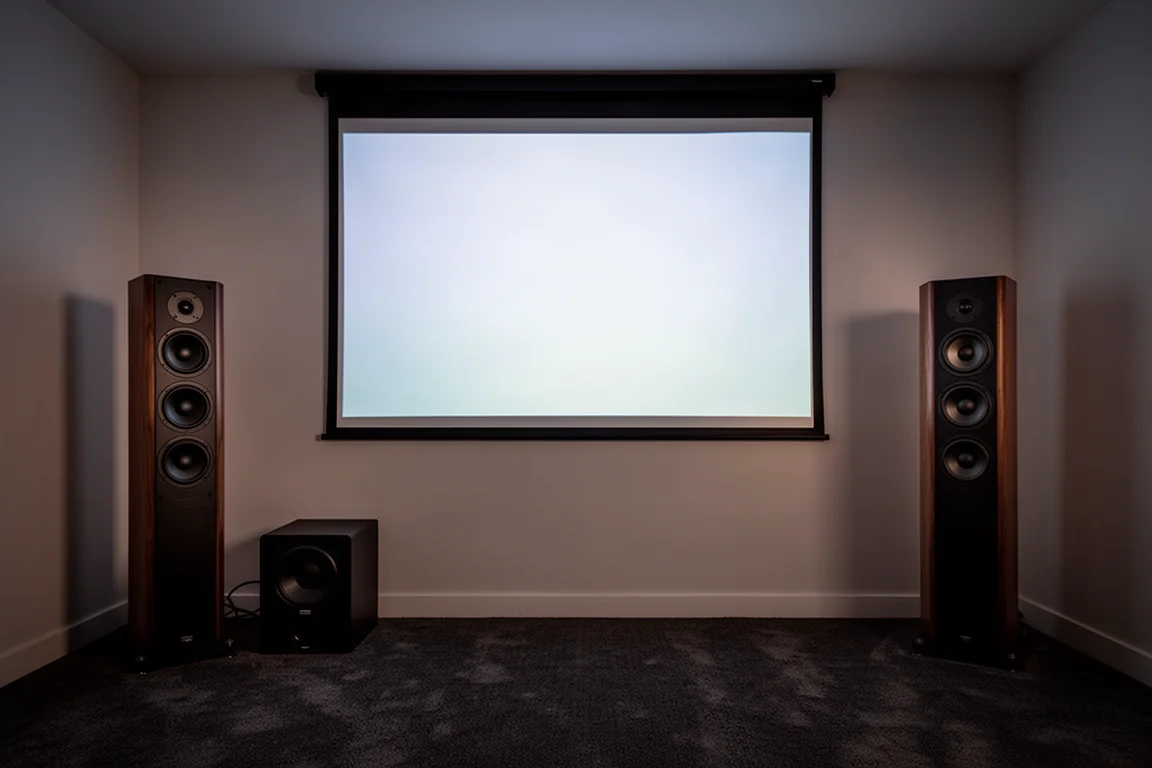
The obvious comparison is JBL’s own HDI 3800, which costs roughly two to three times as much. Objectively, the HDI 3800 remains the better speaker: its estimated in-room response is smoother through the mid-bass, it extends a little lower in room, it avoids the small peak near 3 kHz, and it loses less treble shimmer at the top. Its horizontal radiation is also narrower, at about plus or minus 55 degrees against the Studio 698’s plus or minus 65 degrees, and its gloss finish can reflect projector light in a home theater, which some buyers will want to avoid. Subjectively, the wider radiation of the Studio 698 is a real point in its favor, and the response of either speaker can be smoothed considerably on axis.
The Studio 630 bookshelf, at around $700 per pair, is a different story. It shows a pronounced mid-range scoop of roughly 5 dB and does not sound nearly as neutral as the Studio 698. Between the two, the tower is the stronger performer by a clear margin.
Buying Advice
The Studio 698 rewards a little planning. Budget for subwoofers if you want output below about 50 Hz, expect to use equalization for a small mid-bass cut and an optional touch of treble lift, and give the cabinets at least 3 feet of space behind them. Aim them at the listening position and keep ears at tweeter height.
At around $1,700 per pair, the value proposition is strong. Buyers who want the smoothest possible response out of the box may prefer to stretch for the HDI 3800, but those who want most of that performance with money left over for subwoofers and room correction will find the Studio 698 a sensible, capable choice.
Conclusion
The JBL Studio 698 is not a perfect speaker, and it does not pretend to be one. It has a mid-bass lift that needs managing, a top octave that benefits from a small EQ lift, and a narrow vertical window that favors a single listening row.
Set against that are a true three-way design, wide and stable horizontal radiation, measured output that matches its rating, low distortion across the audible band, and a price that undercuts its own premium sibling by a wide margin. For home theater systems and value-focused two-channel setups alike, it earns its place on the shortlist.
Product link
View more details for JBL Studio 698
This product is mentioned in the review. Check the specifications, options, and compatibility before buying.
View more details for JBL Studio 698Further reading
Related Reviews
Floorstanding Speakers
Acoustic Energy AE109 Mark II Review: A Refined Floorstander at £699
The Acoustic Energy AE109 Mark II is a slim, warm sounding floorstander that delivers clarity, midrange body and strong imaging in small to medium rooms.
Floorstanding Speakers
Acoustic Energy AE509 Review: A Slim Floorstander With Deep, Defined Bass
A practical look at the Acoustic Energy AE509, a slim floorstanding speaker with carbon fibre drivers, deep and well-defined bass, and an easy-going character that rewards careful system matching.
Floorstanding Speakers
Arendal 1528 Tower 8 Review: Reference Neutrality With Real Demands
A close look at the Arendal 1528 Tower 8, a nearly five-foot, 200-pound floorstander that rewards generous space, serious power, and high listening levels with reference-grade neutrality.