E-Readers & Tablets
iFlyTek AINote 2 vs Boox Go 10.3: A Privacy Analysis Comparison
A detailed privacy-focused comparison of two popular e-note devices, examining network behavior, offline integrity, and cloud exposure.
Introduction
Privacy is becoming a central concern for anyone who stores notes, documents, and personal thoughts on a digital device. E-note tablets are particularly interesting because they are designed to replace paper notebooks, which means they often hold sensitive information. The question is not just what these devices can do, but what they do behind the scenes when connected to the internet.
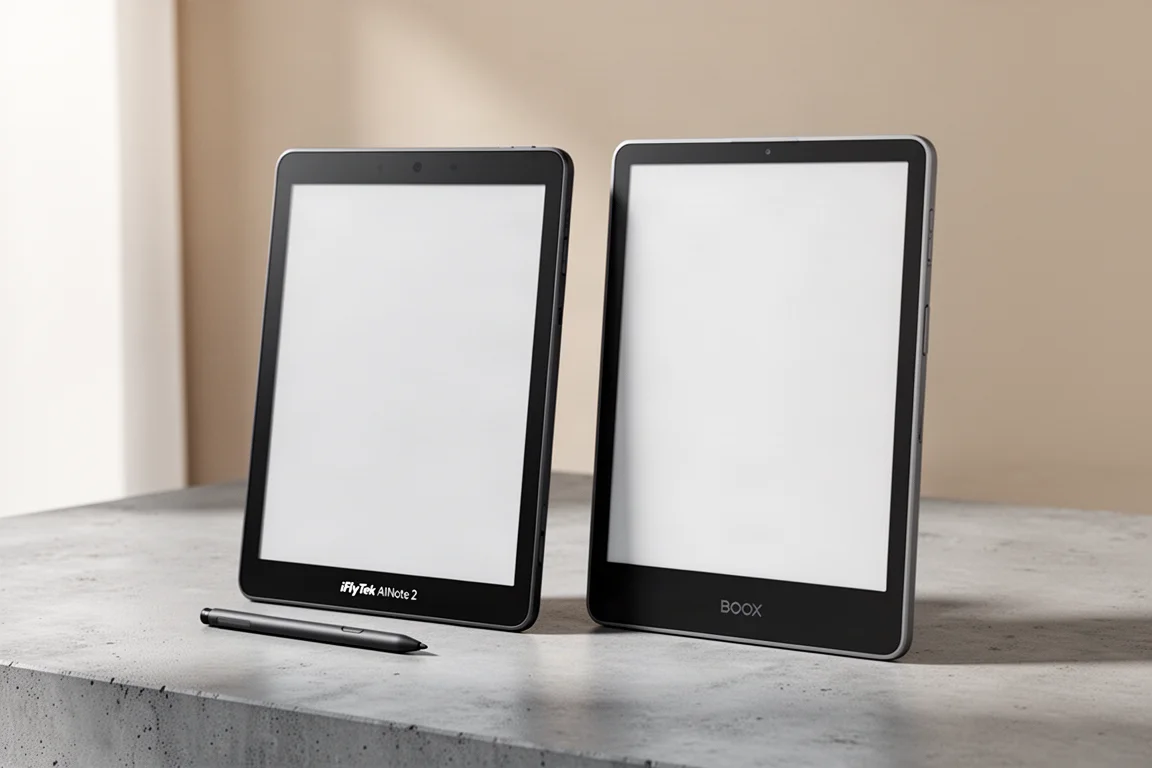
This comparison looks at two popular e-note devices: the iFlyTek AINote 2 and the Boox Go 10.3. Both were put through a structured privacy analysis that examines network communication in different states, including idle, reading, note-taking, and AI feature usage. The goal is to understand how much these devices talk to the outside world, who they talk to, and whether their behavior changes depending on what you are doing.

How the Privacy Analysis Works
The testing methodology involves capturing all network traffic from each device in a controlled environment. A mobile hotspot on a desktop computer is used to isolate the device being tested, ensuring that any captured communication comes only from the device itself. Wireshark is used to record all network activity, and a custom script processes the captured data to filter out noise and extract meaningful patterns.
The analysis consists of 15 distinct tests. These include connecting to Wi-Fi, idle states with the screen on and off, Wi-Fi off transitions, local document reading with Wi-Fi on and off, note-taking with Wi-Fi on and off, OCR recognition with Wi-Fi on and off, AI feature usage, and background OCR. Each test is designed to reveal how the device behaves in different scenarios and whether it communicates more than expected.
The final output is a weighted score based on three categories: offline integrity, cloud exposure, and idle chatter. Offline integrity accounts for 35% of the score, cloud exposure for 45%, and idle chatter for 20%. Bonus and penalty modifiers are applied based on specific behaviors observed during testing.

iFlyTek AINote 2: Privacy Analysis Results
The iFlyTek AINote 2 scored 74 out of 100 in the privacy analysis. The offline integrity score was excellent, meaning the device is truly offline when Wi-Fi is disabled. When the screen was off and the device was in a sleep state, it showed zero network activity, which is a strong positive result.
The cloud exposure score was low, which is not surprising given that the device relies heavily on cloud-based features. Network traffic appeared tied to feature use rather than constant background streaming. This means the device communicates when you are actively using online functions, but it does not appear to send data without your knowledge during idle periods.
However, the idle chatter score was 70 out of 100. During idle testing with the screen on, the device showed remote traffic with no DNS observed, which means it was communicating with servers without revealing the domain names. This lack of transparency is a concern for users who want to know exactly who their device is talking to.
The OCR capability on the AINote 2 is online only, which means it does not receive a bonus for offline functionality. Similarly, AI features are online only, so no bonus is applied there either. The report recommends not treating this device as private by default, and advises keeping Wi-Fi off for sensitive notes and documents.
Boox Go 10.3: Privacy Analysis Results
The Boox Go 10.3 initially scored lower than the AINote 2, but this was due to a miscalibration in the scoring script. After fixing the weighting error, the device scored 87 out of 100, which is significantly higher than the AINote 2.
The offline integrity score for the Go 10.3 was 100 out of 100. All offline states were truly offline, with zero packets observed in every test where Wi-Fi was disabled. The device did send some data to Google Play Store during the Wi-Fi off transition, but this was identified as the device cleaning house before disconnecting, which is not considered a privacy violation.
The idle state with the screen on scored higher than the AINote 2 because of full transparency. The Go 10.3 revealed all DNS queries and server connections during idle, allowing users to see exactly who the device is talking to and how often. This transparency is a significant advantage for privacy-conscious users.
The device also scored well in reading and note-taking tests, with local document reading showing no network activity when Wi-Fi was off. The Go 10.3 was updated to the latest version of its operating system before testing, which may have contributed to the clean results.


Comparing the Two Devices
When placed side by side, the differences between the two devices become clear. The Boox Go 10.3 scored 87 out of 100, while the iFlyTek AINote 2 scored 74 out of 100. The main difference lies in transparency and offline behavior.
The AINote 2 showed remote idle traffic with no DNS or SNI observed, meaning it was communicating with servers without revealing their identities. This is a privacy concern because users cannot verify who the device is talking to. The Go 10.3, on the other hand, provided full transparency during idle, showing all DNS queries and server connections.
Both devices performed well in offline states, with zero network activity when Wi-Fi was disabled. However, the AINote 2 relies on online-only OCR and AI features, which means these functions transmit data to the public internet. The Go 10.3 also has cloud-based features, but its overall behavior was more controlled and transparent.

Buying Advice
For users who prioritize privacy, the Boox Go 10.3 is the stronger choice. Its transparent network behavior and excellent offline integrity make it easier to trust with sensitive notes and documents. The device does not appear to send data without your knowledge, and its offline states are truly offline.
The iFlyTek AINote 2 is still a capable device, but its opaque idle communication and online-only OCR and AI features are worth considering. If you plan to use cloud-based features, be aware that your data will be transmitted to the public internet. For sensitive content, keeping Wi-Fi off is the safest approach.
Both devices are suitable for everyday note-taking and reading, but the Go 10.3 offers better privacy assurances out of the box.
Conclusion
Privacy analysis is a valuable tool for understanding how devices behave behind the scenes. This comparison shows that not all e-note tablets are created equal when it comes to network communication. The Boox Go 10.3 demonstrated stronger privacy characteristics with transparent idle behavior and excellent offline integrity, while the iFlyTek AINote 2 showed more opaque communication patterns and a heavier reliance on cloud services.
For anyone who values privacy in their digital note-taking, the Boox Go 10.3 is the more reassuring option. However, both devices can be used responsibly by understanding their limitations and adjusting settings accordingly.
Further reading
Related Reviews

Coffee Equipment
BEEM vs Melitta EPOS: Two Automated Pour-Over Coffee Makers Compared
A detailed comparison of two automated pour-over brewers: the budget-friendly BEEM and the feature-rich Melitta EPOS with integrated grinder. Which one delivers better coffee?

Security Devices
Best Hidden Camera Detectors 2026: 13 Models Tested for Range, Lens Detection, and Tracker Finding
We tested 13 hidden camera detectors across range, wall detection, lens reflection, and GPS tracker finding. See which models performed best and which budget pick stands out.
3D Scanning Equipment
Budget 3D Scanners Under $1000: Four Practical Options Compared
A detailed comparison of four entry-level 3D scanners under $1000, including real-world scanning tests, accuracy measurements, and practical recommendations for automotive and mechanical projects.