TVs
Hisense U9 vs Hisense U8 vs Samsung S90C OLED: Which TV Is Worth Buying?
A practical comparison of two Hisense RGB Mini-LED televisions and an OLED alternative, with real strengths, trade-offs and a clear buying recommendation.
Introduction
Few things are as satisfying as a television that looks right the moment you switch it on. No menu diving, no endless tweaking, just a balanced picture straight out of the box. Hisense already came surprisingly close to that with its 100-inch U8, and that success creates an awkward question for the more expensive U9. If the cheaper set already looks this good with almost no effort, what exactly are you paying extra for?
This guide compares three televisions that keep coming up in the same conversation: the Hisense U9, the Hisense U8 and the Samsung S90C OLED. Each one solves a slightly different problem, and the right answer depends on how you watch, where the TV lives and how much fiddling you are willing to do.
Hisense U9: The Flagship RGB Mini-LED
The U9 is the brighter, more ambitious of the two Hisense sets, and it arrives with a few practical surprises. It is thinner than the U8 but more than 30 pounds heavier, and it uses a much wider VESA mounting pattern. Even a mount rated for 100-inch televisions may not fit, so it is worth checking your bracket before committing to an upgrade.
Connectivity is another area where the two models diverge. The U8 offers four HDMI 2.1 ports, while the U9 trades one of them for a USB-C port with DisplayPort. That is genuinely useful if you want to plug in a gaming PC or laptop, but it does leave fewer HDMI inputs if every console, streamer and disc player connects directly to the TV.
Out of the box, the U9 opens in an energy-saving profile that looks nothing like what the panel can do. Colour errors, crushed blacks and blown-out highlights are all visible, and while it measures over 1,700 nits, it is not a mode worth keeping. Standard and vivid are not much better. The good news is that help is only a few clicks away. Theater day, theater night and filmmaker modes look far more natural and balanced, with theater day and night measuring almost identically at grayscale Delta E values of 3.6 and 3.4 and a colour Delta E of 4.4. Filmmaker edges slightly ahead at 3.5 for grayscale and 4 for colour.
Those figures are not quite calibrated-out-of-the-box territory, but they are close, and all three profiles deliver strong contrast, solid gamma tracking and natural colour. Some primaries run slightly oversaturated, but most viewers will pick one of these modes and never look back. There is also plenty of brightness in reserve. Hisense claims the panel can reach up to 5,000 nits, vivid measured 4,100 nits, and SDR output can be pushed past 3,000 nits without meaningfully hurting grayscale or colour accuracy. For HDR10, peak brightness came in at just over 4,000 nits, and the format needed very little work to meet calibration standards.
A short calibration session takes the U9 further. Starting from filmmaker mode, a few small adjustments improved grayscale to a Delta E of 1.4 and colour to 1.6, which is reference-tier accuracy. Brightness was deliberately held around 1,000 nits for the best balance of accuracy, impact and viewing comfort.
What separates the U9 from its cheaper sibling day to day is not raw brightness but control over that light. The U9 is brighter overall, yet the difference during everyday streaming is less obvious than its advantage in black-level consistency. Blacks stay inky even in dark rooms, blooming is handled slightly better, and text reproduction stays crisp, which matters if you watch with subtitles. On a pure black test pattern the U9 measured 0.000 nits, a result as good as some of the best OLEDs around.
A firmware update added Dolby Vision 2 Max, and the difference is not subtle. Brightness, contrast and colour all improve through Dolby’s content intelligence, and authentic motion gives filmmakers more granular, shot-by-shot control over motion. Dolby Vision 2 is still new, so features like authentic motion will not be fully realised until more compatible content arrives. The new peak luminance control is easier to appreciate right away. In its default position, Dolby Vision Pro reference measured a grayscale Delta E of 4 and 4.6 for colour; lowering peak luminance by one step improved those to 2.5 and 3 while barely touching light output, which still measured 4,200 nits.
Hisense U8: The More Affordable RGB Mini-LED
The U8 is the set that makes the U9’s price harder to justify. It already looks very good with almost no effort, and it keeps four HDMI 2.1 ports rather than trading one for USB-C. On the 100-inch versions, the U8 actually has more dimming zones than the U9, even though the U9 controls its zones better.
What the U8 gives up is a little brightness and a little light control. It cannot match the U9’s consistency in black levels or its grip on blooming, but it matches its sibling almost exactly on light and colour uniformity, viewing angle and reflectivity. Dolby Vision 2 Max is coming to the U8 as well, so that advantage will not stay exclusive to the more expensive model.
In an objective scoring system, the U9 beat the U8 by single digits, and only after calibration. For anyone who wants the most trouble-free experience and the most accurate image straight from the factory, the U8 is the one to buy.
Samsung S90C OLED: The OLED Comparison
OLED still sets the benchmark for black levels, and the Samsung S90C OLED is a useful reminder of why. In real-world viewing, OLED ekes out marginal wins here and there, even though the gap has narrowed considerably on black patterns.
Where the comparison becomes clearer is midtone separation and overall luminance. Watching the same dark, brownish film material in HDR10 on the OLED produced less separation between middle shades and lower overall brightness than the Hisense’s Dolby Vision 2 presentation. Whether that comes down to lower light output, the absence of Dolby Vision 2, or a combination of both, the difference was noticeable.
Motion is the area where the OLED still pulls ahead. Under 1,000 and 2,000 pixel-per-second stress tests, the Samsung is slightly smoother. Competitive players will still prefer OLED or a purpose-built gaming monitor, but for casual gaming the Hisense sets are more than enjoyable.
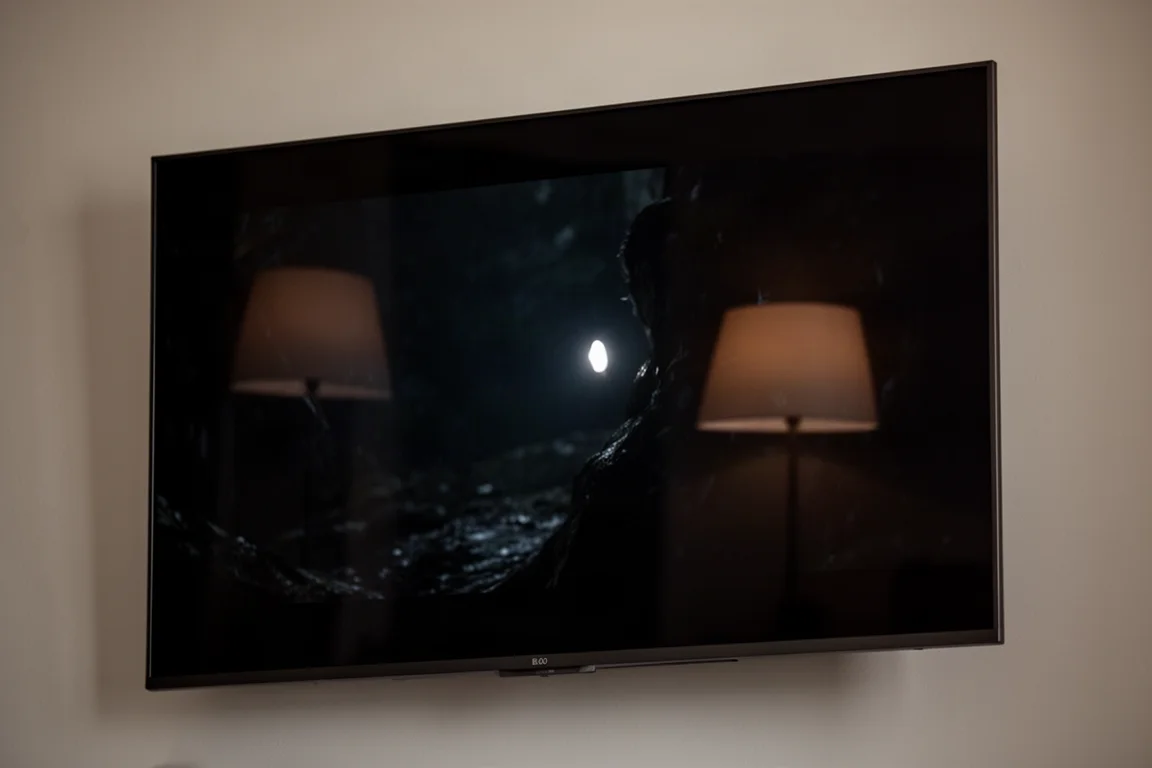
The U9 counters with things OLED cannot easily match: it works in every lighting condition, offers more colour, is more accurate out of the box and, in practice, showed fewer quality-control problems. That does not mean it matches OLED for contrast or motion, but as an all-round television it is the more complete package.
Picture Quality and HDR Performance
Colour volume is one of the U9’s strongest arguments. Across a film owned in every format from SDR to Dolby Vision, the experience improves noticeably as source quality rises, and the difference between a streaming app, a disc and a high-end media server is easy to see. The set renders colour spaces more completely than expected, and it outperformed a comparable Sony model in this department.
Upscaling and cleanup of lower bit rate material are handled well, and with a high-quality source the image fidelity is undeniable. On weaker streams there was occasional minor colour banding in skies and some blocking in the darkest parts of a scene, but never enough to distract. Anyone with a Blu-ray, UHD Blu-ray or media server collection will be rewarded for feeding the TV a better signal.
Uniformity is a strong point. Brightness and colour stayed impressively even across the screen, with no dirty screen effect during normal viewing. Only full-screen white patterns exposed subtle edge vignetting with a slight pink tint, and it never appeared in real content. Off-axis viewing held up well, and the panel does a good job of controlling reflections and ambient light. Both Hisense models can thrive in a bright room or a dark one, which is more than can be said for some glossy rivals that behave like mirrors.
Motion, Gaming, and Everyday Viewing
For everyday television and cinematic content, motion is close to perfect, even during fast-moving motorsport coverage. Gaming at higher refresh rates is exceptional, and casual play through a PS5 with the TV’s gaming aids enabled is a genuinely enjoyable experience.
There are two small annoyances worth knowing about. The first is an audible relay click when the TV is in standby, something it shares with the U8. The second is a set of CEC command issues with a Bang & Olufsen sound system. The manufacturer is aware of the problem and is working on a fix; in the meantime, the workaround is to disable the setting that lets the TV power down connected components over HDMI CEC.
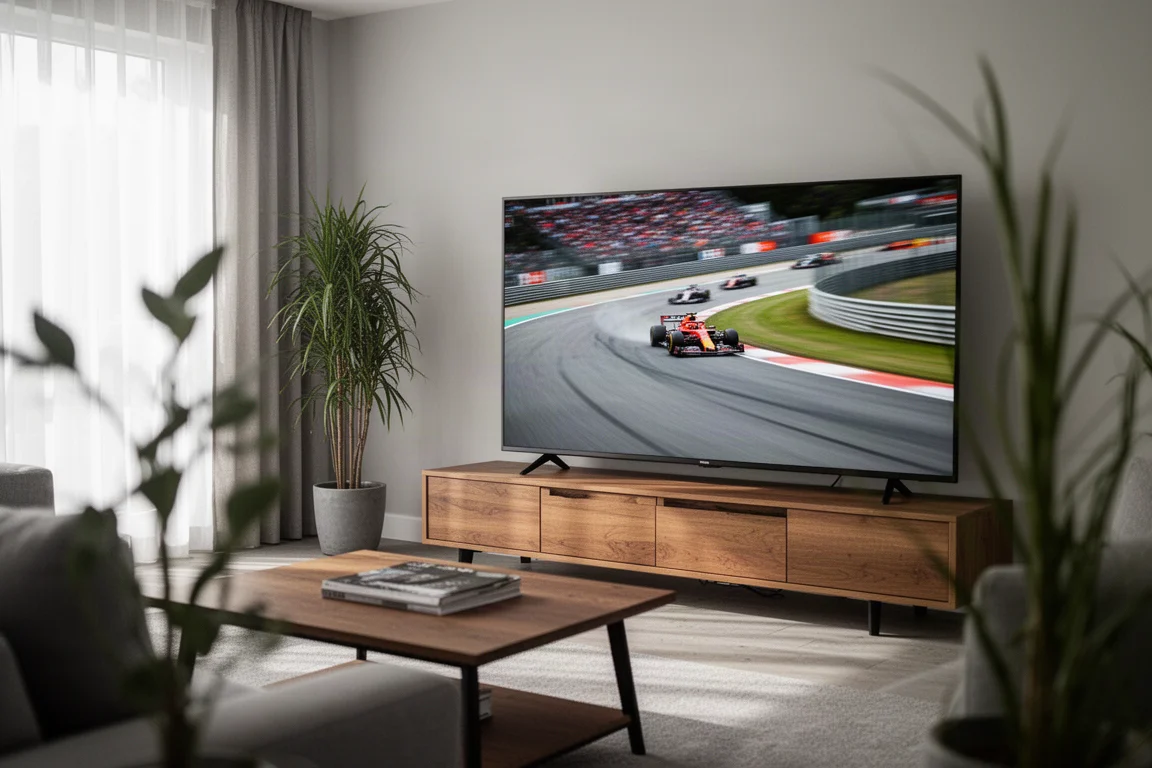
Set against those quirks is a genuinely flexible picture. The U9 does not need a darkened room to look its best, and it holds its own whether the lights are on or off, which makes it an easy recommendation for living rooms where viewing conditions change throughout the day.
Buying Advice: Which TV Should You Choose?
The honest answer is that the gap between the two Hisense sets is smaller than the price difference suggests. In absolute reference terms, with the best source material and a full professional calibration, the U9 is the better television, but only just barely. Put the two side by side and watch everyday content the way most people actually do, and it would not always be obvious which one is which.
If you want the most accurate picture straight from the factory and the least fuss, the U8 is the better buy. If you want maximum brightness and the best control over light and blooming, and you are willing to spend a little time calibrating, the U9 justifies itself. If OLED contrast and the smoothest possible motion matter most to you, the Samsung S90C OLED remains the specialist choice.
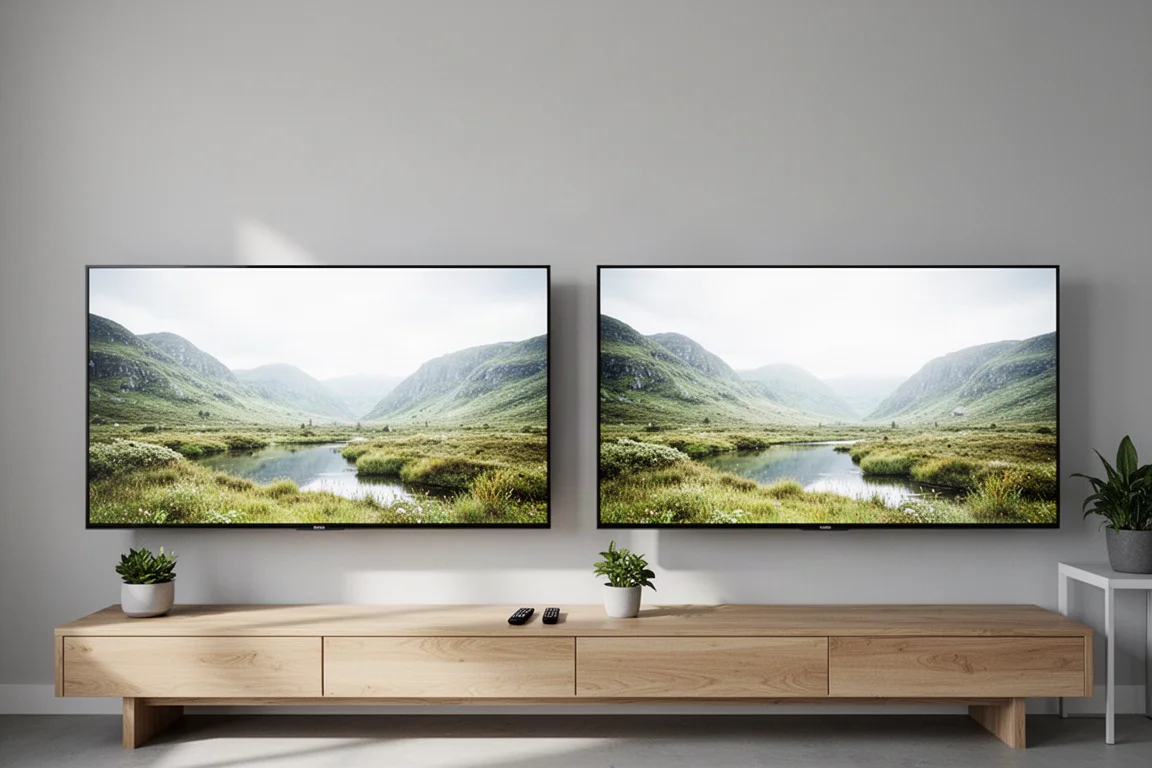
One last practical note before you order: check your existing wall mount. The U9 is thinner but heavier than the U8, with a wider VESA pattern, and a bracket rated for 100-inch screens may still not fit. Budgeting for a new mount is a small detail that is easy to overlook.
Conclusion
Three good televisions, three different priorities. The Hisense U8 wins on value and out-of-the-box accuracy, the Hisense U9 wins on brightness and light control for those willing to calibrate, and the Samsung S90C OLED wins on the black-level purity and motion smoothness that OLED delivers. Match the set to how you actually watch, and any of the three will serve you well.
Further reading
Related Reviews
TVs
Best Sony XR TVs Compared: X90K, X95K, A80K, A90K, A90J, A95K and Z9K
A practical guide to Sony's XR television range, from the value-focused X90K to the 8K Mini LED Z9K, with clear advice on which model suits which room.
TVs
Hisense 100UR8SG Review: A 100-Inch RGB Mini-LED That Takes On OLED
A 100-inch RGB mini-LED television with measured peak brightness of 3,850 nits, wide color volume, and a price far below large-format OLED.
TVs
LG B4 OLED TV Review: Entry-Level OLED With Excellent Out-of-Box Accuracy
A practical look at the LG B4 OLED, covering picture accuracy, gaming features, webOS responsiveness, and how it compares to brighter LED sets and pricier OLED rivals.