Sim Racing
Heusinkveld One Steering Wheel Review: A Lightweight Open Ecosystem Wheel With a Polarizing Design
Heusinkveld's first steering wheel focuses on nailing the fundamentals with a lightweight composite build, a clever button layout, and deep software customization. But its unique grip angle may not suit everyone.
Introduction
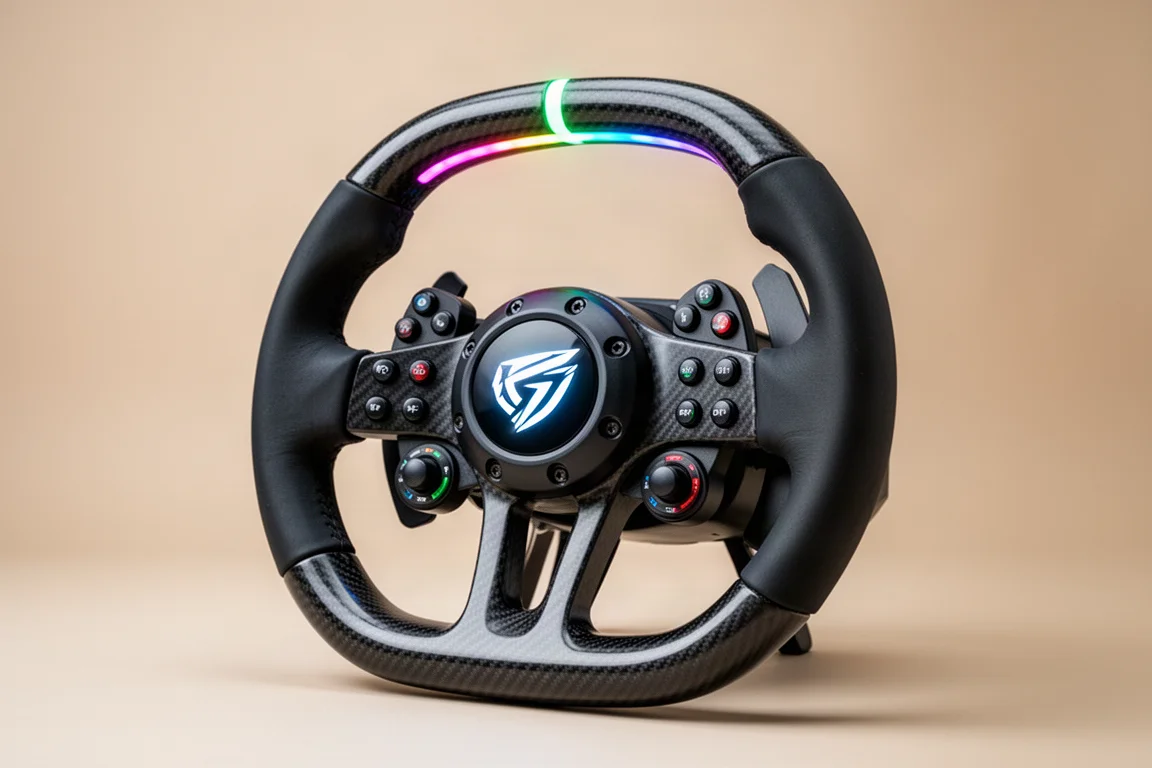
Heusinkveld has long been a respected name in sim racing, known primarily for its pedals. Many of the pedal designs seen today trace back to their original work. With the One Steering Wheel, the company enters a new category with a product that is unapologetically different. It is not a replica of a real race car wheel. Instead, it is designed specifically for sim racing, with a focus on nailing the fundamentals.
The One is an open ecosystem wheel, meaning it works directly with a PC and any wheelbase, as long as you can mount your quick release. It is not console compatible. Priced at €499 from the Heusinkveld website, it sits in a competitive segment. A hub adapter for 70mm bolt patterns costs an additional €34. This review covers the design, build quality, controls, software, and the driving experience, including one notable ergonomic concern.
Design and Build Quality
The first thing you notice when picking up the One is its weight. At just over 1 kilogram, it is extremely light. With the adapter and mounting hardware, the weight increases to about 1.2 kilograms. Most wheels in this segment weigh over 1.4 kilograms, with some approaching 2 kilograms. This low weight reduces inertia and rotating mass, which makes force feedback feel sharper and more responsive, particularly on lower-end wheelbases under 10 Newton meters.
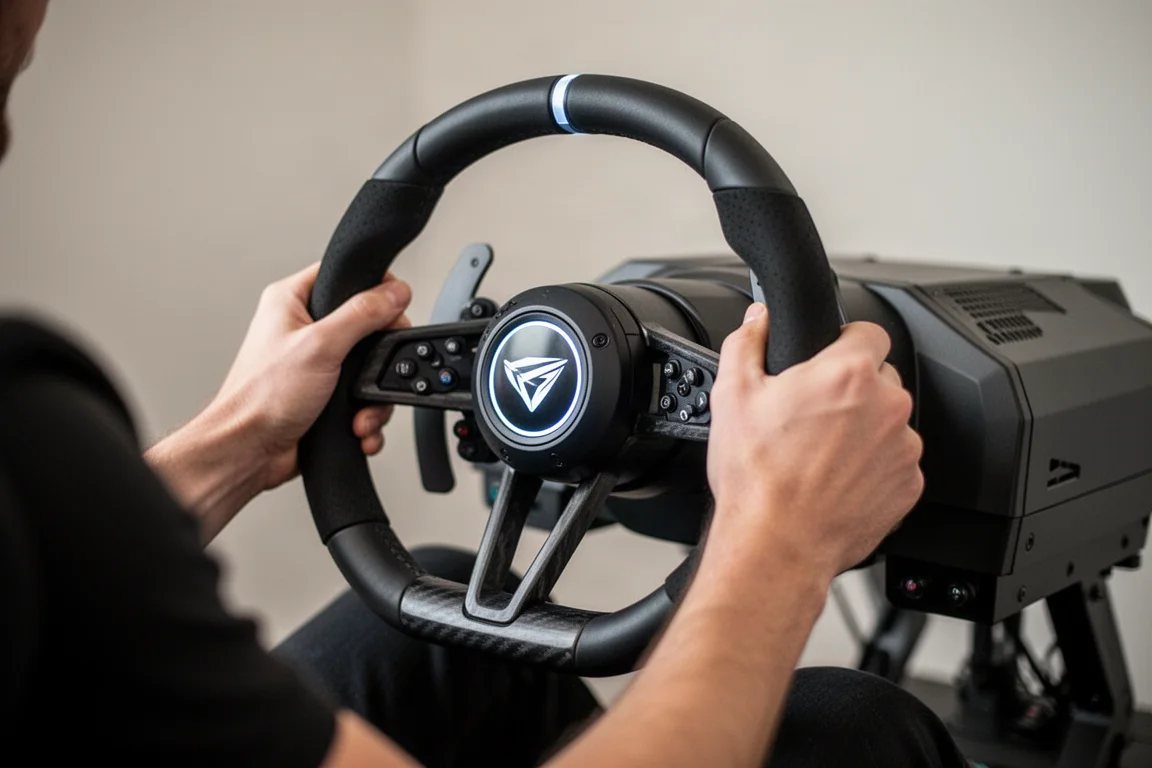
The wheel has a diameter of approximately 270mm at the hand grips, which is on the smaller side. This makes it feel more responsive and snappy, ideal for formula-style cars, prototypes, and GT3 racing. The sweet spot for most drivers is between 280mm and 300mm, so this is slightly narrower than what some may prefer. However, the smaller diameter does make quick inputs like catching oversteer feel more natural.
The entire construction uses a fiber reinforced composite material. Heusinkveld is careful to avoid calling it plastic, but that is essentially what it is. Interestingly, the company states it would have been cheaper to make the wheel from cast aluminium, but the composite material results in a more rigid and lighter design. There is absolutely no flex in any area of the wheel, which is impressive for an open-rim design. The quality of the molding is phenomenal, with a rubberized material on the grips that is almost indistinguishable from the rest of the body.
Controls and Ergonomics
The button layout on the One is one of its strongest features. There are five push buttons on each side, all reachable without adjusting your hand position. The dome-shaped buttons activate even when pressed off-center, which is helpful when driving in VR. The buttons have a satisfying snap and are screen printed. The box includes replacement button caps, and the positions can be swapped by removing a few screws.
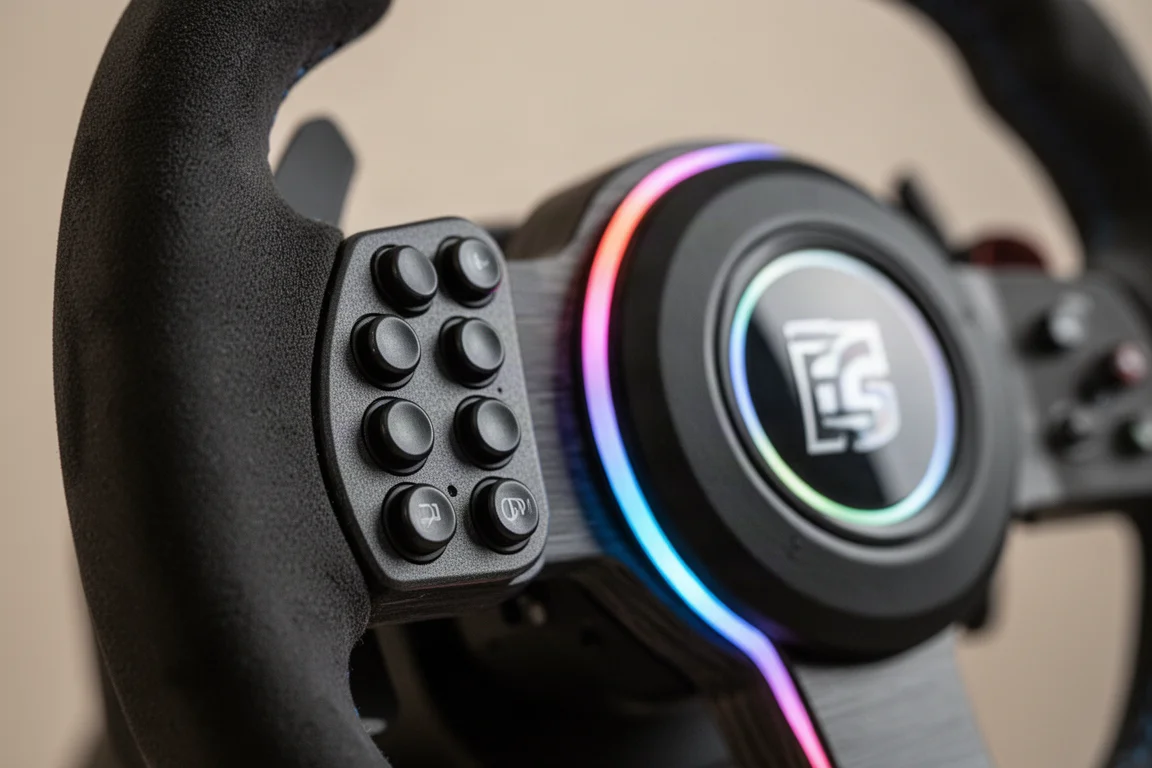
The rotary encoders have a unique flared design that allows them to be activated with your thumb without taking your hand off the wheel. They are on the softer side when it comes to detents, which may take some getting used to, especially with gloves. There are also two push buttons on each side at the bottom, plus a seven-way funky switch with up, down, left, right, rotary, and push functionality.
The software allows for multiple functions per button. You can assign different functions for short or long presses, and any button can be mapped as a function button to enable a second layer. This effectively gives you four functions for each button and encoder. This is particularly useful for controlling things like windscreen wipers or headlights with a single button, using a long press to toggle and a short press to cycle through modes.
Shifters, Paddles, and Mounting
The magnetic shifters on the One have a solid snap and are slightly on the loud side. They do not have an adjustable throw, but they can be extended outward for easier reach. The extension mechanism is toolless and has several steps, though the detents are not clearly defined. The shifters also have push and pull functionality, allowing you to assign upshifts and downshifts to either side, similar to a rally wheel.
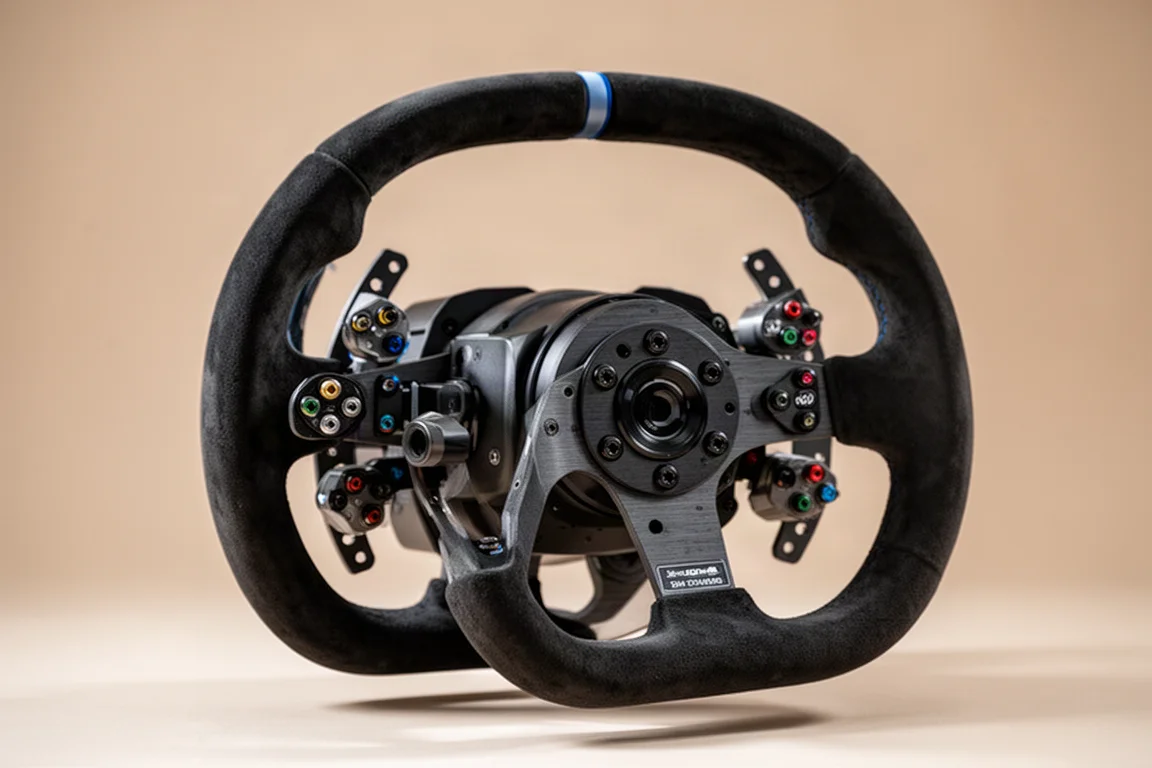
The two analog paddles have a good amount of throw distance, though the progression is not the most linear. They can be assigned as a dual bite point clutch in the software. The paddles appear to be static with no physical adjustments, but the default throw should be sufficient for most users.
The mounting area uses a standard 50mm bolt pattern. For 70mm quick releases, which are more common, Heusinkveld sells an adapter plate for €34. The adapter weighs 120 grams, and with screws, about 170 grams. It uses a spline-type system to lock the two sides together, spreading torsional load across multiple surfaces. The mechanism is solid with no flex or slop, though it does add a significant amount of weight to the overall setup.
Wireless Connectivity and Battery
The One connects to a PC wirelessly using a proprietary low-latency protocol. It comes with a small USB dongle that plugs into your PC. Once the Heusinkveld software is installed, the wheel connects automatically. There is no noticeable latency between pressing a button and seeing the input in the game.
The wheel has an integrated 2800 milliamp hour battery, rated for about 60 hours of use. A battery indicator light turns red at about 10 hours remaining and flashes at about 5 hours. Charging is done via the included USB-A to USB-C cable. A standard 500 milliamp source takes about 5 hours to fully charge, while a 1.5 amp source takes about 1 hour and 45 minutes. In testing, a 5% battery drop was observed over 2 hours of driving with LEDs at moderate brightness.
Software and Customization
The Heusinkveld software, called Smart Control, manages all connected Heusinkveld hardware. It provides a visual representation of the wheel, allowing you to click on each input to adjust its behavior. The software supports profile management, which is useful for switching between different cars and setups.
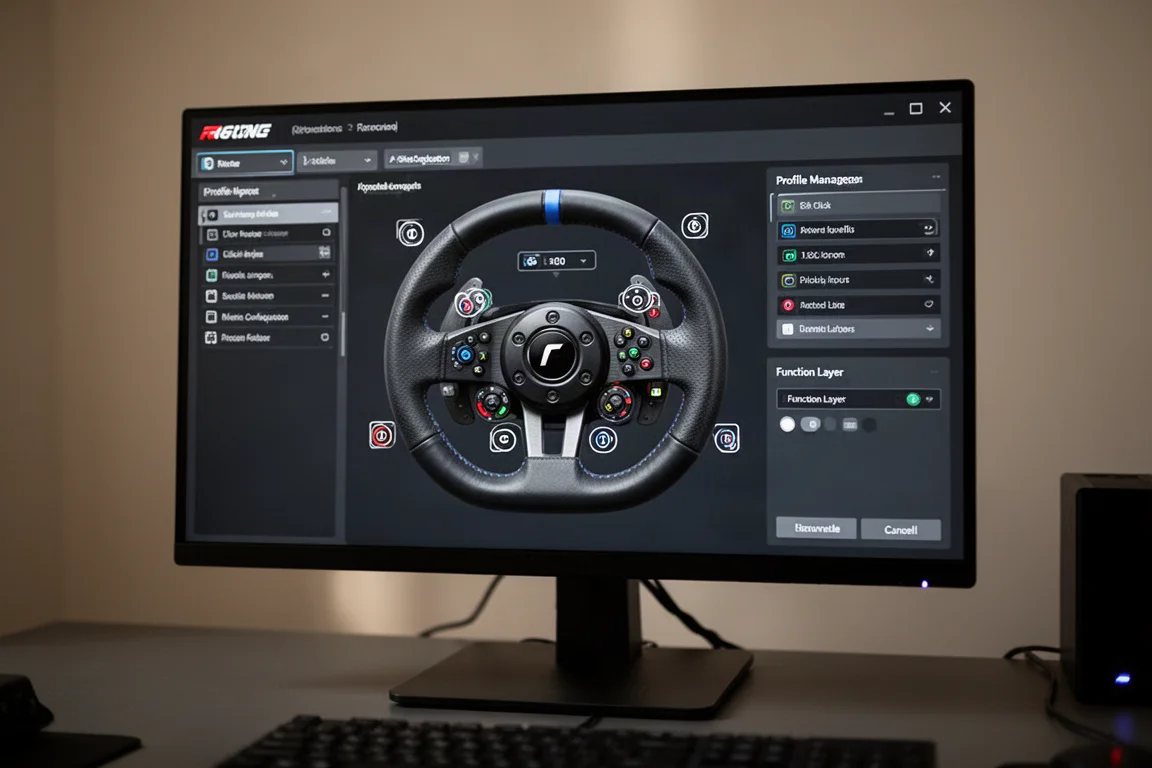
Each button can be configured with regular output, double output with and or either-or logic, function hold, or disabled. You can adjust pulse width to ensure inputs register correctly in different sim titles. The rotary encoders have rate limiting and pulse duration settings, plus assignable button numbers for increase and decrease. This allows you to map different profiles for different cars without remapping in the sim.
The analog paddles have dead zone adjustments, output curve shaping, and the ability to output to a specific axis. The bite point clutch function takes the maximum output from either paddle and caps it at a set level, allowing for a consistent clutch release. There is no way to adjust the bite point from the wheel itself, which would be a nice addition.
The RGB LEDs, including the RPM strip and two flag LEDs, are controlled through SimHub. A built-in profile is available, and the LEDs are fully configurable for custom scenarios like spotter alerts.
Driving Experience
The One is extremely comfortable to hold, with large open thumb spaces and a rubberized grip material that feels grippy without being sticky. The button ergonomics are among the best ever seen on a wheel, with everything reachable without taking your hands off the wheel. The software is complex but powerful, and once configured, the wheel works straight out of the box.
However, there is one significant issue. The hand grips tilt slightly towards the driver when the wheel is at 90 degrees to the floor. This is different from any other sim racing wheel tested. In a normal driving position, this causes the wrists to bend at an acute angle, which led to wrist pain within a couple of laps of driving. This was confirmed by comparing footage with other wheels. Adjusting the wheelbase position can counteract this, but that is not practical if you regularly switch between wheels.
This grip angle may not affect everyone, but it is a physical design choice that could be a dealbreaker for some. It is worth considering if you plan to use this wheel exclusively or if you switch between multiple wheels frequently.
Buying Advice
The Heusinkveld One Steering Wheel is a well-executed product that focuses on the fundamentals. It is lightweight, rigid, and has an excellent button layout. The software is deep and customizable, and the wireless connectivity is seamless. At €499, it is competitively priced for the features offered.
However, the unique grip angle is a potential issue. If you have a fixed driving position and do not switch wheels often, you may be able to adjust your rig to accommodate it. If you frequently swap between wheels, this could be a problem. It is also worth noting that the composite material, while high quality, does not have the premium feel of aluminium or carbon fiber.
This wheel is best suited for sim racers who prioritize functionality and ergonomics over materials, and who are willing to adapt their setup to the grip angle. It is not for everyone, but for those it suits, it offers something genuinely different from the market.
Conclusion
The Heusinkveld One Steering Wheel is a bold first entry into the steering wheel market. It nails the basics with a lightweight, rigid design and an outstanding button layout. The software is powerful and the wireless connection is flawless. The polarizing design and composite materials may not appeal to everyone, and the grip angle is a genuine concern that could cause wrist discomfort for some drivers.
Despite not being the right wheel for every sim racer, it deserves recognition for pushing the category forward. It offers a unique alternative to the many replica wheels on the market, and for those it suits, it delivers an excellent driving experience.
Product link
View more details for Heusinkveld One Steering Wheel
This product is mentioned in the review. Check the specifications, options, and compatibility before buying.
View more details for Heusinkveld One Steering WheelFurther reading
Related Reviews
Sim Racing
Asetek Initium Direct Drive Bundle Review: A Strong Entry Point With a Standout Pedal Set
The Asetek Initium bundle brings a 5.5 Nm upgradeable wheelbase, a functional round wheel, and a surprisingly capable pedal set to a crowded entry-level direct drive market.
Sim Racing
ConSimPit Ecosystem Overview 2026: Wheelbases, Pedals, and Wheels
A detailed look at ConSimPit's sim racing ecosystem, covering wheelbases, pedals, and steering wheels with honest observations on quality and value.
Sim Racing
Cube Controls Astra Review: A Lightweight Sim Racing Wheel That Nails the Fundamentals
The Cube Controls Astra is a lightweight aluminum sim racing wheel that focuses on build quality and driving feel over extra features.