Sim Racing
Asetek Initium Direct Drive Bundle Review: A Strong Entry Point With a Standout Pedal Set
The Asetek Initium bundle brings a 5.5 Nm upgradeable wheelbase, a functional round wheel, and a surprisingly capable pedal set to a crowded entry-level direct drive market.
Introduction
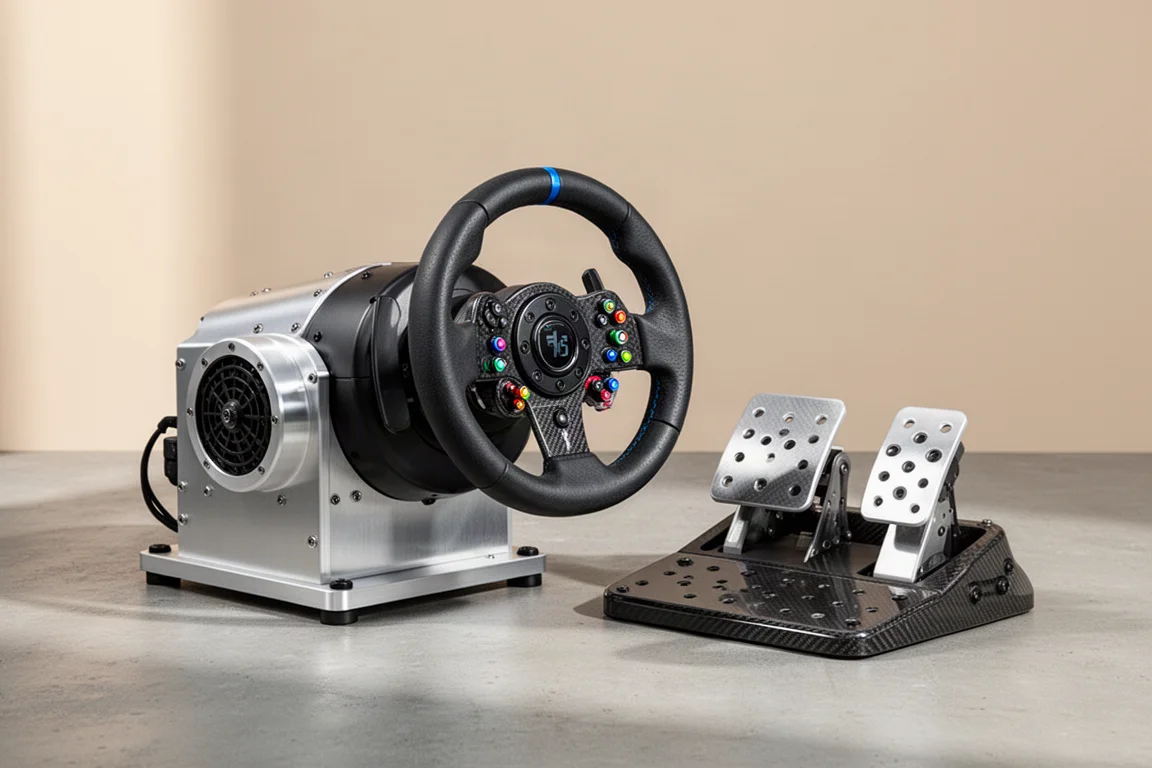
The entry-level direct drive market keeps getting more crowded, and the Asetek Initium range arrives as the latest contender. This bundle includes a new 5.5 Nm direct drive motor that is upgradeable to 8 Nm, a new steering wheel, and a new set of pedals. Upgradability is a big part of the story here, and it is worth examining how this package compares to other options in a very competitive segment.
Asetek Initium Direct Drive Wheelbase
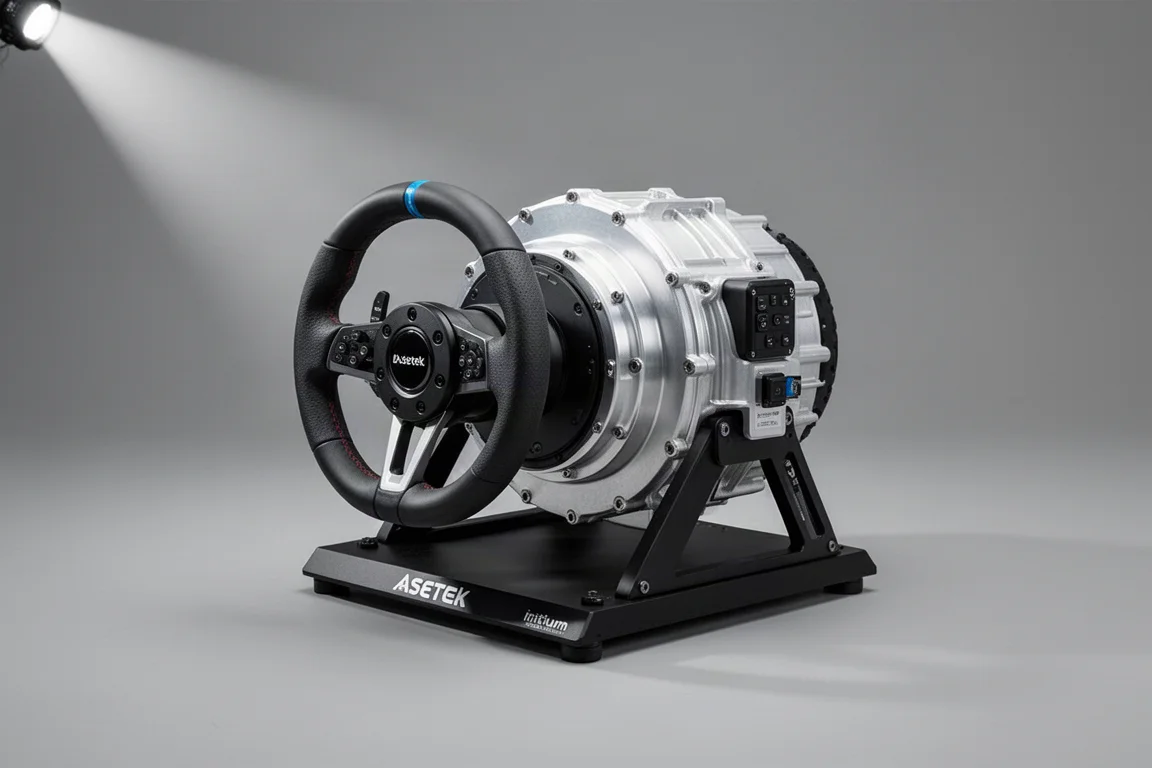
The Initium wheelbase delivers 5.5 Nm of max torque out of the box, with an upgrade path to 8 Nm via an upgraded power supply that is expected to be available later for $89. The cast aluminium housing showed no issues with temperature or performance drop-off during testing, and thermal management seemed solid. A plastic front cover and rear housing follow the design language of Asetek’s other model bases.
The standard Asetek quick release is present on the front, with a small cover protecting the pin assembly from accidental damage. These pins deliver power and data via standard USB protocol to the nose of the wheelbase. This means most third-party wheels can be used directly without a cable running back to the PC. Some of GSI’s more high-end wheels did have issues with the base not supplying enough current, but low to mid-range wheels worked without any problems. This is a notable advantage over other ecosystems in this part of the market, where proprietary protocols often lock out force feedback unless you use an expensive universal hub.
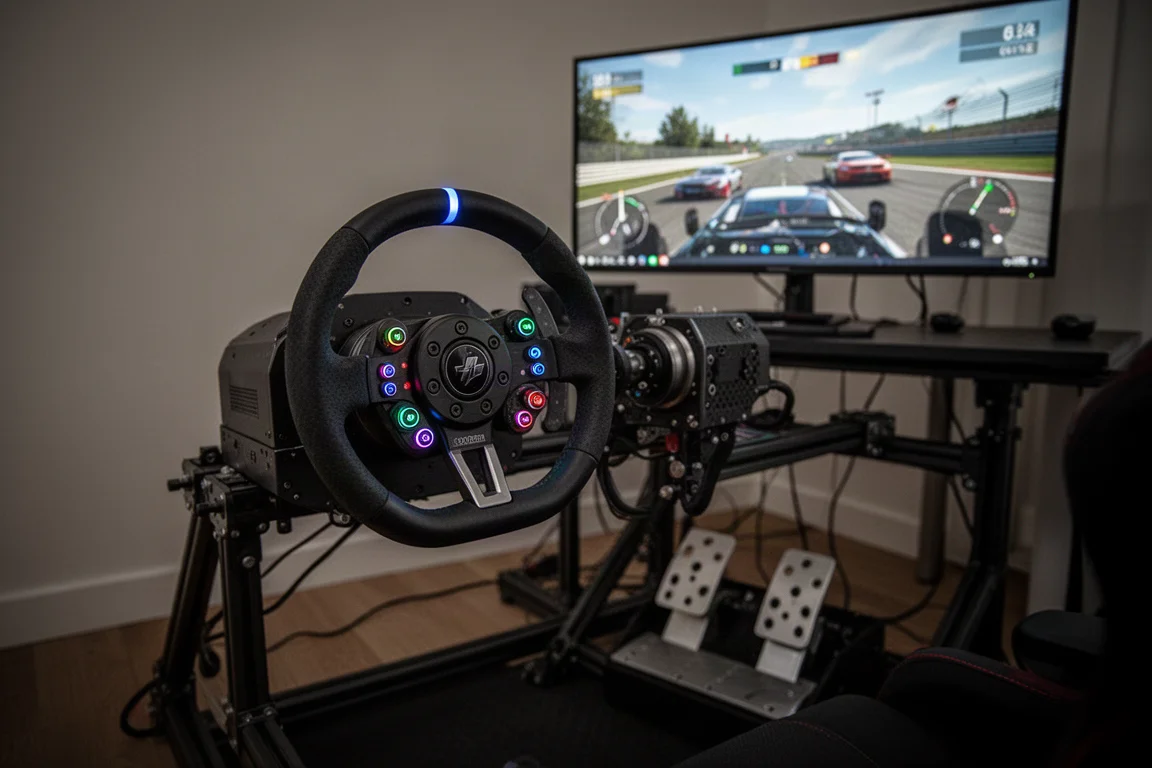
The base includes a solid steel table clamp that gets the job done, though it is not completely flex-free. At these torque levels, the table is likely to move more than the clamp anyway. On the rear, there is a power input, a USB-C PC connection, five USB ports for external peripherals, and a momentary switch for powering the base on and off or putting it into safe mode.
The encoder resolution is 14-bit, providing 16,384 points of resolution throughout a 360-degree rotation. This is on the lower side compared to some competitors. The PXN VD4 and VD6 use a 24-bit encoder, and the Moza R5’s latest revision uses a 15-bit encoder, giving roughly double the resolution. This difference may have a subtle impact on the driving experience, which we will cover later.
Asetek Initium Steering Wheel
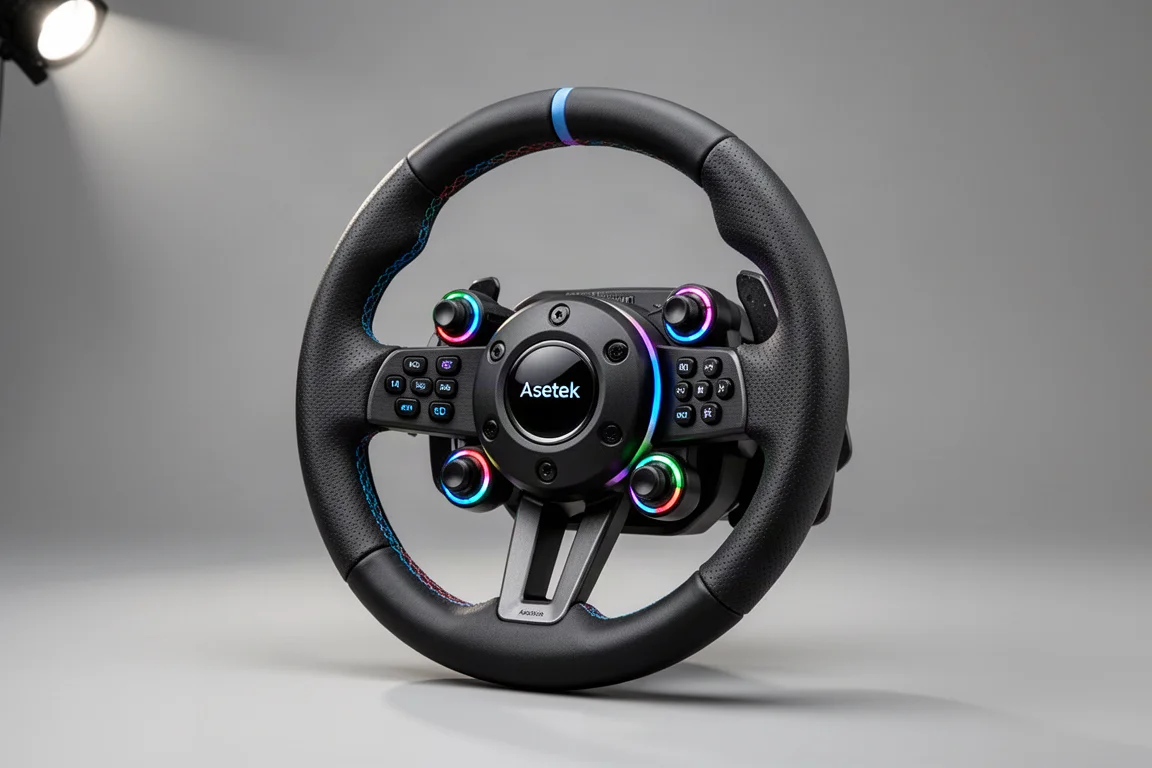
The Initium steering wheel is a bit of a polarizer. The design language leans toward a gaming device aesthetic, which may not appeal to everyone. Subjectively, the wheel looks a little toy-like compared to some race-car-inspired alternatives. Objectively, however, it is a good wheel.
The button quality is fine, with a nice snappy feel. The D-pad is responsive as well. There are 11 assignable push buttons on the front, two rotary encoders with a firm snap in each position, and an RGB addressable RPM strip. A start-stop button in the middle puts the base into safe mode, serving as an emergency stop option.
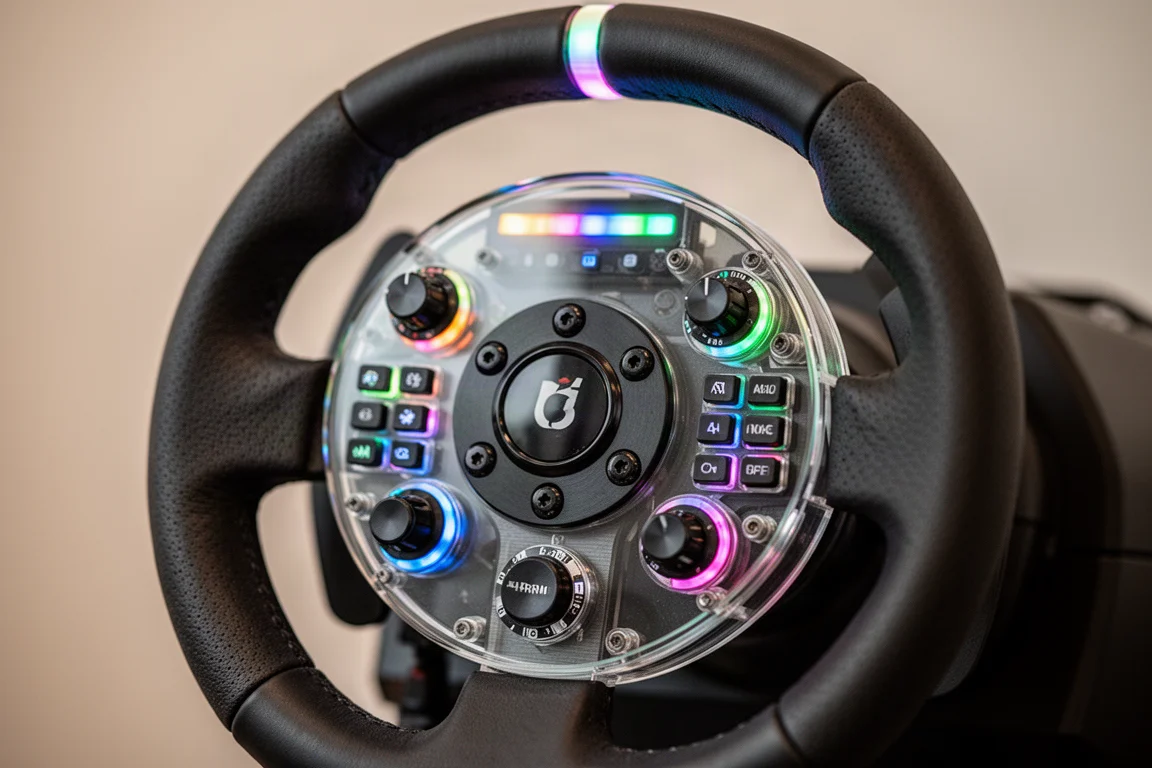
The 300mm diameter and round design make the wheel versatile, allowing for easy hand-over-hand steering for drifting. The rubber grip is ergonomically molded and comfortable. The glass-infused plastic faceplate extends around the back and down to the quick release, providing rigidity without excessive weight. This material is becoming more common in sim racing gear and offers a good balance of stiffness and cost.
One quality concern is that the caps on the rotary encoders pull off very easily. This could be an issue for anyone who fidgets with them, though it can be fixed with a little tape or glue. The shifters are also a weak point, feeling quite rattly. They do the job and are snappy, but they lack the quality feel of some other cheap wheels on the market.
Asetek Initium Pedals
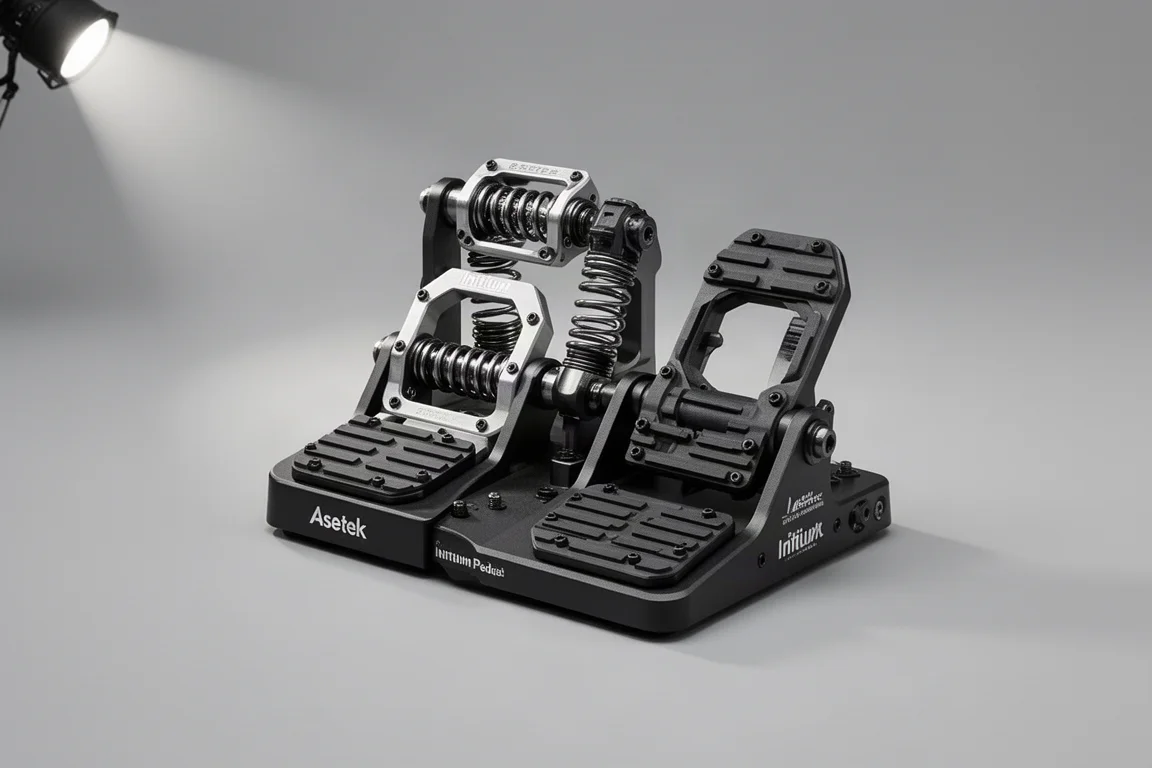
The Initium pedals are the standout part of this ecosystem. Straight out of the box, they are easily the best pedals tested at this price point. There are a couple of reasons for that.
First, the pedals can be switched between a couch or desk setup and a sim rig style setup. This tilts the pedals further forward for a more upright seating position. The adjustment is simple: undo the screws, spin a small plate inside, realign, and bolt it back together. This adaptability is rare in pedal sets designed for floor or carpet use, which are usually very limited when moved to a rig.
Second, the internal design is clever. The pedals use a spring stack with a default softer spring. There is a second stage keeper spring that provides a clearly defined threshold point in the braking. This allows for consistent modulation around that threshold, similar to what you would find in much more expensive pedals. The hall effect sensor at the base of each pedal detects the relative position, and because the physical travel is limited by the spring stack, you can still measure input beyond the threshold point. This is fundamentally different from most other position-based pedals at this price.
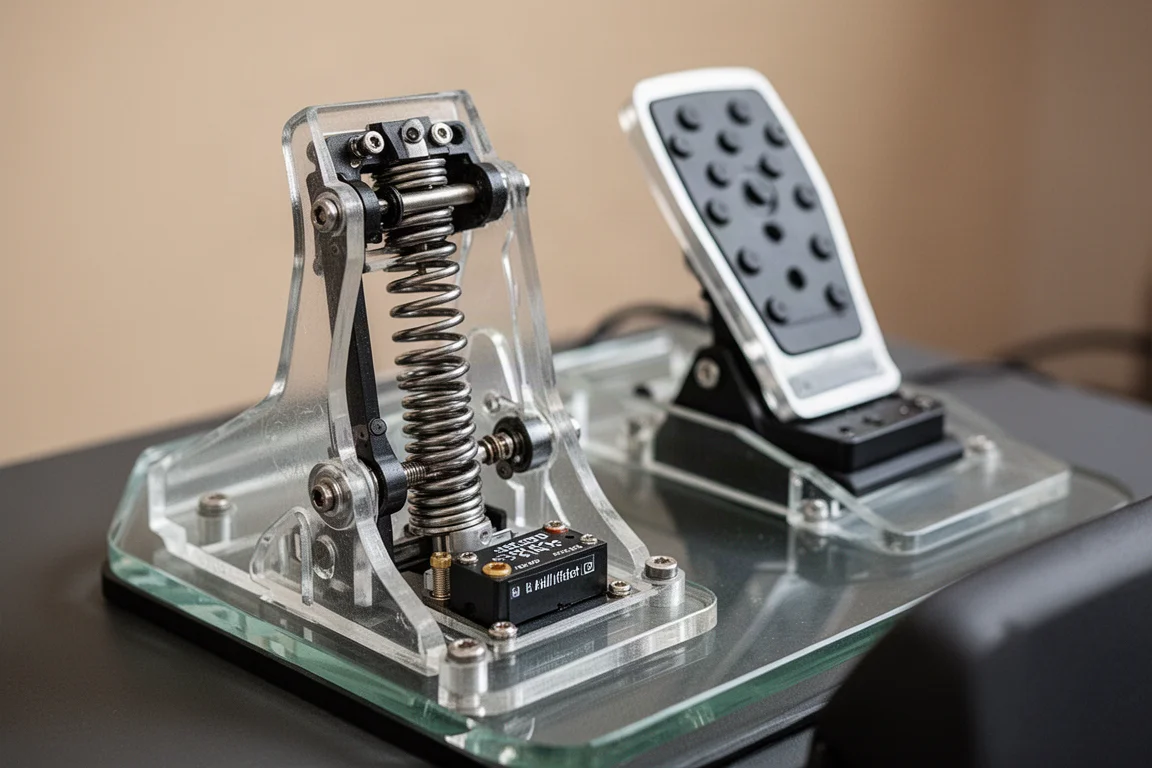
The only real criticism is the profound difference between the weaker and stiffer springs, with no adjustment range between them. Upgrading to the load cell kit for $119 provides more finesse in adjustment. There is also a clutch pedal upgrade for $39, a throttle pedal upgrade kit for $119, and a hydraulic system option for $329. Despite these options, the standard brake performs surprisingly well, and the upgrade may not be as necessary as it seems.
Software and Configuration
The RaceHub software handles all Asetek peripherals in one tidy interface. The left-hand menu shows connected devices, and there are tabs for settings, game setup, and info. Most sim racing titles do not require any setup, though a couple need plugins or manual adjustments.
The steering wheel settings allow for button configuration, including unpressed and pressed colors, as well as momentary or latched modes. Brightness adjustments and shift light customization are available, including smooth transition modes, flash colors, and patterns. SimHub compatibility makes each individual LED in the RPM strip addressable for deeper customization.
The wheelbase settings include center calibration, safety options like automatic centering strength and hands-off detection, and a force feedback tab with basic and advanced modes. The basic mode offers steering range, bump stop hardness, bump stop range, overall force, basic damping, and basic smoothing. The advanced mode adds high frequency limit, damping, friction, inertia, cornering force adjustment, torque behavior prediction, torque acceleration limit, and anti-oscillation. Tool tips explain each setting, and pre-baked profiles for F1 and GT are available.
The pedal settings include upper and lower dead zones, calibration, and nonlinear pedal maps for throttle and brake. These options allow for fine-tuning to match driving style and vehicle characteristics.
Overall Driving Experience
After two weeks of testing across rally, drifting, street racing, GT3, and Formula, the Initium wheelbase proved consistent across all titles. Once the force feedback settings were dialed in, little adjustment was needed between different types of driving. The raw feel is a strong point, with clean and well-polished algorithms that do not require much filtering to feel natural.
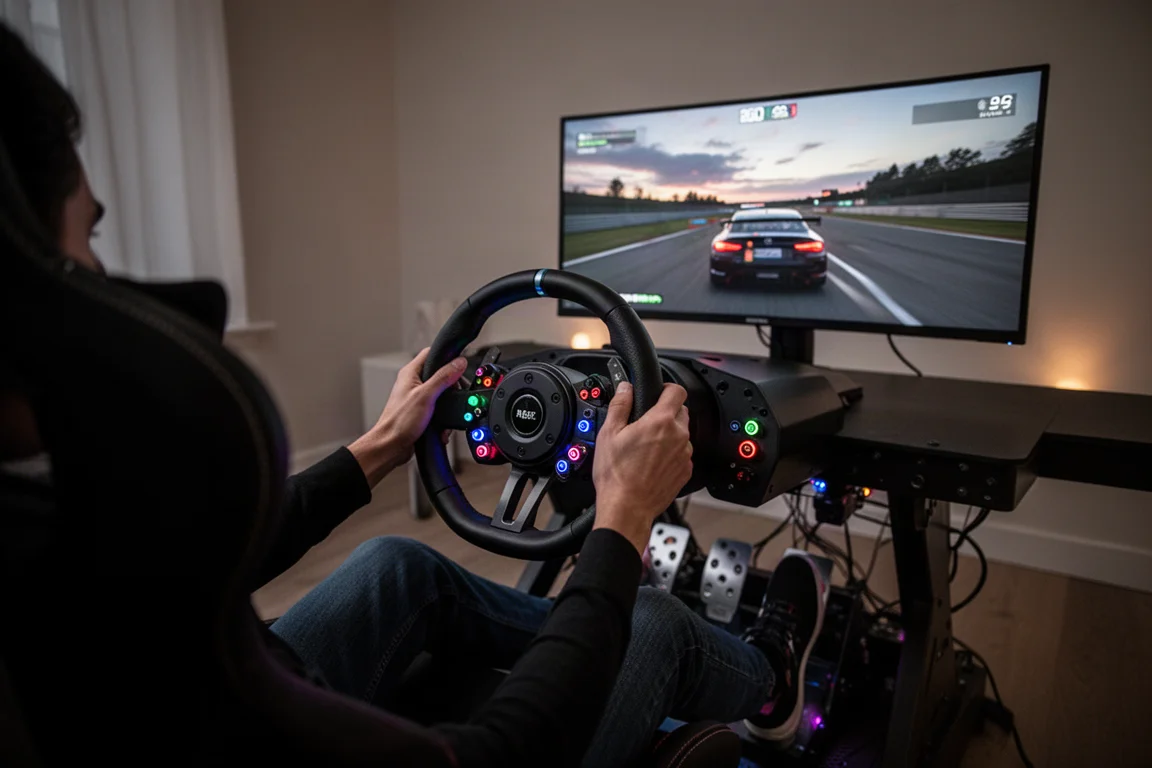
However, 5.5 Nm is not endgame strength. The dynamic range is limited compared to stronger bases, so weaker signals are scaled down, like turning the volume down on a stereo. This is not a criticism specific to the Initium, but rather a general characteristic of entry-level direct drive bases. There is also a slight fuzziness in the rotation that can be noticed in back-to-back testing against smoother competitors like the PXN bases. It is not a dealbreaker, and less than half of people would likely notice it without a direct comparison.
The wheel is lightweight, versatile, and ergonomically sound, despite the subjective design concerns. The pedals, however, are the real highlight. They exceed expectations in engineering, material choices, and driving feel, making them the most important part of this ecosystem.
Buying Advice
The Asetek Initium bundle presents strong value for money in a very competitive market. The wheelbase offers a refined raw driving experience with a clear upgrade path. The wheel is functional and comfortable, though the design may not appeal to everyone. The pedals are the standout, offering performance that rivals much more expensive options.
For those who prioritize raw force feedback feel and a clear upgrade path, this bundle is worth serious consideration. The pedals alone, at $119, are exceptional value and can be used with any wheelbase and wheel. The bundle with the cockpit at $1,049 provides a complete rig for just over $1,000, which is competitive with other options in this price range.
The main limitations are the 5.5 Nm torque output, the lower encoder resolution, and the subjective wheel design. The ecosystem is also less established than some competitors, though it is expected to grow over time.
Conclusion
The Asetek Initium range is a well-executed entry into the entry-level direct drive market. The wheelbase delivers a refined and consistent driving experience, the wheel is functional if not visually appealing to everyone, and the pedals are genuinely outstanding for the price. The upgrade paths for both the wheelbase and pedals add long-term value. While the market is saturated with good options, this bundle stands out for its raw feel and exceptional pedal set. If you understand the limitations of the force feedback, this is a bundle that is likely to thrill its owners.
Further reading
Related Reviews
Sim Racing
ConSimPit Ecosystem Overview 2026: Wheelbases, Pedals, and Wheels
A detailed look at ConSimPit's sim racing ecosystem, covering wheelbases, pedals, and steering wheels with honest observations on quality and value.
Sim Racing
Cube Controls Astra Review: A Lightweight Sim Racing Wheel That Nails the Fundamentals
The Cube Controls Astra is a lightweight aluminum sim racing wheel that focuses on build quality and driving feel over extra features.
Sim Racing
Direct Drive Wheelbase Technology Explained: What You Need to Know in 2026
A practical breakdown of direct drive wheelbase technology, from torque and dynamic range to telemetry force feedback, LF effects, and more.