Tower Speakers
Heco Aurora 1000 Review: A German Tower That Outperforms Its Parts List
Heco's flagship Aurora tower pairs a modest parts list with genuinely strong measured performance. Here is what $1,600 a pair buys, and where the compromises sit.
Introduction
Heco is not a name that turns up often in North American living rooms, but the company behind it has been building loudspeakers in Germany for decades, with roots reaching back to the 1950s. The Aurora 1000 is the flagship floorstander in the Aurora tower series, and it lands at a price that puts it within reach of far more listeners than most flagship designs: $799 each, or $1,600 a pair. In the United States the Aurora line is distributed through Audio Advice.
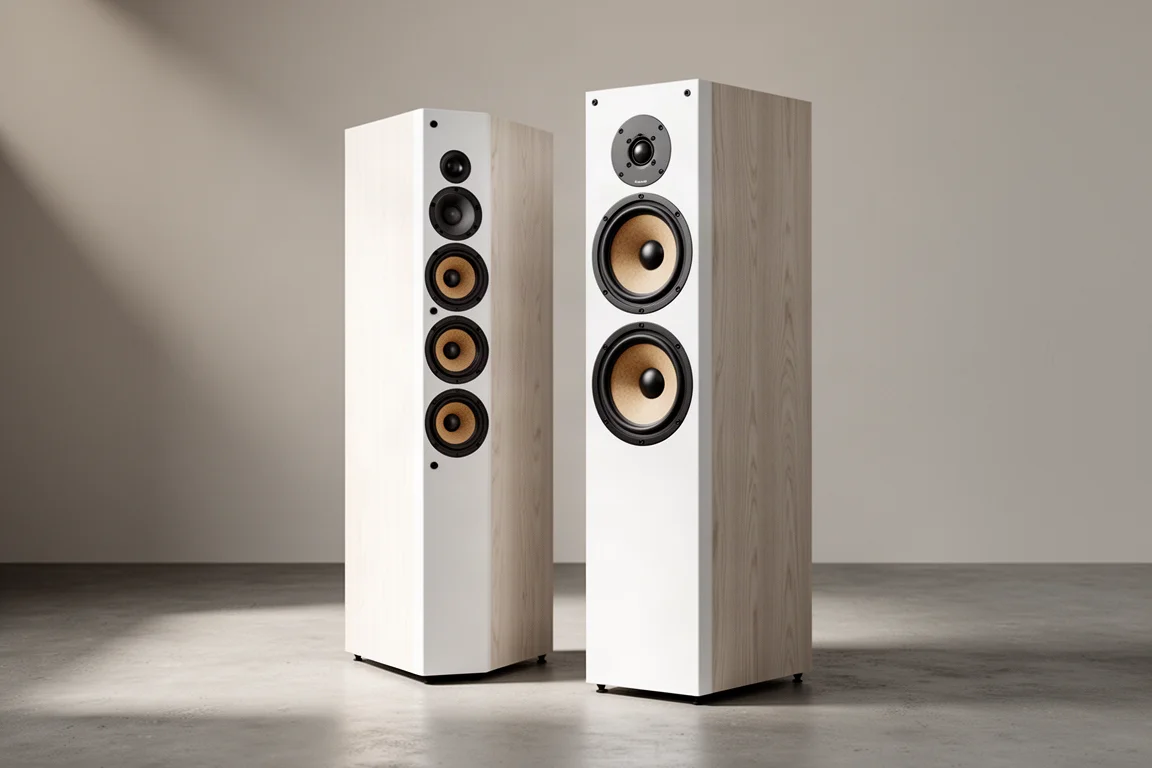
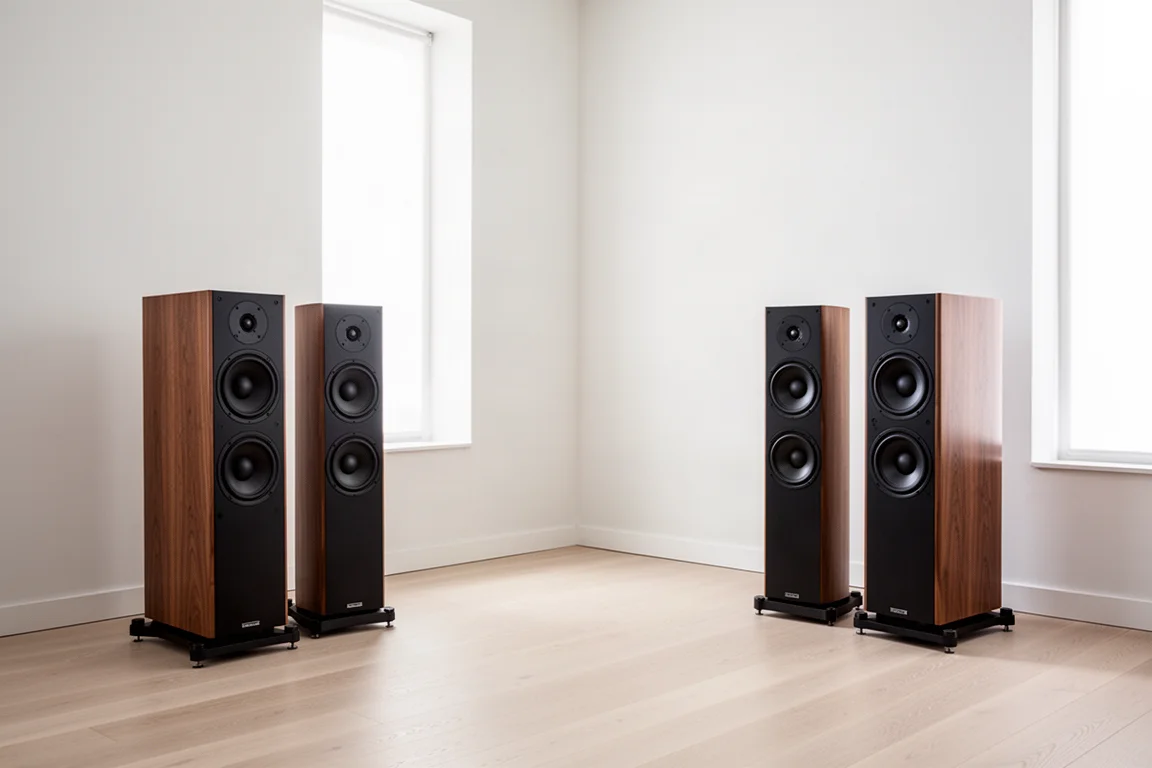
At a glance, the Aurora 1000 does not present itself as a statement product. The side panels wear a wood-grain vinyl, the rear terminal plate is plastic finished to resemble metal, and the drivers use paper cones. Judged on materials alone, it is easy to walk past.
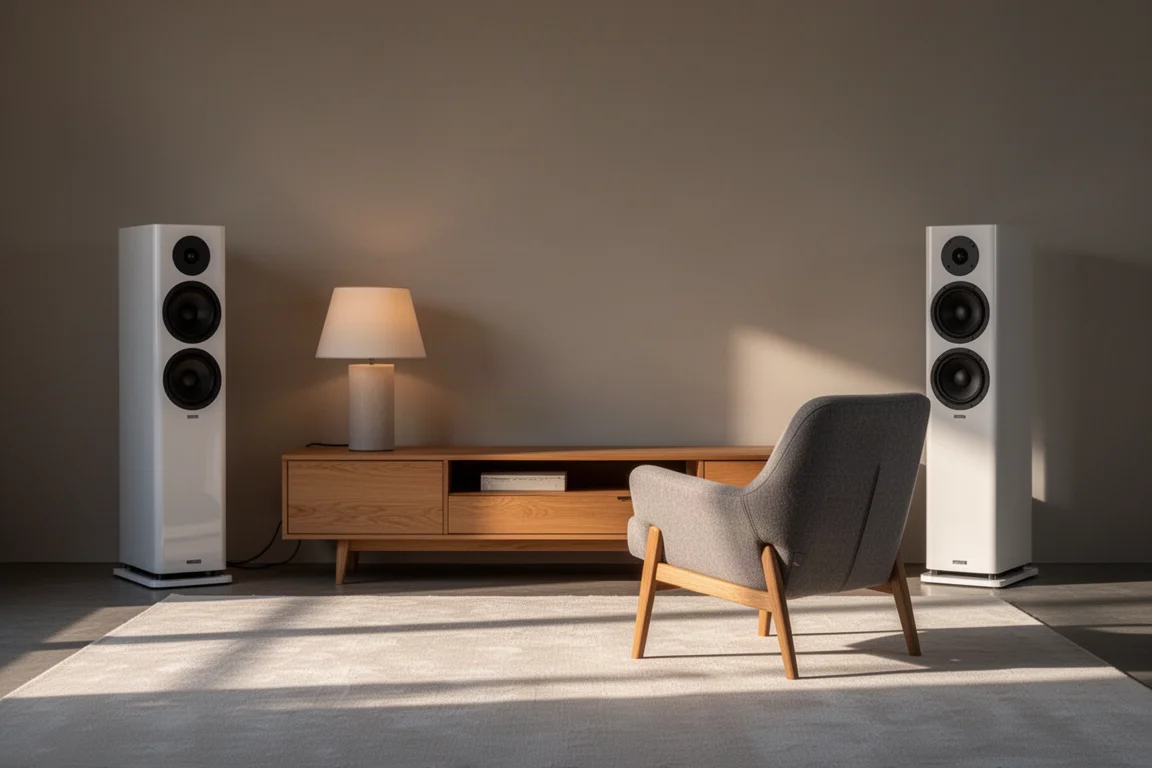
That first impression does not survive contact with the measurements or a listening session. This is a speaker whose performance comes from the way ordinary parts are integrated, not from any single exotic component, and the result is far more convincing than the price or the finish suggests.
Who the Heco Aurora 1000 Is For
The Aurora 1000 is aimed at listeners assembling a serious two-channel or home theater system who want a full-range tower without paying flagship money. Its 93 dB sensitivity means it does not demand exotic amplification, so a competent AV receiver will drive it without complaint and keep total system cost sensible.
It also suits people who value a broad listening window. The speaker holds a similar tonal character well off axis and across a wider vertical range than most towers with widely spaced drivers, so listeners who are not locked into tweeter height still get a coherent presentation.
It is less suited to buyers who put a premium on exotic cabinet materials and finishes, or who expect deep sub-bass extension without adding a subwoofer.
Main Strengths
Sound Quality and Measured Performance
The Aurora 1000 measures unusually well for its price. On-axis response is flat, and the off-axis curves track the on-axis curve closely, which is what lets a speaker sound natural across a real room rather than at one precise seat.
Horizontal dispersion is broad. Output stays strong out to roughly 50 degrees off axis at 10 kHz, and the speaker does not begin to beam until well above 10 kHz, later than many dome-tweeter designs. That means it can be aimed straight ahead and still deliver a neutral, even response across a wide seating area.
Vertically, the design holds its character from about minus 10 degrees to plus 15 degrees, with only a mild dip appearing at minus 15 degrees. That is remarkable for a tower with drivers spread across a 47-inch baffle, and it makes the speaker forgiving of seat height.
At the bottom end, ground-plane measurements are flat down to roughly 60 to 70 Hz before rolling off gently, closer to the behaviour of a well-damped sealed design than the usual ported boom. Bass stays clean and controlled, and room gain fills in the lower octaves in most spaces.
Driver Design and Cabinet Construction
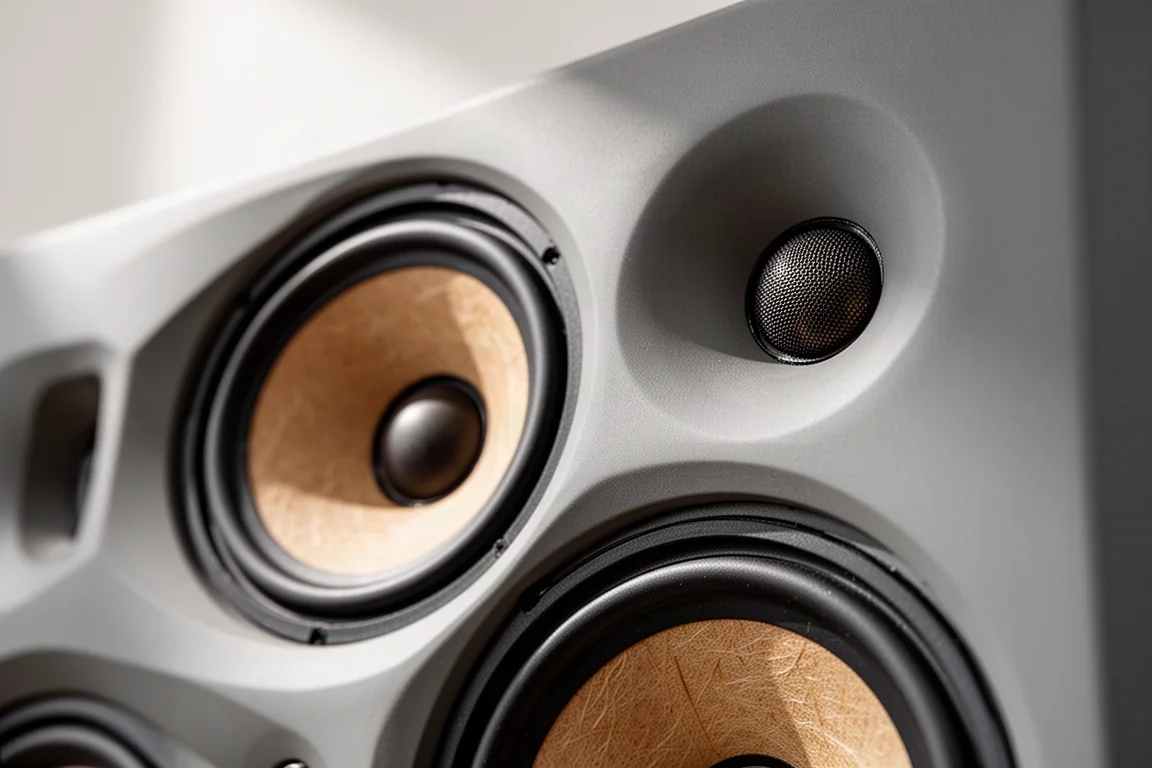
The Aurora 1000 is a three-way design built around a 1-inch dome tweeter, a 6.7-inch paper cone midrange and two 7.9-inch paper cone woofers. The midrange runs unusually wide, reaching down toward 50 Hz, which makes the speaker behave in some respects like a 2.5-way design and likely contributes to its stable vertical response.
The tweeter sits in a shallow moulded waveguide and uses a substantial ferrite magnet with an added bucking magnet. The midrange driver carries a bucking magnet as well. Those magnets were once used to shield drivers from CRT televisions, but their presence here more plausibly raises magnetic field strength in the gap. The driver baskets are ventilated for voice coil cooling and carry Heco branding, a small touch that suggests care in sourcing.
Power handling is rated around 250 watts, and the speaker is bi-ampable, although its output capability does not really demand it. The crossover uses roughly 11 or 12 elements, a more substantial network than the minimal designs often found in budget towers. The cabinet is half-inch MDF with three window braces dividing the internal volume, and the rear ports are flared at both ends.
Things to Consider Before Buying
Cabinet, Finish, and Build
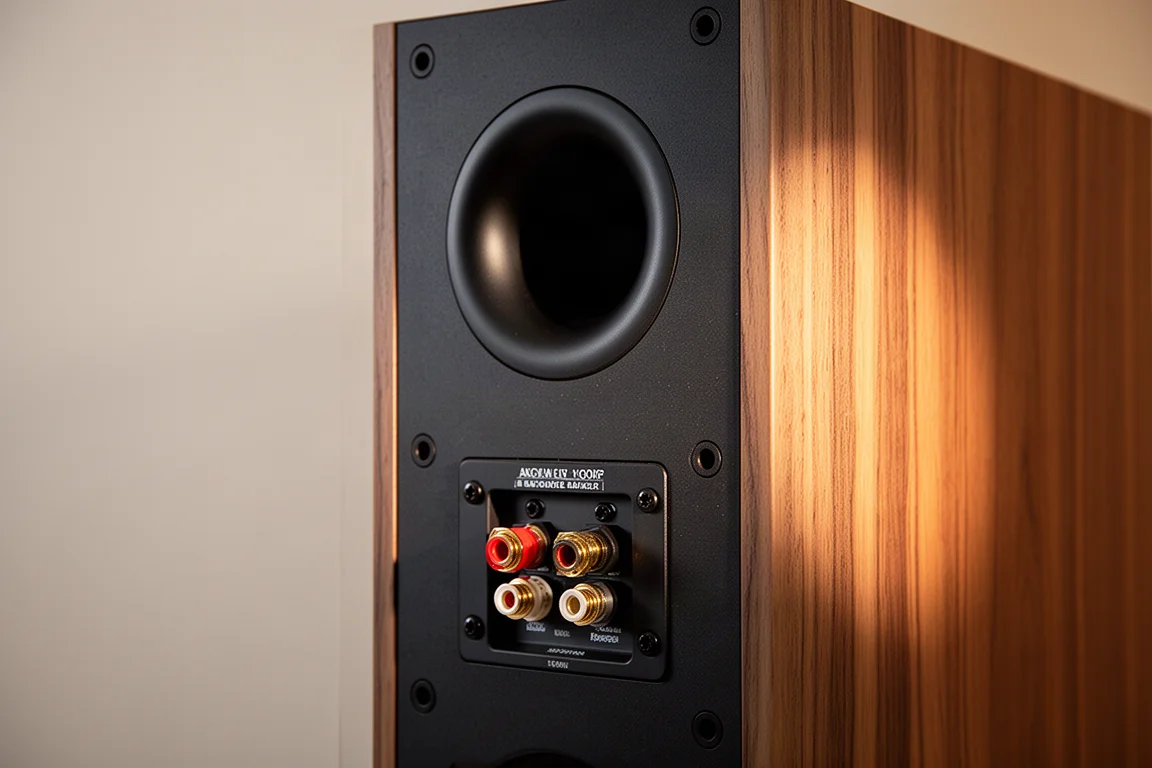
The cabinet is where the budget clearly landed. Half-inch MDF is thinner than the material used in more expensive towers, and the wood-grain vinyl side panels and plastic rear plate look convincing from across a room but less so up close. Neither detail affects the sound, but buyers who care about materials should know what they are getting.
Small ripples appear in the impedance curve between roughly 200 and 500 Hz. Those trace back to upper port resonances rather than to a flexing cabinet panel, which is the better outcome of the two.
Owners who enjoy tinkering can improve cabinet damping by adding internal panel bracing with a viscoelastic adhesive. It is a cheap and effective upgrade on many speakers, but any internal modification will void the warranty, so it is only worth considering for confident DIYers.
Power, Placement, and Setup
Impedance sits closer to 4 ohms than to 8, with a dip toward 4 ohms at high frequencies, a consequence of the ferrite tweeter being used to raise system sensitivity. Nothing here is a difficult load, and any semi-decent amplifier or AV receiver will run the speaker comfortably.
The speaker is intended to run with both rear ports open, which tunes it to about 30 Hz. Sealing one port lowers tuning to roughly 22 Hz and adds usable deep bass, at the cost of 4 to 5 dB of sensitivity. That trade-off makes sense mainly in a small room at moderate listening levels, and it is not how the speaker is designed to be used.
Placement is relatively forgiving thanks to the wide vertical window, but the rear ports still benefit from some distance to the wall behind them.
Buying Advice
Positioning matters here. The Aurora 1000 sits in the middle of a group of high-value tower speakers, above the Monolith Encore T6 on price and below the Polk Reserve R700. It is a more capable speaker than the T6 in most respects. Against the Reserve R700 it is not quite the equal overall, yet in a few areas it is just as good, and occasionally slightly better. That is a strong result for a speaker costing what it does.
If your budget lands near $1,600 a pair and you want a tower that is easy to drive, measures cleanly and throws a wide, stable image, the Aurora 1000 deserves a place on your shortlist. If you want heavier cabinet construction or a more upscale finish, expect to pay more elsewhere.
Conclusion
The Heco Aurora 1000 is a reminder that parts lists and first impressions do not tell the whole story. Its vinyl wrap and paper cones look modest, but its measured behaviour, wide dispersion and clean, controlled bass put it well ahead of what its price suggests. For listeners who want a well-engineered German tower without flagship pricing, it is an easy speaker to recommend.
Product link
View more details for Heco Aurora 1000
This product is mentioned in the review. Check the specifications, options, and compatibility before buying.
View more details for Heco Aurora 1000Further reading
Related Reviews
Tower Speakers
Arendal 1610 Tower 8 vs MoFi SourcePoint 888 vs MoFi V10: Three Tower Speakers Compared
A close look at three large tower speakers in a similar price bracket, from the punchy, heavy-built Arendal 1610 Tower 8 to the coaxial MoFi SourcePoint 888 and the high-output MoFi V10.
Tower Speakers
Definitive Technology BP9020 Review: A Powered Tower With Real Bass and a Few Quirks
A slim tower speaker that hides a powered 8-inch subwoofer inside the cabinet, delivering deep bass and a wide stage alongside some clearly defined trade-offs.
Tower Speakers
Emotiva XT1 Tower Speakers Review: Serious Clarity Under $1,000
The Emotiva XT1 brings three woofers, a dedicated midrange and an AMT tweeter to the sub-$1,000 tower market. Here is where it delivers and what to weigh first.