Soundbars
Devialet Dione Review: A Standalone Dolby Atmos Soundbar With a Rotating Orb
A detailed look at the Devialet Dione, a standalone 5.1.2 Dolby Atmos soundbar with a rotating centre-channel orb, eight built-in woofers and a wall-mount mode that adapts the sound.
Introduction
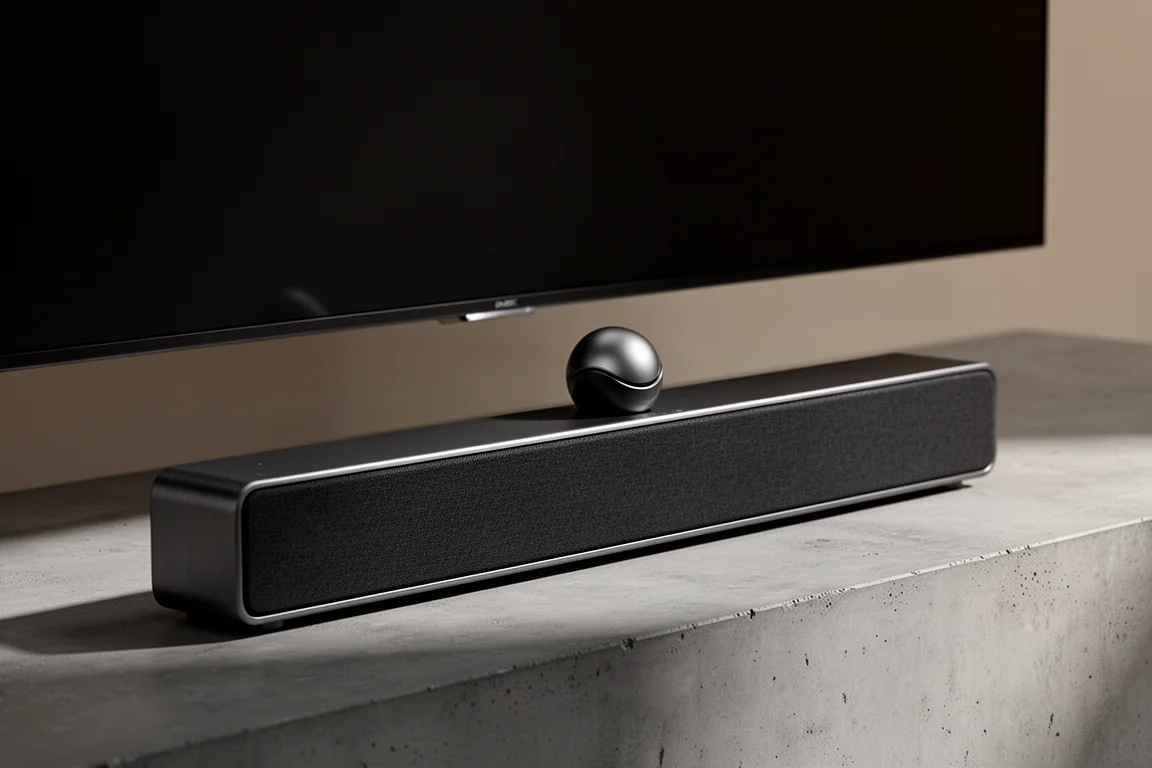
The Devialet Dione is the first Dolby Atmos soundbar from Devialet, a Paris-based acoustical engineering company that has been designing high-performance audio gear since 2007 and is best known for its Phantom loudspeakers. Instead of a bar paired with a separate subwoofer and rear speakers, the Dione is a completely standalone 5.1.2 Dolby Atmos system built for rooms where floor space is tight but the appetite for immersive sound is not.
That ambition shapes the whole product. The cabinet is slim enough to slide under a modern television, a rotating sphere on top serves as the centre channel, and the internal driver array is designed to reach down to 24 Hz without a separate subwoofer.
This review covers the design, the key technology, and how the bar performs in a medium-sized room.
Who This Soundbar Is For
The Dione is aimed at listeners who want Dolby Atmos from a single piece of equipment. In a small to medium living room, a bedroom, or an apartment where rear speakers and a subwoofer are impractical, the appeal is simple: 5.1.2 channels, no extra boxes, no extra cable runs.
It also makes sense for anyone already living with Devialet hardware. The Dione joins Phantom speakers over AirPlay 2, so a home already running a Phantom system can add the bar as another room and manage everything together.
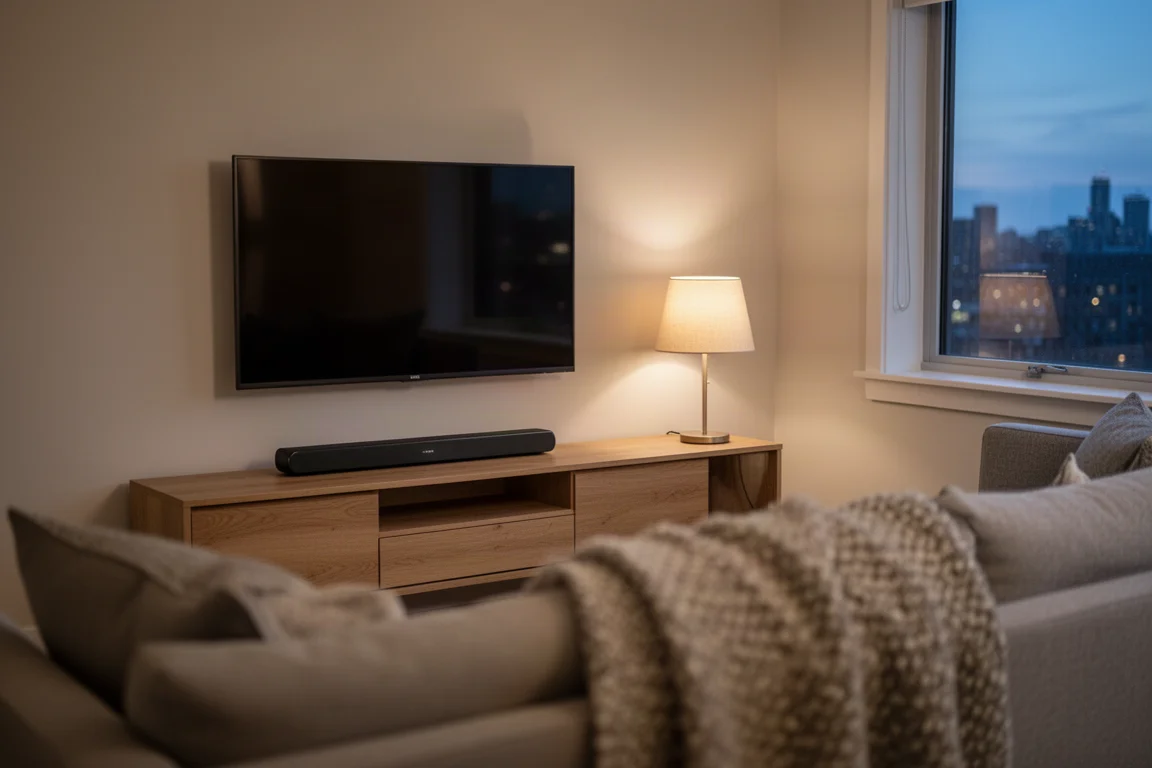
It is not aimed at listeners chasing the absolute limit of immersion. A dedicated subwoofer and physical surround speakers around the room will always produce a more enveloping presentation than a self-contained bar can, and the Dione does not pretend otherwise.
Design and Build Quality
The numbers are unusual for a soundbar. The cabinet stands roughly three inches tall, or about three and a half inches including the sphere, spans 47 inches wide, and measures 6.5 inches deep. It weighs just shy of 26.5 pounds, which says a great deal about the density of the materials.
The body is a dark grey anodised aluminium frame wrapped in carefully selected black acoustic fabric for the grille cloth. In shelf mode, the low profile slides under most modern televisions and looks particularly well matched to screens 55 inches and wider.
The wall brackets and every connection sit on the underside of the cabinet rather than on the back, which keeps the rear face clean and makes wall mounting much simpler. Connections include an Ethernet port for network hookup, a digital optical Toslink input for televisions without ARC or eARC, a single HDMI eARC input for uncompressed Dolby Atmos, and the power connection.
The Rotating Orb and Wall Mount Mode
The first thing most people notice is the patented central orb on top of the bar. The curved sphere is not decoration: it is the dedicated centre channel speaker, and its shape follows the Olsen curve principle used in the Phantom range, a geometry intended to keep sound waves from breaking up or diffracting as they leave the cabinet.
The goal is to spread voices and vocals into the central listening area for clear mid-range reproduction on films and series. Mechanically, the orb rotates, so the bar can be repositioned while the sphere keeps a front-facing orientation.
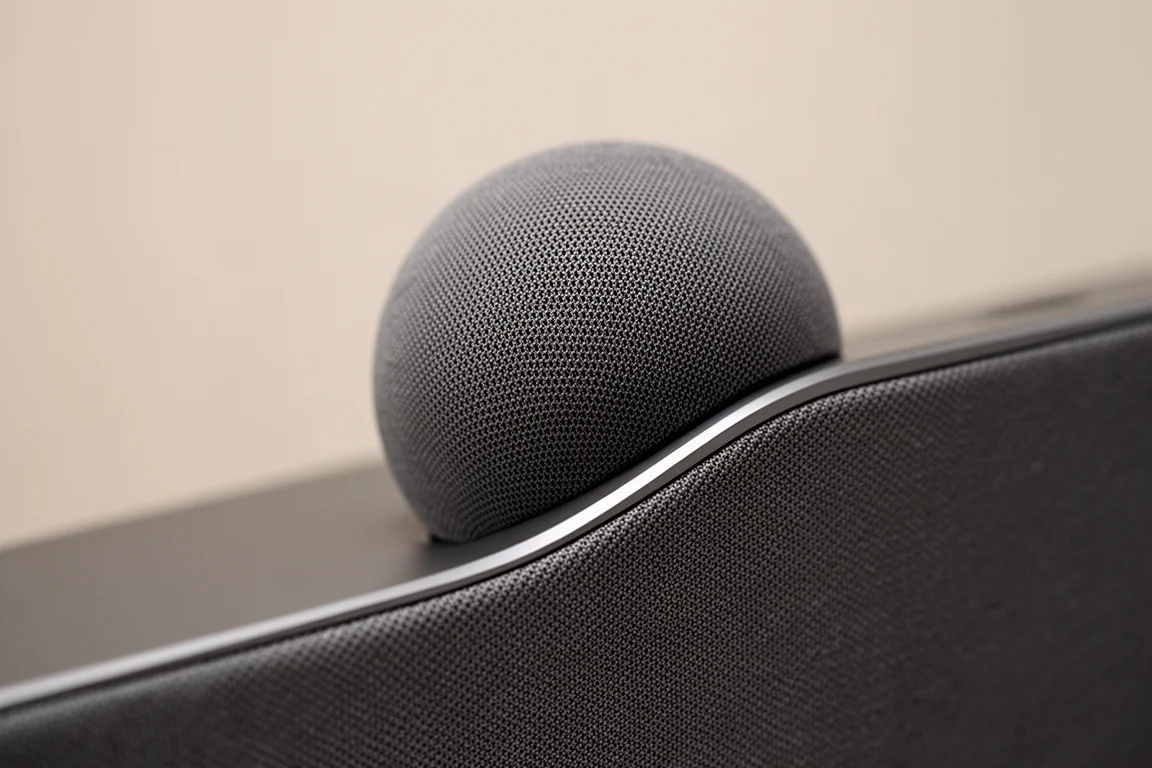
Wall mode is where the design earns its keep. Rotating the orb fully and mounting the bar to the wall changes the directional dispersion pattern of the centre channel, and the orientation of the other drivers adapts with it. A built-in gyroscope detects the mounting position and adjusts the audio signal automatically, using DSP that relies on beam forming. The result is a 5.1.2 presentation tuned for the wall rather than simply fired sideways from it.
Dolby Atmos Performance and Key Features
Under the fabric there are 17 autonomous custom drivers, each built with an aluminium membrane and a high-field neodymium magnet. Nine of them are full aluminium drivers responsible for dynamic mid-range and treble extension up to 21 kHz.
In the default shelf position, two full-range aluminium Atmos drivers on top of the bar fire the height channels upward to create a sense of elevation. Rotate the bar 180 degrees for wall mounting and those height drivers are rededicated as the left and right channels, while the left and right drivers take over Atmos duty. The gyroscope handles the switch automatically.
Bass comes from eight neodymium high-excursion, long-throw woofers that reproduce deep 24 Hz output. In smaller rooms, that is enough to remove the need for a separate subwoofer altogether.
Power is rated at 950 watts total from a custom-built supply, with a maximum loudness of 101 dB SPL, which is ample for a small to medium living room or a large master bedroom. Processing runs through the company’s Intelligence processor, an in-house audio system on a chip with its own DAC carried over from the top-of-the-line Phantom speakers, combining bespoke amplification and signal processing in a one square centimetre chipset that minimises noise and distortion.
Two software features are worth calling out. Adaptive Volume Level is a dynamic level control that tailors levels to the content in real time, lifting quiet dialogue in an otherwise explosive action scene. SPACE is a patented 3D algorithm that upscales non-Atmos sources into a 5.1.2 signal; it is enabled by default and can be switched off in the app.
Room Calibration, Controls, and Streaming
Setup runs through the companion app using the bar’s built-in calibration microphones. The scan needed a few attempts before it settled on an accurate reading, but the improvement in sound once it did was noticeable. A microphone button on top of the bar deactivates the calibration mics, which is a welcome physical control for anyone with privacy concerns.
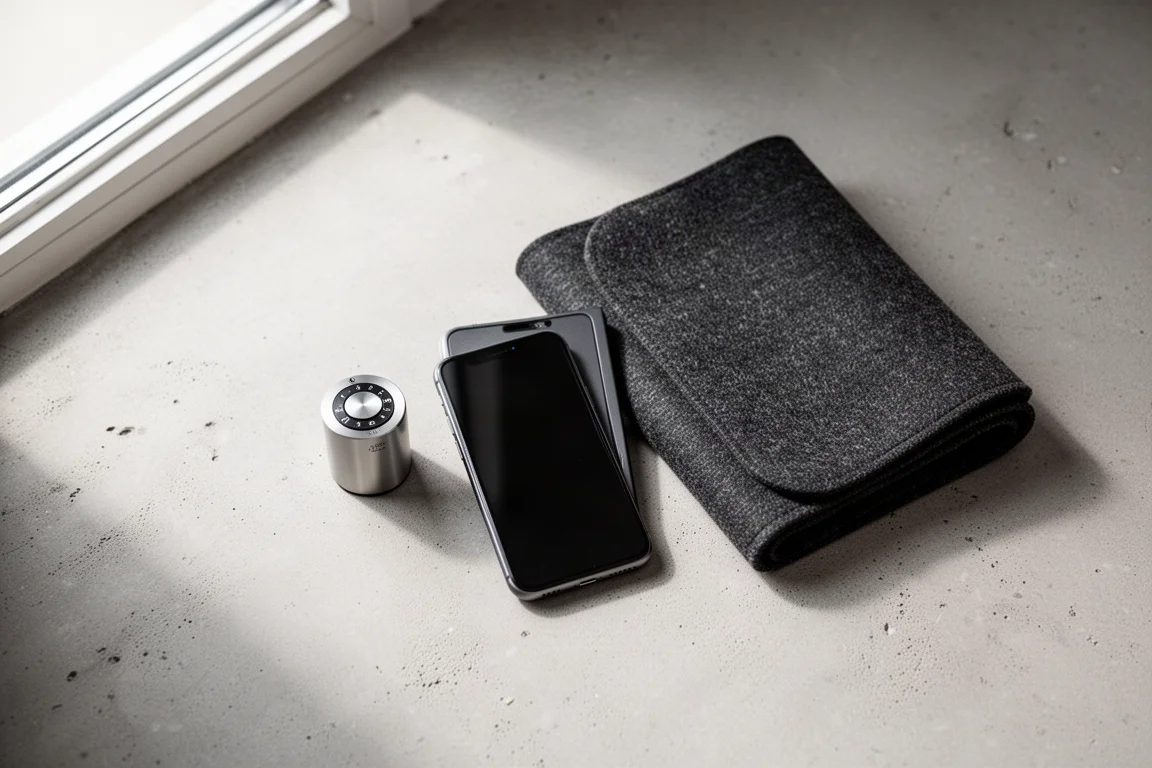
No remote control is included in the box. Devialet’s dedicated rechargeable remote, the same one bundled with the Phantom speakers, is sold separately, and its smooth rotary dial makes precise volume changes easy, especially when several speakers around the house need adjusting individually.
Streaming covers Bluetooth 5.0, AirPlay 2, Spotify Connect and UPnP, the last of which handles high-resolution music stored on external hard drives through the app. Four sound modes are available. Movie converts mono and stereo signals from the HDMI or optical input into a 5.1.2 presentation. Spatial upscales music streamed over AirPlay 2, Bluetooth, Spotify Connect and UPnP into 5.1.2 spatial audio. Voice boosts the accuracy and intelligibility of speech for podcasts, news programmes and audiobooks. Music disables spatialisation for a more faithful stereo reproduction.
Listening Impressions in a Medium-Sized Room
The test room was a typical medium living room, roughly 12 feet wide and 16 feet deep with 9-foot ceilings.
Dialogue was the standout. Streaming The Batman with its Dolby Atmos mix, voices and speech came through clearly and the volume never had to be raised to follow a conversation. At maximum volume that particular mix still did not fill the room, but the Atmos mix of that film is quieter than average, which underlines how much the source material matters. Where the bar did impress was low end. Around an hour and ten minutes in, a bomb scene uses a low-pass filtered effect to mimic muffled hearing, and the bass arrived with enough weight to shake the walls, comparable to having a good compact subwoofer in the room.
A properly mixed Atmos title showed more of what the bar can do. During a fight scene in The Adam Project, kicks, punches and explosions landed with slam and impact, and the centre channel orb kept dialogue clear without leaning on any processing. Voice enhancement mode pushed intelligibility even further, though it also tightened the overall presentation, which makes it a better fit for podcasts, news, sports and narrated documentaries than for films.
Foundation, used as a Dolby Atmos demonstration for the Dione, showed off the mid-range. Dialogue never sounded harsh or hissy, and voices mixed to sound distant remained legible. Smaller effects landed with real detail too: roughly ten minutes into the second episode of the first season, the sound of drilling inside subterranean caverns includes tiny rocky debris spraying upward and falling back to the ground.
Things to Consider Before Buying
The Dione is not a replacement for a full-size home theater. Dedicated surround speakers and a separate subwoofer will always deliver a more immersive result, and the bar’s strength is how much of that experience it delivers from one slim cabinet in a small to medium room.
Source quality matters more than it does with a traditional system. A quietly mixed Atmos track will sound exactly that, and the bar’s own adaptive processing can only do so much.
There is no remote in the box, so the rotary remote is an additional purchase if you want one. Room calibration also benefits from a little patience, since the app may need more than one scan to produce an accurate reading.
On loudness, the presentation could go a little further at the top end to match the Atmos effects of some other bars. Devialet has confirmed an update that will increase loudness, so the ceiling is not necessarily final.
Buying Advice
Buy the Dione if you want Dolby Atmos in a room where extra speakers are not an option. Its slim cabinet fits neatly under a television, the wall-mounted configuration turns it into a genuine design piece, and the built-in woofers mean you can skip the subwoofer without giving up low end. Homes already running Phantom speakers get the additional benefit of a single multi-room ecosystem.
Look elsewhere if you have the space and the budget for a dedicated home theater arrangement, since physical surround speakers and a proper subwoofer remain the more immersive route. If maximum volume headroom is a priority, it is also worth checking where the loudness update lands before committing.
Conclusion
The Devialet Dione is a considered answer to a specific problem: how to get convincing 5.1.2 Dolby Atmos into a room that cannot host a conventional surround system. The rotating orb, the gyroscope-driven wall mode and the eight built-in woofers are not marketing flourishes. They are the engineering that lets a three-inch-tall bar carry clear dialogue and genuinely deep bass on its own.
It will not out-immerse a full home theater setup, and the missing remote and modest top-end loudness are fair points to weigh. For a small to medium living room, a bedroom or an apartment, though, it delivers a great deal of Dolby Atmos from one very discreet piece of equipment, and it does so with a level of finish that matches its high-end positioning.
Product link
View more details for Devialet Dione
This product is mentioned in the review. Check the specifications, options, and compatibility before buying.
View more details for Devialet DioneFurther reading
Related Reviews
Soundbars
Bang & Olufsen Premiere Review: A Compact Soundbar Built to Last
A close look at the Bang & Olufsen Premiere, a compact soundbar with deep bass for its size, automatic sound profiles, and a clear modular upgrade path.
Soundbars
Best Dolby Atmos Soundbars: Six Picks for Movies, Music, and Small Rooms
A practical roundup of six Dolby Atmos soundbars, from compact dialogue-focused bars to expandable systems and an all-in-one flagship.
Soundbars
Bluesound Pulse Cinema Review: A Music-First Soundbar With a Software Catch
A close look at the Bluesound Pulse Cinema, a 3.2.2 soundbar with a genuinely expressive midrange and natural tone, plus the app and expansion limits worth knowing before you buy.