Soundbars
Canvas Review: A New All-in-One Speaker Built Around Real Stereo
Canvas is a premium all-in-one speaker that puts genuine stereo separation, deep in-room bass, and build quality ahead of surround effects, with clear limits worth knowing before you buy.
Introduction
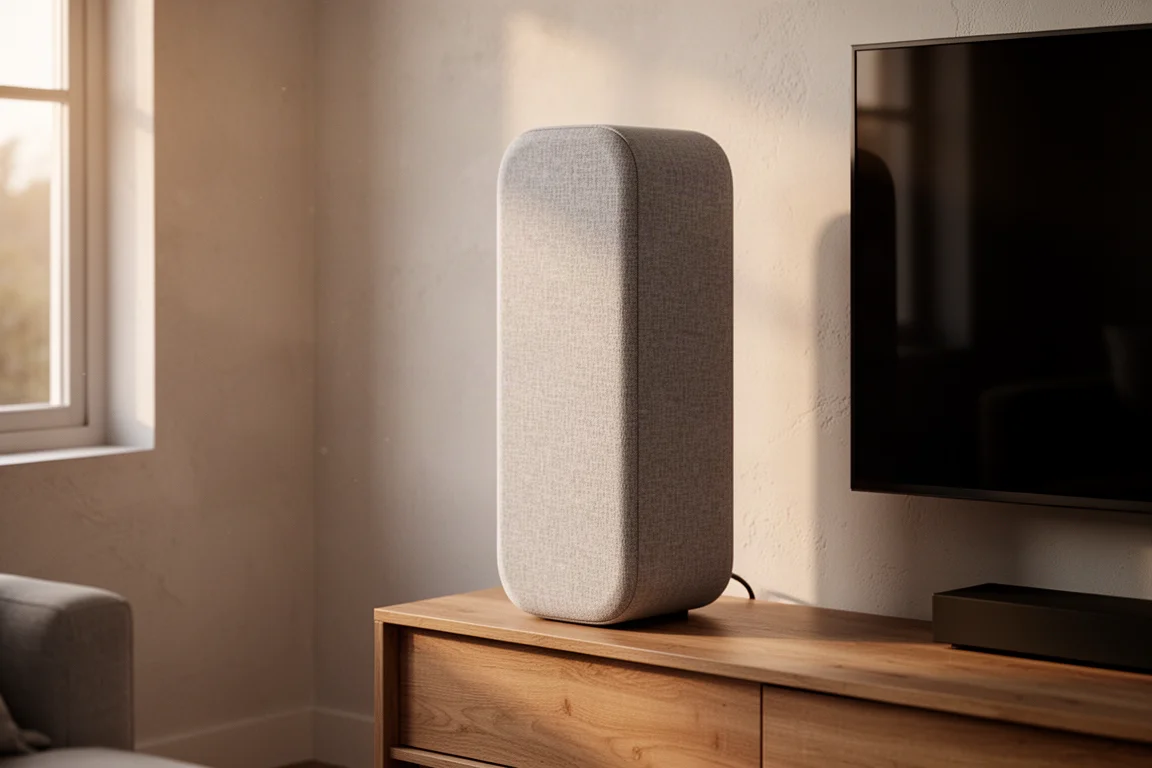
Canvas is the debut product from a new name in home audio, and it takes an unusual position for a speaker designed to sit beneath a television. Most all-in-one bars pursue immersion with a large count of small drivers, heavy digital processing, and a separate subwoofer. Canvas goes the other way. It puts a pair of genuinely full-size speaker drivers into a single cabinet and treats stereo reproduction as the priority, with movie duty as a secondary strength.
Pricing sits around $3,500 in the United States, and the speaker is offered in more than one size with interchangeable covers.
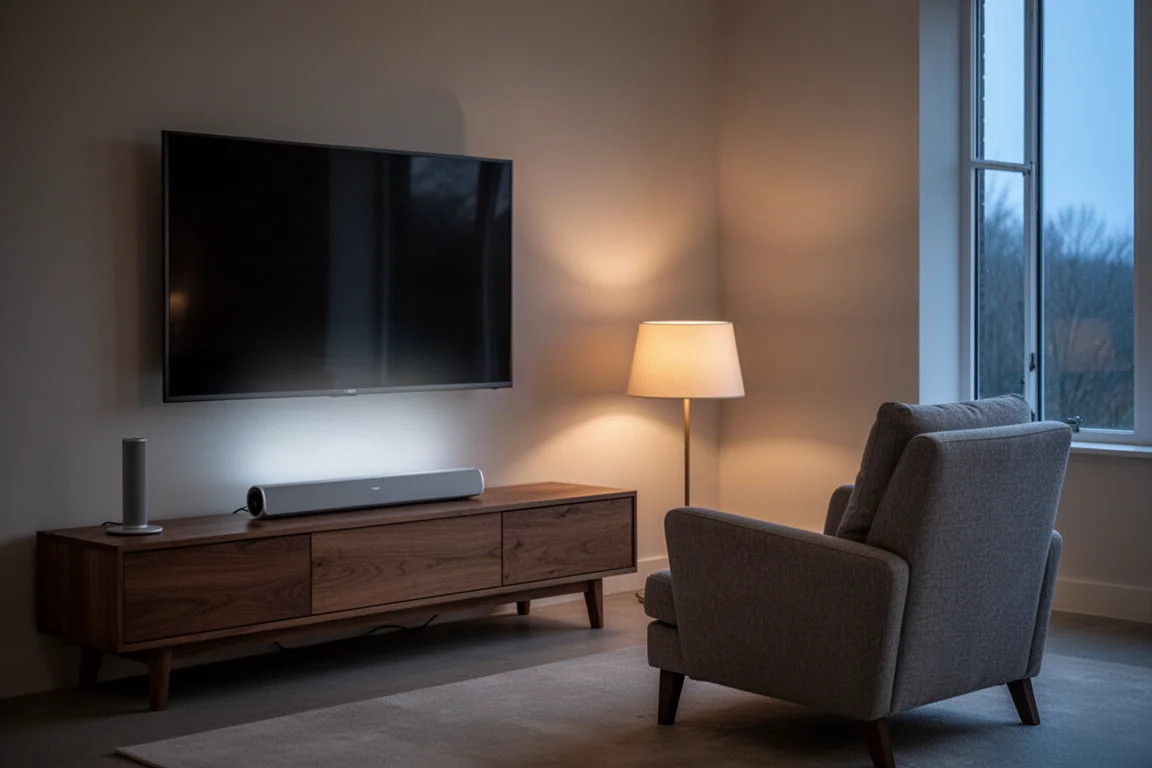
The appeal is straightforward. If you are downsizing a hi-fi or home theater system and want fewer boxes and fewer cables without surrendering tone quality, Canvas is aimed directly at you. It is also the rare all-in-one that behaves like a pair of proper speakers rather than a bar pretending to be one.
Who the Canvas Is For
Canvas suits listeners who are reducing the amount of equipment in their home but are not willing to accept a thin, heavily processed sound. It is a strong fit if you want one component that handles music well, integrates cleanly with a television, and looks deliberate in a living space rather than like an afterthought.
It is also a sensible option for anyone who has been considering a compact all-in-one system from a premium brand but cannot justify the cost of entry.
It is not the right choice if your priority is a sound field that wraps around and behind the listening position. Canvas has no rear speakers and no reflective drivers, so the presentation reaches the sides and slightly ahead of the sofa rather than surrounding it.
Main Strengths
Sound Quality and Scale
Bass extension is the headline. Canvas reached 30 Hz in-room at reference levels of 75 dB, 85 dB, and even 90 dB. That matches an all-in-one system paired with dual 8-inch subwoofers, which itself gives up at roughly 30 Hz. Choosing Canvas over that configuration therefore costs very little in low-frequency reach.
Tonally it behaves like a good pair of bookshelf speakers with a well-placed 8-inch subwoofer sitting nearby. Consistency from about 30 Hz up to 20 kHz is exceptional, and the coherence from top to bottom is the kind normally associated with separate speakers rather than a single cabinet.

Center focus is another strength. The 3D crosstalk-cancellation processing widens the perceived stage and makes the left and right images more defined, but it does not hollow out the center. The center stays solid; only the sense of width grows. It is pure crosstalk cancellation rather than the virtualization trickery used by most bars, and nothing in the material tried sounded unnatural or phasey as a result.
There is no dedicated dialogue mode. A practical workaround exists: switching the 3D processing off collapses the stage back toward the cabinet and pushes voices more forward, which helps with content that is not well miked. On well-produced material the processing can stay on without penalty.
Volume behavior is another point in its favor. It can be driven hard without feeling like it is shouting at you, which is not something every all-in-one manages.
Design, Build, and Setup
Canvas is built better and looks more considered than the typical soundbar. Covers are interchangeable, so the finish can be changed to suit a room, and the cabinet can be floor-mounted as well as placed on a stand or shelf.
Setup is simple. Room correction is onboard and the system runs on a single wire. The platform is also described as upgradeable in both software and hardware, following the approach premium brands have taken with field-upgradable speakers, which suggests the product can grow rather than be replaced.
How the Canvas Compares With the Alternatives
Against the Dragon, Canvas is the stronger performer and the cheaper of the two. The Dragon with dual 8-inch subwoofers gives up at around 30 Hz, so it offers no meaningful extension advantage, and it wants to be played loud to sound its best. Canvas reaches the same low-frequency point without the sense of being yelled at. For anyone considering the Dragon mainly to reduce box count, Canvas covers the same ground with better build quality, room correction, single-wire setup, and a more distinctive look.
Against the Bang & Olufsen Theatre, the picture is more complicated. The Theatre is the more complete product: more drivers, greater overall capability, a genuinely excellent app, and a level of material refinement that is hard to match. It can also be expanded with additional speakers and used with a receiver as a center channel, and its app gives owners far more control. It also costs substantially more, around $11,000 in North America following a broad price increase across the brand. If budget is not a concern and the design appeals, the Theatre is the better all-in-one. Canvas occupies the gap below it at roughly a third of the price, which is a meaningful position in the market.
Against the Sennheiser Ambeo, the split comes down to use case. The Ambeo can produce a genuinely enveloping surround field from a single bar, accepts subwoofers, and offers multiple HDMI inputs. For movie immersion it has a wow factor Canvas cannot match. For music the two are close, and Canvas is the more convincing of the pair, sounding more like a good set of speakers with a subwoofer than like a bar.
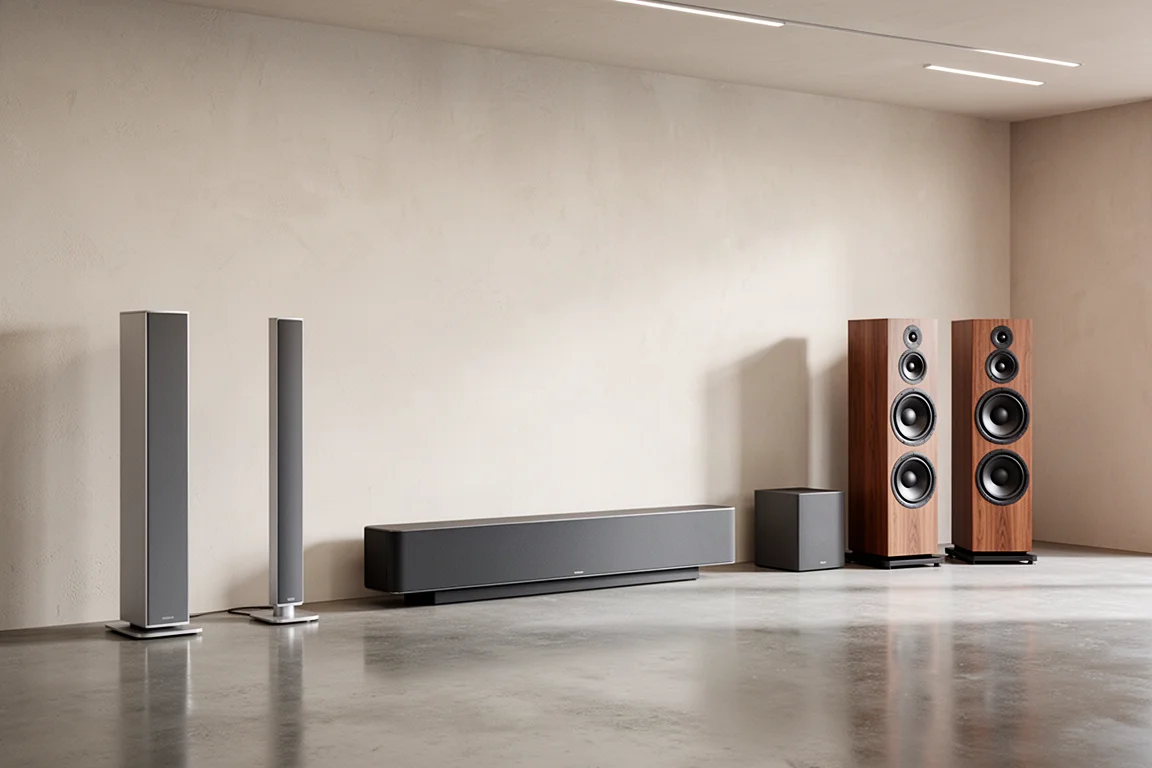
Against the Sony Bravia Quad, Canvas holds its own on tonality. The Quad can come very close on sound quality, though it can lean slightly more V-shaped depending on placement. On its own and without the optional SW3 or SW5 subwoofer, the Quad does not reach as low as Canvas. Where the Quad excels is stereo imaging and surround, performing at a level comparable to a modest separate home theater. Availability is the catch, since Sony’s higher-end audio is sold in only a handful of markets globally.
Against the Samsung Q990D, the comparison is mostly about money and expectations. The Q990D is far cheaper, around €750 in Europe, and it is a capable, well-rounded bar. It does not approach Canvas on tonal quality or coherence, but it is an inexpensive way to find out how a modern all-in-one behaves in your own room.
Things to Consider Before Buying
The most important limitation is immersion. Canvas has no rear speakers and no reflective drivers, so it will never fully surround you. The sound field reaches out to the sides and slightly ahead of the listening position, but not around and behind it. If a true surround effect is a requirement, this is not the product for that job.
There is no subwoofer output at this time. For a speaker built around full-size drivers that may not matter, but a subwoofer connection would let owners solve bass problems created by placement and would make the platform more attractive to listeners moving over from separate components.
There is no dedicated dialogue mode, and the workaround of switching off the 3D processing trades spaciousness for intelligibility. That is a reasonable compromise, but it is not a substitute for a proper dialogue setting.
The companion app is far behind what premium competitors offer. Owners coming from a high-end ecosystem will notice the difference immediately.
Finally, this is a young brand with a single product line and no long track record. The platform is described as upgradeable, but the roadmap beyond the current sizes is not public.
Buying Advice
If you are downsizing from a traditional stereo or home theater system for the first time, the lower-risk path is to start with an inexpensive bar such as the Samsung Q990D and spend time learning how these products behave in your room. Level-match the front, height, and surround channels manually rather than relying entirely on auto setup. Once you know what you like, you will have a much clearer idea of where to go next.
If price is not the deciding factor and the product is available where you live, the Sony Bravia Quad is an easier tonal transition for a long-time stereo listener.
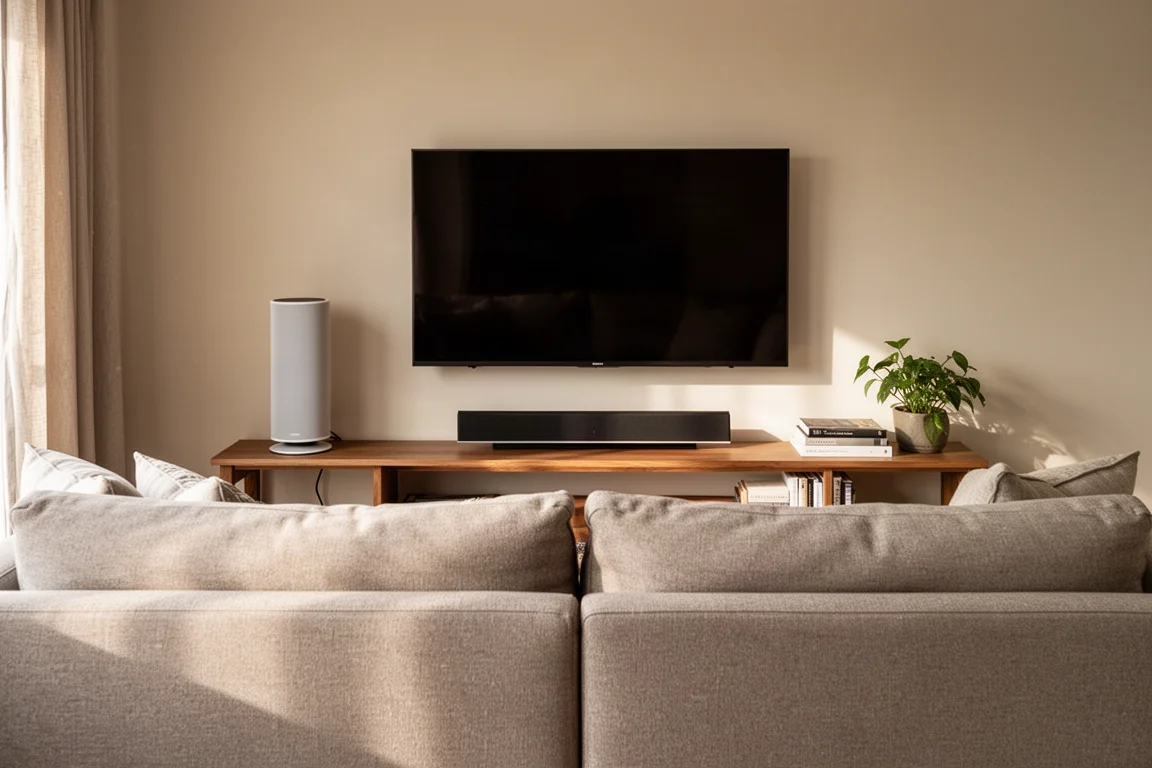
If what you want is a stereo-first presentation that also handles movies with real weight and clarity, and you accept that the sound will not wrap behind you, Canvas is the one to choose. It is the rare all-in-one that sounds like speakers rather than a soundbar, and it does so for less than the flagship alternatives.
Conclusion
Canvas earns its place by doing something most all-in-ones avoid: putting genuine stereo reproduction ahead of surround effects. The bass extension is real, the tonal coherence is high, the build is a step above the category norm, and the price undercuts the premium competition by a wide margin. The trade-offs are equally clear, with no true surround, no subwoofer output, a modest app, and a brand with no history behind it. For listeners who want fewer boxes without giving up sound quality, those are reasonable terms.
Product link
View more details for Canvas
This product is mentioned in the review. Check the specifications, options, and compatibility before buying.
View more details for CanvasFurther reading
Related Reviews
Soundbars
Bang & Olufsen Premiere Review: A Compact Soundbar Built to Last
A close look at the Bang & Olufsen Premiere, a compact soundbar with deep bass for its size, automatic sound profiles, and a clear modular upgrade path.
Soundbars
Best Dolby Atmos Soundbars: Six Picks for Movies, Music, and Small Rooms
A practical roundup of six Dolby Atmos soundbars, from compact dialogue-focused bars to expandable systems and an all-in-one flagship.
Soundbars
Bluesound Pulse Cinema Review: A Music-First Soundbar With a Software Catch
A close look at the Bluesound Pulse Cinema, a 3.2.2 soundbar with a genuinely expressive midrange and natural tone, plus the app and expansion limits worth knowing before you buy.