Heating
Best Diesel Heaters Tested: Civil, Vevor, HCalory and LF Bros Compared
Four budget diesel heaters put through fuel efficiency, heat output, alternative fuel and teardown testing, with a clear buying recommendation.
Introduction
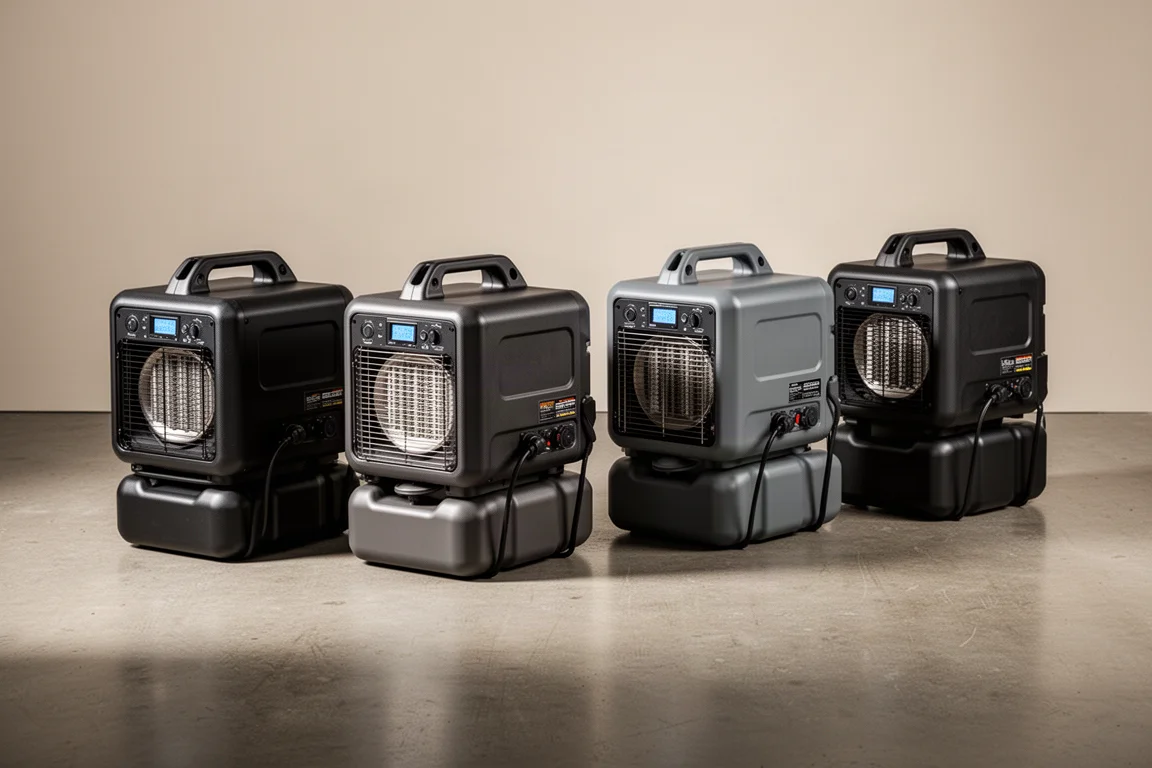
Portable diesel heaters have become one of the most practical low-cost ways to heat an RV, truck, boat, camper, trailer, motor home, caravan or small workshop. To find out which models are actually worth the money, four brands were put through the same series of tests: fuel efficiency, heat output, noise, warm-up behavior, a real-world room heating test, alternative fuel experiments, and a full teardown.
The lineup covers prices from $95 to $250, including the Civil 8KW, Vevor 8KW, HCalory 8KW, and LF Bros 5KW. All four are made in China, and as the teardown shows, they share far more hardware than the marketing suggests. Here is how they stacked up.
Evaluation Criteria
Each heater was tested with the same routine: assembly, a half-gallon fuel fill, warm-up time, power draw measured through a power analyzer, air speed and temperature at the vent, noise level, cool-down time, and finally a 35-minute heating test in an 800 sq ft shop with an outside temperature of 23.5°F. Air speed and vent temperature were measured on both the highest and lowest fan settings.
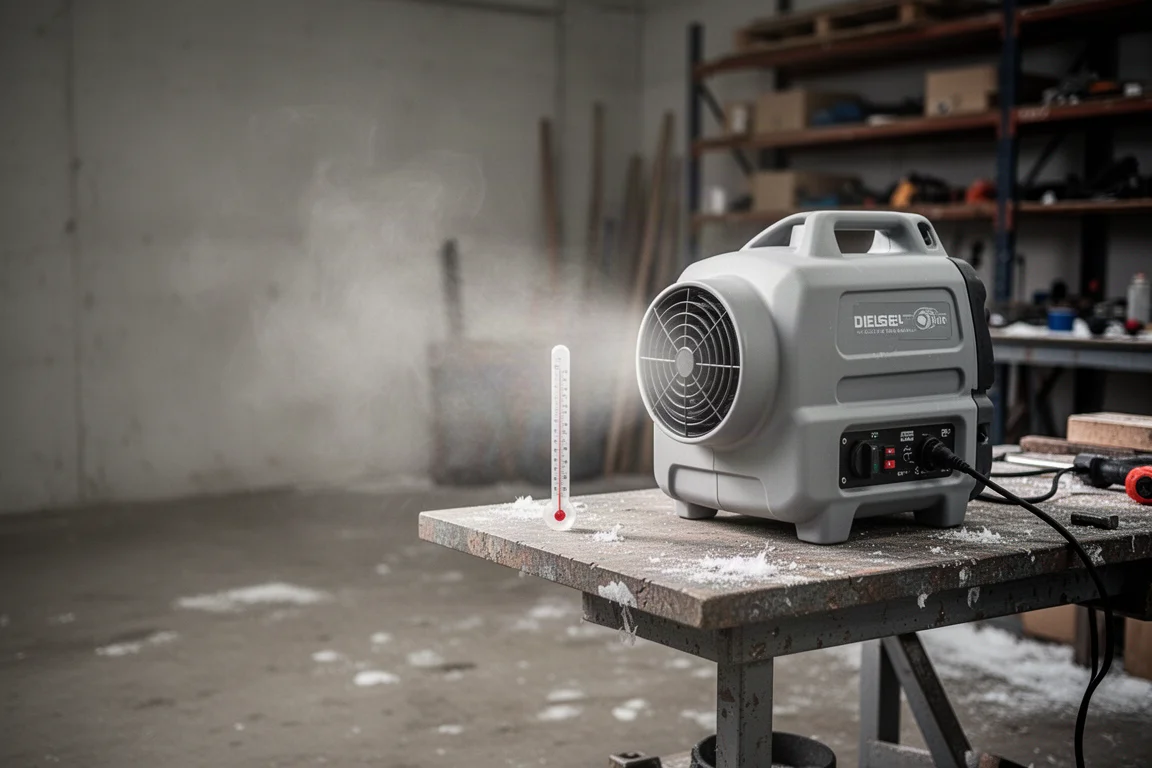
No test like this is perfectly scientific. Changing outside temperatures and different starting points affect accuracy, but the comparison still gives a solid picture of real-world performance.
Civil 8KW Diesel Heater
At $95, the Civil is the least expensive heater in the test. It is rated at 8KW, which works out to just over 27,000 BTUs, and it comes with a remote control, an all-in-one 12-volt LCD display, a claimed silent fan and oil pump with an improved low-frequency pulse, and a silencer to keep noise down. It weighs just over 15 lb, with legs that slide into place, an exhaust hose on the bottom, an air intake hose, an air outlet hose, and extra hardware including hose clamps and power wiring.
Setup is a bit fiddly: the instructions are not easy to understand, and starting it requires pressing OK and the down arrow together, then the up arrow. During the warm-up cycle it drew around 100 watts at peak and produced noticeably more exhaust smoke than the others, though the smoke cleared once fully warmed. On the power station used initially, voltage drop triggered an E-01 error code until a stronger 200-watt AC to DC converter was swapped in.
Once warmed in about five minutes, the Civil held steady at around 47 watts, moved air at roughly 34 mph on high, and pushed out vent air at about 280°F. The exhaust ran around 350°F with the heating element near 375°F. On the lowest setting it was quiet at close to 60 dB and still produced 277°F vent air. The remote is genuinely handy for adjusting heat and powering down, and the cool-down cycle took just over four minutes.
In the shop test, the Civil raised the temperature 12 feet in front of the vent by 7.9°F and the overall shop temperature by 4.3°F over 30 minutes of actual heating, the weakest result of the four.
Vevor 8KW Diesel Heater
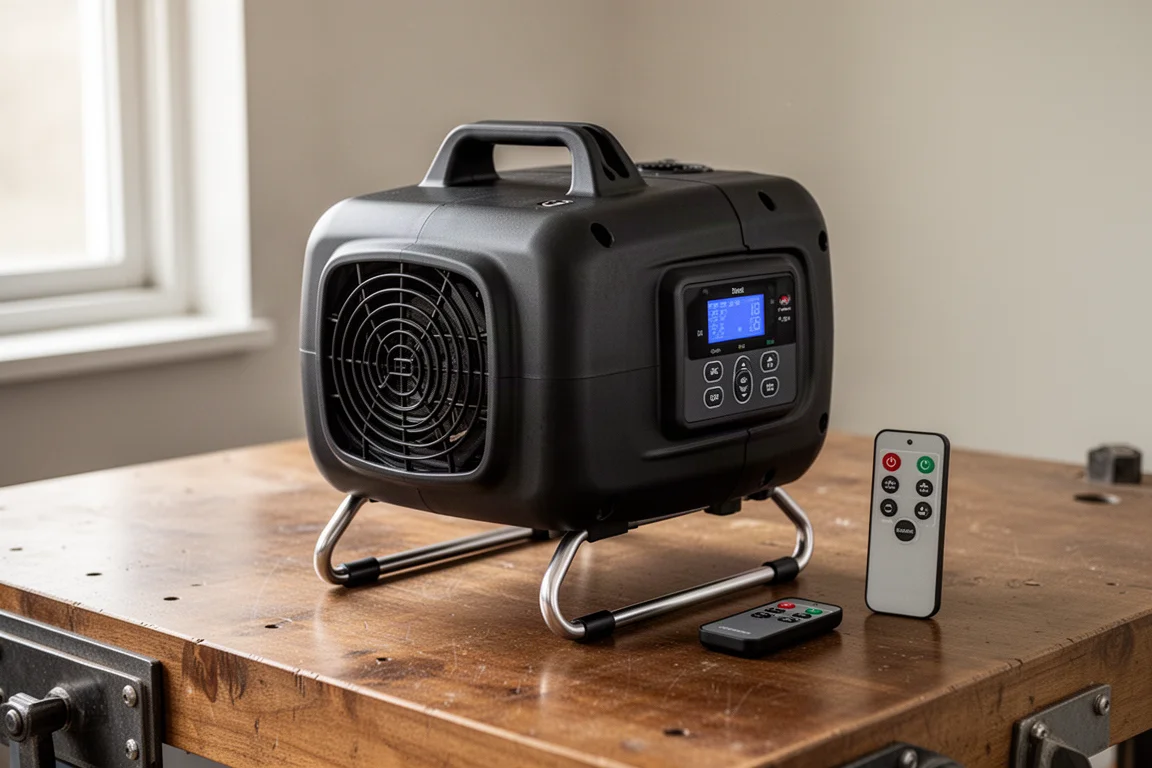
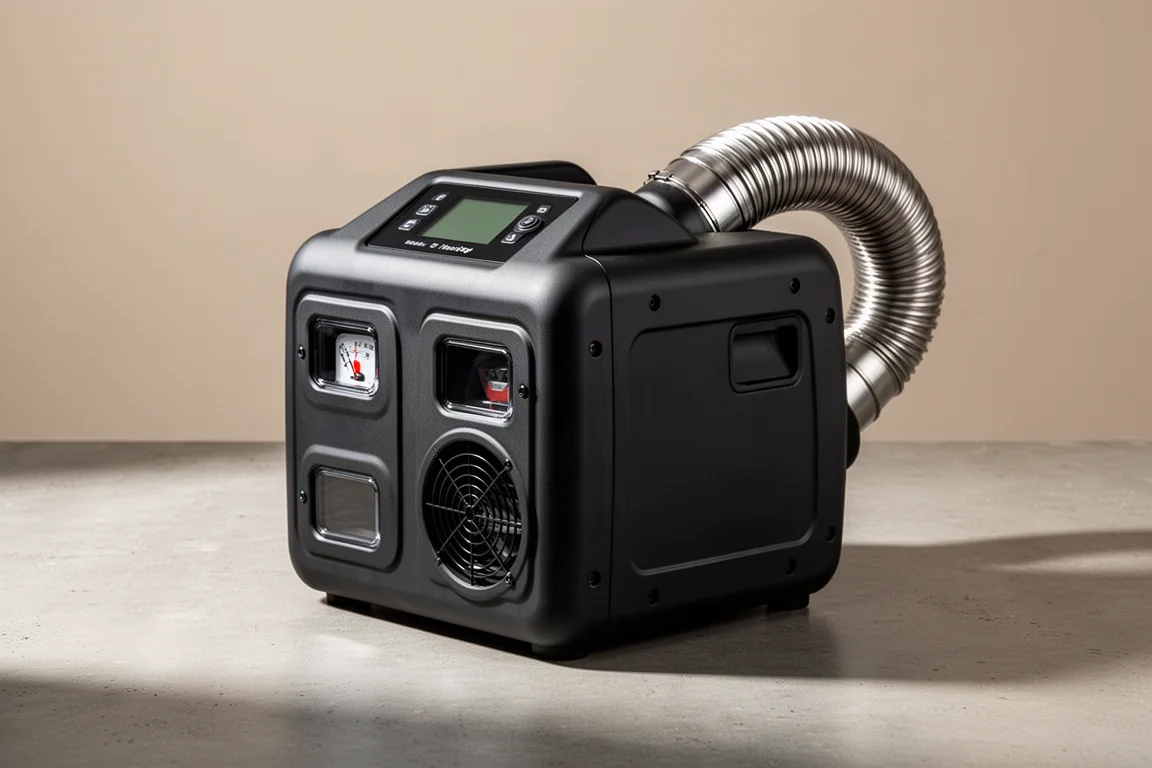
The Vevor costs $118 and matches the Civil’s 8KW rating, but adds Bluetooth app control on top of the remote. Vevor claims it warms up in under 10 minutes and that 1.3 gallons of fuel provides 8 hours of continuous heat. Dual fuel windows on both sides make it easy to track fuel level, and the fuel window reading was acceptably accurate in testing. It weighs 17.43 lb and includes an air inlet hose and air outlet pipe, with the same style of exhaust pipe and muffler as the Civil. One setup note: with a 90-degree bend on the muffler there is not much exhaust clearance, so a couple of boards under the machine help.
The start sequence is much friendlier than the Civil’s: press the power button and it begins warming immediately. Switching from automatic to manual mode gives direct control over vent temperature and fan speed. Peak warm-up draw was around 137 watts, but the burn was much cleaner than the Civil with very little smoke.
On high, air speed matched the Civil at 34 mph and noise was about the same at 74 dB, while steady-state energy use came in slightly lower at around 44 watts. Vent air reached about 240°F with the exhaust pipe near 300°F and the heating element around 375°F. On the lowest fan speed it drew just around 10 watts, ran at 61 dB, and moved air at roughly 19 mph. The cool-down took about five minutes, and the unit even talks to you, announcing power on and off with a “Thanks for using, I wish you a safe journey” sign-off.
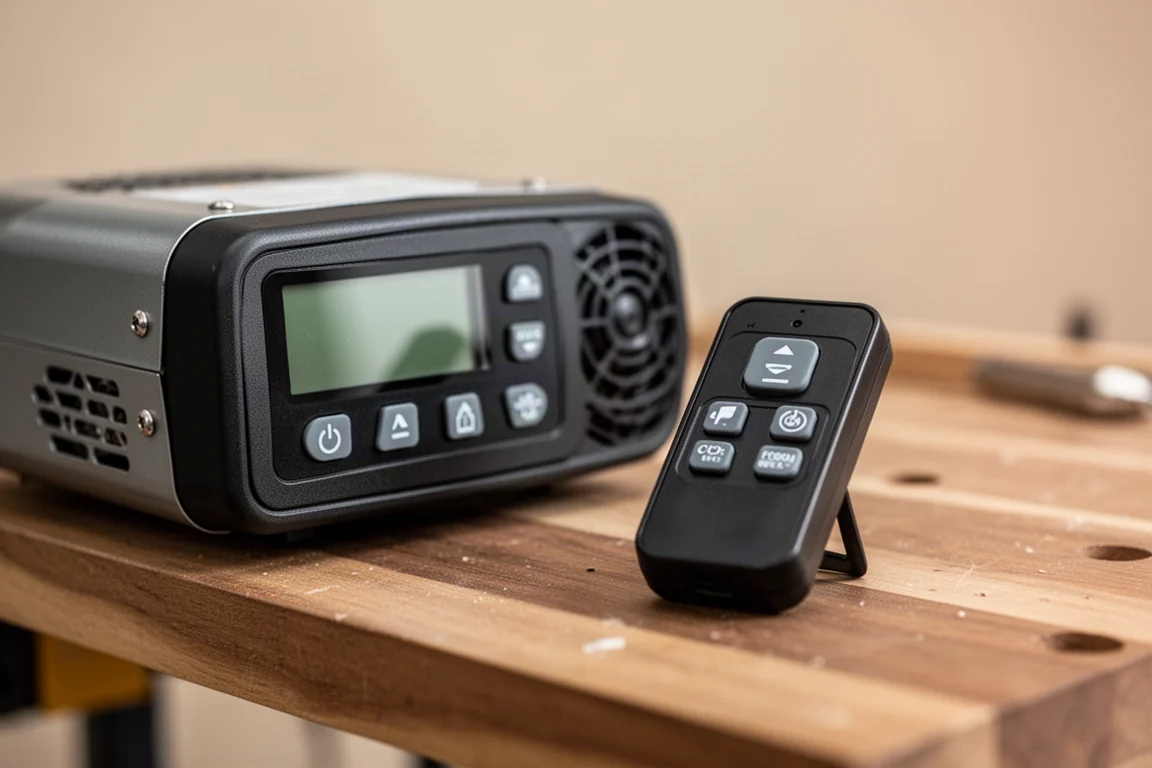
In the shop test the Vevor was strong: a 10.8°F increase at the 12-foot thermometer and a 7.1°F increase in overall shop temperature after 30 minutes of heating.
HCalory 8KW Diesel Heater
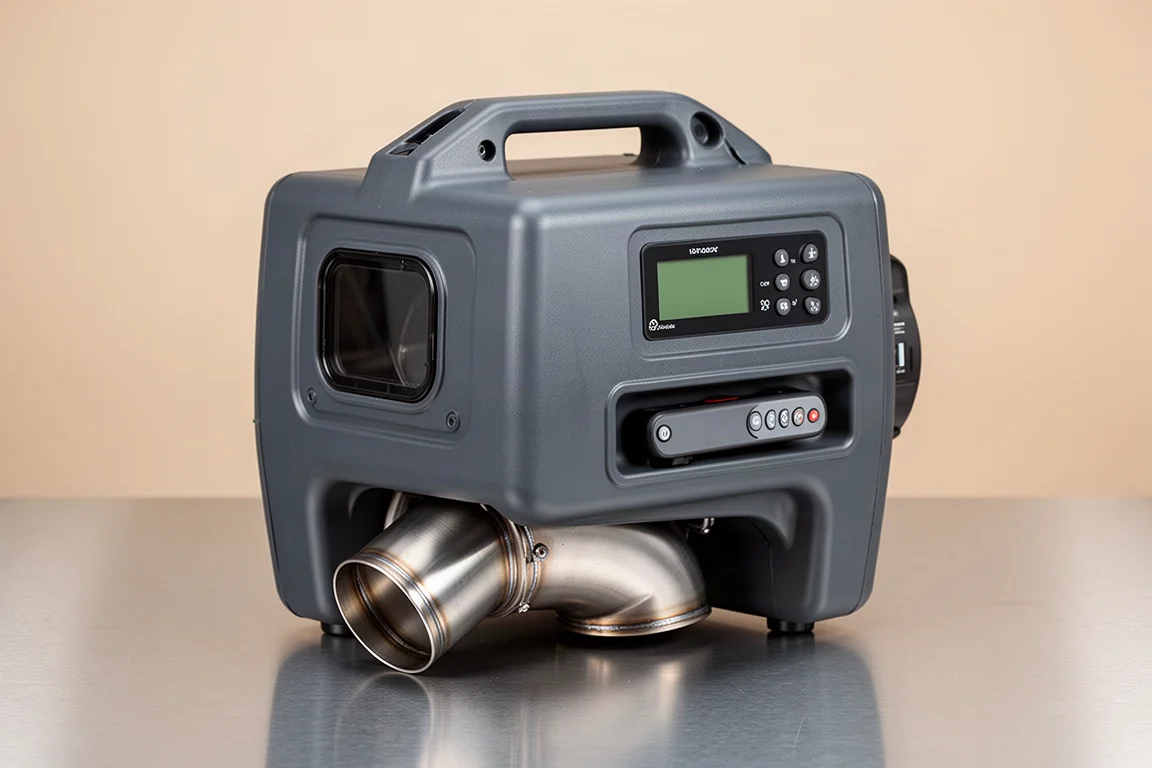
At $200, the HCalory is also rated at 8KW, with claims of heating to 212°F within 10 minutes and fuel consumption as low as 0.02 gallons per hour. It has a dedicated storage compartment for the remote, a protective cover on the main control board, a front fuel window, and weighs just over 16 lb. Two things set it apart: the air intake filter and exhaust elbow come pre-installed, which makes setup easier than the corrugated pipe arrangement on the cheaper units, and the kit includes both a 110-volt AC to DC power supply and a 12-volt DC power supply, a real convenience the other two 8KW units lack. Its instructions were also the best of the three 8KW heaters.
Warm-up peaked at around 140 watts, with only a small amount of exhaust smoke, and it was fully warmed in about five minutes. The plastic case helped keep noise down: at 69.4 dB on the highest fan speed it was the quietest heater in the lineup. It also moved the most air of the three 8KW units at about 39 mph, with vent air around 300°F, a heating element near 430°F, and an exhaust pipe at 209°F. Steady-state draw on high was about 49 watts, and 12 watts on the lowest setting, where it ran at 62.4 dB moving air at around 20 mph. On low, the vent air hit 315°F, the hottest low-speed reading of the group. Cool-down took just over four minutes.
In the shop test the HCalory tracked very closely with the Vevor and just barely edged it out on overall room temperature by 0.2°F, finishing at a 7.3°F overall gain, effectively a tie.
LF Bros 5KW Diesel Heater
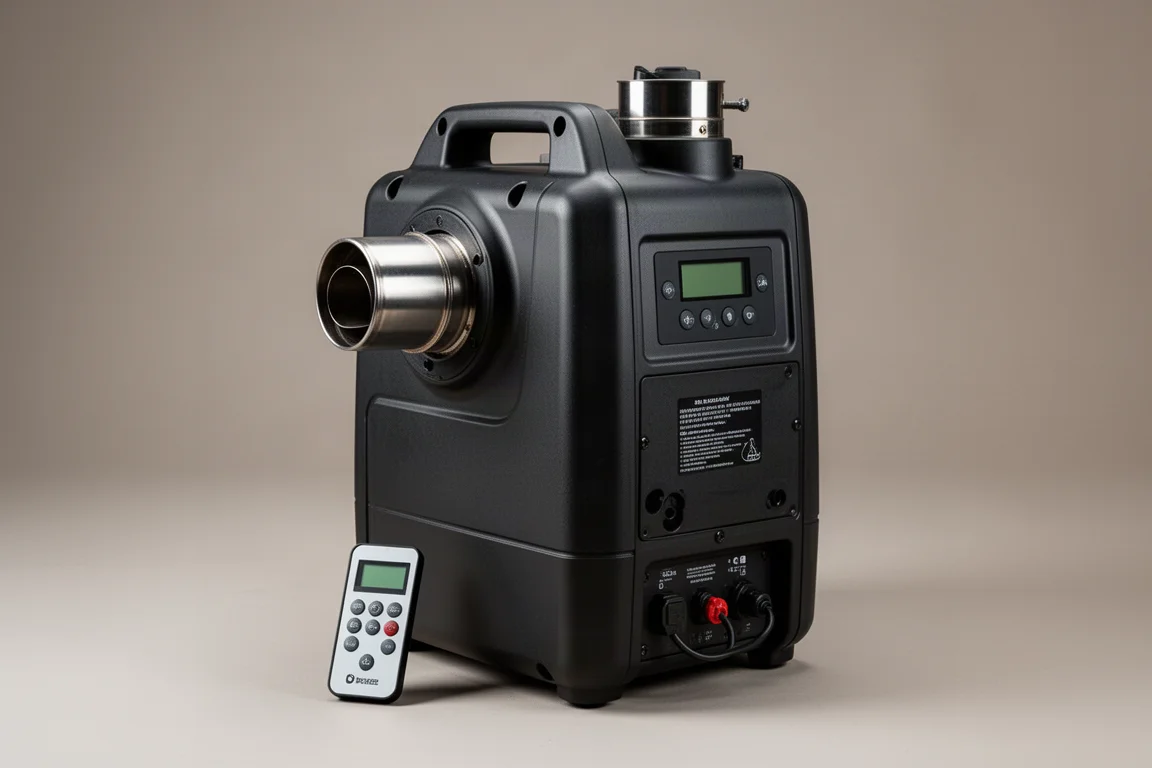
The LF Bros is the most expensive at $250 and the only 5KW unit, billed as an all-in-one that runs on 110V, 12V and 24V. It ranges from about 4,700 BTUs on the lowest setting to 17,000 BTUs on the highest, holds close to 5.5 quarts (around 5 liters) of fuel, and weighs 19.23 lb, the heaviest of the group. Like the HCalory, the intake and exhaust come pre-plumbed, including a connector pipe joining the exhaust pipe to the outlet that feels like a more secure setup. It includes an AC to DC adapter, remote control, LCD screen, and the clearest instructions of all four: add fuel, connect power, press on, and heat comes out.
It was also the easiest to start: one press of the remote’s power button. Peak warm-up draw was only 116 watts, about 24 watts less than the HCalory, and the exhaust stayed completely clean through warm-up with no visible smoke. Noise on high was close to 74 dB, similar to the others.
Performance on high was the best in the group: air speed of about 41 mph, vent air at 326°F, and steady-state draw of 54 watts. On the lowest setting it drew just 13.6 watts, ran at 61.6 dB, still moved air at 23 mph (the fastest low-speed airflow), and produced 262°F at the vent. Cool-down took about four and a half minutes.
In the shop test the LF Bros pulled away from the field, raising the 12-foot temperature by 12.4°F and the overall shop temperature by 9.2°F, the best result despite the lower rated output. Running overnight on high, it heated the shop to a comfortable 69.8°F after about three and a half hours, and a full tank lasted 9 hours 16 minutes on the highest heat setting.
Alternative Fuel Testing
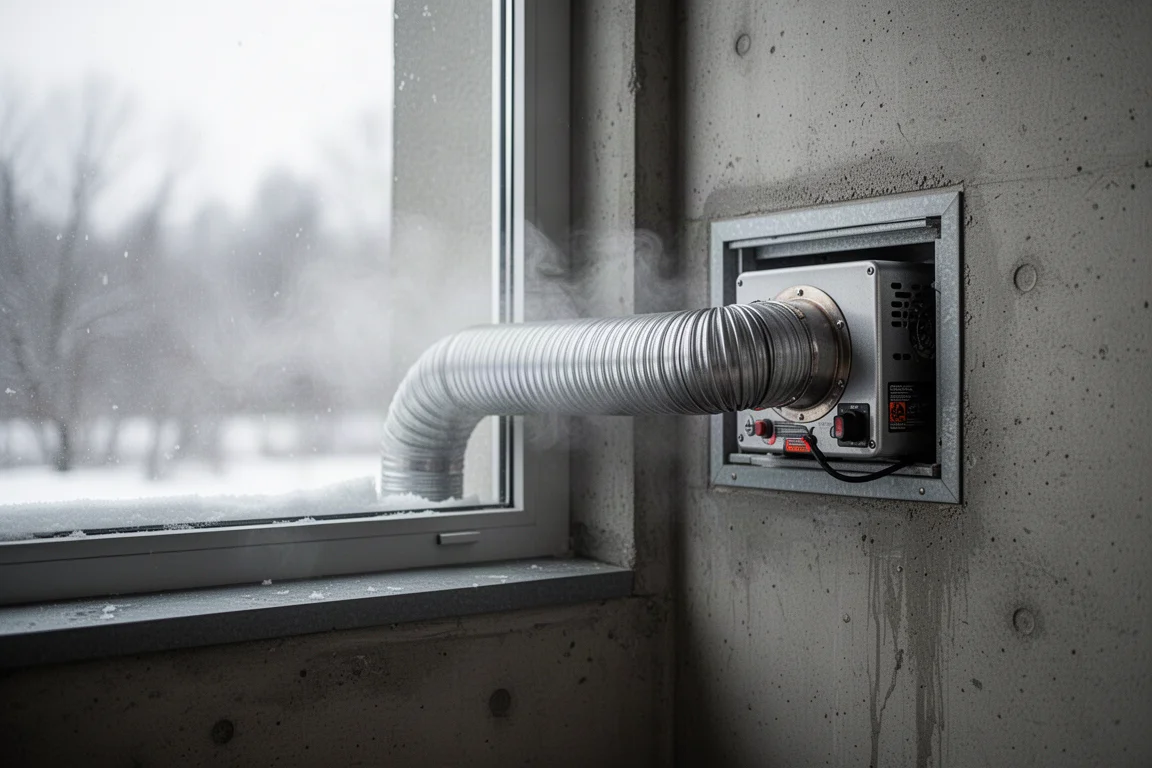
If a winter storm knocks out power and diesel is hard to find, can these heaters run on anything else? The Civil was tested first on straight diesel, burning clean at less than 100 ppm of unburned combustible gases, then on one cup of vegetable oil. Cold vegetable oil is thick, and early on there was distinctly french-fry-scented smoke from the exhaust, but once fully warmed the heater burned the vegetable oil very cleanly with no visible smoke, running about 35 minutes on a single cup.
A blend of used motor oil and diesel also burned well, warming up a couple of minutes slower but running as clean as straight diesel at under 100 ppm for close to 50 minutes on just over a cup of blended fuel. Straight used motor oil, however, was a failure: the heater struggled to ignite it, combustible gas readings climbed toward 1,000 ppm, and the unit shut itself down with a fuel-related error until diesel was added and mixed in.
The practical takeaway: vegetable oil and oil-diesel blends work in a pinch, but straight used motor oil does not, and running alternative fuels will likely cause carbon buildup in the combustion chamber over time.
Teardown: Are They All the Same Inside?
A teardown of the Civil and Vevor reveals a straightforward design. A fuel pump transfers fuel through a metal line into the combustion chamber near the glow plug, the intake fan brings in air, combustion gases exit through the side port, and the heat from the chamber heats the aluminum heat exchanger, across which the main electric fan pulls air. The fan blade has two tiny magnets read by a Hall effect sensor on the control board, and a temperature sensor helps the board maintain proper temperature.
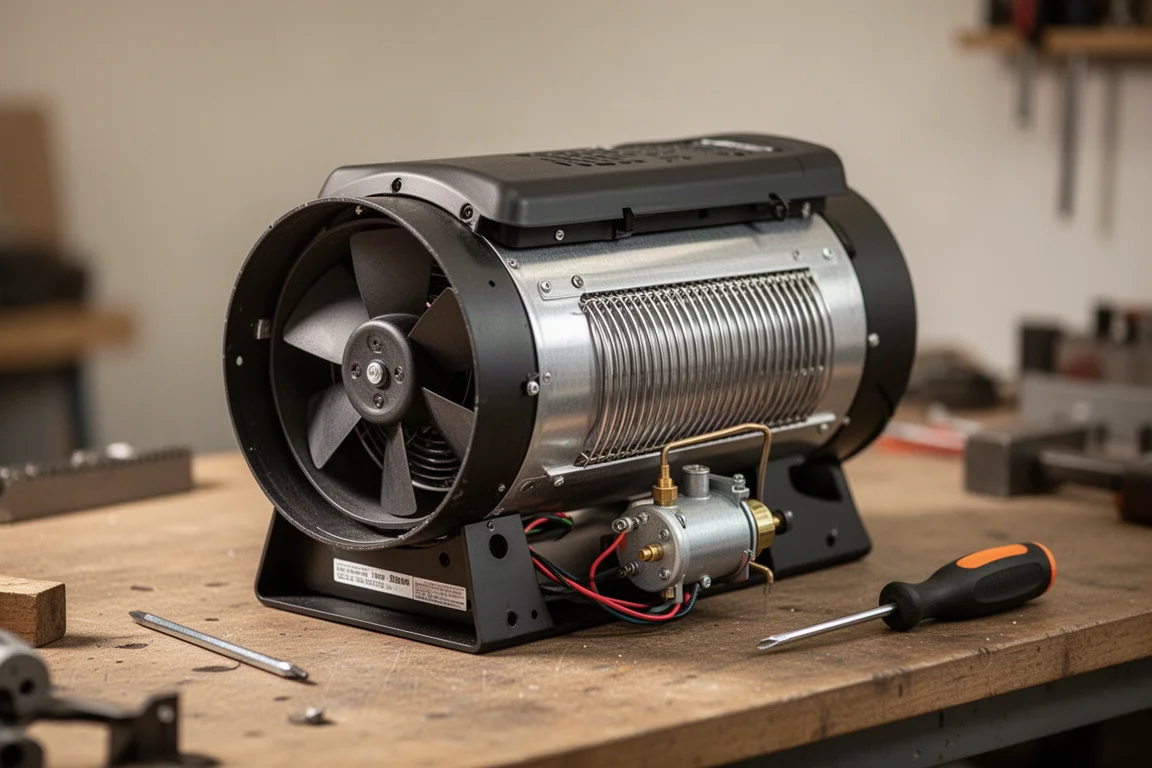
The Vevor’s plastic housing and heater assembly look exactly the same as the HCalory’s, and based on what was on display, all these brands share essentially the same hardware. What varies from brand to brand is the controls and software. Also worth knowing: vertically oriented designs like these have two trade-offs. The fuel pickup is on the side of the tank rather than underneath, so the heater cannot use every last drop, and a tall unit carries some tip-over risk, though solids in the fuel will settle at the tank bottom and never get picked up by the fuel system.
Overall Buying Advice
If the price is around $100, the Civil or the Vevor are the picks. Add an AC to DC power converter and a cigarette lighter power supply cord either way, so the heater can run from a 110-volt wall outlet, battery bank, or generator. Around $150, the HCalory makes sense because the AC to DC converter is already included in the kit. The LF Bros is a very good heater, but at around $250 or more it is overpriced compared to what the cheaper brands deliver with the same core hardware.
Overall, these heaters performed a lot better than expected. They are cheap insurance for a winter storm or a practical way to heat a small building.
Conclusion
All four heaters warmed up in roughly five minutes and proved capable of meaningfully heating a large shop. The Civil is the budget entry with the smokiest warm-up and weakest room heating, the Vevor offers the best value with cleaner burning and Bluetooth control, the HCalory is the quietest and most convenient to set up, and the LF Bros delivers the best raw heating performance, though at a price that undercuts its value. For most buyers, the Vevor at $118 hits the sweet spot, with the HCalory the better choice if you want the included AC power supply.
Further reading
Related Reviews

Heating
Hcalorie SS2 Diesel Heater Review: A Toolbox-Style 8kW Heater That Just Works
A compact 8kW diesel heater with no-assembly setup, app scheduling, and a dry heat output, plus a few trade-offs to know before buying.
Heating
Milwaukee M18 Cordless Propane Torpedo Heater Review: A Genuinely Practical Shop Heater
A cordless propane torpedo heater with 30,000 to 70,000 BTU output, M18 battery or AC power, and surprisingly easy setup. Here is what to know before buying.

Backpacking Gear
Building a 10 lb Base Weight: An Ultralight Backpacking Gear List
A practical walkthrough of the ultralight pieces behind a 10 lb base weight, from a 765 g pack and a roomy one-person tent to a full camp chair and a dependable water filter.