Floorstanding Speakers
Arendal 1528 Tower Review: Flagship Engineering at a Disruptive Price
The Arendal 1528 Tower pairs an HDF cabinet, a lithium magnesium tweeter, and four 8 inch woofers per speaker with a $9,500 per pair price tag. Here is what buyers should weigh before ordering.
Introduction
The Arendal 1528 Tower is the brand’s new flagship floorstanding speaker, and it arrives at a price that will make long-time Arendal owners stop and think. The 1723 THX Tower built its reputation as a value benchmark at the $3,000 to $4,500 mark, and it has stayed there for years. The 1528 Tower asks $9,500 per pair instead.
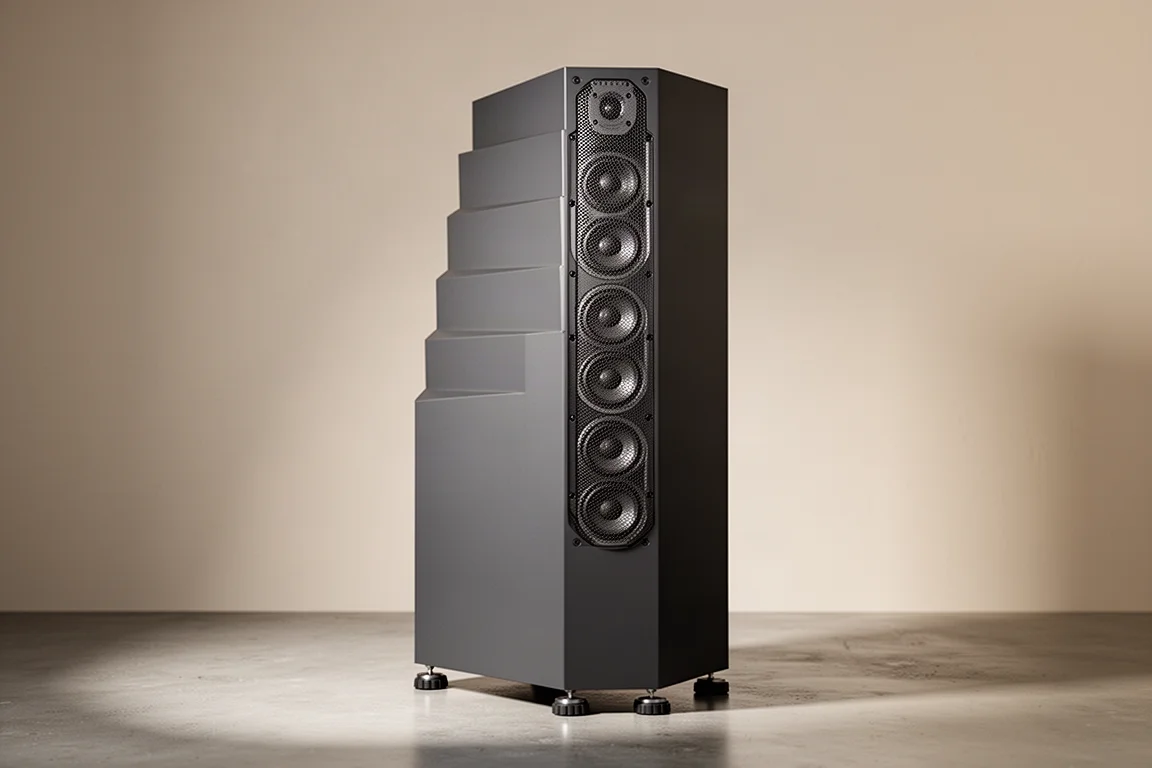
That is a serious number, and it should be. What makes the 1528 Tower worth a closer look is that the jump in physical scale, cabinet construction, and driver quality is at least as large as the jump in price. This is not a familiar speaker with a nicer finish. It is a different class of object: taller than the 1723 THX, dramatically heavier, built from HDF throughout, and fitted with drivers that would not look out of place in a premium standmount monitor costing two thirds of the price of the entire pair.
This review walks through what the 1528 Tower actually is, where the engineering budget has clearly been spent, and the practical questions a buyer should answer before committing to a pair.
Who This Product Is For
The 1528 Tower is built for listeners who have the space to let a large speaker breathe. Arendal recommends roughly 4 meters of listening distance for an optimal setup, with 2.5 meters as a practical minimum. That guidance is worth taking seriously. The speaker will still produce sound in a small room, and plenty of it, but its time-aligned baffle and wide dispersion are designed to work at a distance where the drivers’ outputs arrive together at the listening seat.
Two groups of buyers tend to end up here. The first is the two-channel listener who wants the physical scale of a genuinely large floorstander rather than a slim tower that looks the part but cannot move air. The second is the home theater owner who wants the same dynamics and low-frequency authority across several rows of seating. The even dispersion of this design makes the second case particularly relevant, because the usable sweet spot is broad rather than a single narrow chair.
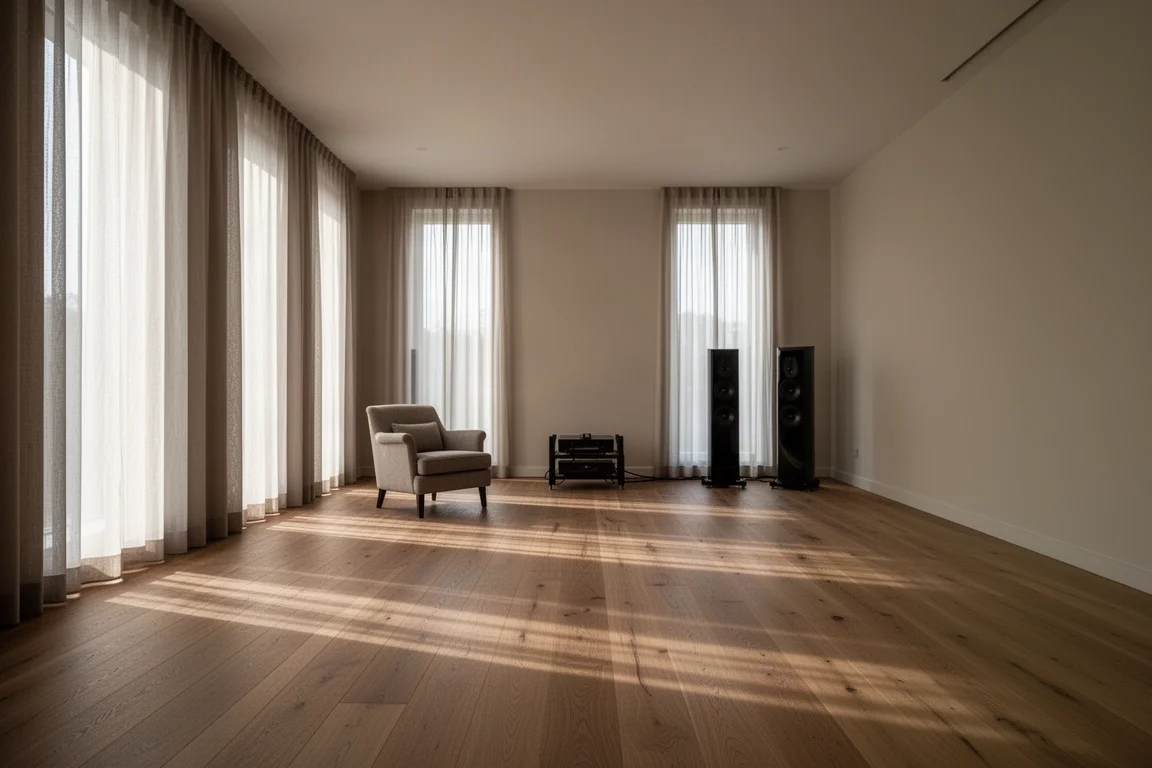
What the 1528 Tower is not is a discreet addition to a living room. At 56.3 inches tall, 18.5 inches wide, and 21.6 inches deep, with each cabinet weighing 174 pounds, it takes over a room and has to be planned for well before it arrives. Buyers who cannot give it that space will be paying for capability they cannot use.
Main Strengths
Driver and Tweeter Design
The tweeter is the most distinctive element of the design. It is a 28 mm lithium magnesium dome, a material that is rare in high-end audio. Its density is roughly one third that of a beryllium dome while retaining comparable stiffness, and Arendal pairs it with a large copper shorting ring and a substantial neodymium motor. The result is a very light, very fast diaphragm backed by a well controlled motor.
The midrange is a 5 inch carbon graphene cone. Rather than a woven carbon weave, the cone uses long carbon fiber strands layered in extremely thin sheets within the graphene, which produces a random breakup behavior and avoids the known resonances of a regular pattern. This is a driver specification normally reserved for premium standmount monitors. A comparable driver design appears in a high-end mini monitor that retails for around $6,500, which puts the 1528 Tower’s driver budget in perspective.
Low frequencies come from four 8 inch high-excursion woofers per cabinet. Arendal states that the motors use large amounts of copper to reduce distortion, and that distortion is roughly half that of the 1723 series drivers. Four of them per speaker is what gives the design its low-frequency extension and dynamic headroom.
Cabinet, Port, and Build Quality
The entire cabinet, including the front baffle, is made from HDF. That is unusual at any price, and it is remarkable in a cabinet this large. The front baffle is a separate assembly rather than a panel bonded flush to the box, and it is produced through a painstaking multi-stage process that gives the speaker its distinctive stepped profile.
The driver protection follows the same logic. Each woofer gets its own steel grille with a rubber backing rather than a single fabric panel stretched across the front. The tweeter has its own protective grille, which Arendal states also raises sensitivity and lowers distortion in the 7 to 15 kHz region, a band that shapes how bright or forward a speaker feels. The midrange grille is there for protection and visual consistency only.
The port sits on the bottom of the cabinet rather than the rear, which makes the speaker far less sensitive to how close it sits to a wall. A large foam plug ships with the speaker so it can be run as a sealed design if a room demands it, at the cost of a gentler low-frequency roll-off. Internally, the port includes small holes filled with damping material to suppress port resonance, which keeps port noise out of the picture even at high playback levels in a large room.
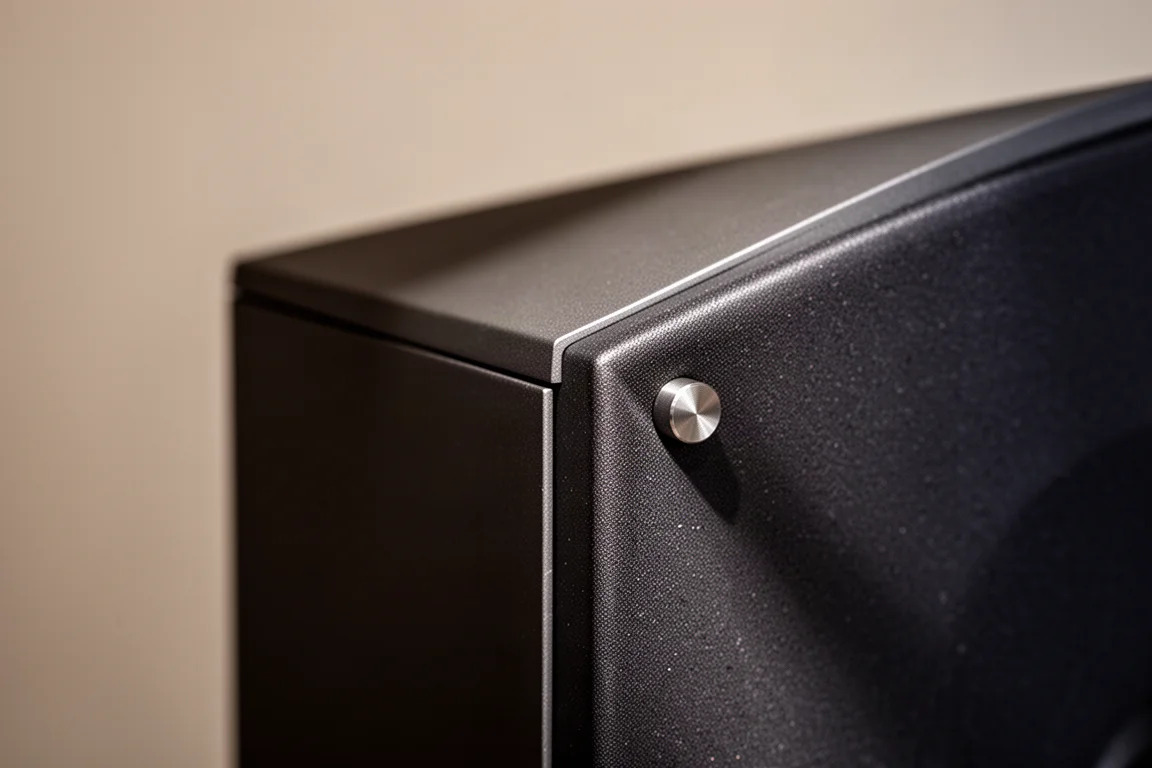
At the base, the cabinet rests on adjustable rubber pucks instead of spikes. They protect hard floors and let you level the speaker precisely, which matters because the baffle geometry is functional rather than decorative. Binding posts are rhodium-plated copper, and jumpers allow the high frequency and midrange to be adjusted by plus or minus 2 dB to suit a room or a personal preference. Arendal enables this adjustment on shipping pairs.
Time Alignment and Dispersion
Two design details shape how the speaker behaves once it is in a room. The first is the separated front baffle, which mechanically time-aligns the drivers so their outputs reach the listening position together. Human hearing is extremely sensitive to timing, and getting it right is a large part of why a multi-driver tower like this can still image with the coherence of a small monitor.
The second is the elliptic waveguide around the tweeter. It controls dispersion so the off-axis response stays even, which keeps the center image locked in place as you move around the room and gives listeners in different seats a similar tonal balance. It also stops the high frequencies from beaming straight at the listening position, which is part of why the speaker stays refined rather than sharp over long sessions.
Sound Character
The first thing that stands out is the sheer size of the presentation. The soundstage is wide, deep, and unusually atmospheric for a speaker at this price, and it holds together even in a room smaller than the design calls for. Bass extends down to 20 Hz with authority and does so cleanly, rolling off linearly with no bloom. Attack and decay feel properly judged: quick enough to sound fast, controlled enough to stay musical rather than mechanical.
Scale is the other defining trait. A cabinet this large moves air in a way small speakers simply cannot, and the effect is not limited to bass. Midrange and vocal material arrives with a physical presence you feel as much as hear, which is the quality that separates a genuinely large speaker from a merely loud one. Dynamic contrast is excellent, handling both quiet passages and wide swings with authority.
The high frequencies are detailed without being bright. There is air and sweetness at the top rather than glare, and the transparency through the midrange is one of the speaker’s strongest arguments. The overall tonal balance is neutral, and the published response sits within plus or minus 2 dB across the range.
Things to Consider Before Buying
The first consideration is the room. This is a very large, very heavy speaker, and it needs distance to perform as intended. If your listening position is closer than about 2.5 meters, the design is working against the space rather than with it. A larger room will not simply make the 1528 Tower louder, it will make it better.
The second is amplification. Sensitivity is rated at 89.5 dB with a nominal 4 ohm impedance. That is manageable for a wide range of amplifiers, including home theater receivers, but the speaker is transparent enough that it rewards better electronics. Everything upstream is passed through, so a high-quality amplifier produces a clearly better result than an average one.
The third is simply the commitment. At $9,500 per pair the 1528 Tower is not an impulse purchase, and a cabinet of this size and weight will need a second pair of hands to move and position. Buyers should also confirm they have the floor space and the wall clearance the design prefers before ordering.
Buying Advice
If the room and the budget line up, the 1528 Tower is an unusually straightforward recommendation. The value argument rests on how much engineering is visible in the product: an HDF cabinet at this size, four 8 inch woofers per speaker, a lithium magnesium tweeter, a time-aligned baffle, and a port designed to avoid resonance. Competing designs with comparable scale and construction generally sit well above this price.
Arendal sells direct, which is part of how the price is possible, and the brand offers a 60-day risk-free trial on its speakers, including this model. That matters with a speaker this large, because it means you can evaluate it in your own room instead of guessing from a showroom. A practical path for most buyers is to confirm the room first, then budget for an amplifier that matches the speaker’s transparency. If both of those boxes are ticked, the 1528 Tower is likely to be the last major speaker purchase for a long time.
Conclusion
The Arendal 1528 Tower is a flagship floorstander that behaves like one while costing considerably less than most of its peers. Its strengths are structural rather than cosmetic: cabinet material, driver quality, time alignment, dispersion control, and bass extension all reflect deliberate engineering choices. The trade-offs are equally clear. It is enormous, it is heavy, and it needs a room and an amplifier capable of doing it justice. Buyers who can meet those conditions will find scale, dynamics, and refinement that are genuinely hard to find at this price.
Product link
View more details for Arendal 1528 Tower
This product is mentioned in the review. Check the specifications, options, and compatibility before buying.
View more details for Arendal 1528 TowerFurther reading
Related Reviews
Floorstanding Speakers
Acoustic Energy AE109 Mark II Review: A Refined Floorstander at £699
The Acoustic Energy AE109 Mark II is a slim, warm sounding floorstander that delivers clarity, midrange body and strong imaging in small to medium rooms.
Floorstanding Speakers
Acoustic Energy AE509 Review: A Slim Floorstander With Deep, Defined Bass
A practical look at the Acoustic Energy AE509, a slim floorstanding speaker with carbon fibre drivers, deep and well-defined bass, and an easy-going character that rewards careful system matching.
Floorstanding Speakers
Arendal 1528 Tower 8 Review: Reference Neutrality With Real Demands
A close look at the Arendal 1528 Tower 8, a nearly five-foot, 200-pound floorstander that rewards generous space, serious power, and high listening levels with reference-grade neutrality.