Audio Power Supplies
AIYIMA 48V 5.2A Power Supply Review: More Headroom, One Audible Catch
A higher-voltage supply for the AIYIMA A07 that adds low-end weight and a fuller bottom end, but also brings an audible tone around 1,600 to 1,700 Hz at higher volume settings.
Introduction
The AIYIMA A07 has become one of the easiest recommendations in budget hi-fi. It sells for around $80, occasionally dipping to $70 or $75, and it is built around the Texas Instruments TPA3255 amplifier chip, a part with a strong reputation among DIY builders for natural, unforced sound. It also responds well to simple upgrades, including a discrete op-amp swap that sharpens clarity without changing the amplifier’s basic character.
The one thing the A07 has always lacked is raw headroom. It ships with a 32V 5A power supply, and AIYIMA now sells a larger 48V 5.2A unit intended to feed the amplifier more voltage. The question is whether that extra voltage turns a great budget amplifier into something that punches far above its price, or whether it introduces problems the stock supply never had.
Who This Power Supply Is For
This supply is aimed at A07 owners who want more output than the stock brick provides. The power chart published on the A07 product listing shows that output depends on both speaker impedance and the power supply in use, and the stock 32V 5A unit delivers roughly 78 watts into 4 ohms and 65 watts into 8 ohms. That is enough for the large majority of speakers, including everything on hand here, with the possible exception of models with sensitivity below about 85 dB.
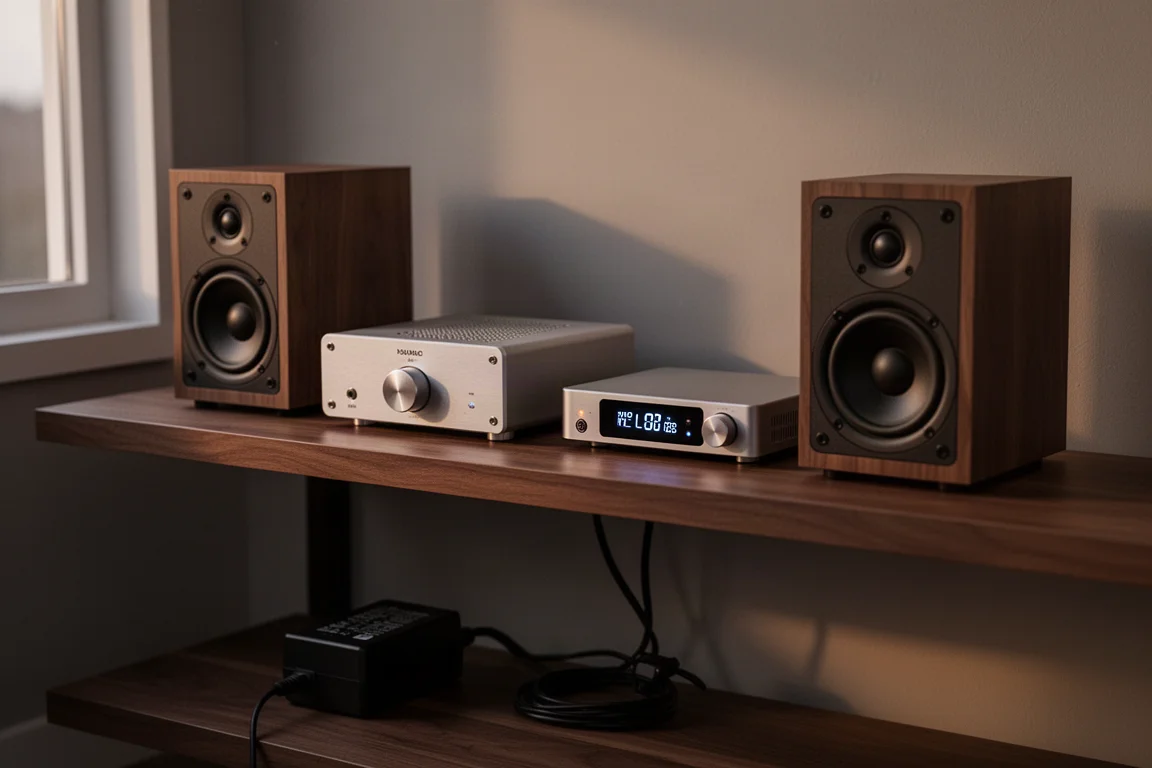
The 48V 5.2A supply is also the first AIYIMA product designed out of the box to complement the A07. Until now, owners who wanted more voltage had to go the DIY route with computer power supplies or adjustable bench supplies. This is a simpler path for anyone who would rather not experiment with wiring.
Main Strengths
Fuller Low End and a Bigger Sense of Scale
We compared the 48V 5.2A supply directly against the stock 32V 5A unit, running both through a pair of Project Speaker Box S5 speakers fed by a Geshelli Labs J2 DAC. The differences were not subtle, though they were not in-your-face either. The bottom end filled out noticeably and bass felt more present, which was a little surprising given how full the A07 already sounds. The wider AIYIMA lineup, including the D03 integrated DAC amplifier with Bluetooth, already leans toward a fuller, more natural presentation than several compact class D alternatives.
That added weight is the clearest argument for the upgrade. If your system feels lean, or you want a little more body through the lower midrange, this is where the larger supply makes itself known.
A Simple Way to Feed the A07 More Voltage
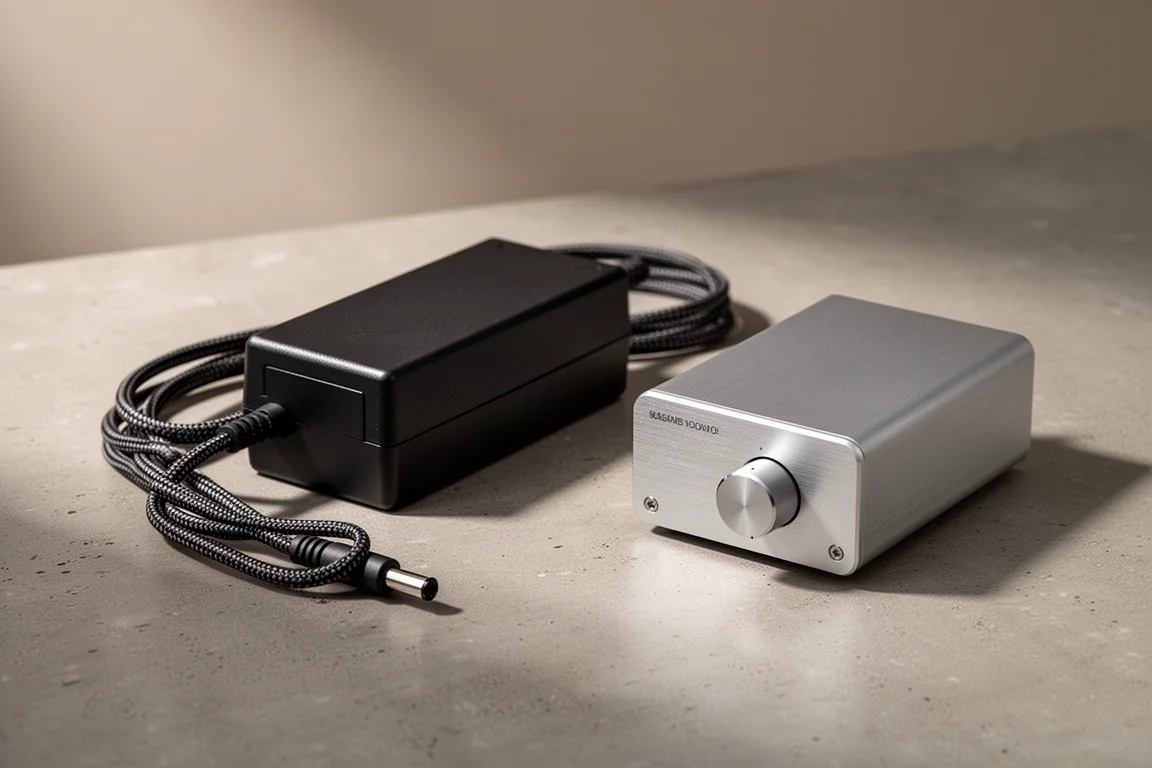
Physically, the 48V 5.2A supply is considerably larger than the stock brick, which hints at the extra capacity inside. It connects the same way and needs no configuration, so the swap takes seconds. For anyone who has priced out adjustable bench supplies or adapted computer power supplies, the appeal is obvious: one part, one cable, no guesswork.
Things to Consider Before Buying
The upgrade is not all upside. In testing, the 48V 5.2A supply introduced an audible tone in the region of 1,600 to 1,700 Hz that the stock supply simply does not produce, and the tone is tied to the volume control rather than to the music.
That single issue shapes the whole recommendation. The sections below explain what the tone sounds like, how it compares with the stock brick, and what it means if you are considering the swap.
Noise Around 1,600 to 1,700 Hz
With no music playing, that tone is audible from the speakers and grows louder as the volume is raised. At the 9 o’clock position on the dial it is essentially inaudible to the naked ear, but it becomes clear around the 12 o’clock position and remains present at full tilt. The stock 32V 5A unit, by comparison, is close to silent at full volume, with only the faintest background hiss that resembles soft snow.
That difference matters because this is not the kind of noise most listeners can tune out. It sits in a sensitive part of the spectrum, and because it rises with the volume control, it is most noticeable exactly when the extra power of the 48V supply is supposed to be doing its job. It is possible this particular unit is faulty, and there is no way to say how common the behaviour is, but the tone was consistent enough during testing that the supply was not tried with the most demanding speaker on hand.
The Stock Supply Already Covers Most Speakers
It is worth remembering what the A07 already does. The 32V 5A supply drives nearly every speaker tried with it, and it does so with a clean noise floor. The 48V 5.2A unit is not listed on the A07 power chart, so there is no published output figure to compare against either, which makes the extra headroom harder to quantify than the extra noise.
Buying Advice
If you genuinely need more output than the stock 32V 5A supply can deliver, the sensible move is to wait or to look at other power supply options rather than committing to this one. The noise heard here is a real concern, and it appeared during ordinary listening rather than under artificial test conditions.
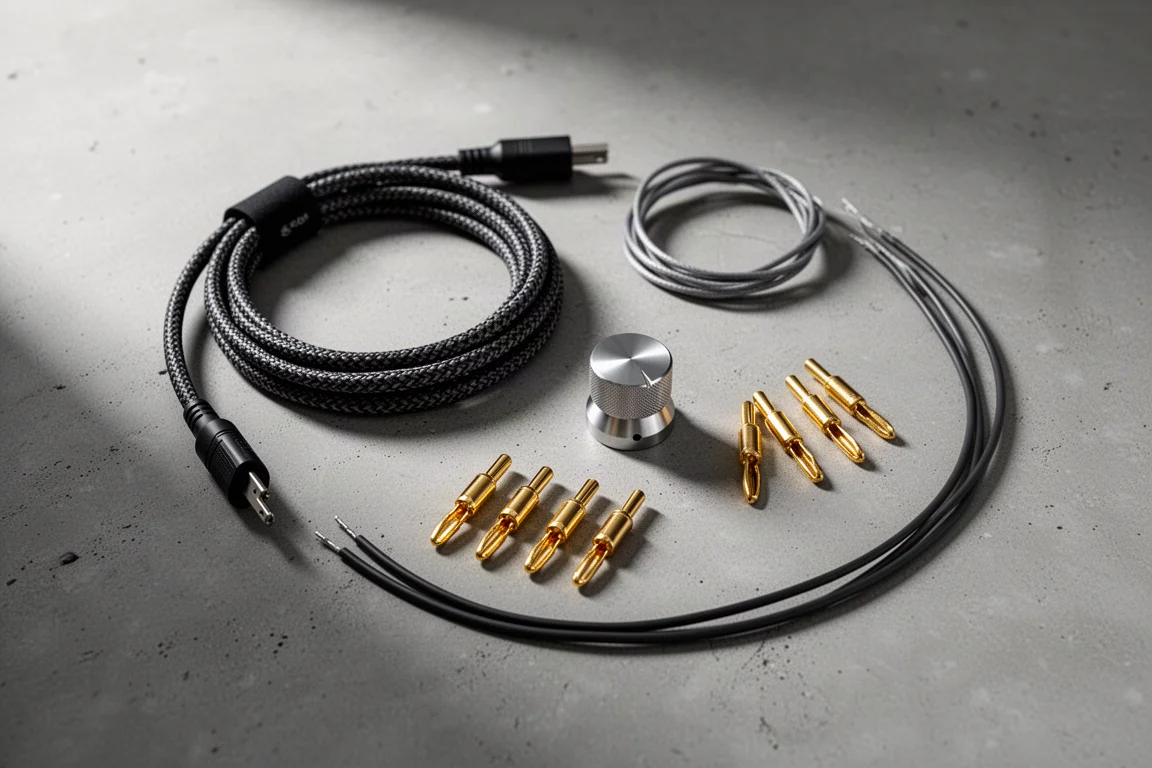
For most A07 owners, the practical answer is simpler: keep the amplifier on its stock supply. It powers a wide range of speakers and it stays quiet, which is exactly what a power supply should do. If you do decide to try the 48V 5.2A unit, buy from a seller with a straightforward return policy so you can send it back if the tone shows up in your system.
If the goal is simply to get more out of the A07, a discrete op-amp swap is the lower-risk place to start. In this setup it sharpened clarity and improved the overall sound signature without adding any noise at all.
Conclusion
The AIYIMA 48V 5.2A power supply does what it promises on the power side. It gives the A07 a fuller bottom end and more low-frequency presence than the stock brick, and it does so without any complicated setup. The problem is the audible tone around 1,600 to 1,700 Hz, which the stock supply does not have. Until that is resolved, or unless a different unit can be confirmed to behave better, the 32V 5A supply remains the safer choice for most A07 owners.
Product link
View more details for AIYIMA 48V 5.2A Power Supply
This product is mentioned in the review. Check the specifications, options, and compatibility before buying.
View more details for AIYIMA 48V 5.2A Power SupplyFurther reading
Related Reviews
Audio Amplifiers
AGD Audion Mark III Review: A Compact Class D Amplifier With Tube-Like Musicality
A gallium nitride Class D amplifier that delivers tube-like midrange warmth, serious bass grip, and a modular upgrade path in a very small chassis.
Stereo Amplifiers
Aiyima A01 Pro Review: A Compact Bluetooth Amplifier With a Full Tone Stack
A practical look at the Aiyima A01 Pro, a budget Class D amplifier with bass, middle, and treble controls, LDAC Bluetooth, and a clear set of trade-offs.
Hi-Fi Amplifiers
AIYIMA A07 Pro vs Fosi Audio BT20A Pro: Two Budget Class D Amps Compared
Same TPA3255 chipset, same price bracket, noticeably different sound. A practical look at the AIYIMA A07 Pro and the Fosi Audio BT20A Pro for anyone building a small hi-fi system.