3D Scanning
3D Scanner Comparison Test: Nine Models Scanned an Automotive Part
A detailed comparison of laser, infrared, and structured light 3D scanners tested on a challenging black automotive plastic part with deep pockets and thin walls.
Introduction
Testing nine different 3D scanners on a single challenging part reveals how different scanning technologies handle black, featureless objects with deep pockets and thin walls. This is a common real-world scenario in reverse engineering and manufacturing. The test compares laser scanners, infrared scanners, and structured light scanners to show which approaches work best for this demanding geometry.
Test Setup and Scanner Categories
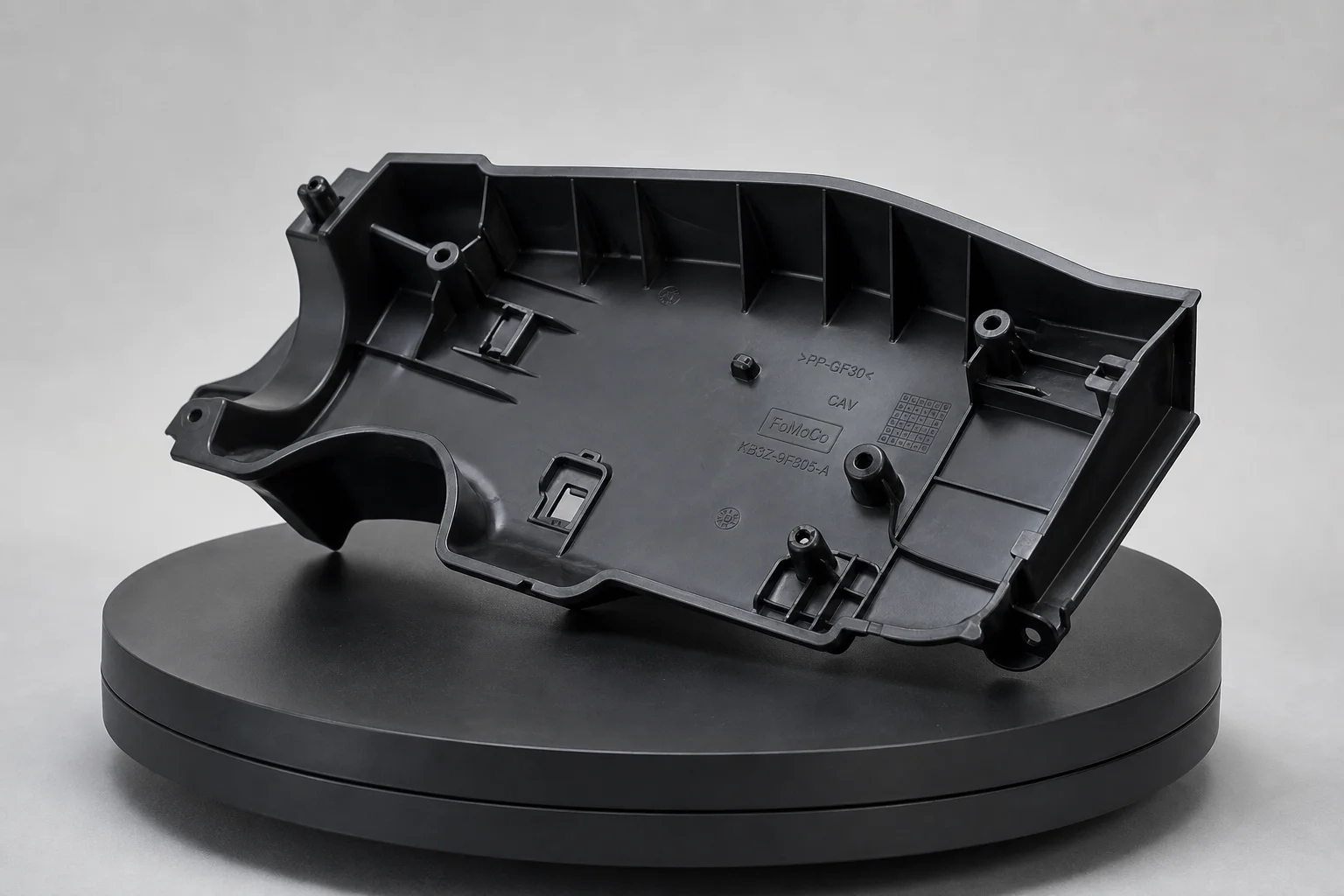
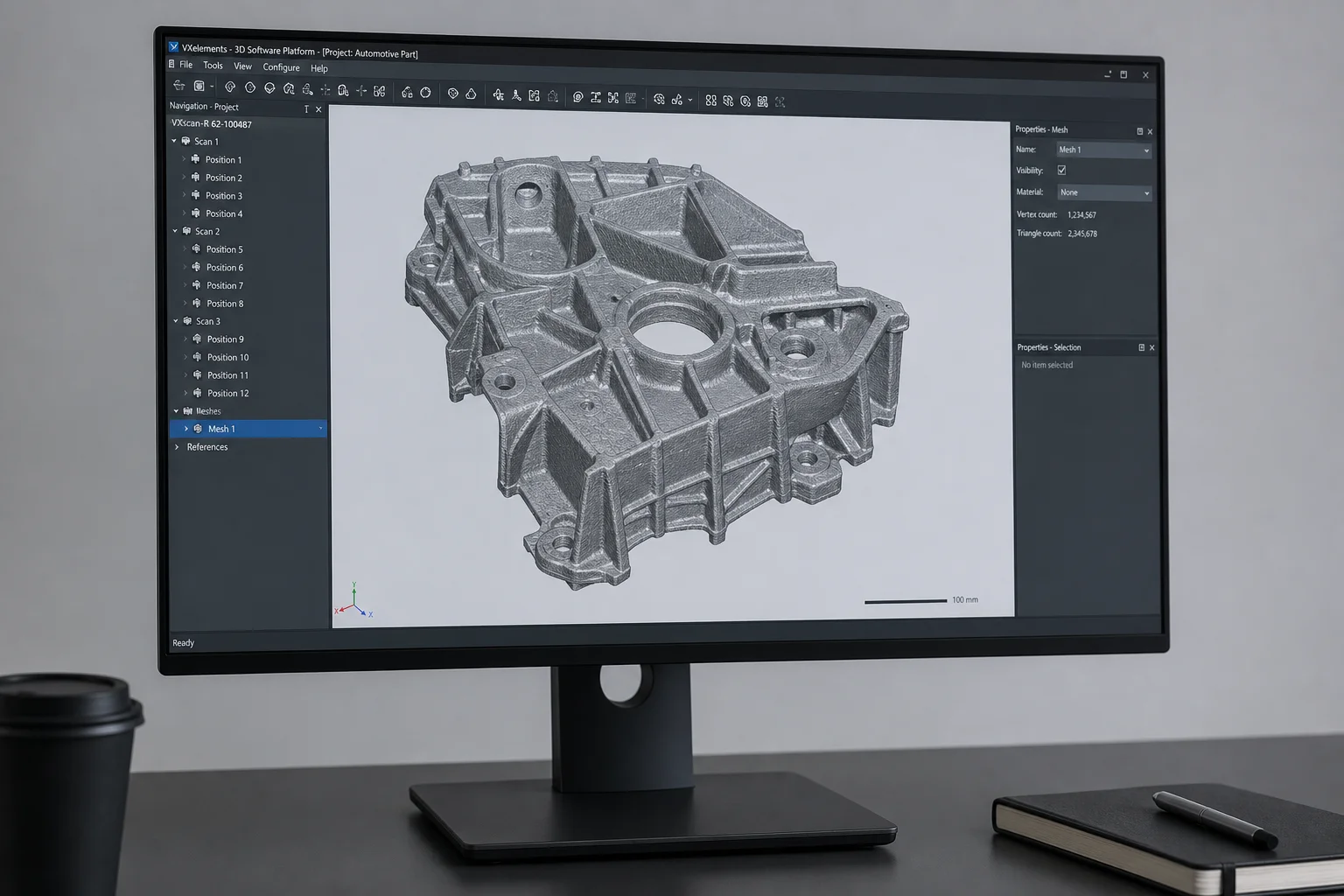
The test subject is a black automotive plastic part: featureless, with deep pockets and thin shells. This type of geometry is typical in automotive manufacturing and presents a genuine challenge for 3D scanning because the lack of surface features and dark color make tracking difficult for many scanner types.
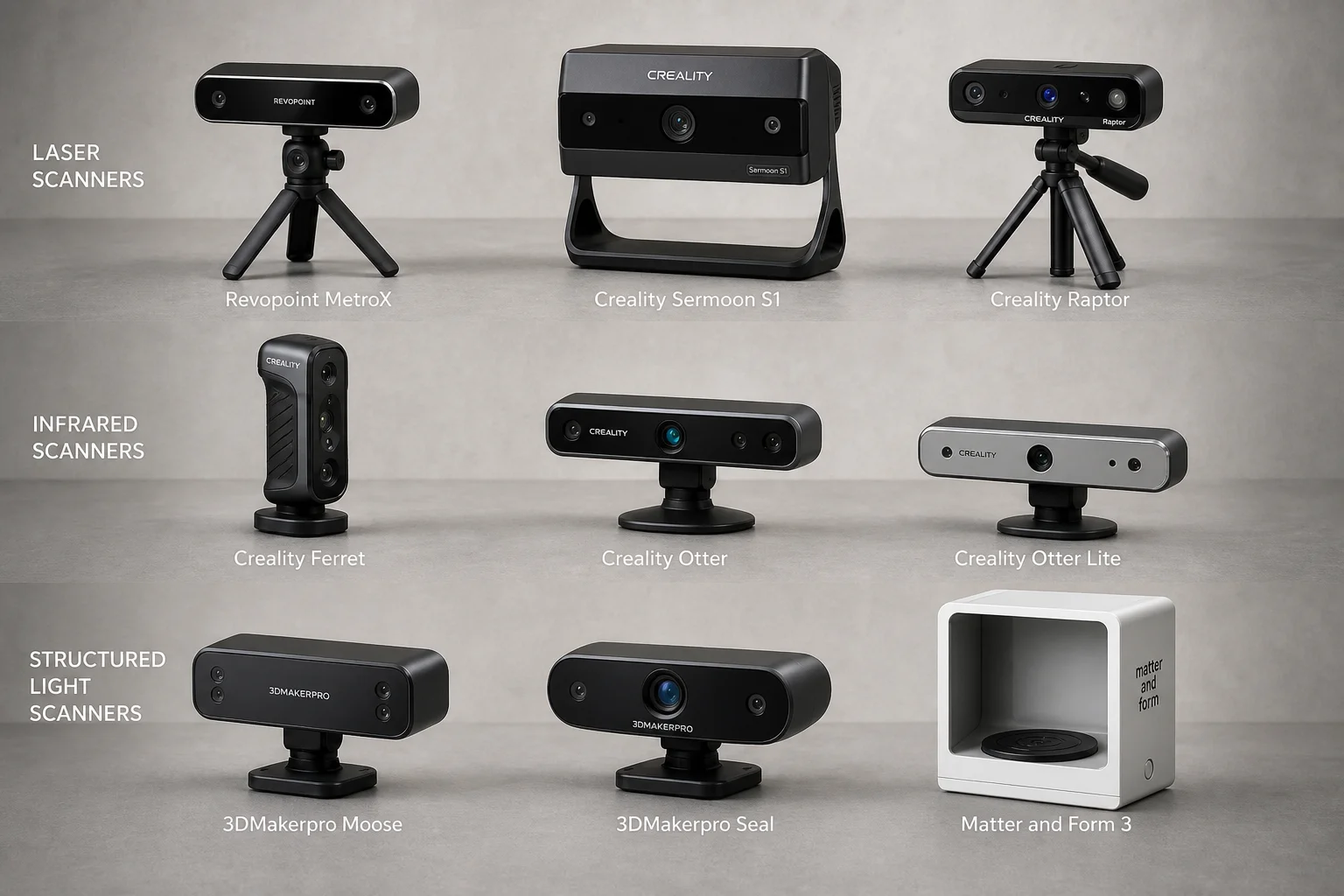
Four scanner categories are represented in this test. Laser scanners use marker-based tracking and are generally the most expensive but most precise. Infrared scanners track geometry and can work with markers, though they are less precise than laser systems. Structured light scanners project patterns and track geometry, offering a middle ground in speed and precision. Each category has distinct strengths and limitations when scanning black objects without spray coating.
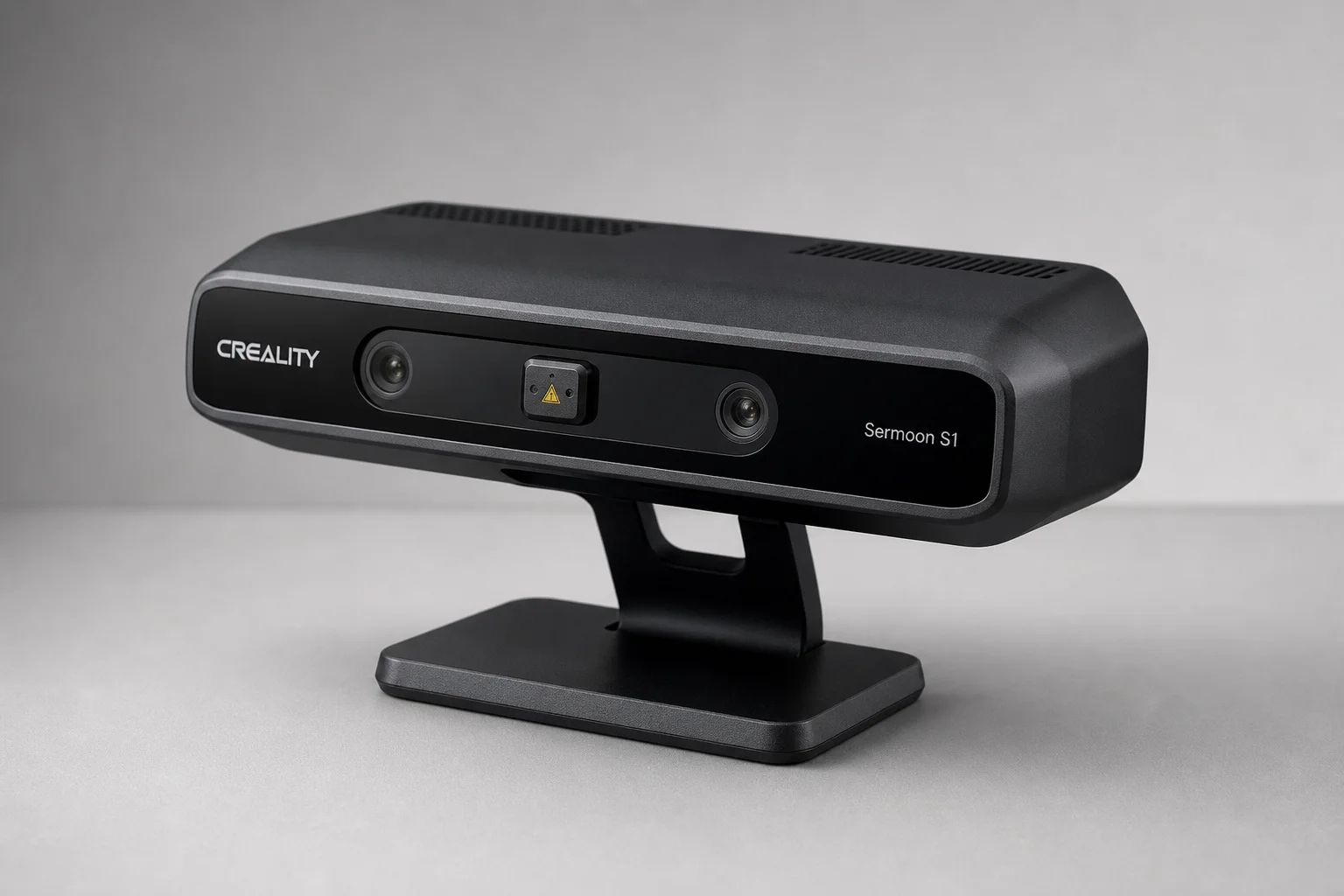
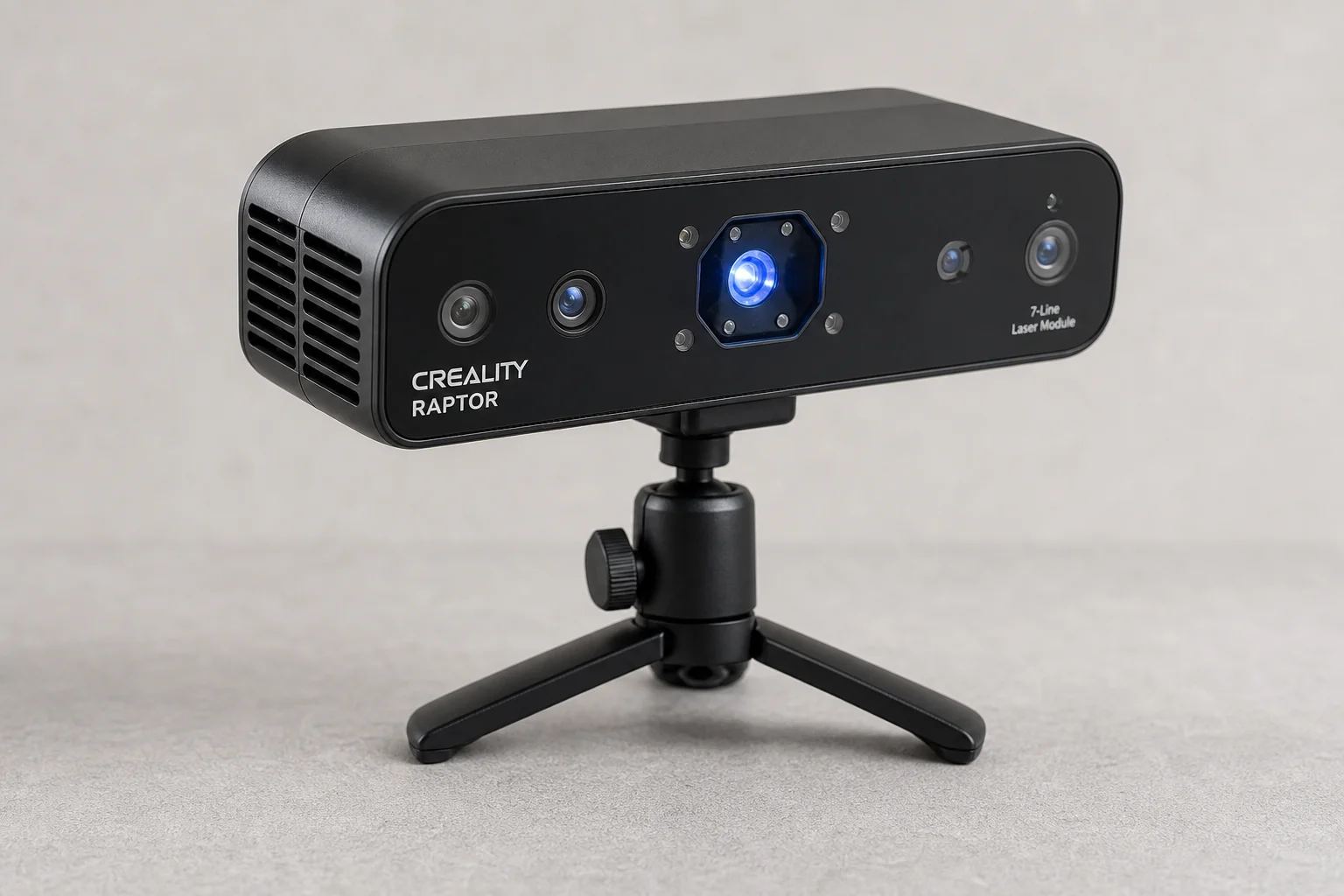
Laser Scanners: Revopoint MetroX, Creality Sermoon S1, and Creality Raptor
Laser scanners are designed to work with markers and deliver the highest precision for marked tracking. They perform best on featureless parts because the markers provide reliable reference points.
The Creality Raptor uses seven parallel laser lines and captures at 90 frames per second. In this test, it achieved 22 microns of accuracy error. The Raptor can lean to a very low angle relative to the turntable, allowing it to capture side walls effectively. However, the seven-line approach struggles with deep pockets because the walls block the laser projection from reaching the bottom. The gap between ribs and the bottom of the 32mm deep hole remained uncaptured.
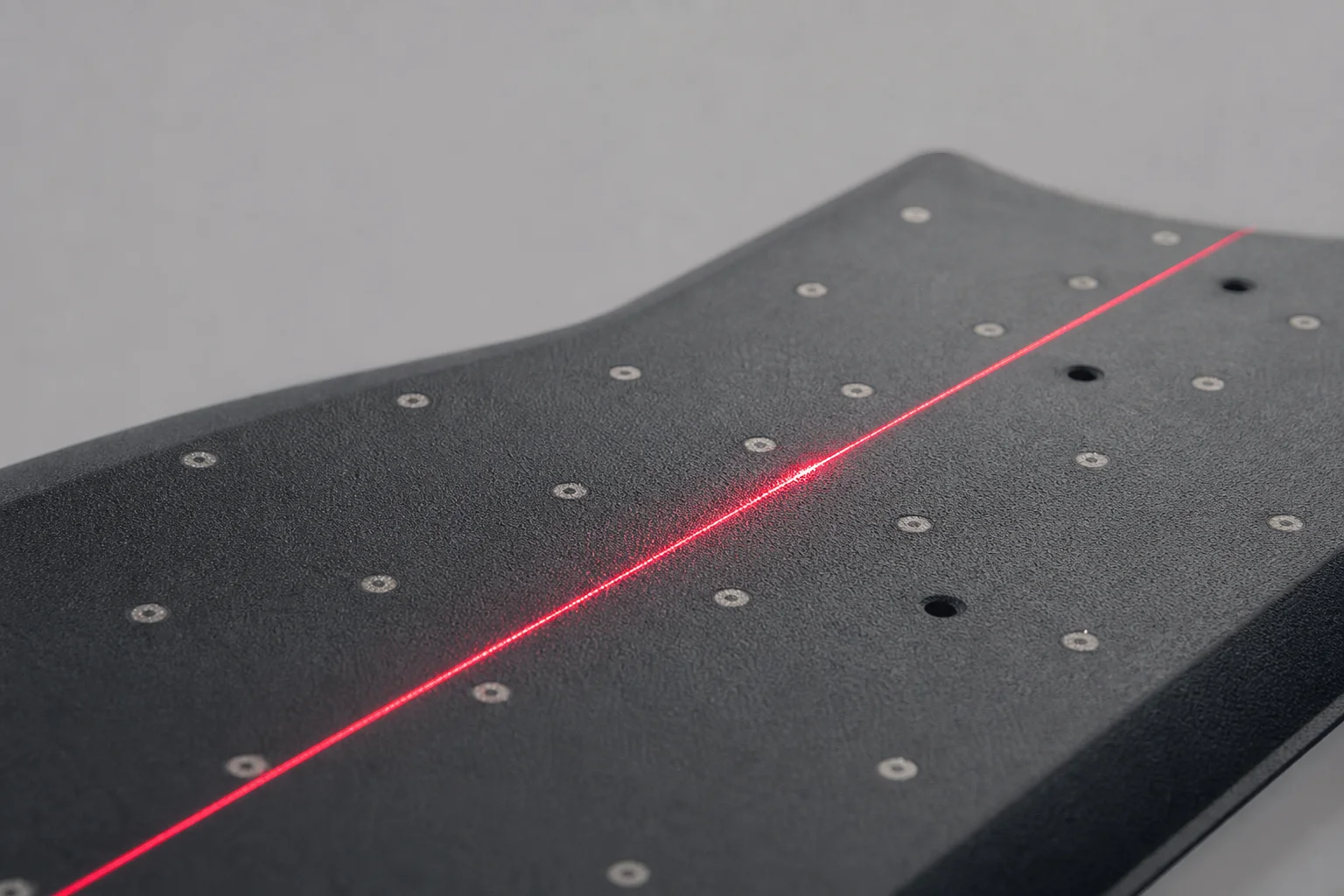
The Creality Sermoon S1 also uses laser scanning but with a single-line option in addition to parallel lines. It runs at 90 frames per second and achieved 32 microns of accuracy error in this test. The single-line mode allows it to reach into deep pockets that the seven-line approach cannot access. The Sermoon S1 produced a more complete scan of the pocket bottoms compared to the Raptor, though it required more manual effort to erase blind spots.
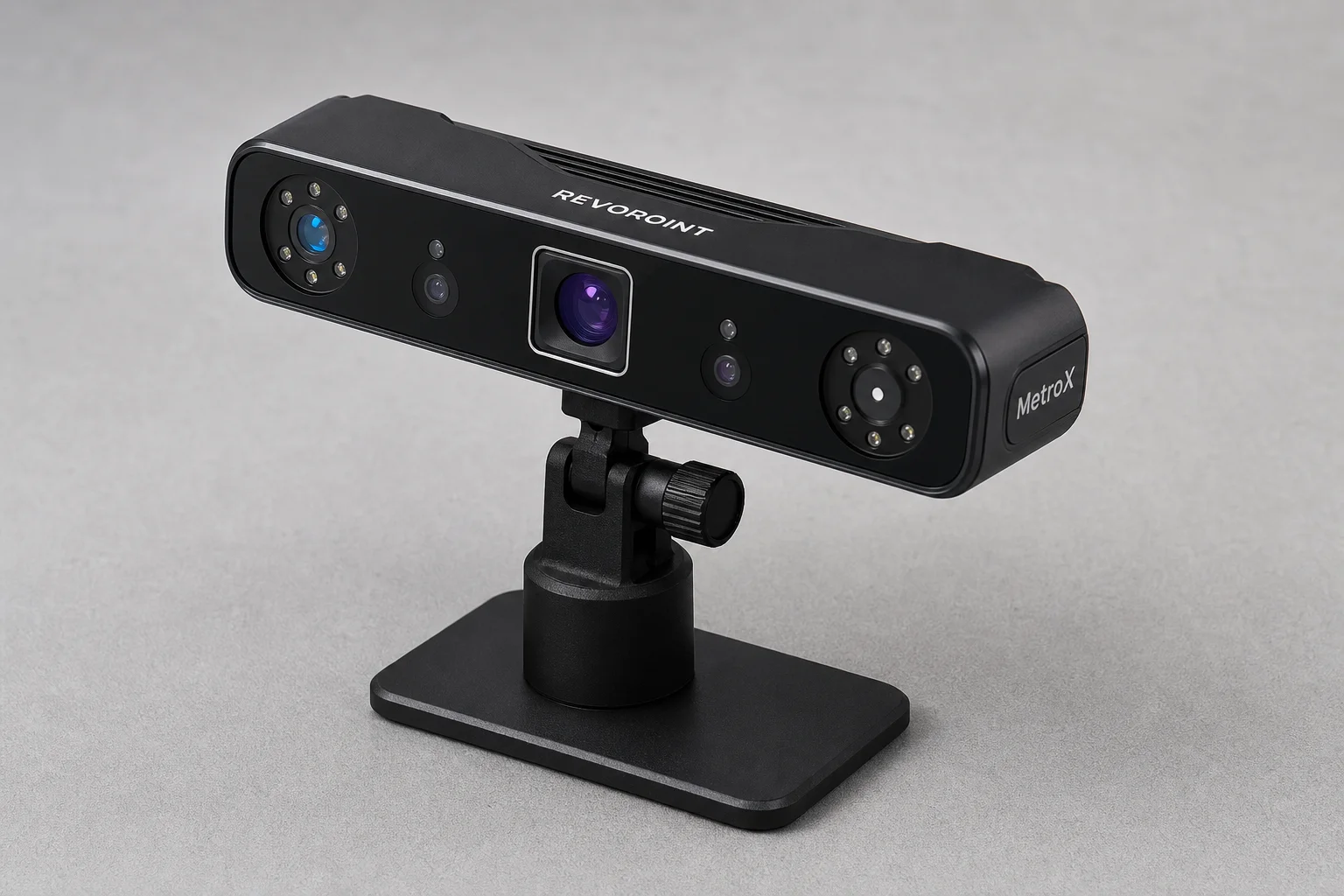
The Revopoint MetroX is a laser scanner that captured more slowly than the Raptor or Sermoon S1. It achieved 136 microns of accuracy error, significantly higher than the other laser scanners. The MetroX also produced noisier results in the hole area and pocket regions, and the overall scan was less complete despite spending the longest scanning time. The resolution of embossed text was lower than the Raptor and Sermoon S1.
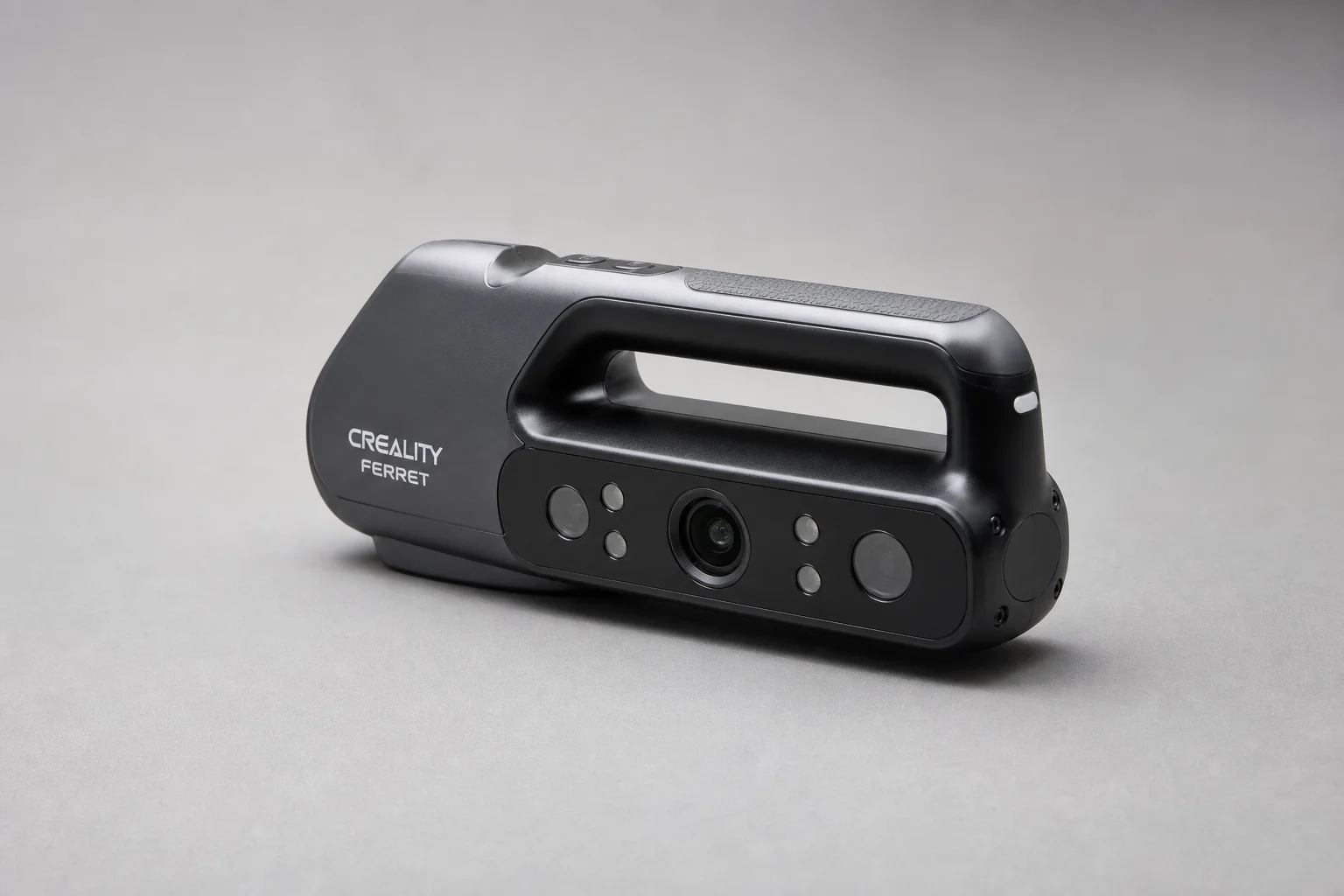
Infrared Scanners: Creality Ferret, Otter, and Otter Lite
Infrared scanners track geometry rather than markers and are designed to scan black objects without spray coating. They offer faster frame rates than laser scanners but lower precision.
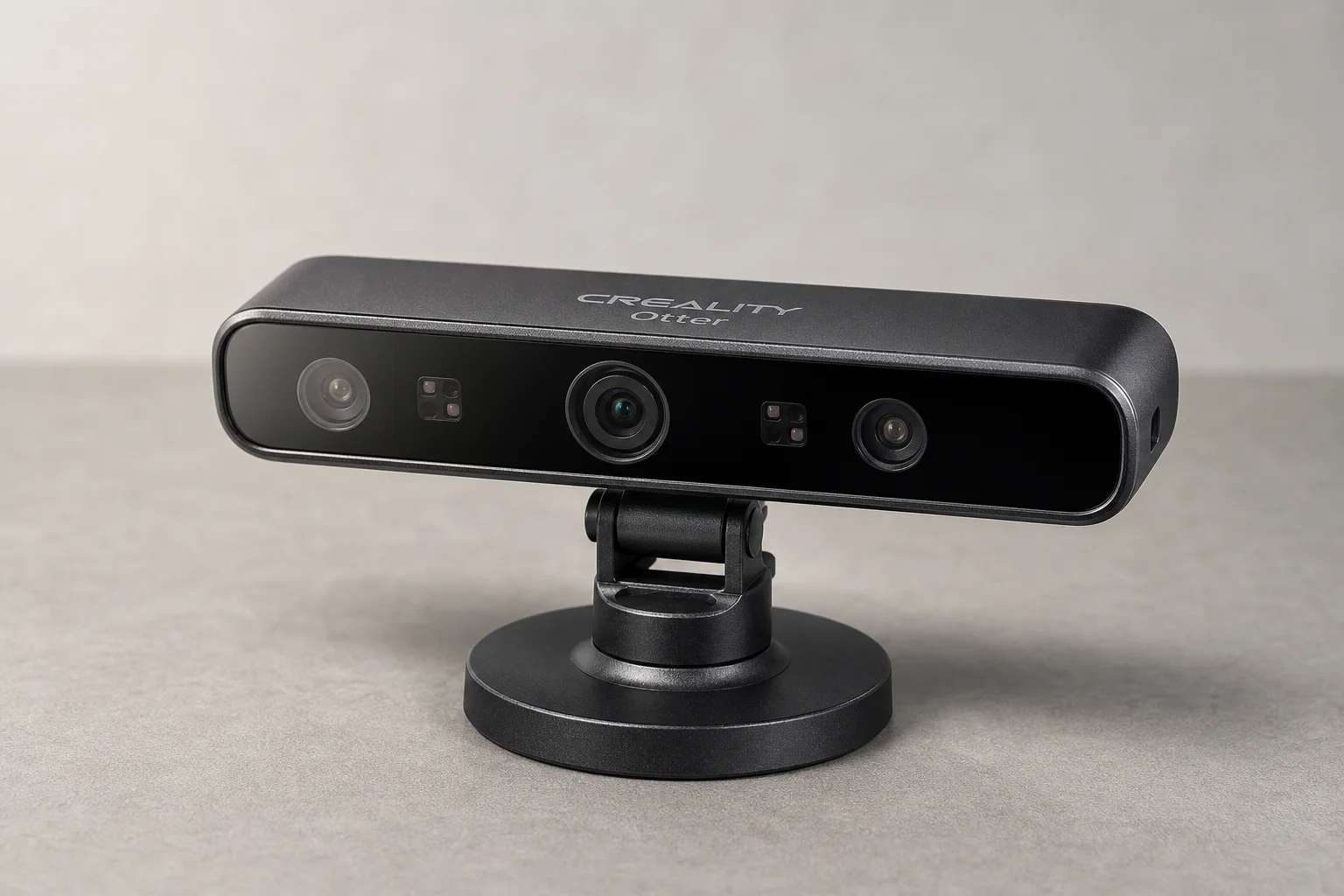
The Creality Otter is an infrared scanner that performs best in geometry tracking mode rather than marker mode. When using markers on a black object, the exposure required to see the black surface burns out the markers, making tracking unreliable. In geometry mode with automatic exposure, the Otter achieved 17 microns of accuracy error, which is competitive with the laser scanners. The Otter can lean to a low angle and captures side walls well. It reached into the deep pocket better than the Raptor, though not as completely as the Sermoon S1.
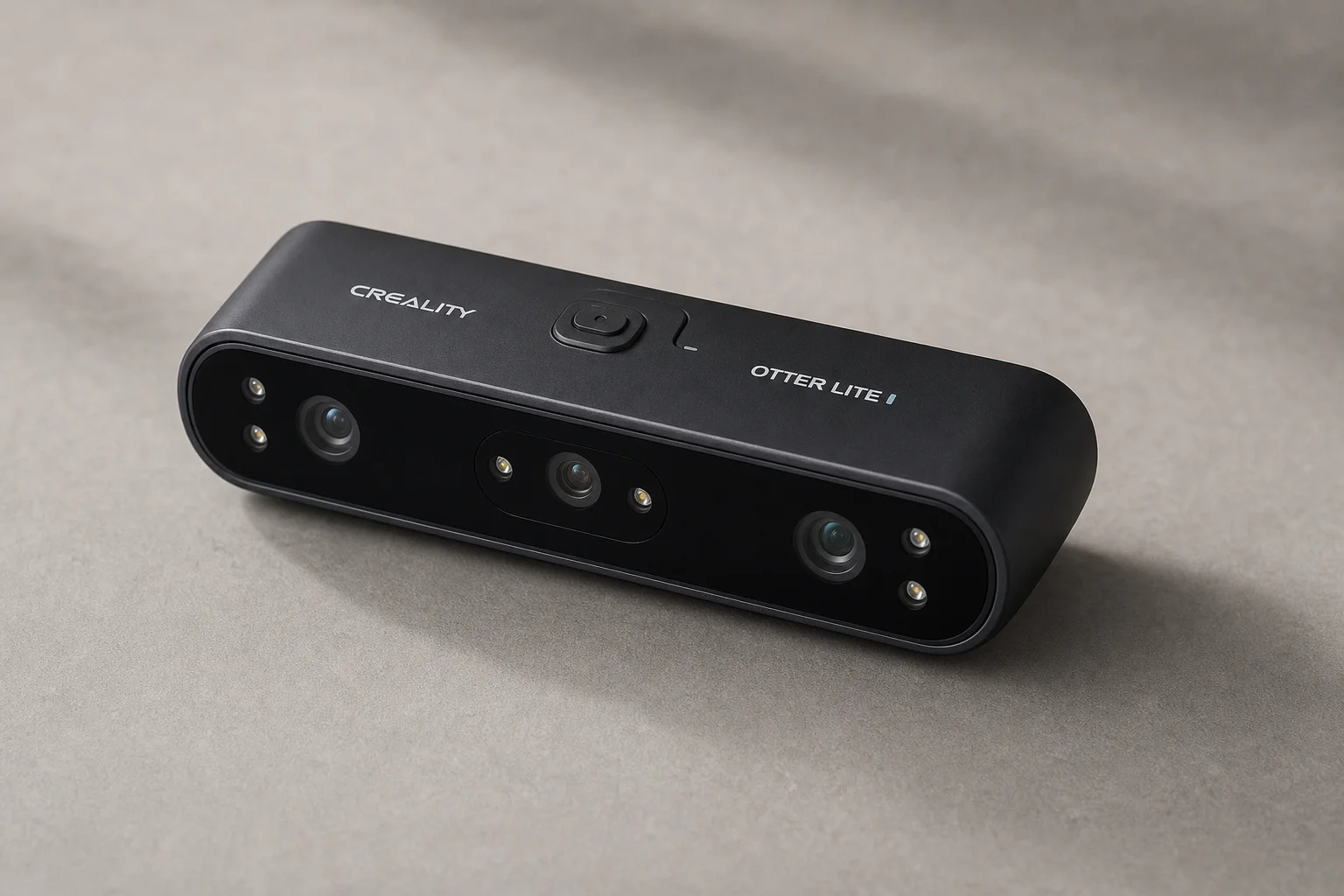
The Creality Otter Lite is a more compact version of the Otter but with lower resolution capability. In this test, it achieved 17 microns of accuracy error, matching the full Otter. However, the resolution is lower, and the embossed text appears blurred. The Otter Lite is not recommended for reverse engineering small parts because the detail is insufficient.
The Creality Ferret is designed for larger objects, roughly shoe-sized. On this smaller part, it failed to deliver useful results. The working distance is greater than the Otter models, which reduces resolution. The accuracy error was 270 microns, far too high for precision work. The Ferret does not include a calibration board and is simply not suited to small, intricate geometry.
Structured Light Scanners: 3DMakerpro Moose, 3DMakerpro Seal, and Matter and Form 3
Structured light scanners project a pattern and track geometry. They scan slower than infrared scanners but offer higher resolution than infrared in many cases.
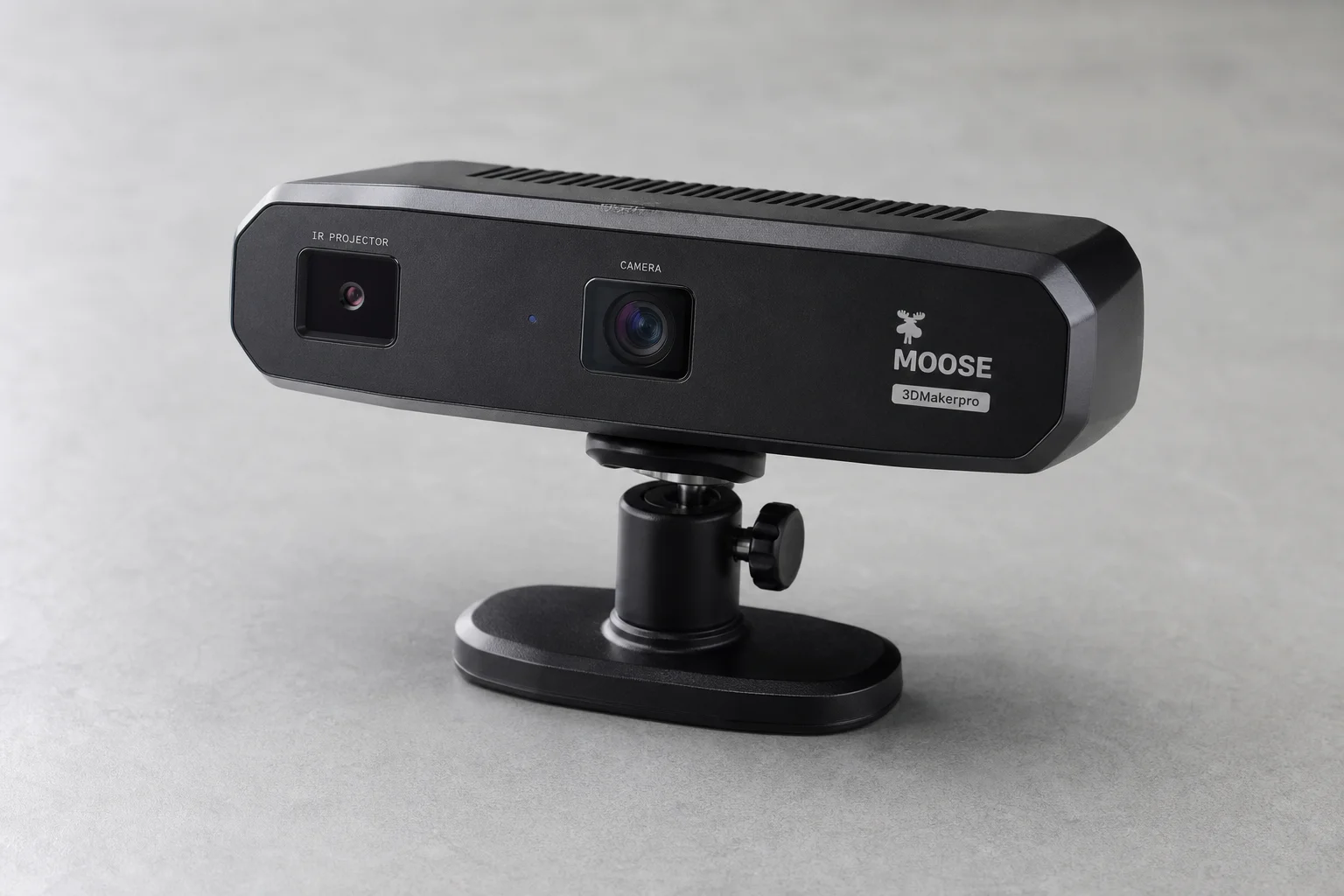
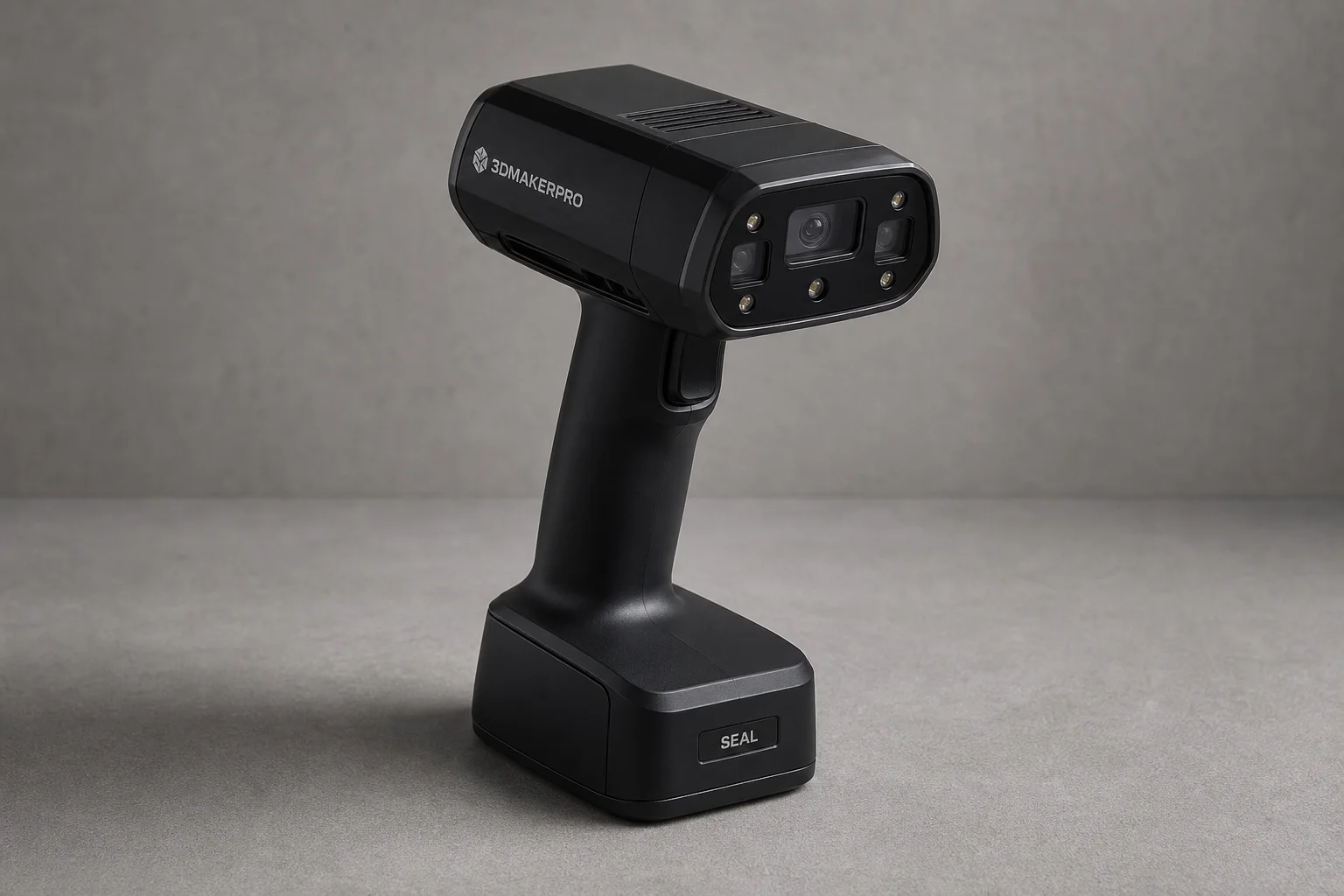
The 3DMakerpro Moose has a resolution of 0.2mm and a larger capture range. The Seal has a resolution of 0.15mm and a smaller capture range, making it better suited to smaller objects. Both scanners track at 10 to 15 frames per second, slower than infrared scanners. The Moose and Seal have identical tracking performance; the difference is mainly in capture range and resolution.
The 3DMakerpro Seal achieved 51 microns of accuracy error in this test. It produced good surface quality and tracked well, though it generated some boundary noise. The resolution is comparable to the Otter in small mode. The Seal cannot scan high-contrast surfaces well; if an object has both white and black areas, the scanner struggles unless spray is applied to reduce contrast.
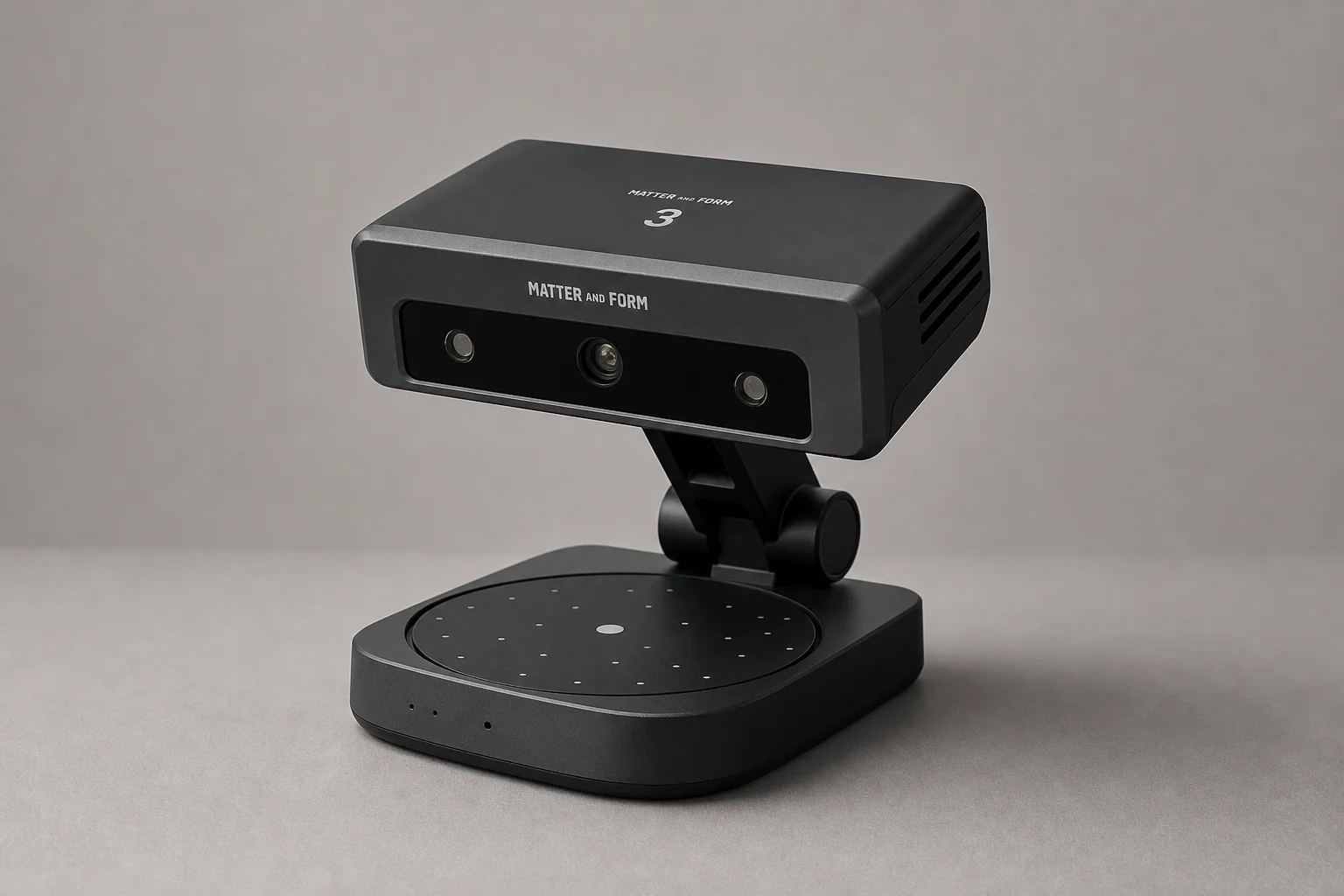
The Matter and Form 3 is a structured light scanner with a recent firmware update that improved black object scanning. It includes a 13-megapixel camera, which provides higher resolution than the Raptor when scanning smaller objects. The new firmware allows adjustment of projector brightness, making black object scanning much more reliable than before. In this test, it achieved 90 microns of accuracy error. Some very thin walls were not captured, but the overall improvement in black object handling is significant. The processing time is longer than other scanners, especially at high resolution.
Accuracy and Completeness Comparison
Accuracy error under 50 microns is generally acceptable for CNC milling, FDM printing, or resin printing. Parts produced from scan data with this level of precision will fit correctly.
The Otter achieved the lowest accuracy error at 17 microns, matching the Otter Lite. The Raptor achieved 22 microns, and the Sermoon S1 achieved 32 microns. These three laser and infrared scanners are suitable for precision reverse engineering work.
The MetroX at 136 microns, the Ferret at 270 microns, and the Matter and Form 3 at 90 microns fall outside the acceptable range for tight-tolerance work. The Seal at 51 microns is just above the threshold.
Beyond accuracy, scan completeness matters. The Sermoon S1 captured the bottom of the deep pocket better than the Raptor because the single-line mode can reach into areas blocked by walls. The Otter captured side walls well and produced a smooth surface. The MetroX produced noisy results in the hole and pocket areas, which could cause problems when locating hole positions.
For embossed text resolution, the Raptor delivered the sharpest detail, followed closely by the Sermoon S1. The MetroX had lower resolution despite the same 0.15mm fusion setting. The Otter produced good resolution with smooth surface quality. The Otter Lite resolution was too low for detail work.
Conclusion
For reverse engineering small black parts with deep pockets and thin walls, the Creality Otter in geometry mode offers the best balance of accuracy, completeness, and ease of use. The Sermoon S1 is the best laser scanner choice if you need to reach deep pockets. The Raptor is a solid alternative if you prefer the traditional laser approach. The Ferret and Otter Lite are not suitable for this type of work. The Matter and Form 3 has improved significantly with the latest firmware but still trails the Otter and laser scanners in this specific test. The choice depends on your budget, the size of objects you typically scan, and whether you need the highest precision or can accept slightly lower accuracy for faster scanning.
Further reading
Related Reviews
3D Scanning
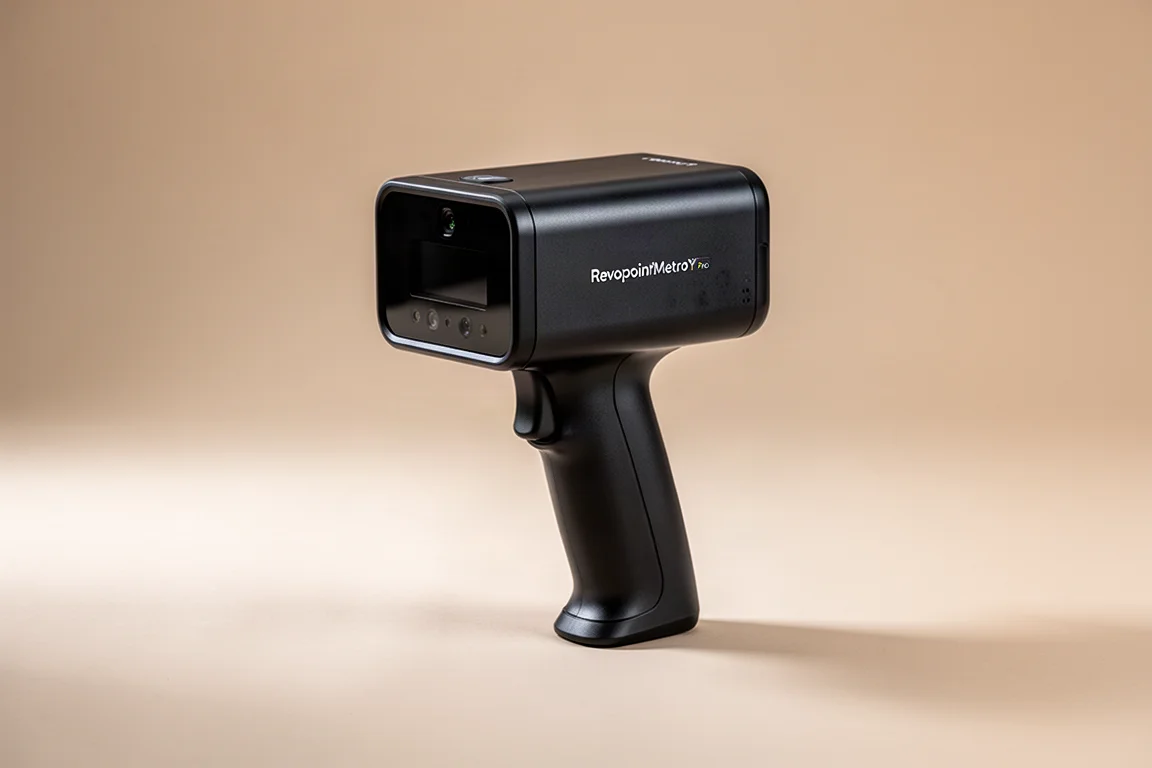
Revopoint MetroY Pro Review: A Versatile 3D Scanner for Practical Projects
A hands-on look at the Revopoint MetroY Pro 3D scanner, covering accuracy, scan modes, and real-world usability for engineering and design work.
3D Scanning
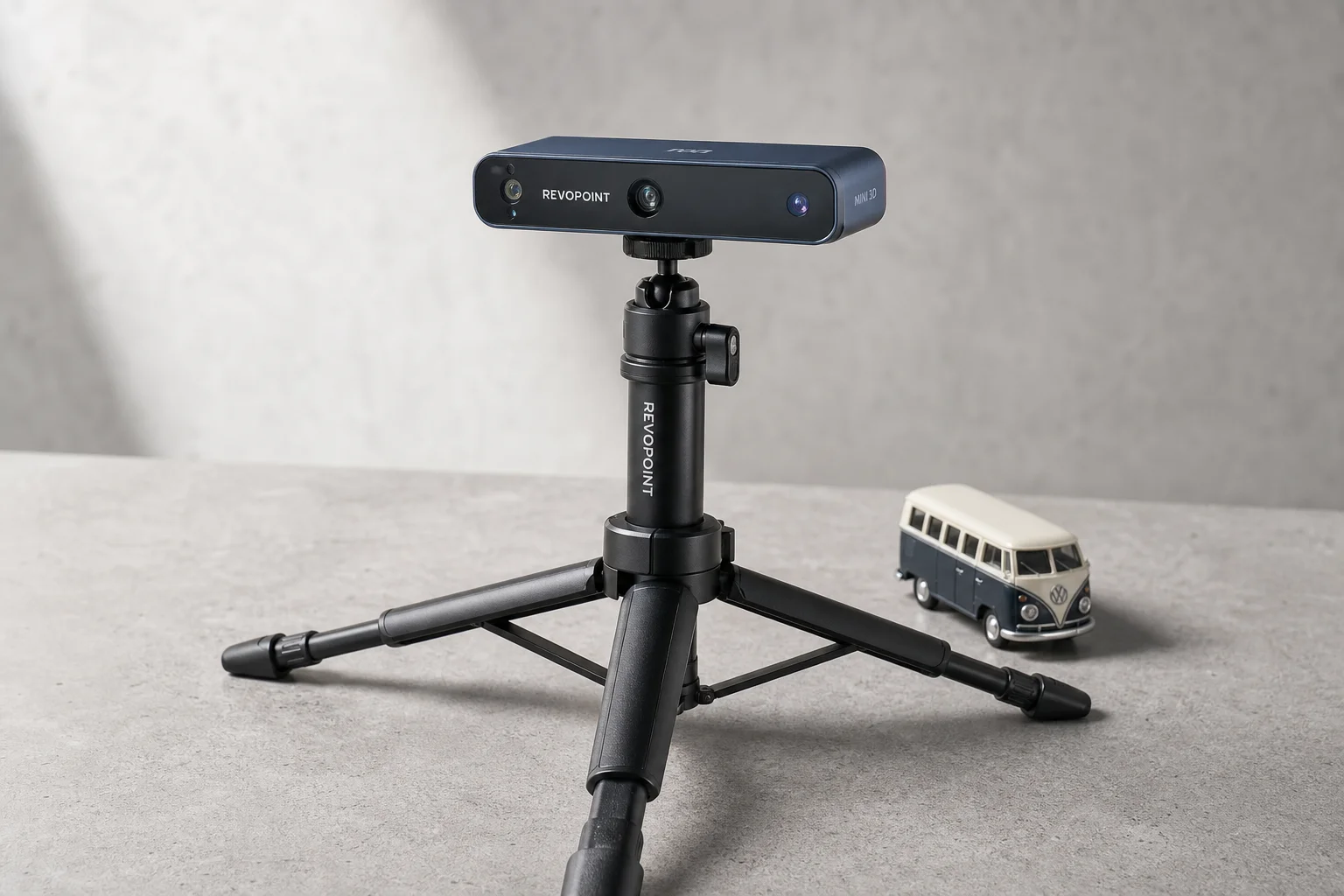
Revopoint Mini 3D Scanner Review: Budget-Friendly Detail Capture for Small Objects
The Revopoint Mini uses blue laser scanning to capture fine details on small objects and larger items. A practical budget 3D scanner for hobbyists and makers seeking workable scans without premium pricing.
3D Scanning Equipment
Best 3D Scanners Under $1000: Four Practical Options for Enthusiasts
A detailed comparison of four sub-$1000 3D scanners for larger scans and detailed parts, tested on real projects with accuracy measurements and usability insights.