Robotic Lawn Mowers
Yarbo Review: A Hands-Free Robotic Lawn Mower That Does Far More Than Cut Grass
After three weeks of constant use, this GPS robotic mower delivers impressively straight cut lines, handles soaked terrain on tank tracks, and swaps attachments for year-round yard work.

Introduction
Robotic lawn mowers have long demanded a trade-off: bury boundary wire around your yard or commit to a permanent perimeter cable setup. That alone kept many buyers away. Yarbo takes a different approach with a fully GPS-guided, hands-free machine that maps your yard through an app, cuts on a schedule you never have to think about, and pulls double duty across seasons with swappable attachments.
After three weeks of daily use on just under an acre of thick, often rain-soaked grass, this machine has handled every cut. It is not the cheapest option in its class, but the combination of cut quality, terrain ability, and year-round attachments makes a strong case for a specific kind of buyer.
Setup: Less Intimidating Than It Looks
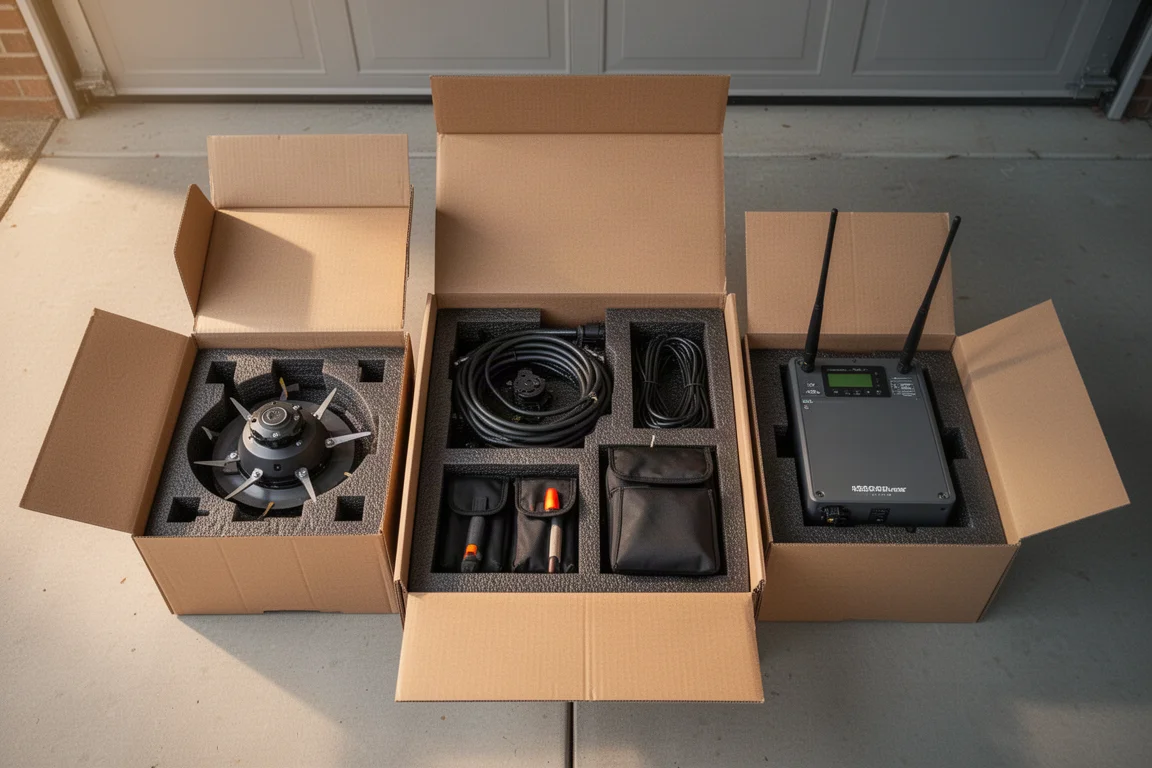
The arrival is the intimidating part. Multiple boxes show up with the main robot, cutting head, data center, charging pad, cabling, and accessories, and the pile looks like a serious project. In practice, assembly is straightforward. Packaging is excellent, tools are included, and smaller items are tucked into the foam inserts, so go through every box carefully.
Attachment swapping is simple too. The cutting head lifts off, aligns with four pins on the robot body, and connects with a single electrical cord. The robot itself is heavy, roughly a couple hundred pounds, so it should be driven onto the charging pad using the included remote or a phone as a remote control, not lifted by hand.
Data Center and Charging Pad
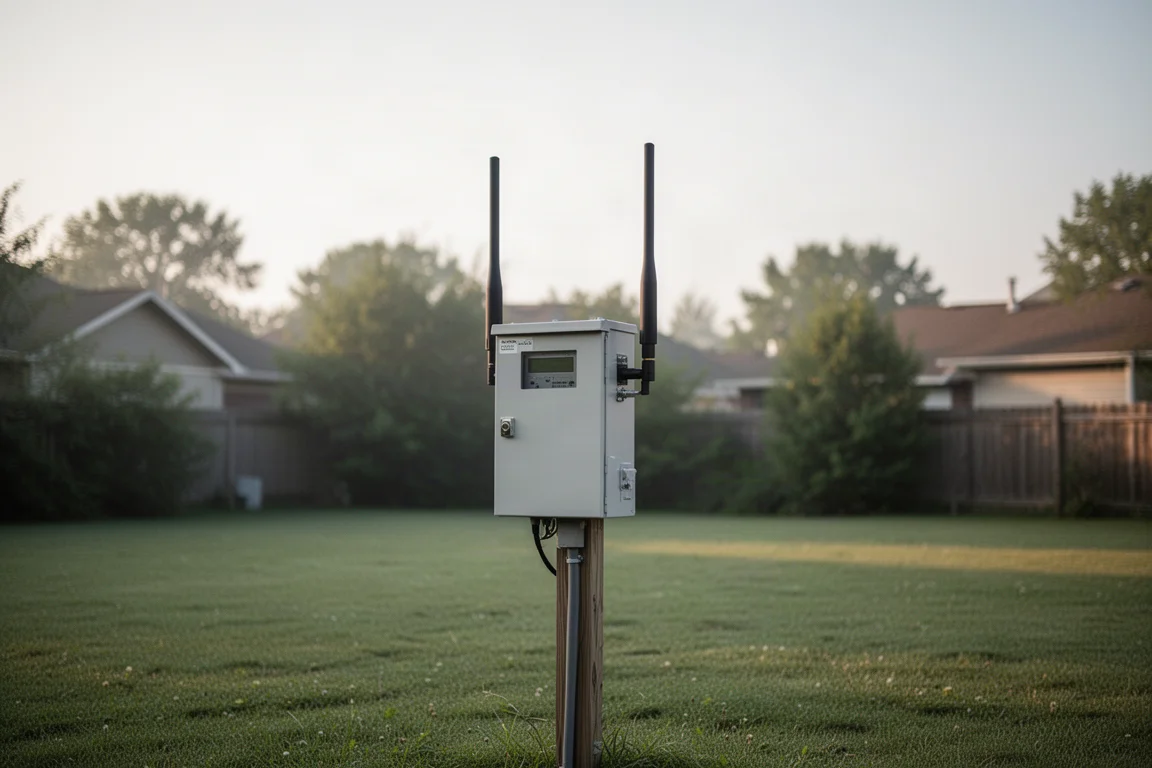
Two pieces of infrastructure make the system work. First is the data center, which needs a strong satellite signal: it requires 120 degrees of openness around it, so avoid placing it under trees or right against the house. A 100-foot Ethernet cable runs from the data center to a supplied PoE box, which plugs into your modem and the wall. A solid green light means you have good signal; a flashing red light means relocate the unit.
The Yarbo app walks you through the rest: reinstalling the data center from settings, then entering your Wi-Fi details through the diagnostic tools. Second is the charging pad, which works like a large phone charging surface. The robot simply drives onto it. A charging brick is also included as an alternative, though the pad is the more convenient option for everyday use.
Mapping the yard is done by walking the perimeter in the app, then drawing no-go zones around obstacles like sheds or trampolines. The app shows cut percentage, remaining time, estimated recharge time, and pause or stop controls, and it tracks exactly where the robot is and what it is cutting in real time.
Cut Quality and Navigation
This is where Yarbo genuinely surprised. On the first run, the grass was high, thick, and wet after weeks of rain, and the machine still produced clean results. One tip learned the hard way: use the incremental cutting setting, which trims in small fractions of an inch across several passes down to your target height, rather than cutting everything at once.
Navigation is the standout feature. Set to light-touch obstacle response, the robot senses objects like trees that were never mapped as no-go zones, works its way around them, and then picks up exactly where it left off in the cutting pattern. Unlike simpler robotic mowers, it does not lose its place. If the GPS signal drops under trees, it keeps cutting from memory and resumes normally.
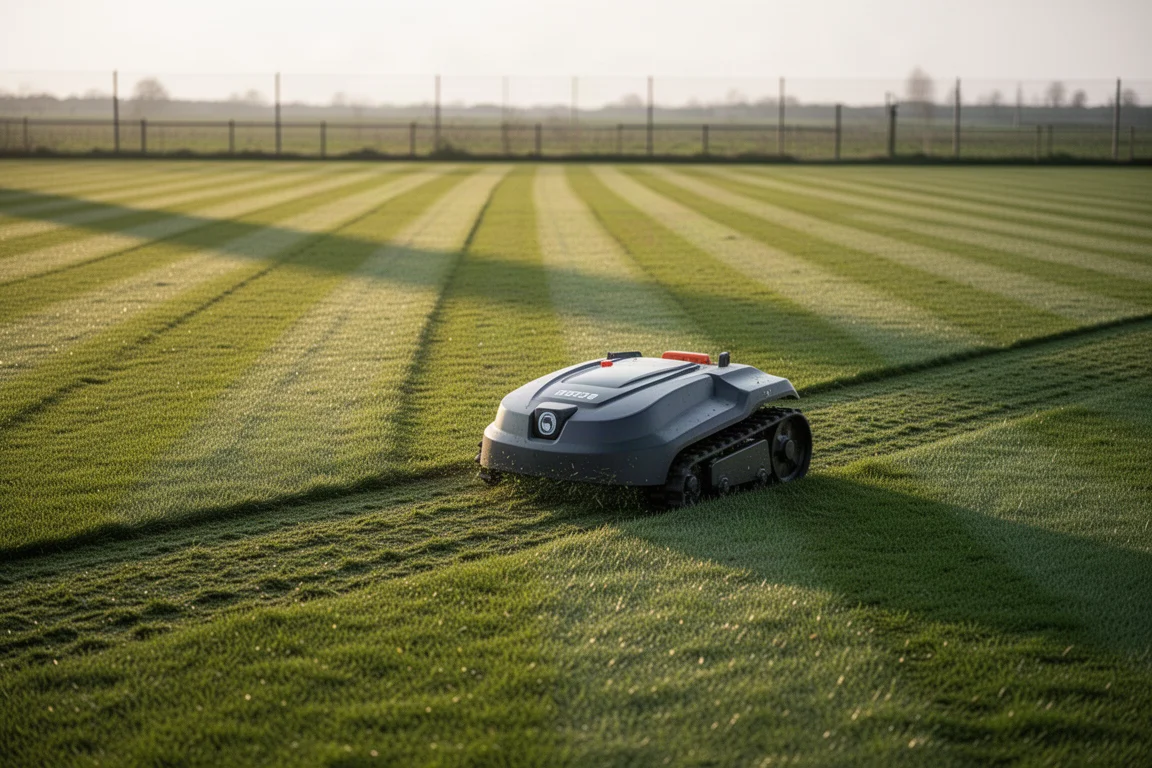
Straight lines are handled flawlessly, and the cutting deck follows the contour of uneven ground rather than scalping dips the way a rigid mower deck can. Turn behavior is configurable too: U-turn, zero-turn, or a three-point smart turn. On soaked ground, smart turn repositions the machine gently to avoid tearing the turf. The tank tracks float over squishy, saturated lawn where a riding mower would sink.
Noise is minimal. With the volume up close, there is only a faint motor whine, and from inside the house it is essentially unnoticeable. Cutting can be scheduled every couple of days or set to trigger automatically at 80 percent battery and return to charge at 20 percent, so the whole cycle runs without anyone home.
Attachments and Everyday Utility
The mower is only the beginning. The same base accepts a snowblower attachment rated to throw snow up to 12 inches deep, a leaf blower module that can direct leaves into a designated area through the app, fertilizer spreaders, edge trimmers, and string trimmer heads. These can be bought separately or bundled as a kit, so you can start with mowing and expand later.
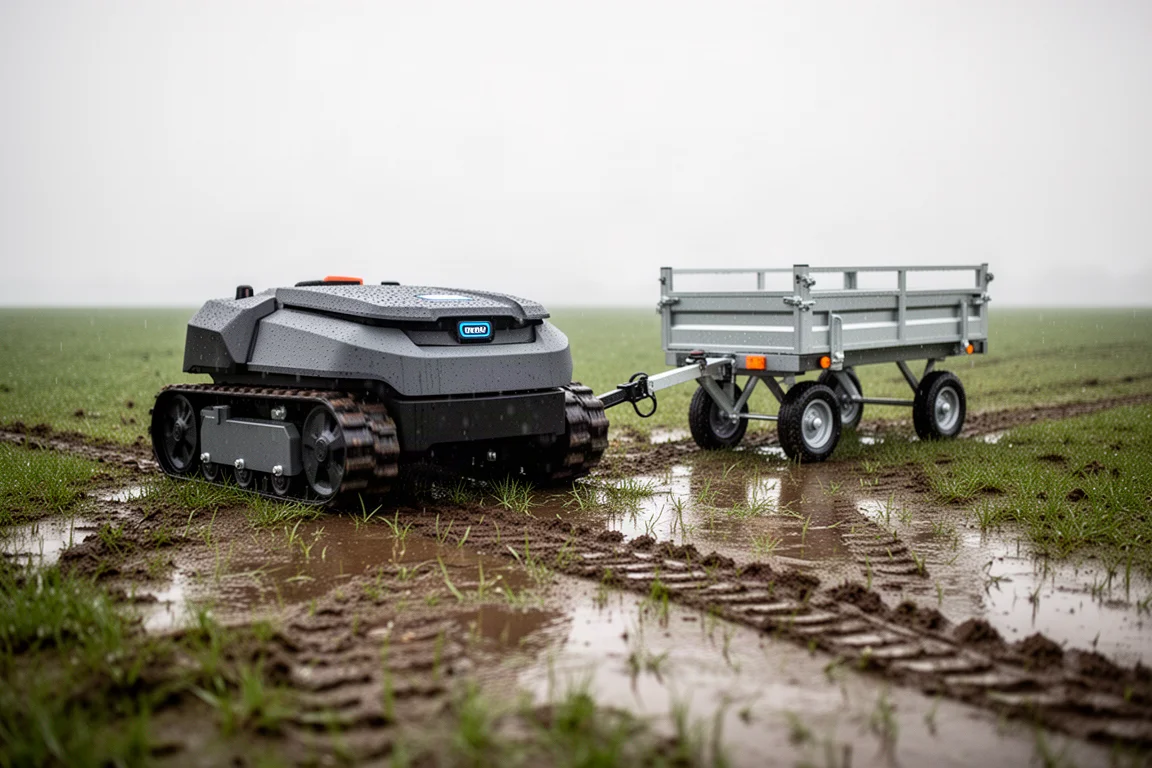
A hitch with a bolt-on mount accepts a utility cart, and a Follow Me mode uses the onboard cameras to trail behind you as you walk, useful for hauling mulch or tools around the property. Accessories include a back brace mount, a snow plow blade, and spare cutting blades, with replacements available separately.
One important caveat: the small razor-style blades underneath mean the yard must be cleared of sticks, branches, and debris before scheduled runs.
Things to Consider Before Buying
There are honest trade-offs. The system is pricey, and the modular attachment approach means the total cost grows if you add seasonal modules. Setup has a learning curve, particularly the data center placement and Wi-Fi configuration, though customer support handled both a remote firmware update and a Wi-Fi pairing question quickly and effectively.
Coverage is rated for up to 6 acres, with the robot automatically returning to its base to recharge and then resuming where it left off. On the test property of just under an acre, a full cut with smart turn enabled takes over five hours; switching to U-turn would shave a couple of hours off, but since the machine works unattended, the time difference matters little. It has also been left outside through multiple downpours without issue, and it rolls over curbs and rough edges without damage thanks to the flexible track design.
Who This Machine Makes Sense For
This is not for everyone. If you enjoy mowing and your yard is small, simple, and dry, a conventional mower remains the sensible choice. But for busy households, older owners who can no longer push a mower, rental property owners, people heading on vacation, or anyone with difficult terrain like steep slopes or wet low-lying areas, the tracked design and hands-free scheduling remove the single most tedious recurring yard chore.
Buying Advice
If the goal is to never mow again while keeping the lawn looking sharply maintained, Yarbo justifies its price with cut quality, GPS reliability that survives signal dropouts, and genuinely impressive terrain handling. Start with the lawn mower configuration, then add the blower or snowblower modules as seasons and budget allow. Clear the yard of debris, follow the incremental cutting guidance, and let the schedule do the rest.
Conclusion
Yarbo delivers on the promise of a truly hands-free lawn: perfect straight lines, smart obstacle handling, automatic recharge-and-resume cycles, and a platform that extends into snow clearing, leaf blowing, trimming, and hauling. It is expensive and the setup takes patience, but for buyers with challenging yards or simply better things to do with their weekends, it earns its keep.
Product link
View more details for Yarbo
This product is mentioned in the review. Check the specifications, options, and compatibility before buying.
View more details for YarboFurther reading
Related Reviews

Robotic Lawn Mowers
Sunseeker Elite X4 Review: A Wire-Free Robotic Mower for Smaller Lawns
A lidar-based robotic mower with fast setup, smart obstacle handling, and razor-style cutting, best suited to smaller yards under about 0.3 acres.

Robotic Lawn Mowers
Sveer Blicks Robotic Lawn Mower Review: Cable-Free Cutting That Actually Works
A lidar and vision robotic mower that mapped a complicated half-acre paddock in minutes, avoided unmapped obstacles, and cut through long, wet grass without getting stuck.
Smart Home
Amazon Echo Hub Review: A Smart Home Dashboard That Finally Gets It Right
The Amazon Echo Hub puts smart home controls front and center with a fast, simple interface. Here is how it performs as a family-friendly dashboard.