Studio Monitors
Swissonic A306 Review: A Neutral Two-Way Powered Speaker With Smart Rear Switches
A compact two-way powered speaker with excellent dispersion, useful rear DSP switches, and an import cost that shapes the value equation outside Europe.
Introduction
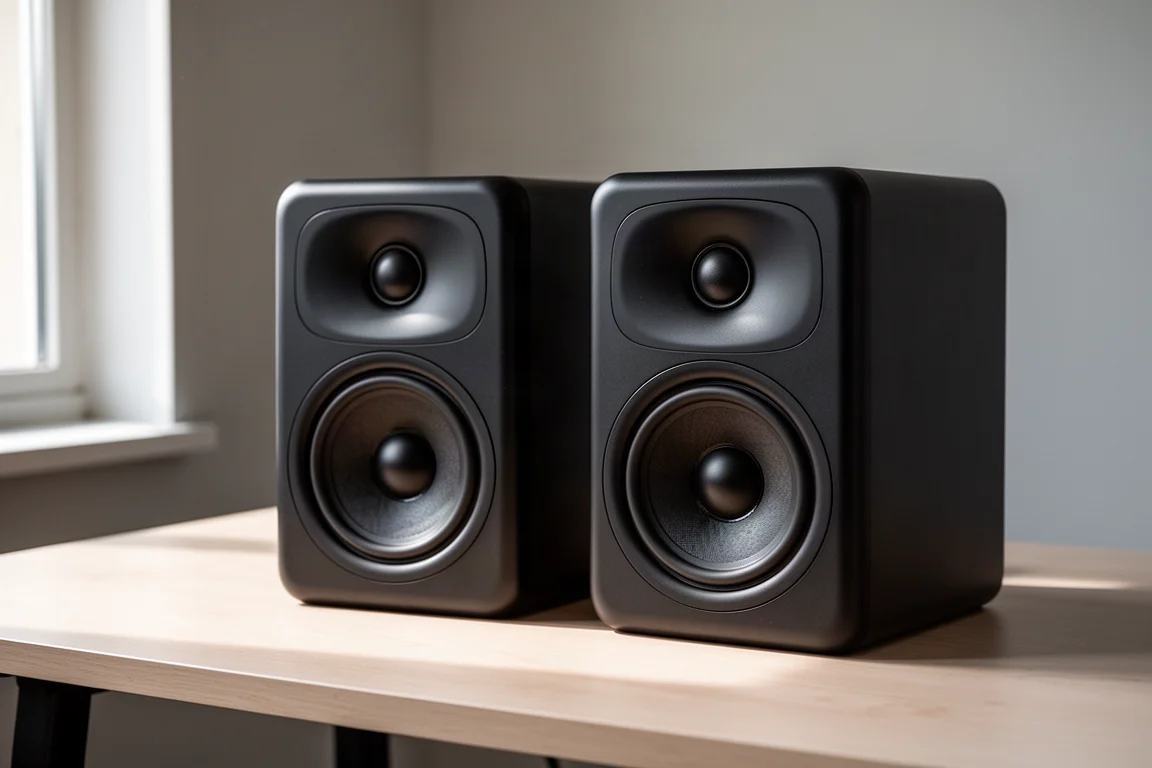
Swissonic is an in-house brand of the German retailer Thomann, and the A306 is a compact two-way powered speaker aimed at desktop use as well as farfield listening in a standard room. It pairs a 6.5-inch woofer with a 1-inch silk dome tweeter mounted inside a shaped waveguide, and it accepts both XLR and RCA sources. Around the back sits a bank of DSP switches for placement and tonal trimming, which is unusual at this price.
At roughly $250 per pair, the A306 looks like an obvious value play, and for listeners in Europe it very often is. Buyers in the United States face a different calculation: shipping runs about $60 per speaker, and the supplied power plug is European, so an adapter adds around $15. That pushes a delivered pair to roughly $385. Even so, the speaker holds up well against the well-known alternative that most buyers compare it to, and the rest of this review covers where it wins and where it does not.
Who the Swissonic A306 Is For
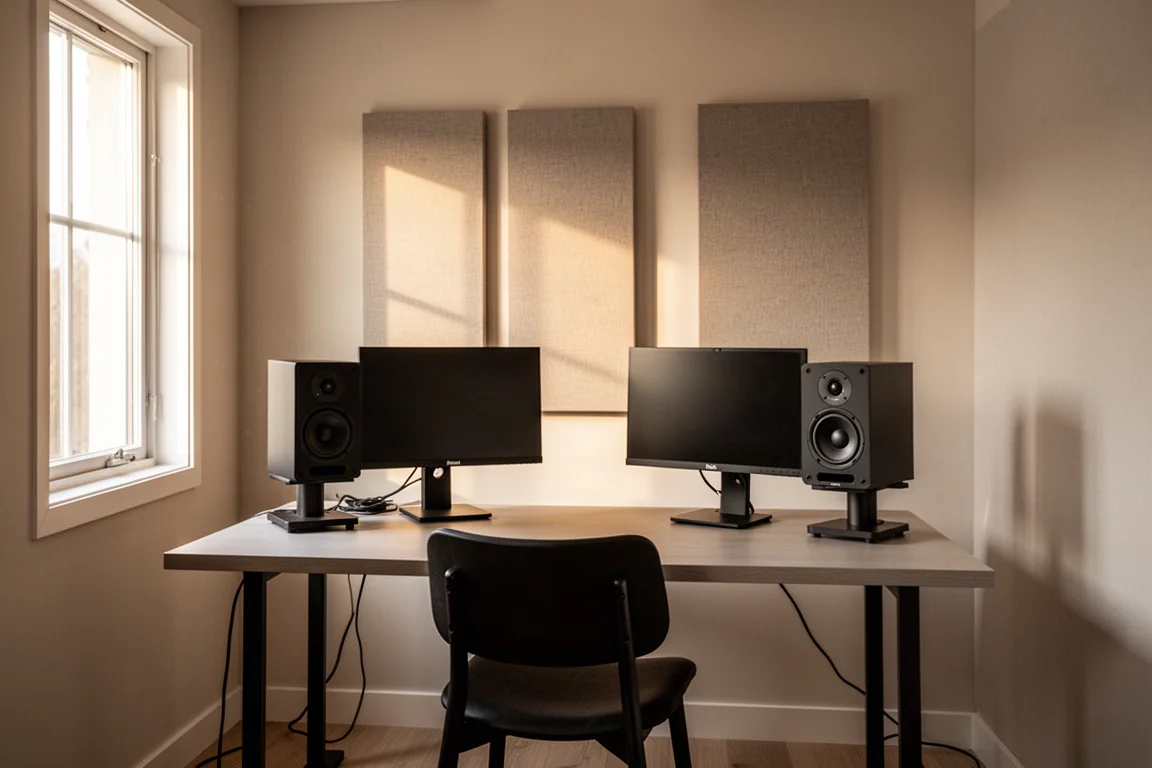
The A306 makes the most sense on a desk or in a small room where a two-way powered monitor can be placed at a sensible distance from the wall. It is also intended for farfield use in a standard room, so it does not have to live next to a laptop. Its combination of XLR and RCA inputs means it can take a balanced feed from an interface or an unbalanced feed from a consumer source without extra hardware, and because it is a powered design it does not need a separate amplifier.
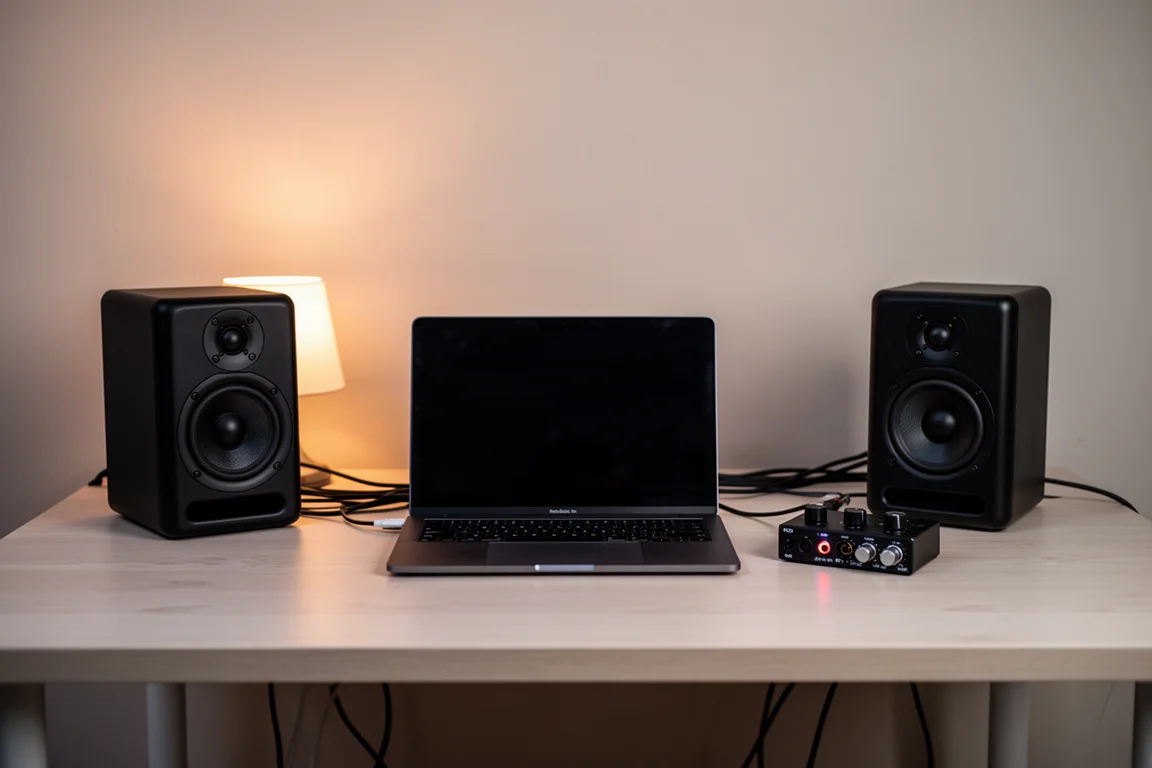
Listeners who enjoy tailoring a system will get the most out of it. The rear switches let you tell the speaker whether it is sitting close to a wall or further out into the room, and they let you nudge the treble and bass up or down. If you would rather set something down and never touch it again, that flexibility simply goes unused, but it costs nothing.
It is a less natural fit for anyone who wants a single-box solution with streaming built in, or for a very large room where a compact 6.5-inch two-way will run out of headroom. It is also a harder sell in the US once shipping and the plug adapter are added, unless you specifically want what it does well.
Build Quality, Inputs, and Placement Options
The cabinet looks tidy and reads as a studio speaker rather than a lifestyle object, but it is plastic and does not carry much weight. Most of the mass appears to sit in the amplifier and the woofer motor. That is the main physical compromise, and it is a fair one at this price.
Connectivity is simple: XLR and RCA inputs, plus the switch bank on the back. The switches cover wall placement, treble level, and bass level. There is no app, no display, and no network connection, which keeps the speaker predictable.
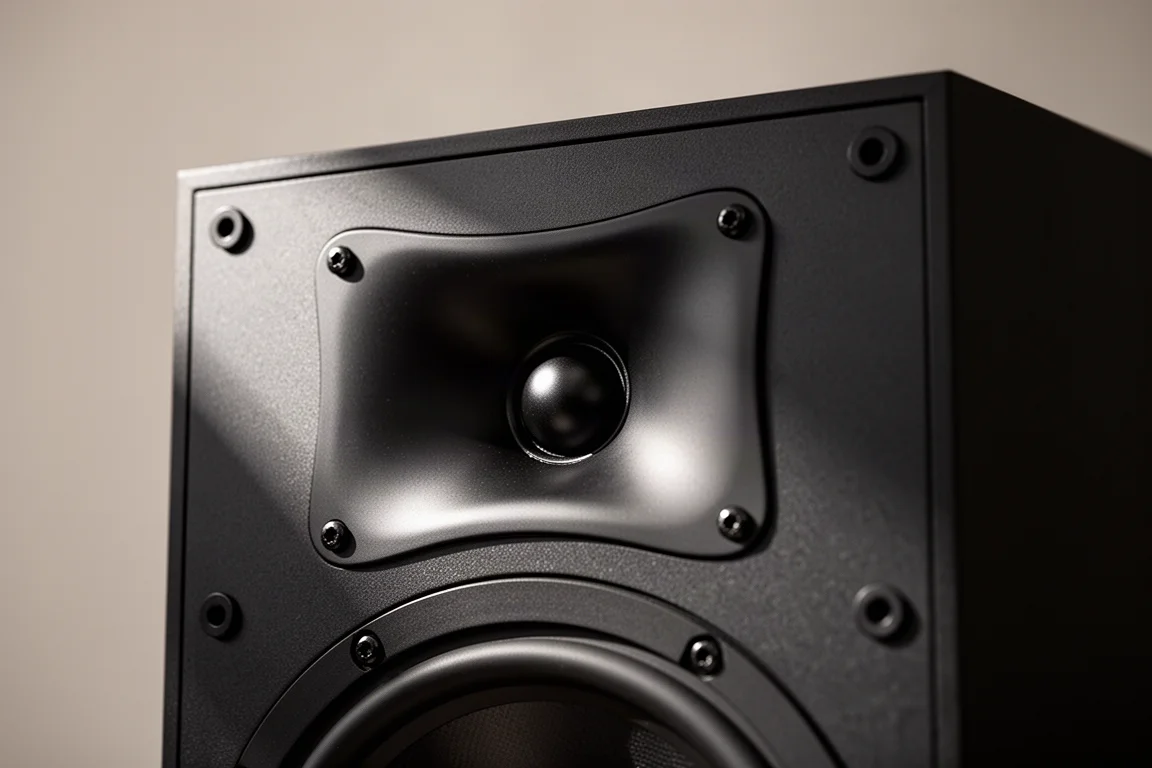
The waveguide around the tweeter is the most distinctive part of the design, and it is not just decoration. It does a genuinely good job of controlling dispersion, which is one reason the speaker holds together so well off axis.
Sound Quality and Measured Performance
Out of the box the A306 is a little bright. There is an audible rise in the treble that adds emphasis to cymbals and sibilant sounds without becoming harsh. The high frequency trim on the back drops that by 2 dB, and after that the top end is smooth and linear.
Through the lower midrange, roughly 200 Hz to 400 Hz, the speaker is slightly dipped. Tracks that normally carry a bit of weight in that region sound leaner than expected. Lifting the bass switch by 2 dB, which begins around 400 Hz and rises as frequency falls, fills that in and brings back the body those recordings are supposed to have. With the treble down 2 dB and the bass up 2 dB, the A306 is easy to listen to across a wide range of material.
Measured on axis, the response sits within roughly 2.5 dB either way from 80 Hz to 16 kHz, and the bass reaches an F3 of about 43 Hz with an F10 of 34 Hz, so 40 Hz is usable in a room. There is a mild scoop through the midrange around 800 Hz, a small resonance near 300 Hz, and a narrow cancellation between about 1.4 kHz and 1.6 kHz that is most likely an enclosure or port resonance. It is narrow enough, and small enough in amplitude, that it is unlikely to be noticeable in normal listening.
Horizontal dispersion is excellent for the price, tracking smoothly out to about 60 degrees at the minus 6 dB point. Vertically, the reference axis sits between the tweeter and the midwoofer, and the response stays reasonable within about 15 degrees above or below that line, so ear height at that midpoint gives the best result. The tweeter and midwoofer are also time aligned, which is uncommon in this class. Distortion looks good at both 86 dB and 96 dB at one metre, and multi-tone distortion across the full range is clean. Crossing the speaker over to a subwoofer at 80 Hz barely changes the distortion behaviour, and there is very little compression, which suggests the output is well managed.
The Rear DSP Switches and How to Use Them
The back panel is where the A306 earns its keep. Placement switches let you compensate for a speaker sitting close to a wall versus one placed further out into the room. The treble trim moves the top end up or down, and the bass trim lifts or lowers the low end from around 400 Hz downward.
A sensible starting point is to leave the speaker on its default settings, take the treble down by 2 dB, and add 2 dB of bass. From there the adjustments are yours: if you prefer a brighter sound, leave the treble alone, and if your room already reinforces the low end, cut the bass instead. It is a small set of switches, but it covers the two things most likely to bother you.
How It Compares to the JBL 306P MK2
The obvious rival is the JBL 306P MK2, a speaker that is widely recommended and often discounted, sometimes to under $200 per pair and more typically somewhere between $250 and $300. Preference scores for the two are very close, so the decision comes down to smaller differences.
On axis, the A306 has about 2 to 3 dB more output at 60 Hz and 80 Hz, and around 5 dB more at 30 Hz, so it digs deeper. The midrange dip described earlier is present on the A306 and less obvious on the JBL. At the top end the JBL shows wider and deeper irregularities, including a broader dip in the same 1.4 kHz to 1.6 kHz region.
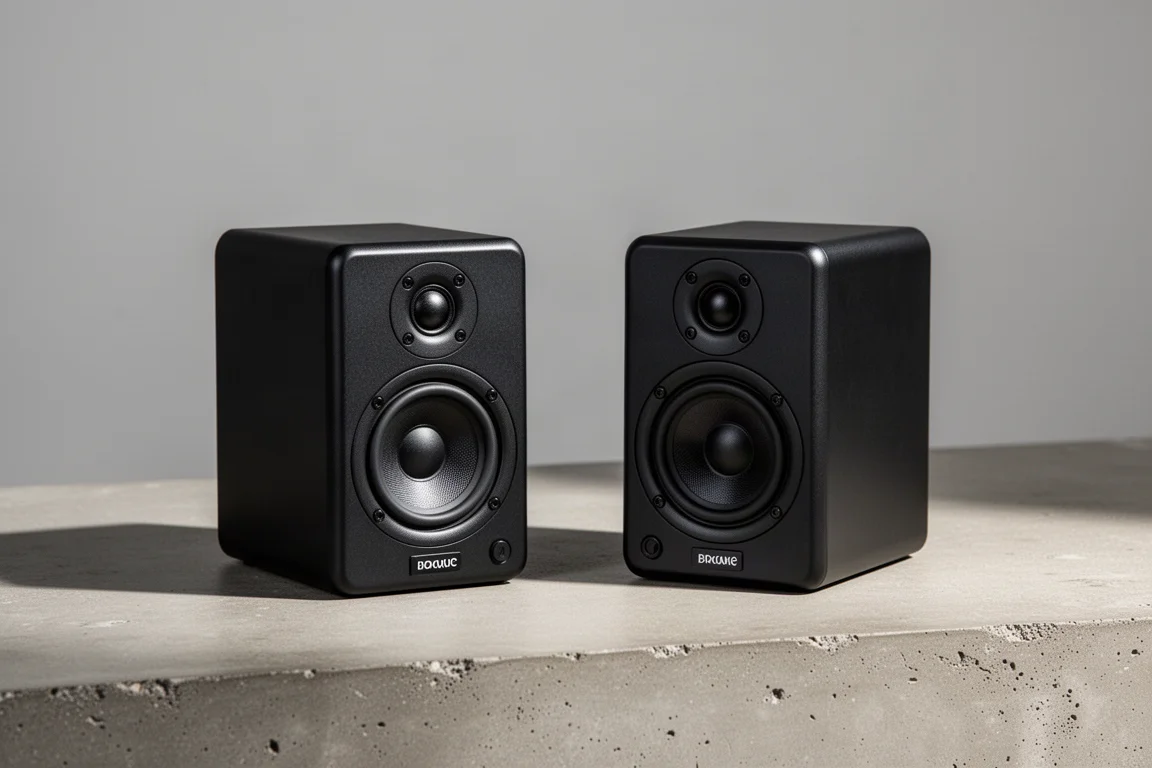
Horizontal dispersion is the other dividing line. The JBL may be marginally wider, but the A306 is more consistent, and at roughly 60 degrees of usable coverage there is little reason to ask for more. The A306 also benefits from the time alignment between its drivers. Overall the A306 takes a slight edge, though the gap is narrow enough that another listener could reasonably land on the other side. In the US, that edge has to justify an extra $100 to $150 once shipping and the adapter are included.
Things to Consider Before Buying
The build is the clearest compromise. The cabinet is plastic and light, and it does not feel like premium hardware, even if it looks the part on a desk. Buyers in the US should also budget for the full landed cost: around $250 for the pair, about $120 in shipping, and roughly $15 for a European to US plug adapter, for a total near $385. European buyers do far better, at around €280 per pair plus shipping, which is sometimes free.
The speaker also asks a little of you. It is slightly bright out of the box and slightly lean through the lower midrange, and the fix is a couple of switches on the back rather than a setting in an app. There is no room correction beyond those switches, and no wireless connectivity at all.
Buying Advice
If you are in Europe and you want a neutral, well-behaved powered two-way for a desk or a small room, the A306 is a strong option at its price, and the DSP switches make it easy to fit into a real room rather than an ideal one. Set the treble down 2 dB, add 2 dB of bass, and spend a little time on placement and ear height.
If you are in the US, the decision is about willingness to pay for the import. A delivered pair lands near $385, which is more than the JBL alternative typically costs, and the A306’s advantages in bass extension, dispersion consistency, and driver time alignment are real but not enormous. Buyers who want the deeper low end and the more consistent off-axis behaviour, and who do not mind the shipping and the adapter, will find the A306 rewarding. Buyers who want the simplest possible path to a good pair of monitors can reasonably choose the alternative and keep the difference.
Conclusion
The Swissonic A306 is a genuinely neutral two-way powered speaker with excellent directivity for its class, useful rear-panel tuning, and enough bass extension to make 40 Hz usable in a room. Its weaknesses are modest: a plastic cabinet, a slightly bright and slightly lean default voicing that two switches correct, and an import cost that changes the value equation outside Europe. Treated as what it is, a compact powered monitor with unusually good engineering for the money, it is easy to recommend to the right buyer.
Product link
View more details for Swissonic A306
This product is mentioned in the review. Check the specifications, options, and compatibility before buying.
View more details for Swissonic A306Further reading
Related Reviews
Studio Monitors
ADAM Audio A8H Review: A Three-Way Studio Monitor That Also Knows How to Have Fun
A three-way active studio monitor with an 8-inch woofer, a handmade AMT tweeter, and two distinct tunings, the ADAM Audio A8H aims to satisfy both critical work and everyday listening.

Studio Monitors
Best Studio Monitors 2026: Six High-End Options Compared
We tested six premium studio monitors in a real studio space to see which ones deliver the best mix of accuracy, musicality, and value.
Studio Monitors
Focal Alpha 65 Evo Review: An Honest Studio Monitor With Real Bass
A bi-amplified active studio monitor with deep bass, useful tone controls and a truthful, uncoloured voicing, assessed for small studios and home setups.