Fountain Pens
Santini Safety 1920 Review: A Handmade Italian Safety Filler With Real Character
A large, handcrafted Italian safety filler with an in-house 18k nib, retractable nib mechanism, and a filling process that rewards patience.
Introduction
The Santini Safety 1920 is not a subtle pen. It is large, expensive, and built around a filling system most fountain pen users have never handled. And that is exactly why it is interesting. Santini is an Italian workshop that makes its pens and nibs entirely in-house, by hand, and this model revives the vintage safety filler: a pen with a retractable nib designed not to leak in a pocket.
This is a review of one pen in the petrol finish, fitted with an 18k number eight nib ground to a medium stub. If you have been curious about whether a safety filler still makes sense in a world of cartridge converters, this should help you decide.
Who This Product Is For
If you like large, girthy pens, this is immediately appealing. It is a very big pen with real presence, and the slightly hourglass-shaped section makes it more comfortable than its size suggests. If you prefer slim pocket pens, this is simply not your pen, and no amount of admiration for the mechanism will change that.
It also suits buyers who value provenance. The parts are made in Italy, the nib is made and ground in-house, and the feed is ebonite. At €699 excluding VAT, you are paying for handwork, not marketing.
{{image:1}}
Unboxing and Packaging
Santini clearly treats this as a luxury product. The box has a magnetic closure and feels genuinely luxurious, with a soft velvet bed inside and a protective sleeve for the pen. The package includes a warranty card, a thick, well-designed color brochure with extensive filling instructions, and a handwritten nib test card. Because safety fillers carry specific risks, the detailed instructions are a thoughtful touch rather than filler.
Also included is a 1 ml eyedropper, and Santini is specific about this: three eyedroppers of ink, no more. The guidance is to leave 10 to 15 percent of the barrel empty, because overfilling is apparently the most common beginner mistake with this system.
Design and Build
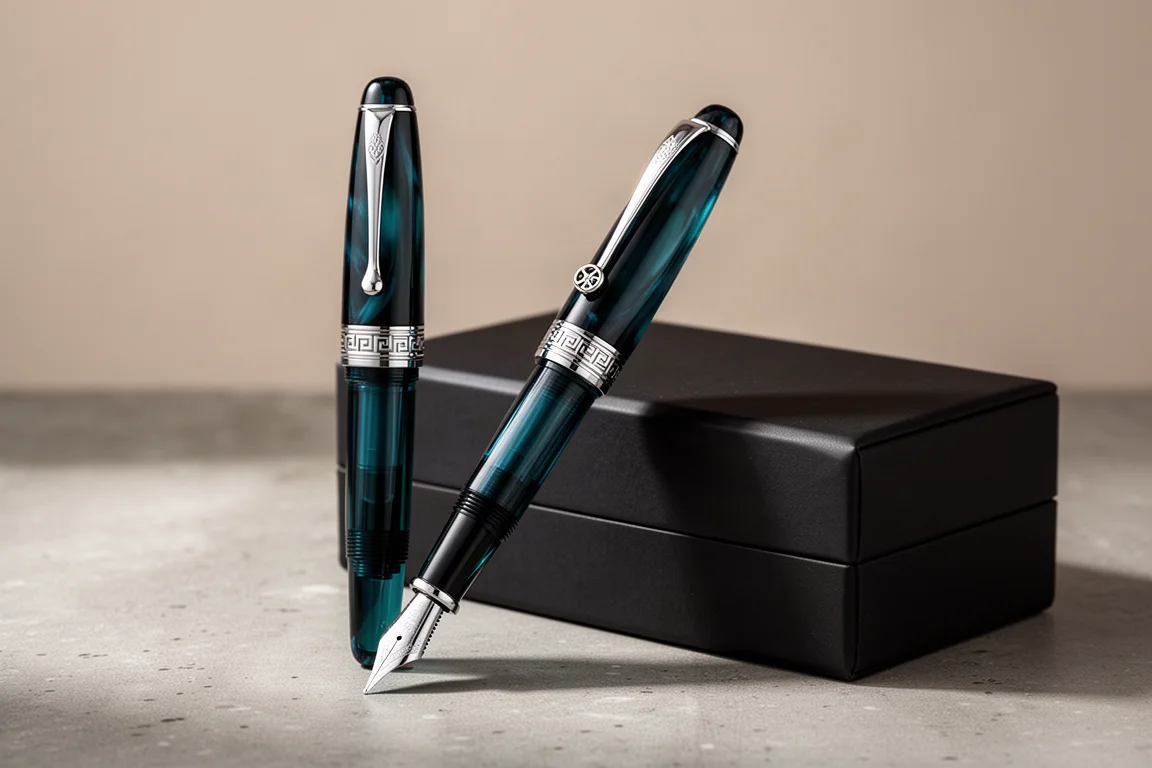
The petrol finish on this example is a translucent acrylic, so you can see hints of the mechanism inside. If translucent dark teal is not your taste, Santini offers other resins that are more colorful and equally attractive. The trim combines brass with rhodium plating, including a Greek key band at the cap and barrel and a clip with a small wheel detail and a gently curved shape.
The nib is a large number eight, 18 karat, rhodium plated, made and ground in-house. Nib options include extra fine, fine, medium, broad, stub, architect, oblique, and others, so you are not locked into one writing style.
{{image:2}}
The Safety Filler Mechanism
Here is where the pen gets unusual. A safety filler has a retractable nib. You twist the turning knob at the tapered end of the barrel, and the nib slowly extends or withdraws. When fully retracted, the ink reservoir seals, which is what makes the pen safe to carry: the cap can fill with ink, but it will not leak out once the nib is sealed inside.
This works, and it is genuinely satisfying to watch. But it demands care. Uncapping and extending the nib takes a deliberate sequence, so this is not a pen for quick notes. It is also an eyedropper-only system: there is no cartridge or converter option, because the mechanism is the barrel.
Filling and Everyday Use
Filling is a ritual. The pen must stand upright on a level surface, which is why it is designed to stand on its own. You draw ink with the eyedropper and add three measures directly into the barrel without tipping it over. Tip it while uncapped and open, and roughly 3 ml of ink goes everywhere.
The honest caveat: ink will find its way onto your hands. This is not because the pen leaks, it does not, but because the process involves an open, upright barrel full of ink. Experienced safety pen users will likely be tidier about it. If you insist on staying perfectly clean, think carefully before buying.
{{image:3}}
Writing Performance
The medium stub grind is a very pleasant writer. It is a very wet pen, and the stub produces clear line variation without being dramatic. It is not a flex nib, though careful pressure can squeeze out a little more variation. Reverse writing is barely legible, which is typical of stub grinds, so treat it as a one-direction pen.
Two practical notes. First, the smaller sweet spot of a stub means writing slightly more slowly than with a round nib. Second, this particular sample was not happy on coated paper, producing occasional skips, but it behaved well on other paper. The skips appear to be a paper interaction rather than a nib fault. Posting is possible, though with a pen this size it is hard to see why anyone would.
Things to Consider Before Buying
The price is the obvious hurdle. At €699 excluding VAT, this is an expensive pen, and some buyers will reasonably decide it is not worth it to them. The justification lies in the mechanism, the handmade Italian construction, the in-house 18k nib, and the ebonite feed. Whether that adds up is a personal call.
The other consideration is speed and cleanliness. The retractable nib means uncap, twist, write, twist, recap, every time. And there will be ink on your fingers occasionally, especially when filling or if you half-cap the pen with the nib still out. If either of those sounds like a dealbreaker, a conventional fountain pen will serve you better.
Buying Advice
Buy the Santini Safety 1920 if you want a large, comfortable, beautifully made pen with a genuinely different filling mechanism, and you are willing to trade convenience for character. Skip it if you want a quick-notes pocket pen or a spotless filling experience. Choose your nib carefully: the in-house grinding means the stub, broad, and oblique options are real choices, not afterthoughts.
Conclusion
The Safety 1920 is a lot of pen: physically, financially, and mechanically. It is not practical in the everyday sense, but it is a fantastic, comfortable writer with real craftsmanship behind it, and the safety filler mechanism is genuinely fun to use once you accept its quirks. For enthusiasts who want something different from the standard converter pen, it is an easy pen to love, ink-stained fingers and all.
Product link
View more details for Santini Safety 1920
This product is mentioned in the review. Check the specifications, options, and compatibility before buying.
View more details for Santini Safety 1920Further reading
Related Reviews
Fountain Pens
Best Budget Fountain Pens Tested: 9 Pens, One Clear Winner
A hands-on comparison of nine affordable fountain pens for everyday writing, calligraphy, and sketching, with a clear standout for flexible nib fans.
Fountain Pens
Aurora Optima Review: An Italian Piston Filler That Punches Above Its Price
A 14k gold nib, ebonite feed, and a beautifully deep oraloid body make the Aurora Optima one of the most rewarding piston fillers around.
Fountain Pens
Cross Bailey Light Review: The Entry-Level Fountain Pen Worth Keeping at the Office
A plastic-bodied Cross with a metal clip, snap cap, and famously smooth extra fine steel nib. Around $15, available almost everywhere, and easy to recommend.