Pool & Outdoor
Ryobi 18V Pool Vacuum Review: A Cordless Dust Buster for Your Pool
A cordless pool vacuum that runs on your existing Ryobi 18V batteries, skips the hose entirely, and costs a fraction of a robot cleaner. Here is what it does well and where it falls short.
Introduction
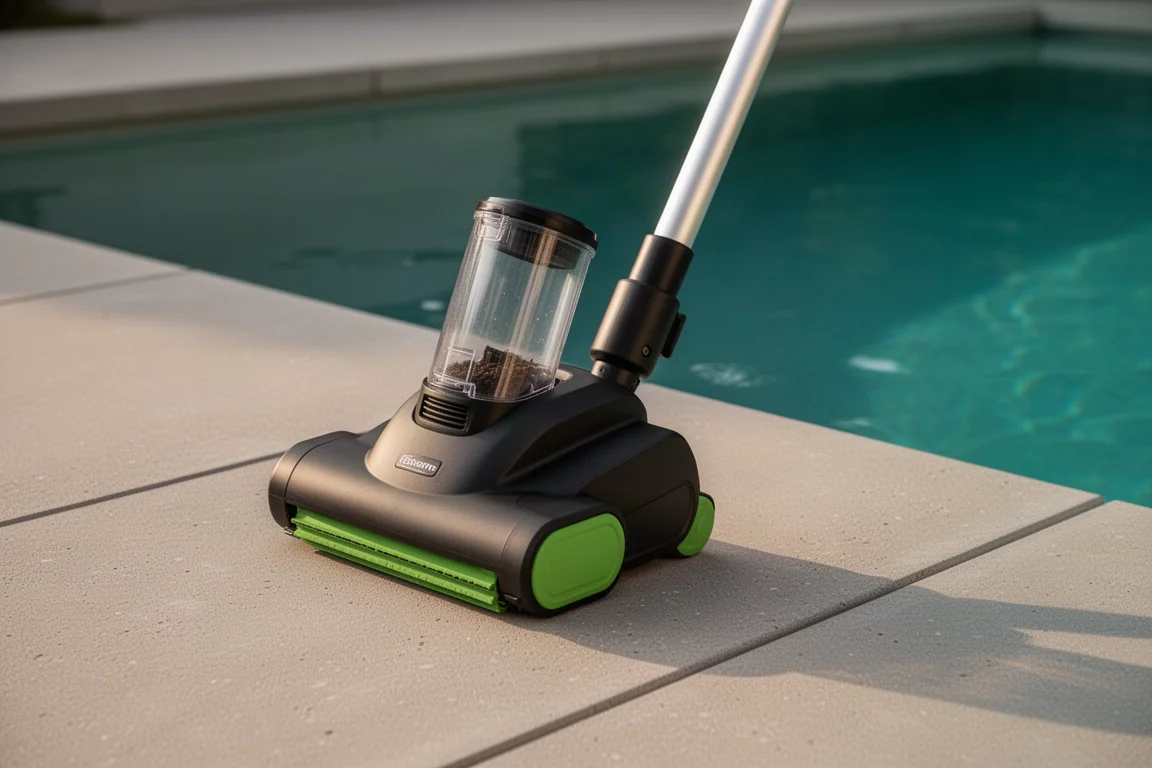
If you already own any cordless Ryobi tools, the idea behind the Ryobi 18V Pool Vacuum will click instantly: it is basically a dust buster for your pool, running on the same batteries you already have. The pitch is simple. Instead of dragging a suction hose around the deck and messing with your pump, you clip this onto your existing pole, drop it in the water, and vacuum debris into its own built-in canister.
For anyone staring down a $1,000 robot cleaner and balking at the price, this sits in a very different tier. It is a small, targeted tool for frequent spot cleaning, not a set-and-forget robotic system. After putting it through a real week of heavy silt buildup, here is how it held up.
Who This Product Is For
This vacuum makes the most sense for pool owners who clean often but lightly. If your pool collects leaves, grass, dirt, sand, or fine silt on a near-daily basis, and you already vacuum a couple of times a week with a manual head, this replaces the hose-and-pump routine with something you can grab and go.
It is also a natural fit for anyone already invested in the Ryobi 18V ecosystem. The tool accepts 2, 4, and 6 amp-hour batteries, so run time scales with whatever you already own. If you have no Ryobi batteries, factor that into the total cost, because the vacuum itself is sold as a bare tool.
How It Works
The design is refreshingly uncomplicated. The head inserts over the top of any standard pole, the same one you use for your net or manual vacuum. On the front you get a clear plastic section where you can watch debris travelling up into the catch bin, with a removable filter inside that catches the fine stuff. A release button, a power button, and a battery bay on the back round out the controls.
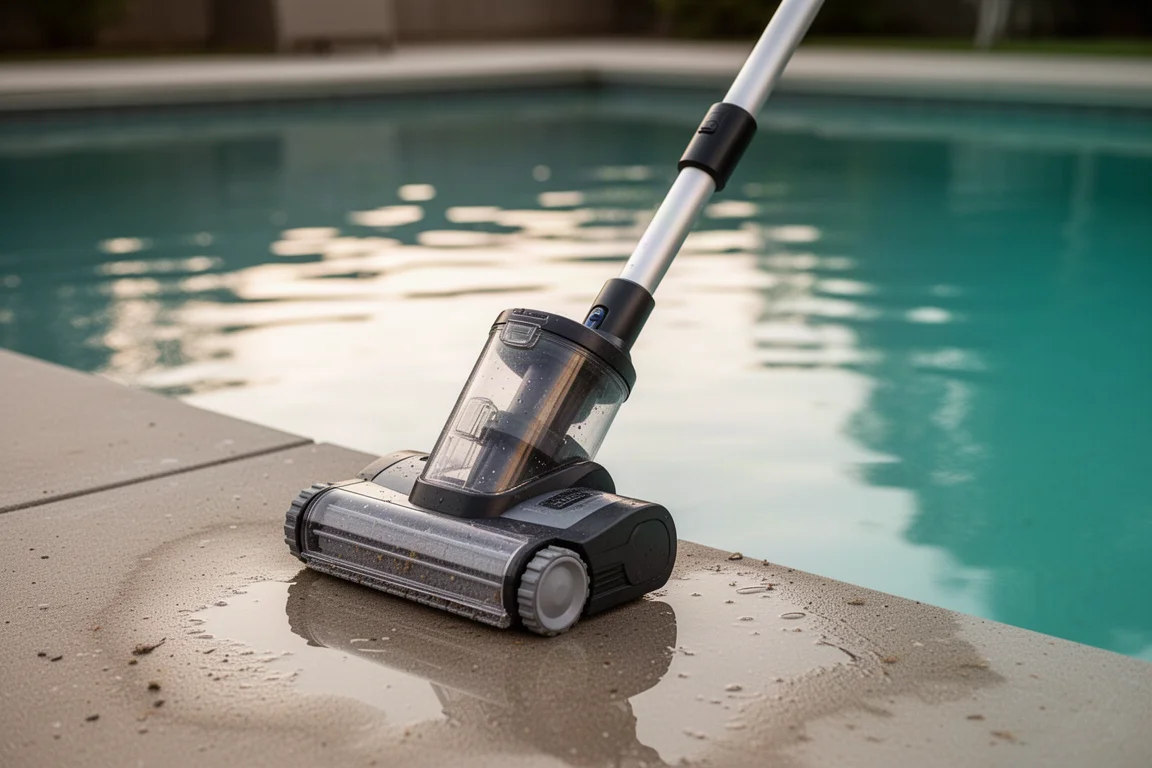
The battery compartment is sealed with a rubber gasket, so once it is closed and locked you do not have to worry about water reaching the battery. There is also a rubber over-mold on the front that adjusts back and forth for reaching into different areas, brushes on the underside like a traditional vacuum head, and rollers that help it glide along the pool floor.
One important habit: turn it on only once it is in the water, and let it fill up before you start working. Trapped air makes it buoyant at first, and running the motor dry is not the goal. Once filled, it sinks and behaves much better.
Using It in the Pool
In actual use, the biggest quality-of-life win is the missing hose. No more tangling around your legs, no more accidentally yanking the hose out of the skimmer and disrupting your pump suction. Everything the vacuum picks up goes into its own canister instead of your filtration system, which means large leaves never reach your filter.
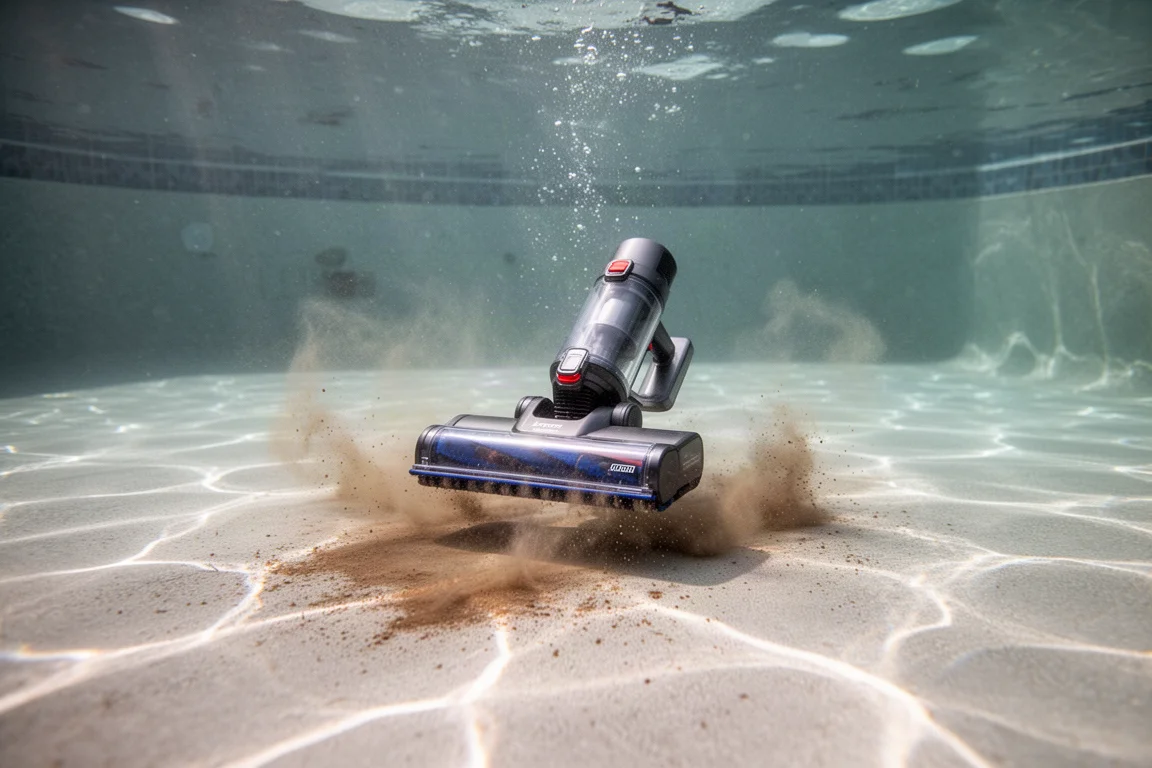
It is light and easy to push around, light enough that anyone can use it, and the pole gives you enough reach to clean the middle of the pool without ever getting in the water. It pulls up leaves and larger debris into the canister effectively, and it handled the fine brown silt that was coating the pool daily well enough to make daily maintenance far less of a chore.
The honest caveat: it is not as powerful as a standard hose-driven pool vacuum hooked to your pump. It has real suction and does a good job for its size, but if you expect shop-vac-level pull, that is not what this is. It is a small vacuum for small and fine debris, and it is best judged on those terms.
Emptying and Cleaning
After a session, emptying is quick. You can let the water drain back into the pool if you have only been picking up larger leaves, but with fine sediment it is better to remove the whole head, hit the release button, and pull the filter cartridge out.
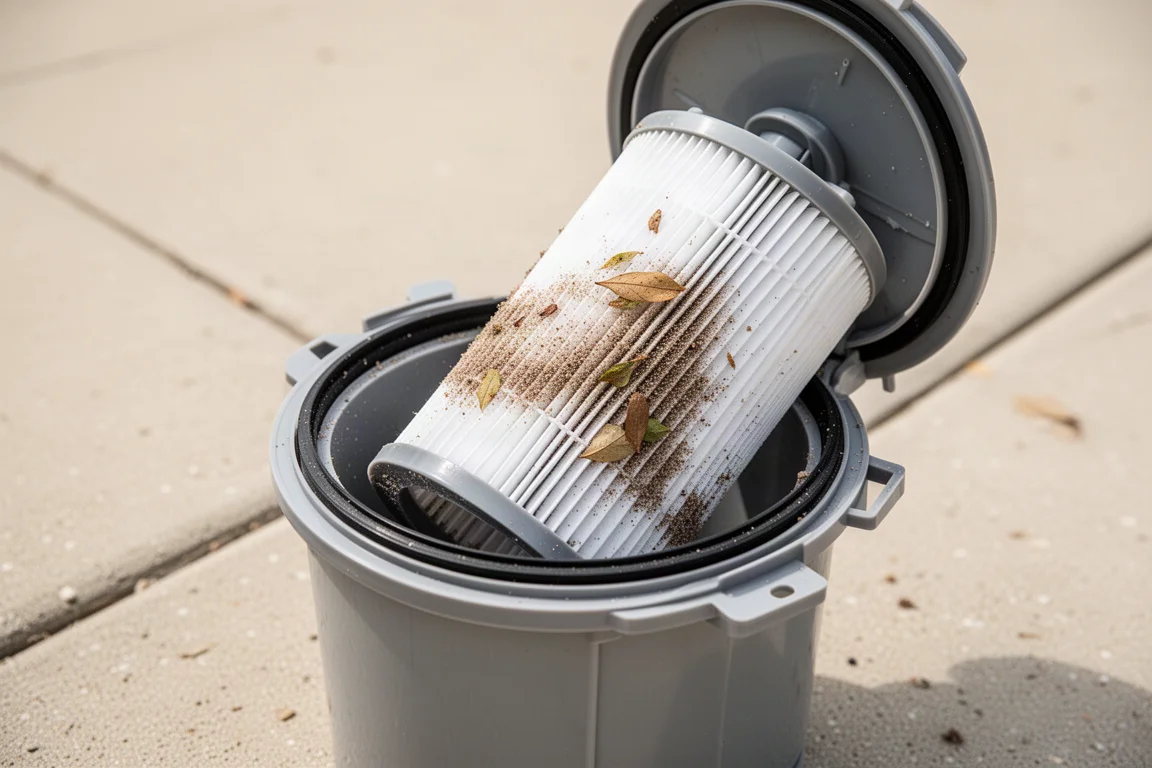
The filter catches the fine debris while larger items like grass and leaves settle in the canister. An internal flapper prevents anything from falling back into the pool once it has been pulled up. Rinse the filter out, dump the canister, and it is ready for the next run.
Key Specs and Run Time
Ryobi rates this vacuum for above-ground and in-ground pools as well as hot tubs, and says it is ideal for sand, dirt, leaves, and similar debris. It carries an IPX8 rating, meaning it is water resistant up to 13 feet underwater. Suction performance is rated at 13 gallons per minute, and the catch tank holds 1.7 liters, which is respectable for a vacuum this size.
Run time depends entirely on which battery you slide into the back:
| Battery | Run Time |
|---|---|
| 2 amp-hour | 45 minutes |
| 4 amp-hour | 90 minutes |
| 6 amp-hour | 120 minutes |
Even on the smallest pack, 45 minutes is enough for multiple spot cleans, and with a 6 amp-hour battery you can get several full cleans from a single charge. It is also genuinely quiet in operation; underwater you hear a low rumble, and from the pool deck there is a hum quieter than a neighbor’s lawn mower.
Things to Consider Before Buying
The trade-offs are worth knowing upfront. First, the tool was out of stock at the time of testing, so availability can be spotty and it may take some patience to grab one. Second, there is a slight buoyancy from air trapped in the battery case. When you pull the head back toward you, you can feel it wanting to rise a little. It is minor and does not cause real problems, but it is noticeable. Third, and most significant, the suction is simply not at the level of a hose-powered vacuum running off your pump. It does its job well within its limits, but those limits are real.
Buying Advice
This is not a replacement for a robot cleaner or a powerful suction setup, and it does not pretend to be. It is a compact, cheap-to-run maintenance tool that solves the exact problems a hose vacuum creates: tangled hoses, disrupted pump suction, and debris loading up your filter.
If you match its strengths to your situation, it is an easy recommendation:
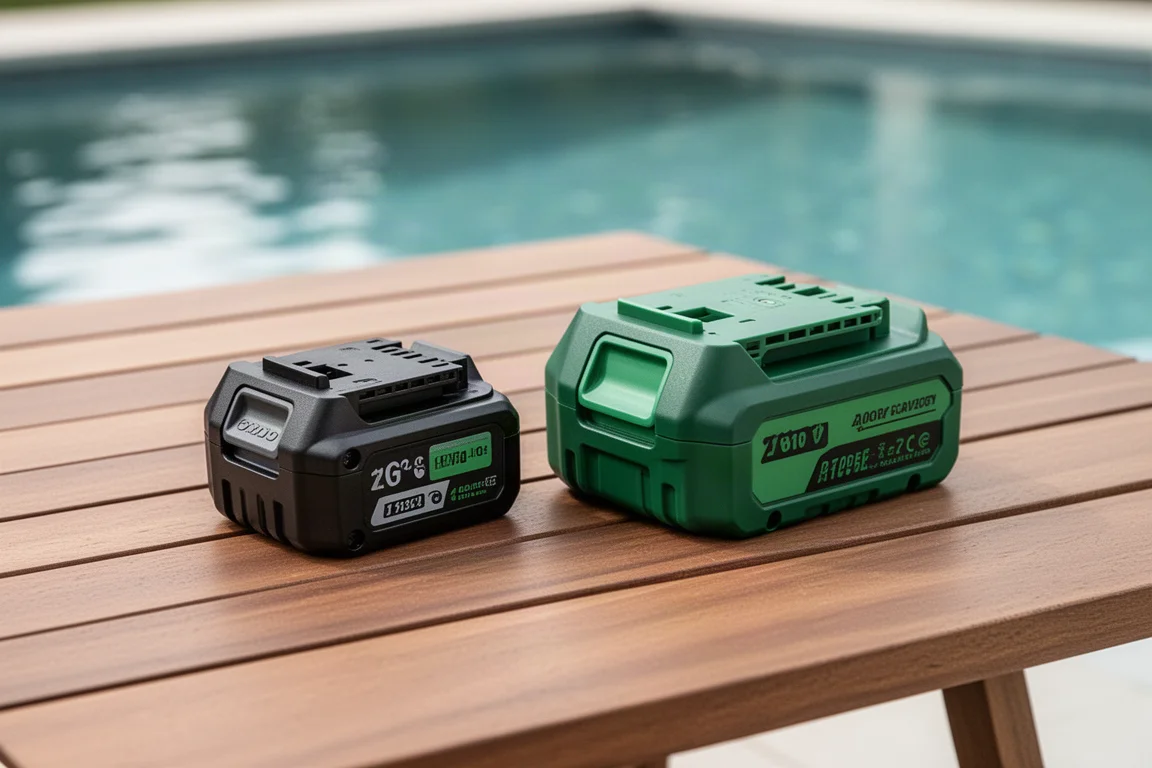
- Already own Ryobi 18V batteries: this is nearly a no-brainer. Pick the battery size based on how long your cleaning sessions run.
- Frequent light cleaning: daily silt, leaves, and dirt are exactly what this is built for.
- Want to protect your filter: all debris goes into the canister, not your filtration system.
- On a budget: it costs far less than a robot vacuum while covering the routine-cleaning role.
Skip it if you need deep, heavy-duty suction for large debris volumes, or if you want a fully autonomous cleaner. In those cases, a robot or a proper suction-side vacuum is the better spend.
Conclusion
The Ryobi 18V Pool Vacuum is a well-executed idea: take the ecosystem batteries you already own, seal them up properly, and turn your existing pole into a cordless pool cleaner. It is compact, quiet, easy to empty, and offers genuinely long run times. Its weaknesses, modest suction and slight buoyancy, are the fair price of that simplicity. For pool owners who clean often and just want the chore to be less of a hassle, it hits a sweet spot the $1,000 robot cleaners never aim for.
Product link
View more details for Ryobi 18V Pool Vacuum
This product is mentioned in the review. Check the specifications, options, and compatibility before buying.
View more details for Ryobi 18V Pool VacuumFurther reading
Related Reviews
Pool & Outdoor
Aiper Scuba S1 vs S1 Pro: Two Cordless Robotic Pool Cleaners Compared
We put the Aiper Scuba S1 and Scuba S1 Pro side by side in a heavily used desert pool to see how each handles sand, dust, leaves, and pet hair.
Pool & Outdoor
Beatbot AquaSense Review: A Cordless Robotic Pool Cleaner That Cleans So You Don't Have To
A smart, cordless robotic pool cleaner with four brushes, wall-climbing treads, and app control. Here is what it does well and what to check before buying.
Pool & Outdoor
Beatbot iSkim Ultra Review: A Robotic Pool Skimmer With Solar Power and a Mind of Its Own
A solar-powered robotic surface skimmer that maps your pool, scrubs the edges, clarifies the water, and parks itself when done. Here is who it actually makes sense for.