Backpacking Tents
Nemo Dagger OSMO 3P Review: A Roomy Freestanding Three-Person Tent
A detailed look at the Nemo Dagger OSMO 3P, a freestanding three-season tent for three people with recycled OSMO fabric, six pockets, and a very quick pole system.
Introduction
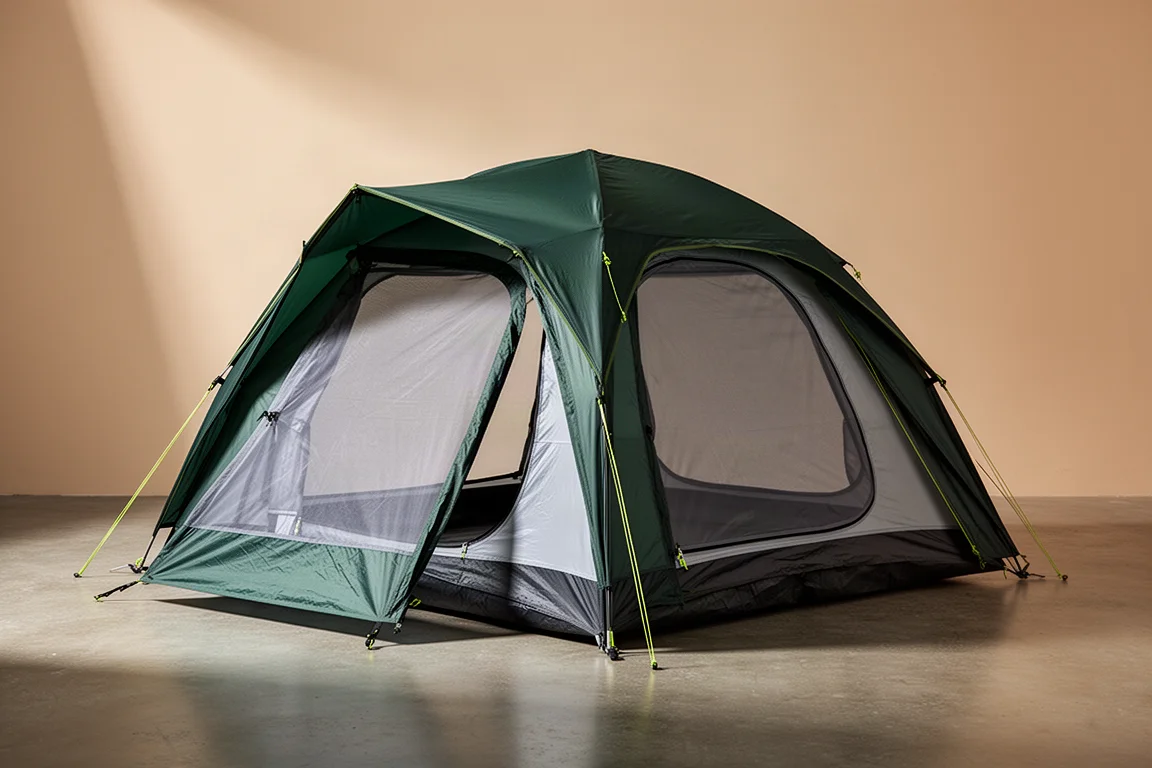
The Nemo Dagger OSMO 3P is a freestanding, three-season tent built for three people, and it arrives with a set of design decisions that make it unusually easy to live with. The brand presents it as a lightweight backpacking tent, which is a fair description of the lightest configuration but a more debatable one once every component is packed. At around $590, it sits in the upper part of the three-person tent market, and the price will vary depending on where in the world you buy it.
Weight here is genuinely a choice rather than a fixed number. Stripped back, the tent can be pitched at roughly 1.6 kg. With the full setup, including the outer canopy and every accessory, it comes in closer to 2.1 kg. Split between two or three people, that is a reasonable amount of shelter to carry, and it reframes the tent as something you can take further than its size first suggests.
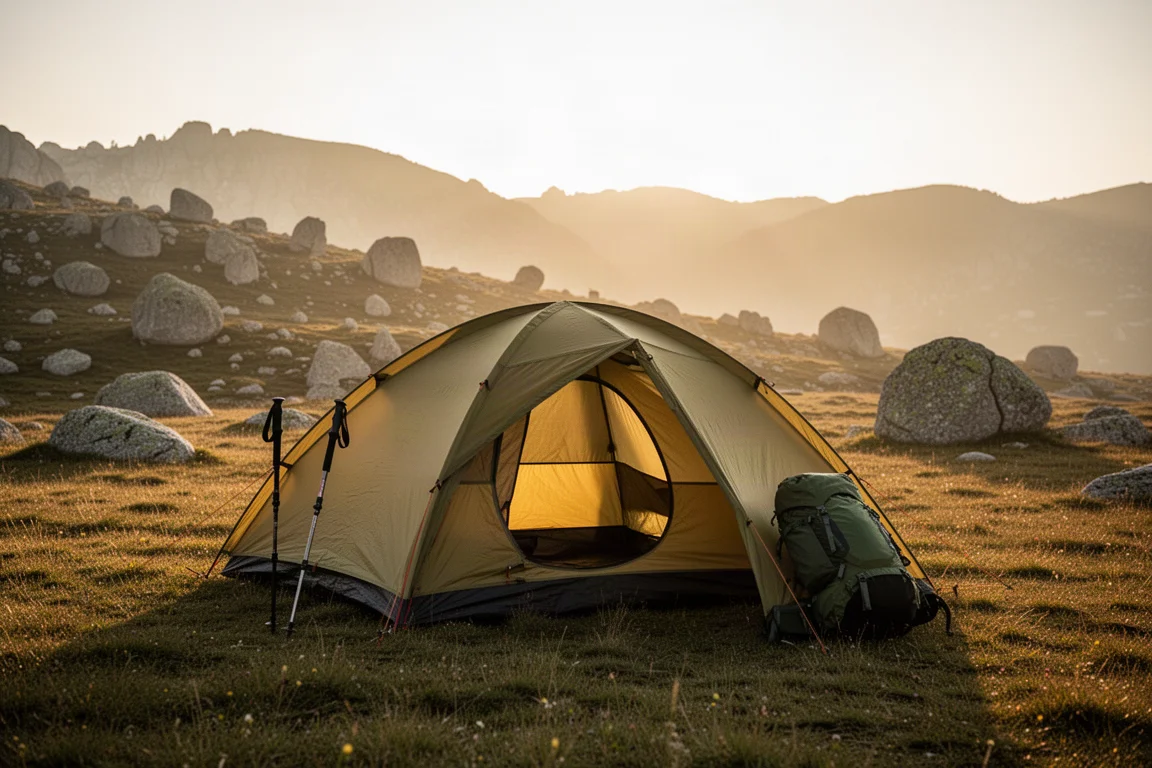
What makes the package interesting is how modular it is. The pegs, the guy lines, the outer canopy, and an optional footprint can each be left at home or brought along depending on where you are going and what you expect the weather to do. A three-person freestanding tent is also not limited to backpacking trips. It works just as well as a base camp shelter, a canoe trip tent, or a roomy option for two people who simply want more space.
Who This Tent Is For
This is a tent for people who want volume. Three adults, two adults with a lot of gear, or a pair who prefer to spread out all fit comfortably inside, and the two vestibules mean wet kit does not have to come in with you. Anyone who has shared a cramped two-person tent in bad weather will recognise the appeal immediately.
It also suits campers who dislike fighting with a tent at the end of a long day. The pole system is colour coded and clips together quickly, which matters most when you are tired, in wind, or working with cold hands. Freestanding construction means the tent holds its shape without pegs, so it can be repositioned easily if you end up facing the wrong way.
The trade-off is that this is not a minimal solo shelter. If you mostly travel alone and count every gram, a smaller tent will always make more sense. The Dagger OSMO 3P earns its place with groups, families, and anyone who values living space over the smallest possible pack size.
Main Strengths
The strengths here are practical rather than decorative. Almost every feature exists to make pitching, sleeping, or storing gear easier, and the details tend to hold up once you actually use them.
Freestanding Setup and the Pole System
The frame uses DAC Featherlite poles, supplied in two colour-coded sets, one lime green and one grey, which makes the pitching sequence easy to follow the first time and quick to repeat afterwards. The pole ends have a small ball fitting that clips into a plastic receiver at each corner rather than threading through a sleeve. It is a genuinely simple system, and it is easy to operate with gloves on, which is a real advantage in shoulder-season conditions.
The canopy pole is the piece that lifts the roof and creates the headroom, and it clips in place at both ends before the fabric is tensioned. Each corner has a labelled attachment point for pegging out, so the shape can be pulled tight once the frame is up. The tent ships with ten triangular pegs that have a notched catch to hold guy lines in place, plus four loose guy lines, a pole repair splint, and a peg bag. The poles account for roughly 560 g of the total weight and the pegs add around 167 g.
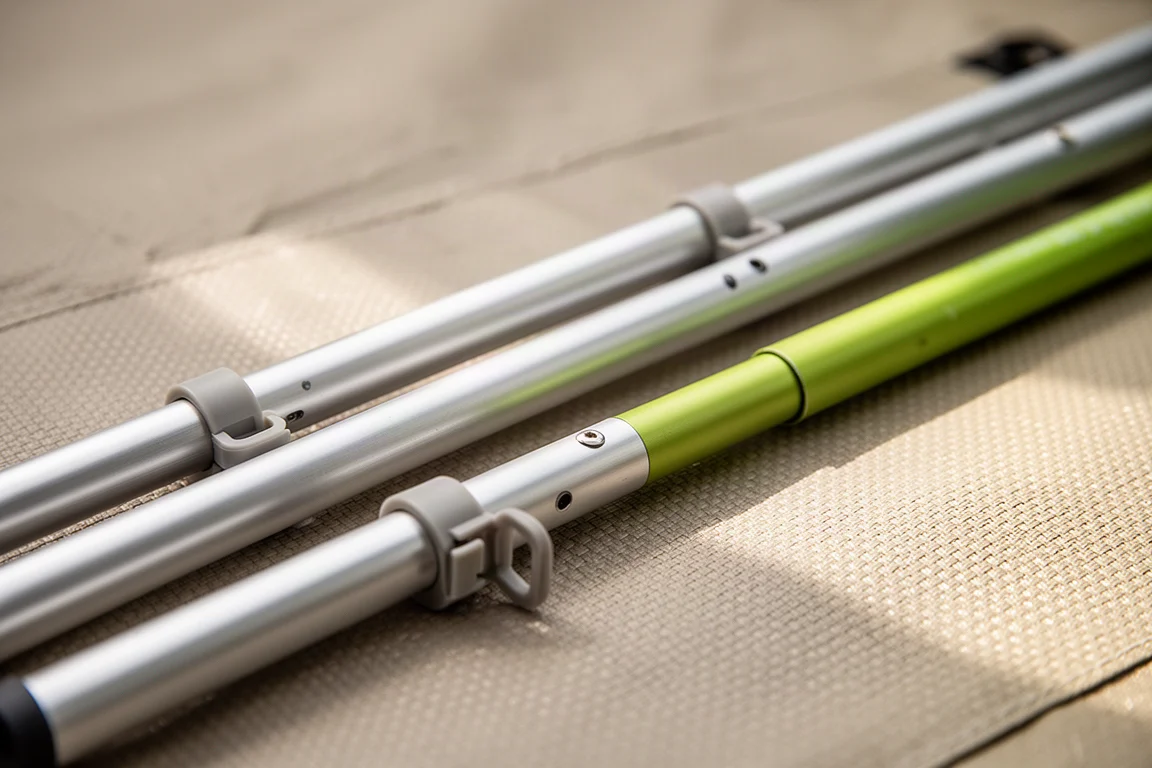
Because the tent is freestanding, pegs are not part of the structure. They are there to hold the tent in place and to pull the fabric out a little further, which improves both interior volume and airflow between the inner and outer layers. On a calm night in soft ground, the frame alone will stand the tent up perfectly well.
The included pole splint is a small but welcome addition. A damaged pole section does not have to end a trip, and having the repair sleeve in the bag means you are not relying on finding a replacement in the nearest town.
Interior Space, Storage, and Ventilation
Two doors, one on each side, mean nobody has to climb over anybody else, and the tent can simply be rotated if the view or the wind direction changes. Both vestibules are generous enough to sit up in, cook in, and store packs, and one can be treated as a storage side while the other stays clear as an entry and cooking space.
Inside, the storage provision is unusually thorough. There are six pockets in total, including corner pockets and triangular pockets positioned for the person sleeping in the middle, plus a series of attachment points along the roof for a clothesline or a lantern. One of those points is a button clip, which is a small detail that makes hanging a light far less fiddly. There are also dedicated light pockets with an elastic top, designed to hold a head torch so it diffuses a soft glow across the interior instead of glaring from a single point.
Headroom is generous. Sitting upright is comfortable even for a taller occupant, which supports the ventilation strategy as much as the comfort one, since warm, damp air rises and has room to move. Both doors can be unzipped from the top down for extra airflow, and the side panels can be rolled back and toggled open on both sides, effectively opening up two walls of a four-sided tent. Condensation management is one of the areas where a three-person tent earns its keep, and this one gives you a lot of ways to move air through the space.
Fabric, Weather Protection, and Materials
The tent takes part of its name from its fabric. OSMO is the brand’s own material, made from 100% recycled polyester with a ripstop weave, which makes it more resistant to snags and abrasion from rocks and twigs. The same fabric is used for the floor as well as the outer canopy, and both are rated to a 2,000 mm hydrostatic head. The inner body uses a fine no-see-um mesh with nylon ripstop, so insects stay out while air keeps moving.
The material story goes beyond recycled content. The yarns are free from PFC and PFAS, and the fabric is produced without fire retardant chemicals. The brand also states that the OSMO fabric resists water penetration for longer than a conventional weave and stretches less when wet, which helps the tent keep its shape and its weather protection over time. The pole bag is made from recycled polyester as well, and the brand notes a collaboration with its pole supplier on reducing climate impact across production.

In practice, that combination matters most on hard, rocky ground and in sustained rain. A ripstop fabric is more forgiving when you are pitching on gravel or dragging a packed tent out of a stuff sack, and a floor with a high hydrostatic head rating is what keeps ground moisture where it belongs.
Things to Consider Before Buying
The main point to weigh up is the pitching sequence. This is an inner-first design, which means the mesh inner body goes up before the outer canopy. In dry weather that is a non-issue. In steady rain, the inner is exposed while you attach the outer, and water can get into the sleeping area before the tent is fully protected. Anyone who camps regularly in wet conditions should think carefully about whether they are comfortable with that order of operations.
The Landing Zone is a small accessory panel that clips into the vestibule to keep gear off the ground, with three colour-coded hooks. It is a nice idea and it does protect kit from damp ground, but it is optional in every sense. A waterproof pack cover or a groundsheet does much the same job, and some users will find the extra piece more trouble than it is worth. Where the hooks attach is not immediately obvious, which adds a small learning curve.
There are a few smaller considerations. The guy lines are supplied loose rather than attached, so you will need to fit them yourself if you want the extra stability. The inner floor can look slack in places, and there is not a dedicated peg-out point in every spot where you might instinctively want one, so tensioning takes a little experimentation. The high bathtub floor is excellent for keeping water out, but it needs to be pulled taut to work as intended. Finally, the lightweight label deserves context: at full specification the tent is closer to 2.1 kg, which is very reasonable for a three-person shelter but is not an ultralight figure.
Buying Advice
At around $590, this is a considered purchase, and the value case depends on how you will use it. A three-person tent that comfortably sleeps three, with two doors, two usable vestibules, and enough pockets to keep everyone organised, delivers a lot per person when the cost and the weight are split across the group. Buying secondhand is worth considering if you can find one, since it reduces the entry price considerably.
Think about the configuration you would actually carry. Leaving the footprint, the guy lines, and some of the pegs behind saves weight on calm summer trips, while bringing everything along makes the tent far more stable in exposed, windy terrain. The freestanding frame means you can pitch almost anywhere, but carrying at least a few pegs is worthwhile because they pull the fabric out and improve airflow between the layers.
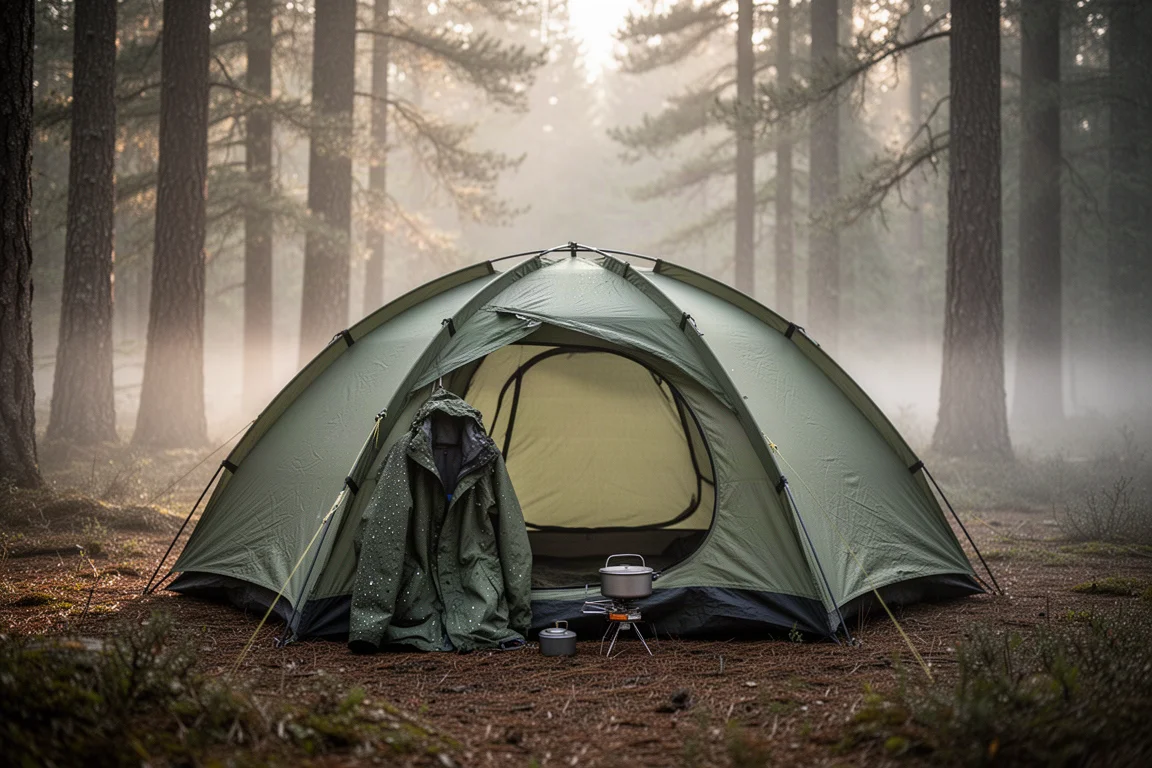
If your trips are mostly dry and you want space, storage, and a fast pitch, this tent makes a strong case for itself. If you regularly camp in heavy rain and prefer a design where the outer goes up first, that single characteristic is worth weighing against everything else here, because it will shape how the tent feels on the wettest nights of the year.
Conclusion
The Nemo Dagger OSMO 3P is a thoughtfully built three-person freestanding tent with a quick, colour-coded pole system, generous headroom, six pockets, two doors, and two vestibules. Its recycled OSMO fabric, PFC and PFAS free yarns, and 2,000 mm hydrostatic head ratings give it a materials story that goes well beyond marketing language. The main compromises are the inner-first pitch in wet weather, the optional Landing Zone, and a full-specification weight that is fair for a three-person tent rather than remarkable.
For groups who want room to move, a simple pitch, and a shelter that adapts to the trip, it is an easy tent to recommend. Weigh the pitching order against your usual weather, decide which components you will actually carry, and this tent will serve you well for a long time.
Product link
View more details for Nemo Dagger OSMO 3P
This product is mentioned in the review. Check the specifications, options, and compatibility before buying.
View more details for Nemo Dagger OSMO 3PFurther reading
Related Reviews
Backpacking Tents
3F UL Lanchan Pro 1 Review: A 1 lb 8 oz Single-Wall Trekking Pole Tent
A practical look at the 3F UL Lanchan Pro 1, a single-wall trekking pole shelter with a 1 lb 8 oz weight, 20D silnylon fabrics, and a roomy 90 x 31 x 49 inch interior.
Backpacking Tents
3F UL Taiji 2-Person Tent: A Convertible Backpacking Shelter Worth a Closer Look
A practical look at the 3F UL Taiji two-person tent, covering its materials, true two-person interior, fly-first pitching, and the seasonal inner swap that lets one shelter cover more of the year.
Backpacking Tents
3FUL Lanshan Twoerson Pro Review: A Light Trekking Pole Shelter That Struggled in Rain
A two-person trekking pole shelter with a 2026 redesign, pitched with sticks and put through a night of steady rain. Here is what worked, what did not, and what to check before buying.