Camping Shelters
NatureHike Gabled Cartel Tarp Review: A Big Awning With Real Trade-Offs
A large awning-style tarp kit sized for four to six people, with taped seams and tidy stitching, but also short stakes, fragile guy line knots, and a retail price that is hard to justify.
Introduction
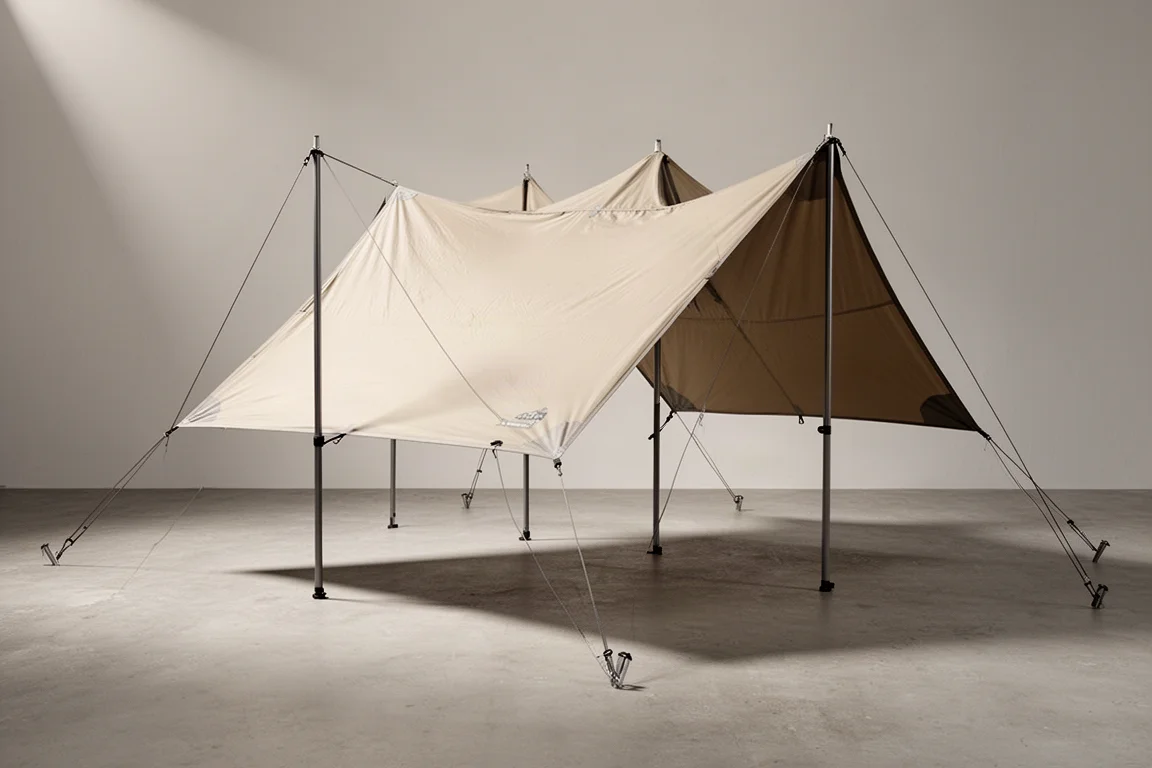
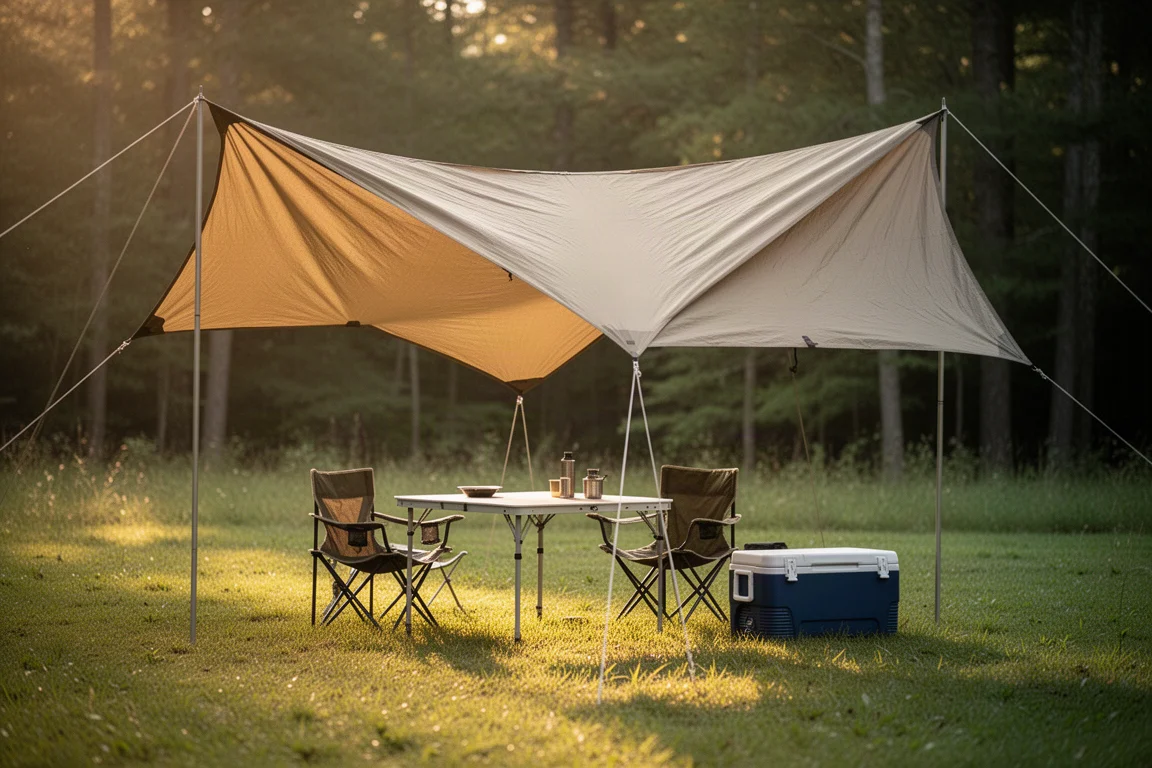
NatureHike’s Gabled Cartel Tarp is an awning-style shelter kit rather than a tent: a large tarp paired with the poles, guy lines, and stakes needed to raise it. NatureHike positions it for camping, for use beside a vehicle, and for covering a picnic table, and the footprint is generous enough for roughly four to six people to sit underneath. That combination of size and simplicity is genuinely appealing for anyone who wants a big covered space without pitching a full tent. The problems show up in the details, and they are worth understanding before deciding whether this kit belongs in your car.
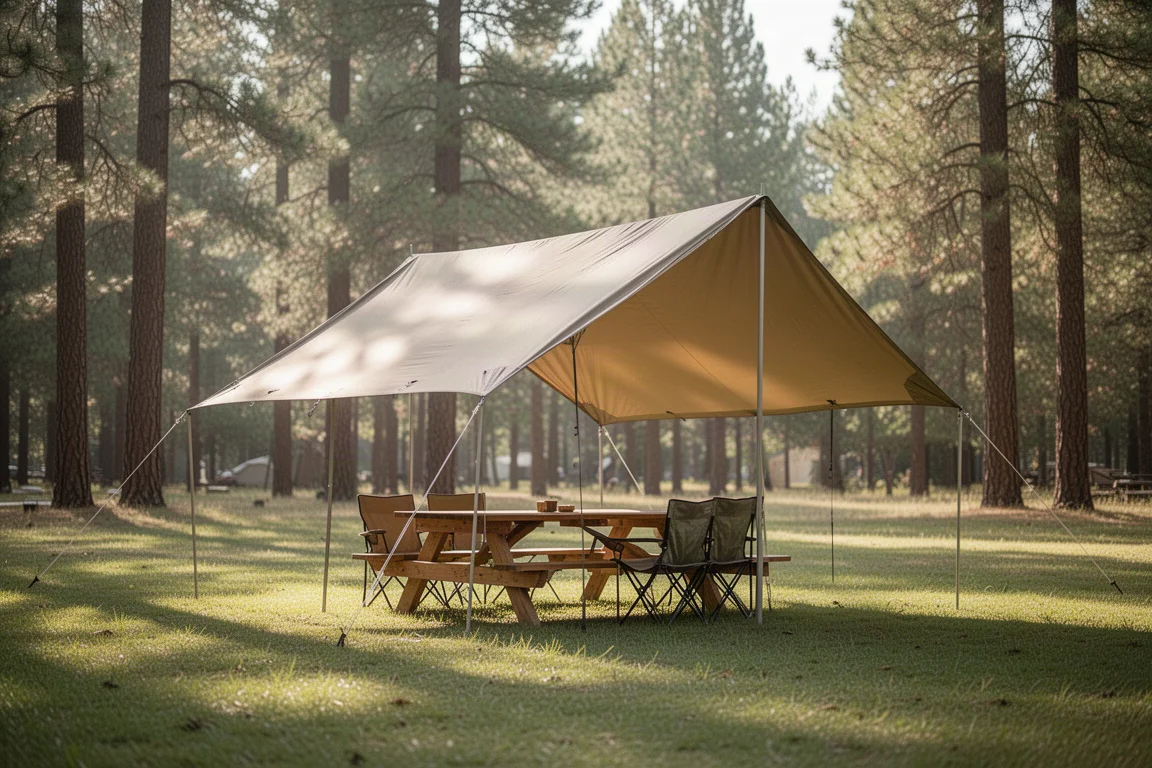
At full stretch the shelter measures about 19 ft 4 in long and 11 ft 2 in wide at its longest and widest points. The whole kit packs down to roughly 26.8 by 6.7 by 6.3 in and weighs around 15 lb. That is a substantial amount of coverage, and it is also a substantial amount of material to carry, handle, and stake out.
Who This Product Is For
The case for this tarp is strongest for car campers and anyone who sets up a base for a day or a weekend. Because it is large and freestanding with its own poles, it works over a picnic table, beside a parked vehicle, or as a communal covered area for a group of four to six people. It is not a backpacking shelter: at around 15 lb for the full kit, it is meant to travel by vehicle rather than on your back.
Buyers who want a big awning and are willing to spend time on setup, and to correct a few hardware details themselves, will get the most from it. Buyers who expect a quick pitch, clear instructions straight out of the bag, or a lightweight package should weigh the trade-offs carefully, because the sections below explain where this kit asks more of its owner than it should.
Main Strengths
Build Quality and Waterproofing
The stitching on the tarp looks clean, with no obvious loose threads or uneven seams, and the seams are taped, which is a meaningful plus for a shelter that will see rain. The outer face carries an aggressive DWR treatment that beads water effectively, and in wet conditions the fabric has stayed waterproof with no visible leaking. NatureHike’s product information lists the shell as Oxford fabric, though it quotes two different weights, 150D and 50D. The 150D figure is the more plausible specification for a shelter of this size, since a 50D Oxford would be exceptionally thin for this kind of load.
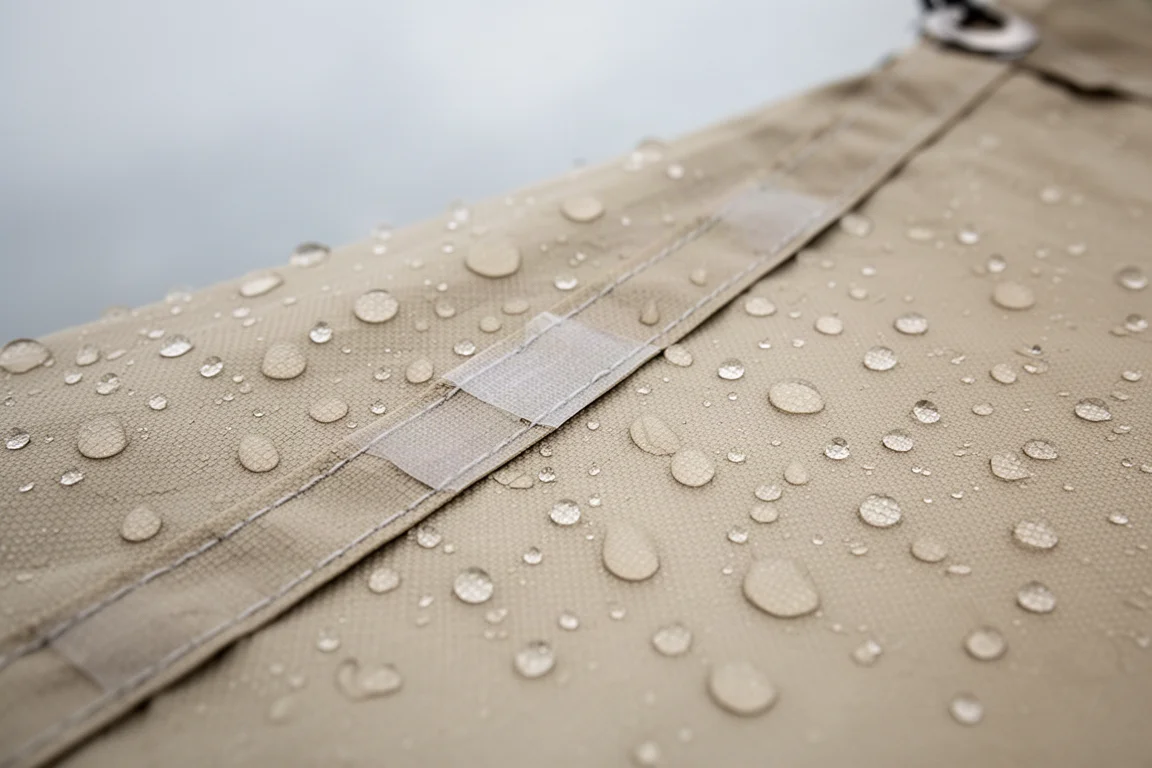
Oxford polyester is a long-established and inexpensive fabric, and it is common on budget tarps and tents. That does not automatically make a shelter poor, because quality depends on how a manufacturer builds with it, and here the construction itself looks sound. The trade-off is feel: the material has a distinctly cheap hand, which matters when you weigh it against the asking price rather than against the fabric alone.
What the Kit Includes
The kit arrives with a storage bag that has two carry handles and two zippers, and the zippers are SBS hardware rather than the more familiar YKK name. Alongside the tarp and its compression strap are instructions, nine tent stakes, seven guy lines, and three poles. Two of the poles measure 86.6 in and the third measures 74.8 in, which is what gives the shelter its peaked profile.
The shape is worth noting before you buy: one long edge is straight while the opposite edge rises into two peaks, creating the gabled, awning-like coverage. The stakes include glow-in-the-dark tie-off points, and the guy line hardware is galvanized and noticeably heavy. Note too that one side of the tarp uses fabric in a different color from the rest, which may be a deliberate design choice or a production inconsistency.
Things to Consider Before Buying
Setup, Instructions, and Hardware
Setup is where the kit asks the most of its owner. The included instructions are close to useless, and anyone who has not pitched a similar shelter before will likely find them exceptionally frustrating. The guy lines are not attached to the tarp at the factory, so every line has to be threaded and tensioned from scratch, adding time to a process that could have been shortened considerably.
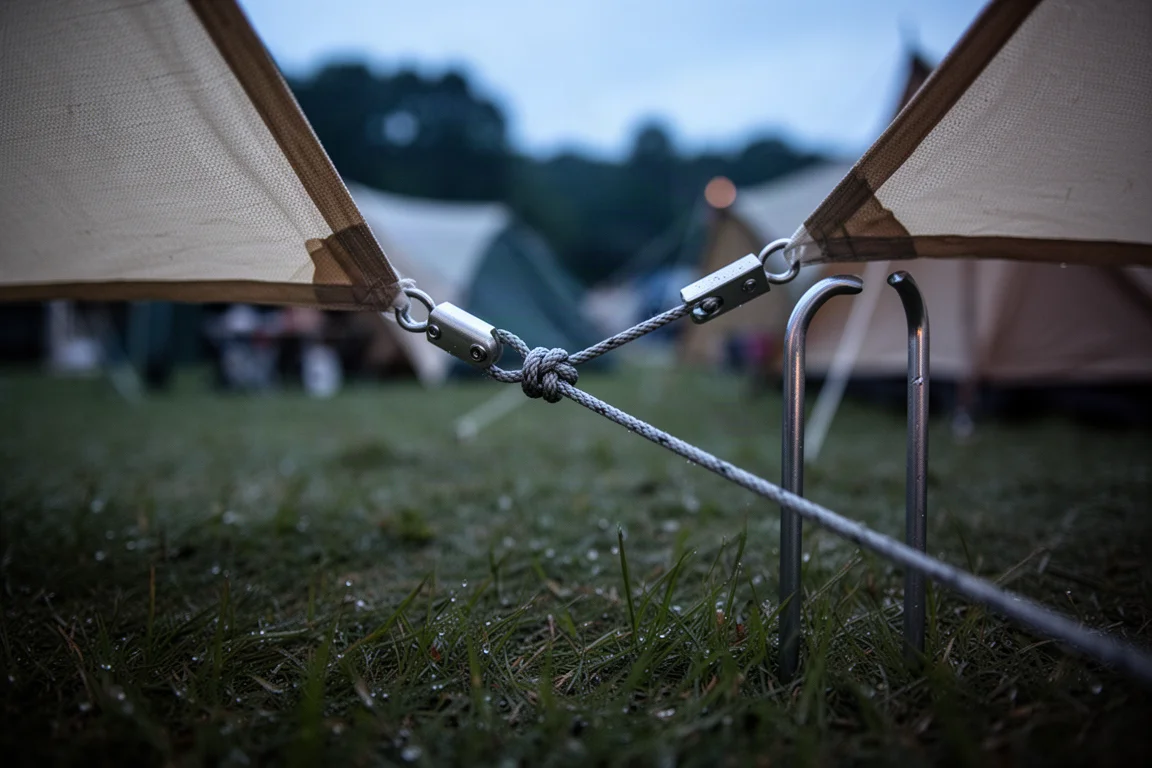
Two hardware issues stand out. The poles are held together by tensioners rather than locking mechanisms, so they can pull apart if handled roughly, and the pole sections are not color coded even though those sections differ in length. Assembling the right pole from the right sections therefore becomes guesswork, which produces a slightly imperfect frame. The stakes are also short for a shelter this large, and a tarp of this footprint benefits from longer stakes that anchor firmly in the ground. Most seriously, the aluminum hardware on the guy lines is secured with knots that come undone, and a piece of hardware can work loose and disappear entirely. Owners should expect to retie those knots before relying on the shelter.
Light Transmission and Heat
The fabric colors are very light, and a great deal of light passes through the tarp. Under direct sun the interior stays bright, and heat comes through along with the light, so the shelter does not deliver the deeper shade that darker fabrics provide. If you plan to sit underneath it on a hot day, this is a genuine consideration, and a darker material would block more light and heat while doing the same job.
Price and Value
NatureHike lists the tarp at almost $300, around $286, with sale pricing near $200. Comparable tarp-and-pole setups are available for considerably less, including options around $130, $98, and $116, a tent-and-tarp combination near $200, a large awning around $161, and vehicle-mounted awnings under $200. Those alternatives typically use darker fabrics that cut more light and heat. The same product is also sold through the NatureHike store on AliExpress for about $15, a figure that is far easier to justify for an Oxford polyester shelter than a retail price approaching $300.
Buying Advice
At its AliExpress price of roughly $15, this kit makes a certain kind of sense: a large, waterproof, taped-seam shelter with poles included. At $200 or $286 the value proposition falls apart, because the materials are inexpensive, the poles are neither especially light nor especially strong, and the stakes and guy line hardware need attention before first use. Buyers who want this style of shelter can find darker, comparable setups at lower prices that block more light and heat.
If you do choose the Gabled Cartel Tarp, plan on replacing or upgrading the stakes, retying the guy line knots, and treating the instructions as a starting point at best. Buyers who want an easy first pitch and dependable shade on a hot day should compare the alternatives carefully, because the fabric’s light color and heat transmission are built into the design rather than something you can adjust later.
Conclusion
NatureHike’s Gabled Cartel Tarp gets several fundamentals right: the size is generous, the seams are taped, the stitching is tidy, and the fabric has kept water out so far. The problems are equally clear. The instructions are unhelpful, the guy lines arrive unattached with knots that fail, the stakes are undersized for the footprint, the pole sections are unmarked, and the light fabric lets through more light and heat than many buyers will want. Price is the biggest obstacle: the kit is difficult to justify at retail, while at the low AliExpress price the same package reads as reasonable value for a large polyester shelter.
Product link
View more details for NatureHike Gabled Cartel Tarp
This product is mentioned in the review. Check the specifications, options, and compatibility before buying.
View more details for NatureHike Gabled Cartel TarpFurther reading
Related Reviews
Camping Shelters
Alps Mountaineering Stealth 1 Bivy Review: A Waterproof Claim That Does Not Hold Up
The Alps Mountaineering Stealth 1 Bivy carries a 2,000 mm hydrostatic head rating and a waterproof claim, but sustained rain exposure and build quality concerns make it difficult to recommend.
Camping Shelters
AquaQuest Safari Hybrid 20 ft x 13 ft Tarp Review: Two Years Under a Very Large Roof
A long-term look at the AquaQuest Safari Hybrid 20 x 13 tarp, covering build quality, weather protection, setup realities, and who should buy one.
Camping Shelters
Backcountry Light Mesa 3 Hot Tent and Floor SL Tarp Review
A practical look at the Backcountry Light Mesa 3 four-season hot tent and its optional Floor SL Tarp, covering materials, stove jack design, packed weight, pricing, and the trade-offs to weigh before buying.