Studio Monitors
Kali Audio IN-UNF Review: A Clever Desktop Monitor System With a Narrow Fit
A near-field desktop monitor system built around two coaxial orb satellites and a central base module. Clean directivity and a built-in USB audio interface, weighed against real placement and bass trade-offs.
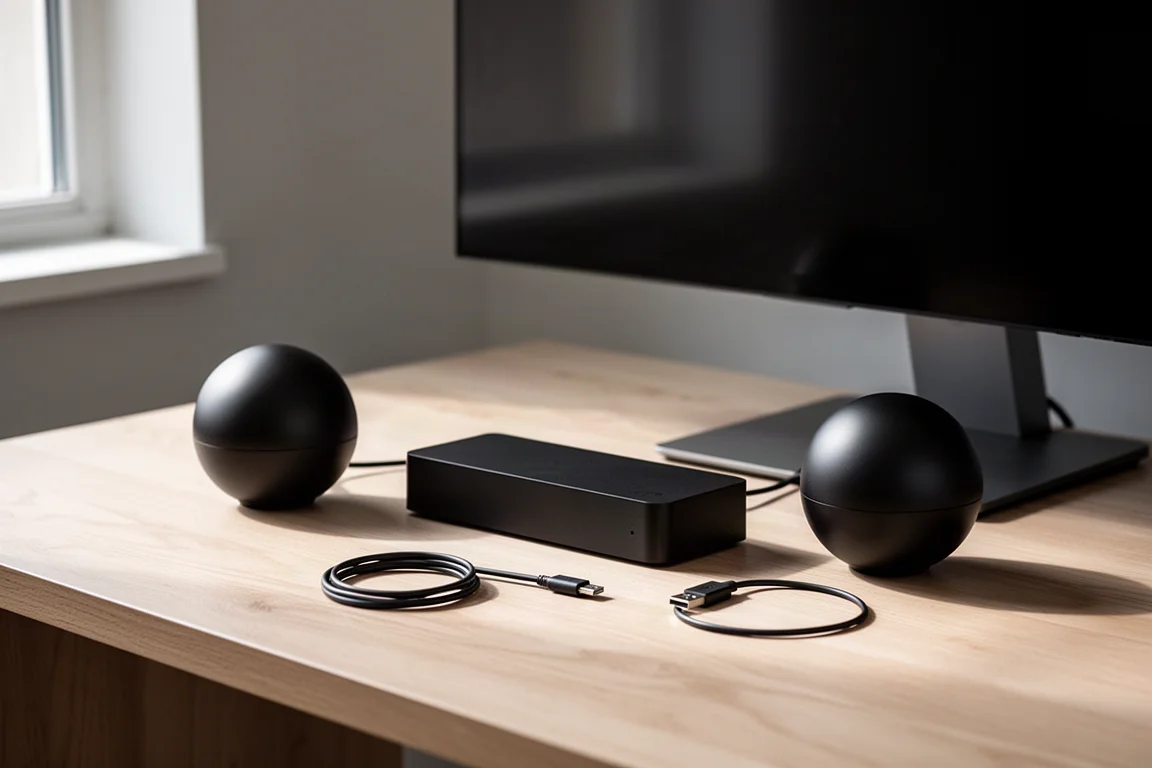
Introduction
The Kali Audio IN-UNF takes an unusual route to desktop monitoring. Instead of a pair of conventional boxes, it splits the job between two small coaxial satellite speakers and a central base module that handles the low end and houses the electronics.
The result is a system designed to sit on a desk rather than on stands, with a listening distance of roughly 0.8 meters, about arm’s length. That short throw changes what matters. Room reflections contribute far less than they would with larger monitors placed further away, which is exactly the situation the IN-UNF is built for.
It is a genuinely interesting piece of engineering. It is also a very specific solution, and whether it makes sense depends almost entirely on the desk it is going onto.
Who This System Is For
The IN-UNF is intended for near-field listening at a desk, with the satellites positioned about arm’s length from the listener and the base module centred between them. At that distance the room has far less influence on what you hear, so the system’s own behaviour dominates the presentation.
Kali includes a setup sheet that specifies how far the satellites should sit from the base module, along with dip switches for adapting the system to different placements, such as positioning it near a wall or running the base module upright rather than lying flat. Following that guidance matters more here than it does with a standard pair of monitors, because the satellites and the base module are tuned to work together as one unit.
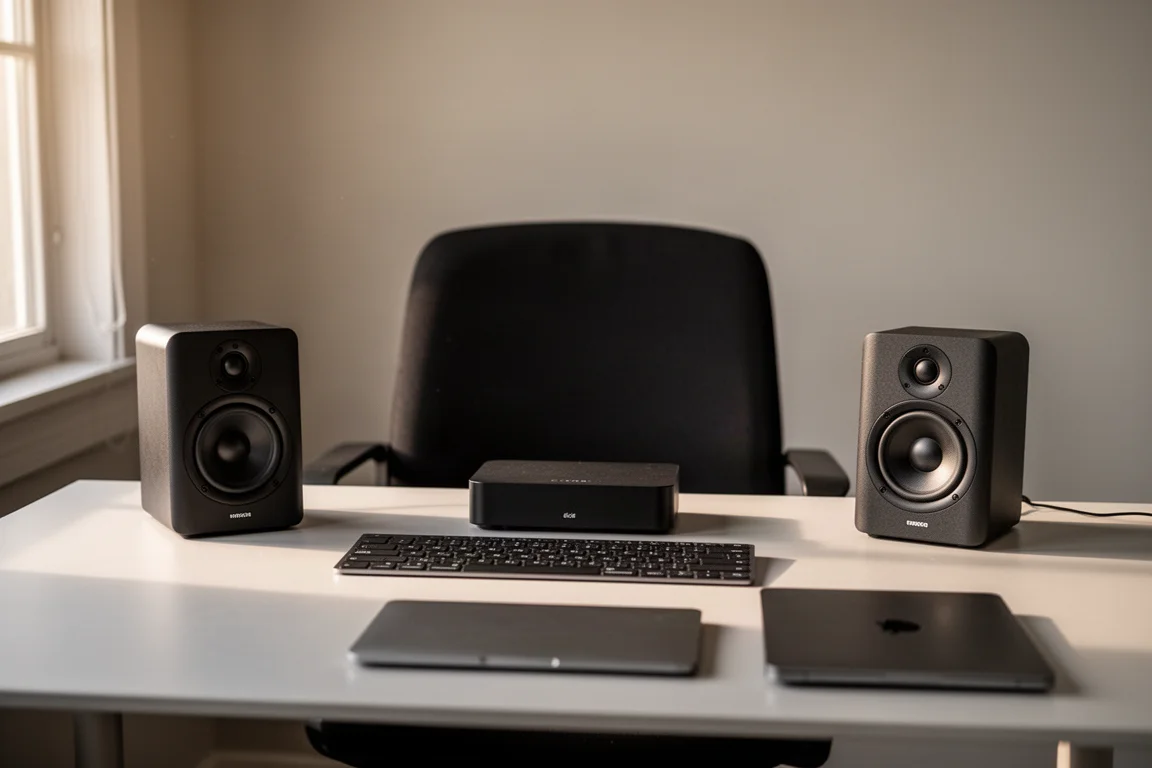
That makes the system most relevant to someone who wants a single integrated desktop monitoring setup with USB connectivity built in, and who is willing to place the parts where the manufacturer asks. It is a harder fit for a desk already dominated by large or ultra-wide displays, where the required spacing between the satellites and the base module competes with the space the screens need.
Main Strengths
The strengths of the IN-UNF are mostly structural. The shape of the satellites, the crossover strategy and the way the system connects all come from deliberate design decisions rather than from tuning alone.
A Coaxial Orb Design That Keeps Diffraction Low
Each satellite uses a coaxial driver mounted in a rounded, orb-like enclosure. Because there is effectively no flat baffle surrounding the driver, the usual diffraction effects from baffle edges are largely absent, and the satellite behaves much like a bare driver inside an enclosure. That produces a clean directivity profile, and it is the same principle behind the common practice of mounting mid-range and tweeter drivers in round housings to reduce diffraction.
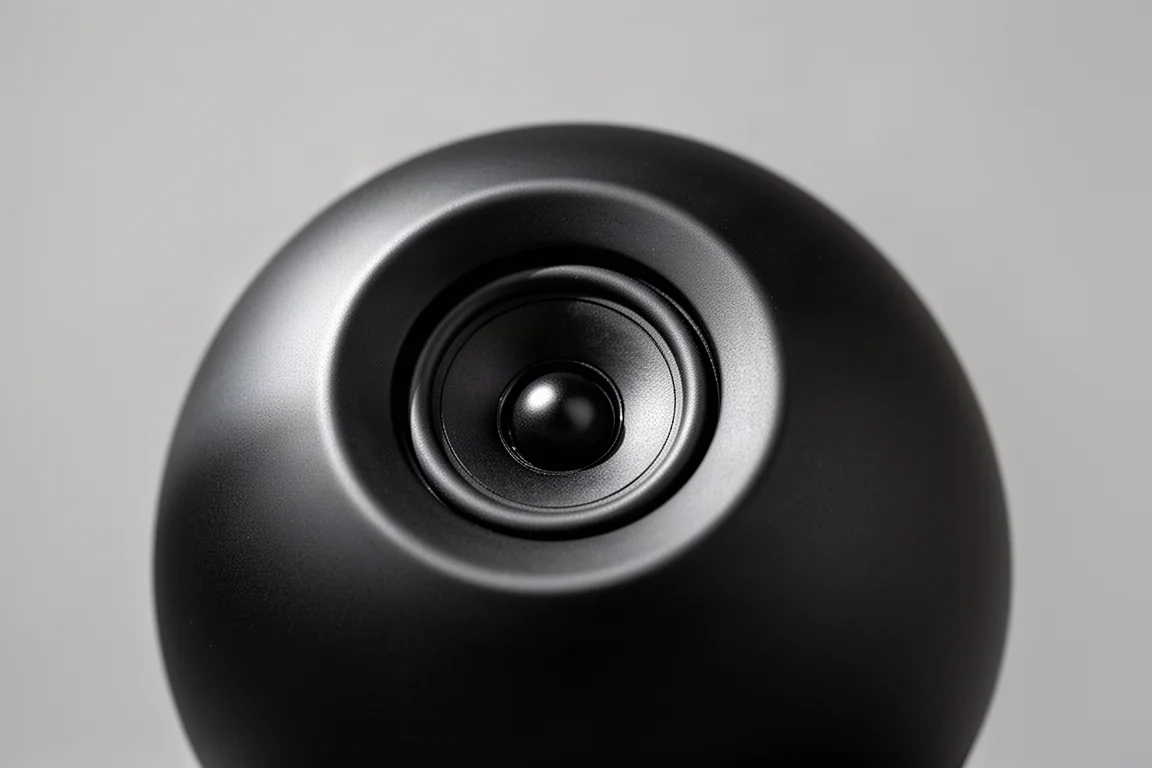
The practical benefit is tidy off-axis behaviour and predictable response to equalisation. Some diffraction is still visible higher in the range, tied to the coaxial driver itself, and that particular area can be harder to smooth off-axis. In near-field use there is very little room interaction to manage, so this is a minor consideration rather than a limitation.
Near-Field Imaging That Locks Vocals in Place
At a desk, vocals and mid-range content sit firmly in the centre between the two satellites. The phantom image holds steady rather than drifting through the crossover region, and because the satellites are close together that centred presentation reads as an advantage rather than a compromise. The system also sounds noticeably larger than its footprint suggests.
Horizontal soundstage comes across well, and the satellites worked reliably aimed directly at the listener, which is not always true of coaxial designs. The base module crosses over to the satellites at 280 Hz according to Kali’s specification, well above the 80 Hz crossover typical of a subwoofer and satellite pairing. That high crossover is the reason the centre image behaves the way it does.
USB Connectivity That Doubles as an Audio Interface
The IN-UNF can serve as its own audio interface. Connecting over USB is enough to get audio into the system, so a minimal desktop setup does not need a separate interface box on the desk. Internal DSP handles the crossover and the tuning between the base module and the satellites.
For anyone assembling a small, self-contained monitoring position, that is a meaningful convenience. It reduces the number of boxes, cables and power supplies involved, and it keeps the working area closer to the clean, compact setup the system is designed around.
Things to Consider Before Buying
Two practical questions decide whether the IN-UNF is the right purchase: how much desk space it really saves, and how much low-end extension you need.
Desk Space and Placement Demands
The space saving is smaller than the concept implies. The base module is not small, and the satellites do not tuck beneath a monitor the way compact cube speakers can. The base module has to sit on the desk surface and cannot be hidden away.
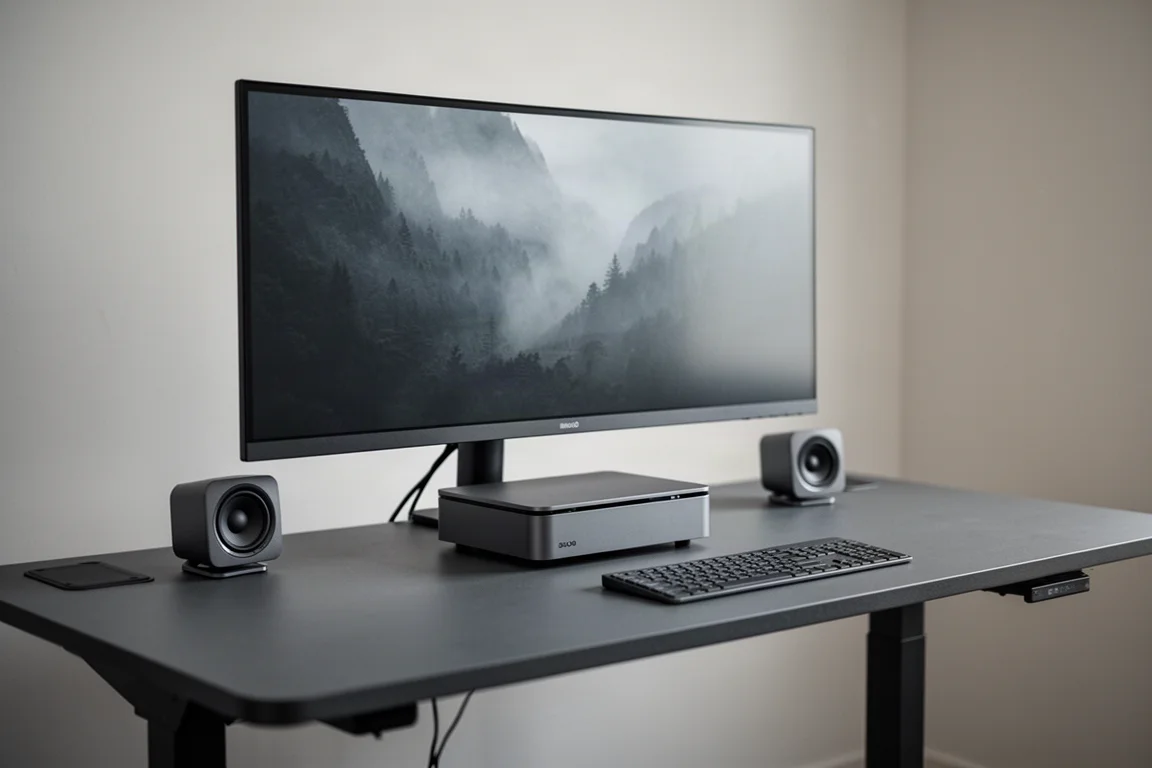
There are workarounds, but each one costs something. A monitor can rest on top of the base module, though that pushes the screen higher than most people want. The base module can be moved behind the monitors, but then the satellites have to move back with it and the screen ends up further away. On a large sit-stand desk with dual monitors, the geometry still did not resolve comfortably. Kali’s guidance also calls for a specific separation between the satellites and the base module, which limits how freely the three parts can be arranged.
Bass Depth and Room Interaction
The satellites use very small drivers, and the low end falls away rather than extending deep. Bass output is respectable for the size of the package, especially with some room reinforcement behind it, but it does not reach down into the 40 to 50 Hz region. Deep sub-bass is simply not part of what this system delivers.
Out of the box, the tuning benefited from adjustment. A broad lift around 100 to 130 Hz made male vocals sound overly rich and gave kick drums extra boom, and trimming that region smoothed the presentation considerably. A dip in the 400 Hz region appeared in one desk setup and not another, producing a fatter, less precise sound where it occurred. Because that behaviour tracked the placement rather than the speaker itself, the answer is to find the best seating position available and work from there.
Soundstage height is the most consistent limitation. Everything reads as coming from the desk surface, which is partly a consequence of how low the satellites sit relative to ear height compared with typical bookshelf monitors.
Buying Advice
The decision comes down to whether this specific form factor solves a problem you actually have. If a compact, self-contained desktop system with USB input and a coaxial satellite design is exactly the shape your desk needs, the IN-UNF delivers genuine engineering quality and a coherent, well-integrated sound.
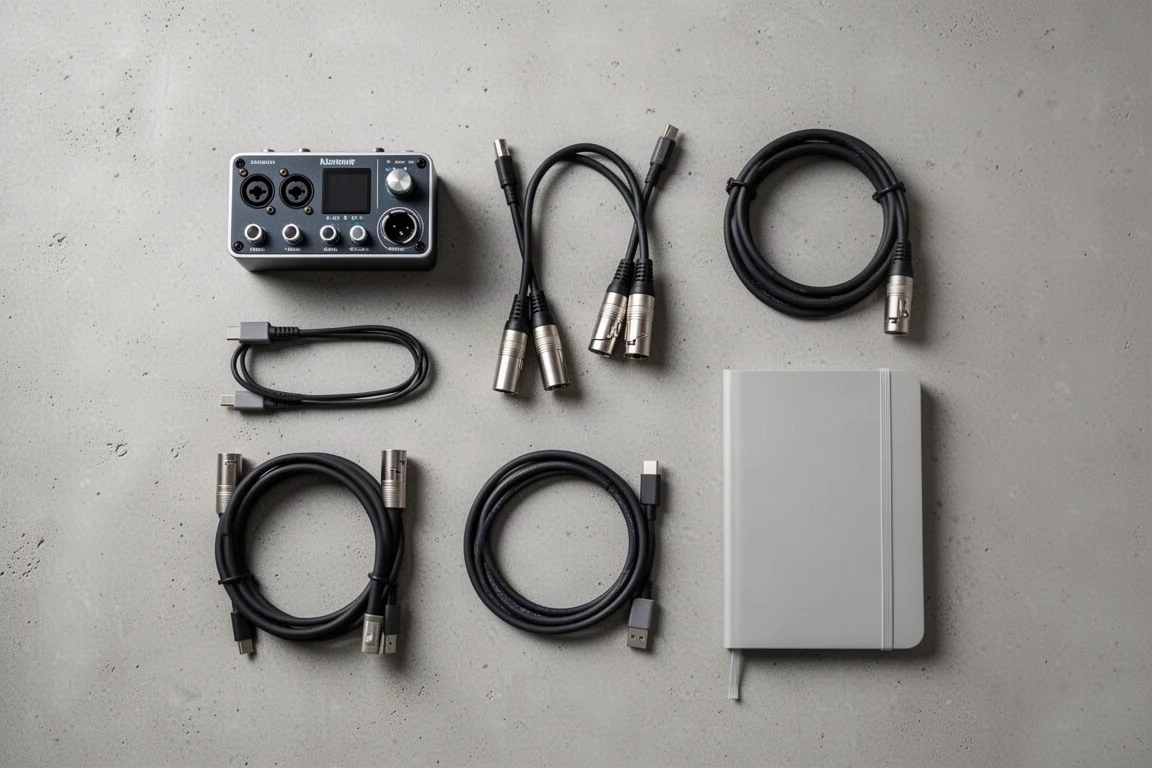
For most desktop monitoring setups, though, Kali’s own conventional monitors are the more straightforward choice. The LP-6 V2 costs less, and the IN-5 and IN-8 sit in the same family with larger cabinets and deeper bass. None of them produce the satellite-and-base crossover behaviour, and none of them impose the same placement discipline.
A small audio interface paired with a conventional pair of monitors occupies a comparable amount of desk space while giving you more freedom in how everything is arranged. If the IN-UNF’s design appeals to you on its own terms, it is a well-executed piece of engineering worth considering. If you are simply looking for the strongest desktop monitoring value, the simpler options are easier to recommend.
Conclusion
The IN-UNF is an impressively engineered desktop monitor system. The coaxial orb satellites keep diffraction low, the near-field imaging is solid and centred, and the built-in USB audio interface makes for a tidy, minimal setup.
The trade-offs are equally clear. Space savings are modest, the base module has to live on the desk, bass depth is limited, and the soundstage sits low. It is a niche product that will suit a specific desk and a specific set of priorities very well, and it is harder to justify when Kali’s own conventional monitors offer more for less.
Product link
View more details for Kali Audio IN-UNF
This product is mentioned in the review. Check the specifications, options, and compatibility before buying.
View more details for Kali Audio IN-UNFFurther reading
Related Reviews
Studio Monitors
ADAM Audio A8H Review: A Three-Way Studio Monitor That Also Knows How to Have Fun
A three-way active studio monitor with an 8-inch woofer, a handmade AMT tweeter, and two distinct tunings, the ADAM Audio A8H aims to satisfy both critical work and everyday listening.

Studio Monitors
Best Studio Monitors 2026: Six High-End Options Compared
We tested six premium studio monitors in a real studio space to see which ones deliver the best mix of accuracy, musicality, and value.
Studio Monitors
Focal Alpha 65 Evo Review: An Honest Studio Monitor With Real Bass
A bi-amplified active studio monitor with deep bass, useful tone controls and a truthful, uncoloured voicing, assessed for small studios and home setups.