Outdoor Jackets
Haglöfs Spitz Jacket Review: A Gore-Tex Pro Shell for Hard Mountain Weather
A close look at the Haglöfs Spitz Jacket, a 510g Gore-Tex Pro climbing shell that pairs two membrane types, a helmet-ready hood, and independent pit zips.
Introduction
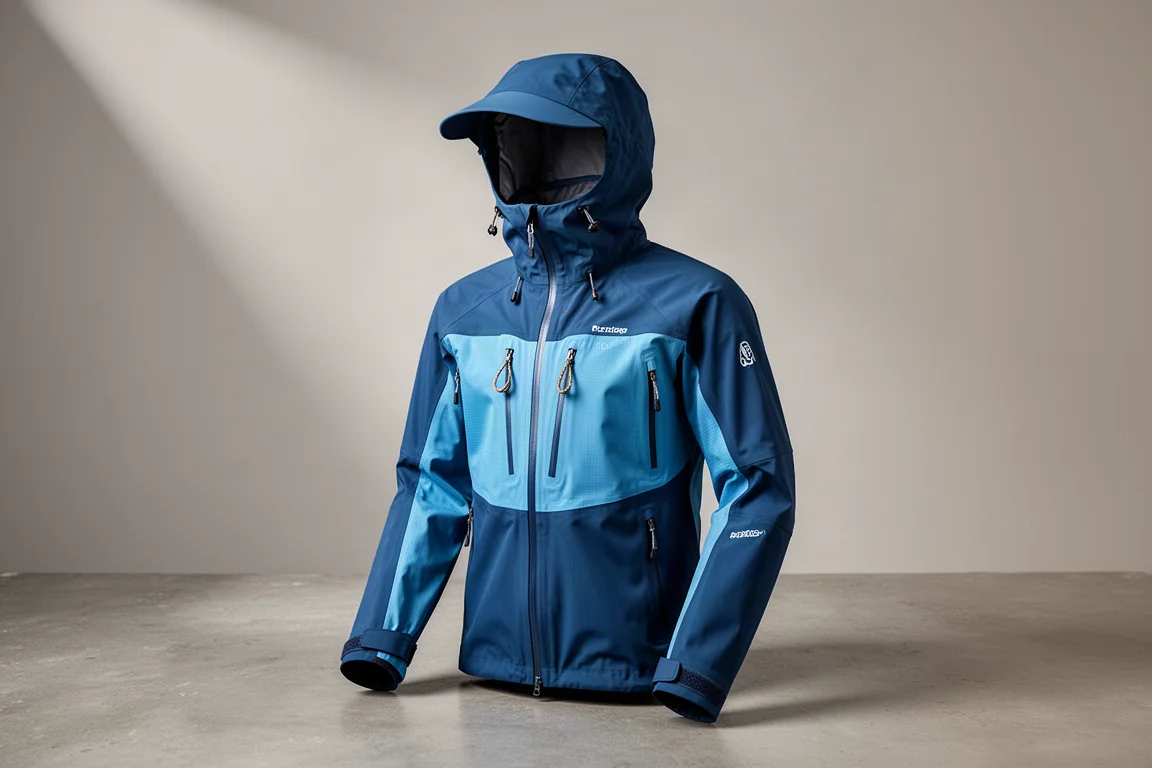
The Haglöfs Spitz Jacket is a Gore-Tex Pro shell aimed at climbers, ski tourers, and walkers who spend long days in wet, windy mountain weather. It weighs 510g in a medium, which keeps it light on a harness without giving up the robustness that hard conditions demand.
What stands out is the way the jacket is put together. Rather than loading the shell with every possible feature, the design keeps the essentials within easy reach and out of the way, so the jacket feels slick on the body even though there is a lot going on underneath.
Who This Jacket Is For
This is, first and foremost, an out-and-out climbing jacket. It is cut to work with a harness and a helmet, and it stands up to the abrasion a rucksack puts on a shell. The same qualities translate well to ski touring and to walking in the hills. Ski tourers get a Reco reflector in the hood, which is a useful detail for avalanche safety, plus a small pocket that suits a lift pass. Walkers get generous side venting that can double as a way to warm hands or reach a layer underneath.

If your days involve a rope, a pack, and weather that changes its mind, this is the kind of shell that suits the job.
Main Strengths
Haglöfs has built the Spitz around two Gore-Tex Pro membranes rather than a single fabric, and the way those panels are placed is what makes the jacket interesting.
Gore-Tex Pro Where It Matters
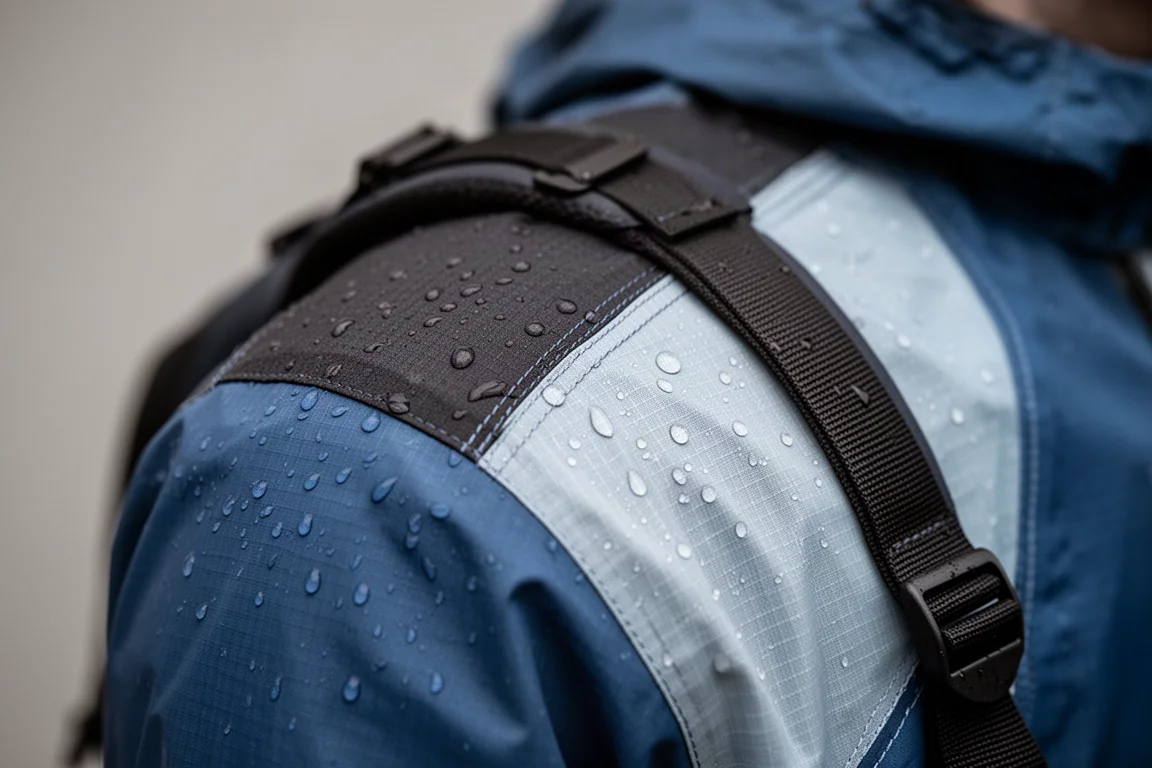
Gore split its Pro range into categories, and the Spitz uses two of them. The lighter blue panels are the most breathable version, placed where you overheat and sweat most: under the arms and across the core. The dark blue panels are the most rugged version, positioned exactly where a rucksack rubs. That means the shoulders, the underside of the arms, the cuffs, and the hips get the tougher membrane, while the front and armpits get the more breathable one.
The result is a jacket that feels light at 510g for a medium but is sturdy enough for the harshest conditions. Shoulder wear is one of the most common failure points on a shell, so putting the rugged membrane there is a sensible trade.
Climbing Cut and Helmet-Compatible Hood
The cut is one of the strongest arguments for the Spitz. Arms raise cleanly, the jacket sits well inside a harness, and it layers over a helmet without fighting you. It stays smooth on the body rather than bunching up, so you can still see your gear while climbing.
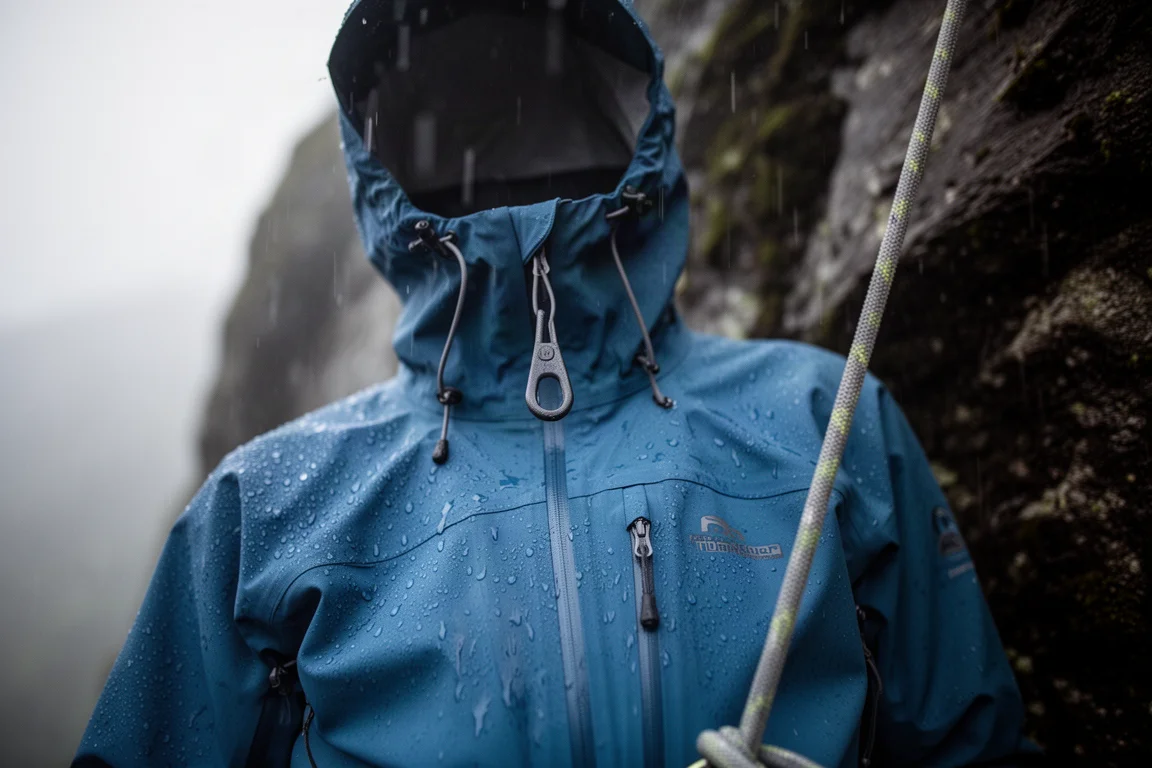
The hood is a highlight. It has a wide peak and swallows a helmet, and it uses two pull cords at the front and two at the back. The rear cords pull the hood back and cinch it at the neck, which stops it from dropping down in front of your eyes. When you need to get a helmet on, you can let the hood balloon out and then dial it back in.
Pockets, Ventilation, and Details
The feature set is large but quiet. Two big Napoleon chest pockets sit high enough to reach with a pack on, and the pull cords are oversized so they are easy to find with gloves. The cuffs use tabs that are simple to grab with gloves on, and the main zip is two-way, which is genuinely useful when you are belaying and need to reach a device without opening the whole jacket.
The pit zips are the clever part. Instead of one long zip that snags on the corner at the armpit, the Spitz uses two separate zips: one in the roof of the arm and one down the side of the jacket. There is no corner to catch, and each zip works independently. The side zips also give access to a mid layer, so you can reach a phone or a snack, and in bad weather they work as a warm place for your hands.
Inside there is a zipped mesh pocket and a loose open bungee pocket for gloves or a phone. There is also a small pocket for a ski pass or an energy bar, and a loop on the back of the hood that lets you hang the jacket without stressing the Gore-Tex.
Things to Consider Before Buying
The Spitz deliberately has no hand pockets. On a climbing shell they would sit under a harness or a rucksack and be cut off from use, so Haglöfs leaves them out and lets the side vents do some of that work instead. If hand pockets are a habit you rely on, this is worth knowing before you commit.
The two-way main zip adds a little extra hardware to manage when the jacket is tucked into a harness, though that is exactly the situation where it earns its place. And because the jacket is built for hard use rather than casual wear, the fit is tuned for movement over a harness and helmet rather than for a loose everyday drape.
Buying Advice
The Spitz makes the most sense for people who already know they will be out in proper weather. Climbers get the best of it, because the cut, the hood, and the reinforced membrane placement are all aimed at rope work. Ski tourers will appreciate the hood reflector and the pass pocket, and walkers who want a durable shell with real venting will find plenty to like.
If you are choosing between this and a lighter, more minimal shell, the deciding factor is abrasion. The Spitz accepts a rucksack and a harness without complaint, and the rugged panels are there for exactly that reason. If your shell mostly lives in a city, the extra protection is less relevant and a simpler jacket may serve you just as well.

Either way, match the jacket to the plans you actually have. A shell built this specifically for mountain use rewards riders and climbers who put it in that environment regularly, and it still performs as a straightforward, dependable layer on wet hill days.
Conclusion
The Haglöfs Spitz Jacket is a well-judged climbing shell. Two Gore-Tex Pro membranes placed by function, a cut that moves well in a harness, a helmet-ready hood with rear cinch cords, and a deep but unobtrusive feature set all point in the same direction. It is light enough to carry all day and tough enough for the worst of the weather.
Product link
View more details for Haglöfs Spitz Jacket
This product is mentioned in the review. Check the specifications, options, and compatibility before buying.
View more details for Haglöfs Spitz JacketFurther reading
Related Reviews
Outdoor Jackets
Arc'teryx Alpha Jacket Review: A Lightweight Gore-Tex Shell Built for Climbing
A detailed look at the Arc'teryx Alpha Jacket, a lightweight Gore-Tex mountaineering shell with rugged shoulders, a Hadron body, and a deliberately simple feature set.
Outdoor Jackets
Arc'teryx Atom LT Review: A Versatile Synthetic Midlayer for Cold Weather
A detailed look at the Arc'teryx Atom LT, a lightweight synthetic midlayer built for active cold-weather use, with its strengths, trade-offs, and who it suits best.
Outdoor Jackets
Haglöfs L.I.M Mimic Barrier Hood Review: Light, Breathable, Built to Move
A close look at the Haglöfs L.I.M Mimic Barrier Hood, a 282 g windproof and breathable synthetic layer that works alone in mild weather and as part of a winter system.