Optics
GoYojo HD Thermal Monocular Review: A Budget Thermal Tested for Birding
A budget thermal monocular with a 50 Hz frame rate and 16 GB storage, tested in the field for owls, ducks, and small mammals to see if it earns a place in a birder's kit.
Introduction
Most thermal optics built for birding sit firmly in the premium bracket, often costing between $2,000 and $3,000. The GoYojo HD thermal monocular claims to offer roughly 10% of that price, which raises an obvious question: can a genuinely budget thermal actually work for birding?
To find out, this review puts the device through real field use: owling in dark woods, scanning ponds for waterfowl, and tracking small mammals. The short version is that it does what it promises, but with trade-offs that matter depending on what you plan to point it at.
Specs and Key Features
The GoYojo HD is a monocular thermal imager with a 50 Hz frame rate, which is considered the gold standard for thermals, especially for birding use. That refresh rate alone puts it ahead of many budget competitors that drop to lower frame rates.
It claims detection out to 2,500 m, though that figure applies to large heat sources. A car can be detected at up to 2,500 m and a person at up to 944 m. Birds have much smaller heat signatures, so realistically expect a couple of hundred meters at most, probably under 500 m in ideal conditions.
The sensor is a 256 x 192 resolution with a 12 MP image size. That is very much entry-level territory, and premium thermals offer considerably more resolution. Other claimed specs include 4x digital magnification, six viewing modes (white hot, black hot, red hot, rainbow, iron red, and glimmer), built-in video and photo capture, 16 GB of internal storage, an IP65 waterproof rating, USB C connectivity, and a companion app called Guide IR that connects your phone to the device.
Two practical notes on the software side: videos record in MP4 and photos in JPG, so files transfer easily. The Guide IR app is only available on Google Play, so iOS users cannot use it.
Design and Controls
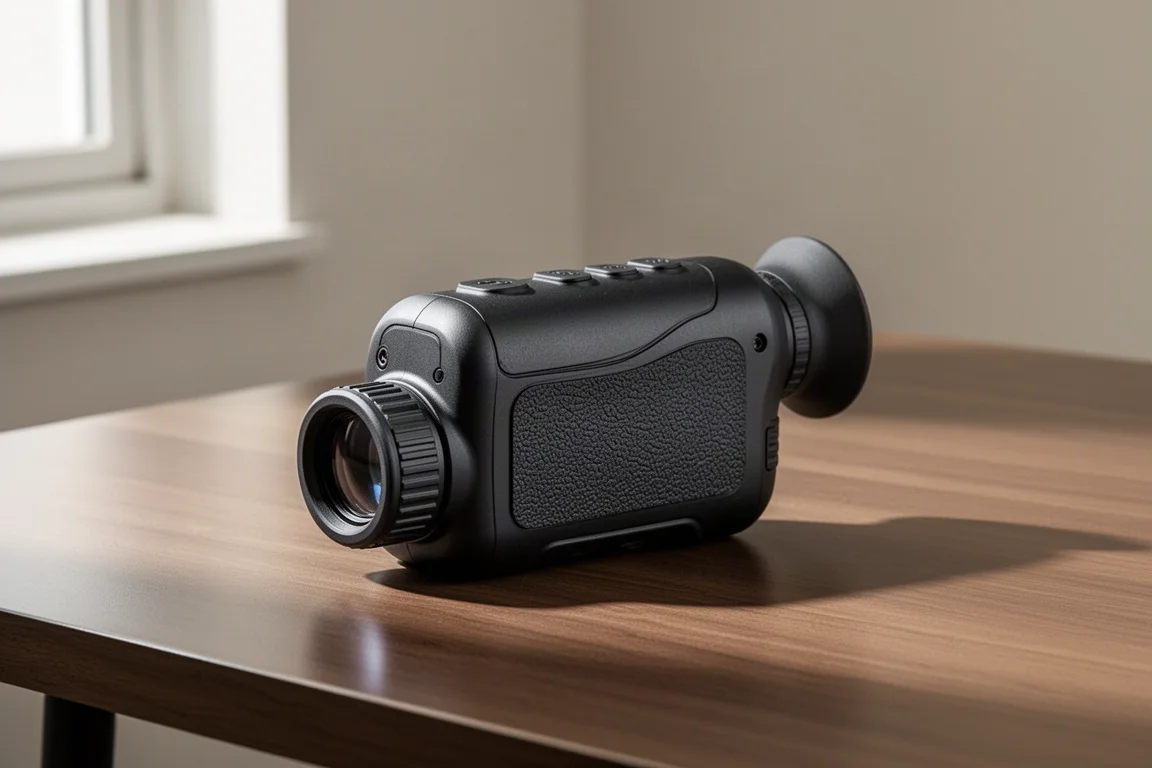
The monocular ships in a nice magnetized box with a soft carrying case, a charging cable, and an instruction manual. The device itself is small enough to carry in a pocket, and a lens cover protects the objective end. The eyecup sits on the opposite end, which is where you look through.
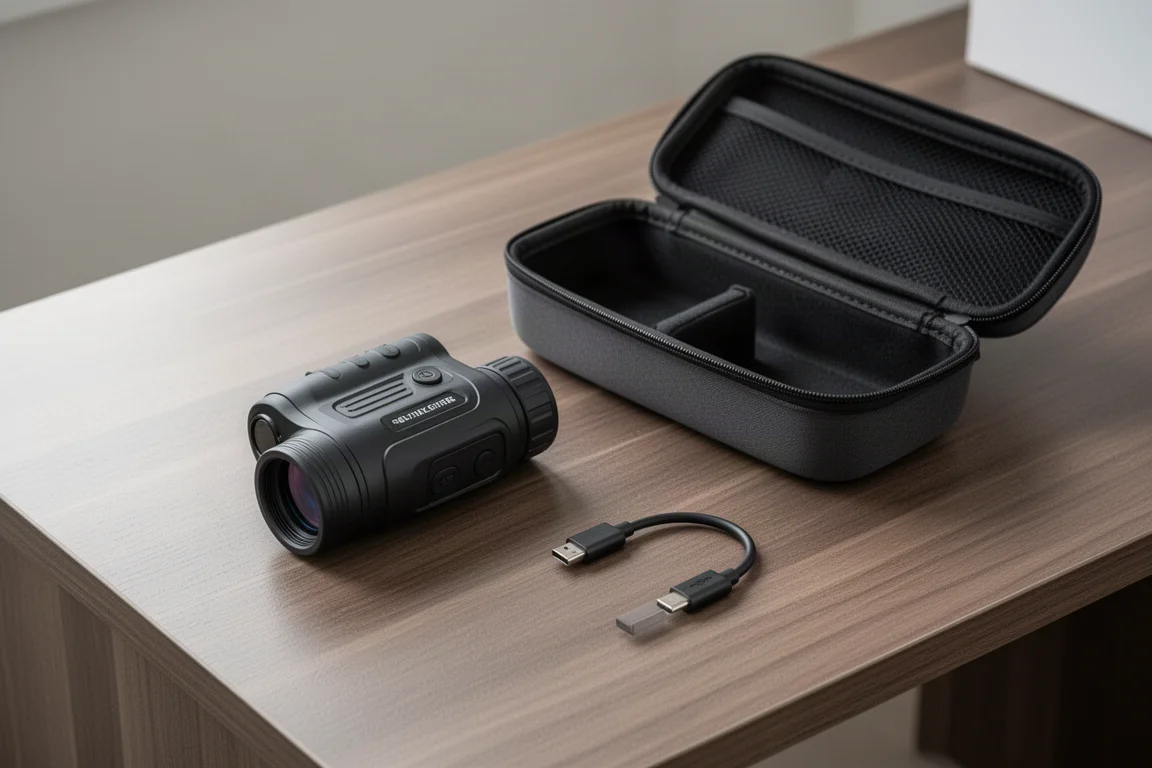
Controls are straightforward. The top panel has a power button, a mode button for switching between the six thermal palettes, a zoom control that you hold down to magnify, and a capture button that records video when held and takes a photo when tapped. Internal capture works as advertised, and the USB C port makes extracting files simple.
One honest caveat: like any optic, extended viewing through the monocular can become tiring. The phone app would help here for iOS users, but it is Android only.
Field Test: Owls in Cache County
The first real test took place at night in Cache County, looking for owls in dense woods. A flammulated owl had just been heard nearby, which made for a perfect stress test of whether the unit could pick out small heat signatures among trees.
The results were mixed but informative. The hot spot tracker, a small square box that moves across the screen, did a good job of highlighting even small heat sources. A flying squirrel was caught scrambling up a tree trunk, though it appeared as just a faint dark spot that was easy to miss.
A saw-whet owl sitting about 10 yards away was clearly pinned by the thermal. In red hot mode and the orange-yellow rainbow mode, the owl was visible, and white hot worked too. Black hot mode proved the best palette for picking out owls in a forest. Glimmer mode was the weakest and did not show the bird at all.

The important limitation: there was no definition for identification. Without first spotting the owl with a flashlight, it would have been impossible to say which species was sitting there. In fact, on this outing most finds came from ears, bare eyes, or a flashlight first, and the thermal only confirmed them afterward.
Field Test: Ducks on a Pond
At a local pond, ducks were only about 5 to 10 feet away, which gave the sensor the best possible chance. Even at that close range, the thermal clearly showed a duck-shaped heat signature separating cleanly from the cooler water, but the definition was not enough to identify species. The only reason a mallard could be guessed at was the light bill and dark head visible at near-zero distance.

Zooming in made things worse. The 4x magnification is digital, so image quality degrades noticeably as you zoom. Staying fully zoomed out preserves the most detail and is the recommended way to use this device.
A more distant duck on open water was barely distinguishable as a tiny darker speck, reinforcing that small, distant birds are beyond what this sensor can resolve usefully.
What It Does Well (and What It Does Not)
The strengths are real. The device reliably differentiates heat signatures and points out warm objects, the hot spot tracker picks out even small targets, and bigger mammals show genuine detail because their heat signatures are much larger. The 16 GB internal storage is arguably the biggest feature on the camera, and the 50 Hz frame rate is a legitimately strong spec at this price.
The weaknesses matter for the intended use. It will not pick out a bird that is not already close by, it struggles to distinguish small animals from gaps in foliage at distance, and it offers no identification help. For several hundred dollars, you get a lot of capability, but several hundred dollars simply does not buy the clear, ID-friendly viewing experience that several thousand dollars does.
Who This Product Is For
For birders specifically, the answer is no. The common advice within birding is that if you are going to buy a thermal, buy something premium enough to be worth the money, and this unit does not deliver enough contrast for finding and identifying birds in forests, which is exactly the scenario you would buy it for.

Where it genuinely shines is mammal viewing. If you want to see what is moving in your yard, your neighborhood, or off the roadside, this will pick out mammals well, and larger subjects show satisfying detail. It also detected the flying squirrel and the saw-whet owl in the field, so it is not useless for birds, just frustrating when contrast and definition matter.
Buying Advice
If you are shopping specifically for a budget thermal monocular and understand the limits, this one works. It detects what it claims to detect, records usable MP4 video and JPG photos, and survives heavy rain, splashes, and dust thanks to its IP65 rating. Just keep expectations calibrated: you get what you pay for, and at this price the view will never match a premium thermal.
If birding is the primary goal, save toward a higher-tier thermal instead. If general wildlife spotting, especially larger mammals, is the goal, this is a reasonable entry point.
Conclusion
The GoYojo HD thermal monocular is an honest budget thermal: it detects heat signatures as promised, records internally, and comes well equipped with 16 GB of storage and a strong 50 Hz frame rate. It falls short as a dedicated birding tool because small, distant birds lack the contrast and definition needed to find and identify them. For spotting mammals around the yard or neighborhood, it is a much better fit.
Product link
View more details for GoYojo HD Thermal Monocular
This product is mentioned in the review. Check the specifications, options, and compatibility before buying.
View more details for GoYojo HD Thermal MonocularFurther reading
Related Reviews
Optics
Best Spotting Scopes 2026: Four Models Compared Side by Side
A practical comparison of four spotting scopes across different price points, with honest notes on optical quality, contrast, and value.
Optics
Choosing a Rifle Scope: Three Maven Models for Different Hunting Needs
A practical guide to selecting a rifle scope based on price, size, and features, with three Maven models that cover close-cover, all-around, and precision shooting.
Optics
SVBONY SV202 8x32 Binoculars Review: A Compact All-Rounder for Birding
ED glass, IPX7 waterproofing, and a pocketable build make the SV202 8x32 an easy pick for birders who want a lightweight pair under $200.