Multi-Tools
GOAT Tool Review: A Fully Modular Multi-Tool for People Who Like to Tinker
A modular multi-tool that lets you swap, reorder, and replace every component. Here's what works out of the box, what needs a quick tweak, and who it is really for.
Introduction
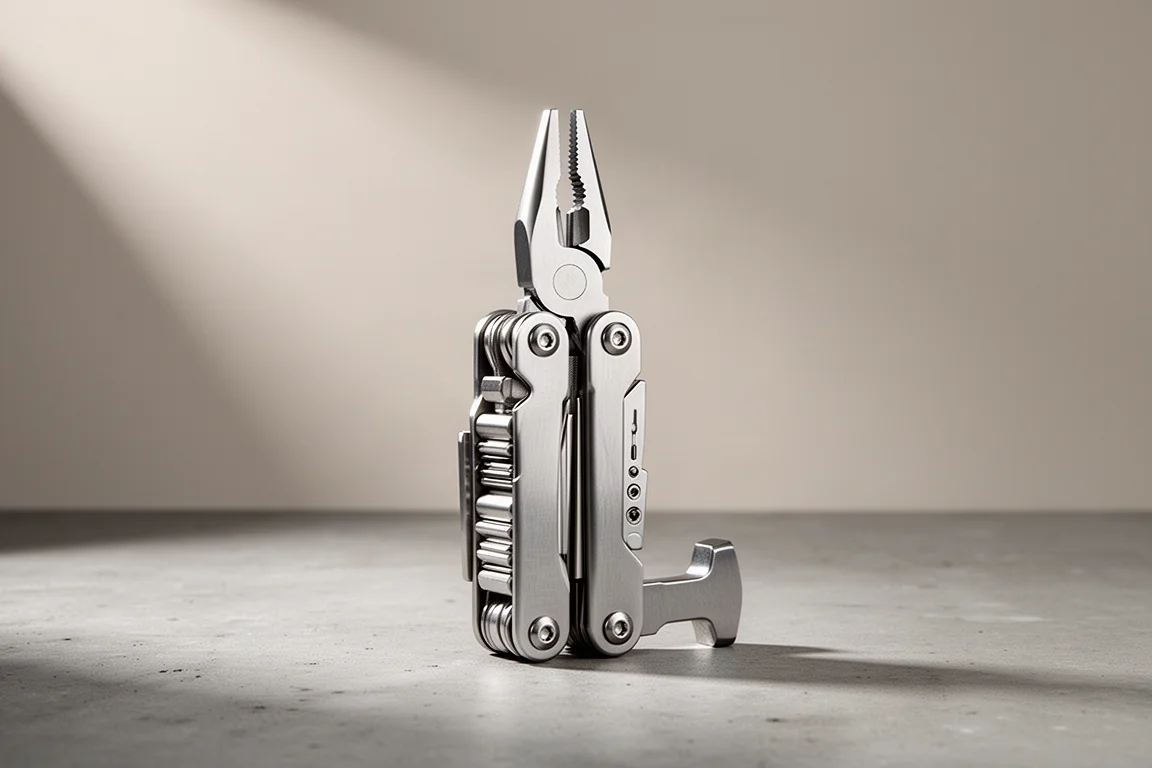
Most multi-tools ask you to accept them exactly as they come. The GOAT Tool takes the opposite approach: it is a multi-tool that is completely modular in design, with interchangeable parts that you can reorder, replace, and reconfigure without buying a whole new tool. Now that Kickstarter units are in backers’ hands, it feels like the right moment to walk through what this tool actually is, the quick tweaks that improve it dramatically on day one, and the quirks you should know about before buying.
The short version: this is not a Leatherman Wave or a Swiss Tool replacement. It sits weirdly in its own category, aimed at people who enjoy manipulating and designing their tool as they see fit. If that description fits you, there is a lot to like here.
The Pliers Head
Starting with the newest version of the tool, the plier head includes a hammering end at the back that is best described as a persuading surface rather than a true hammer. Grip matters here: holding it in a way that leaves your hand directly behind whatever you are hitting risks an impact to the palm. Instead, curl your hand into a trigger-like grip and wrap around, which delivers a surprising amount of force while the flexibility of your hand keeps the impact from travelling all the way through.
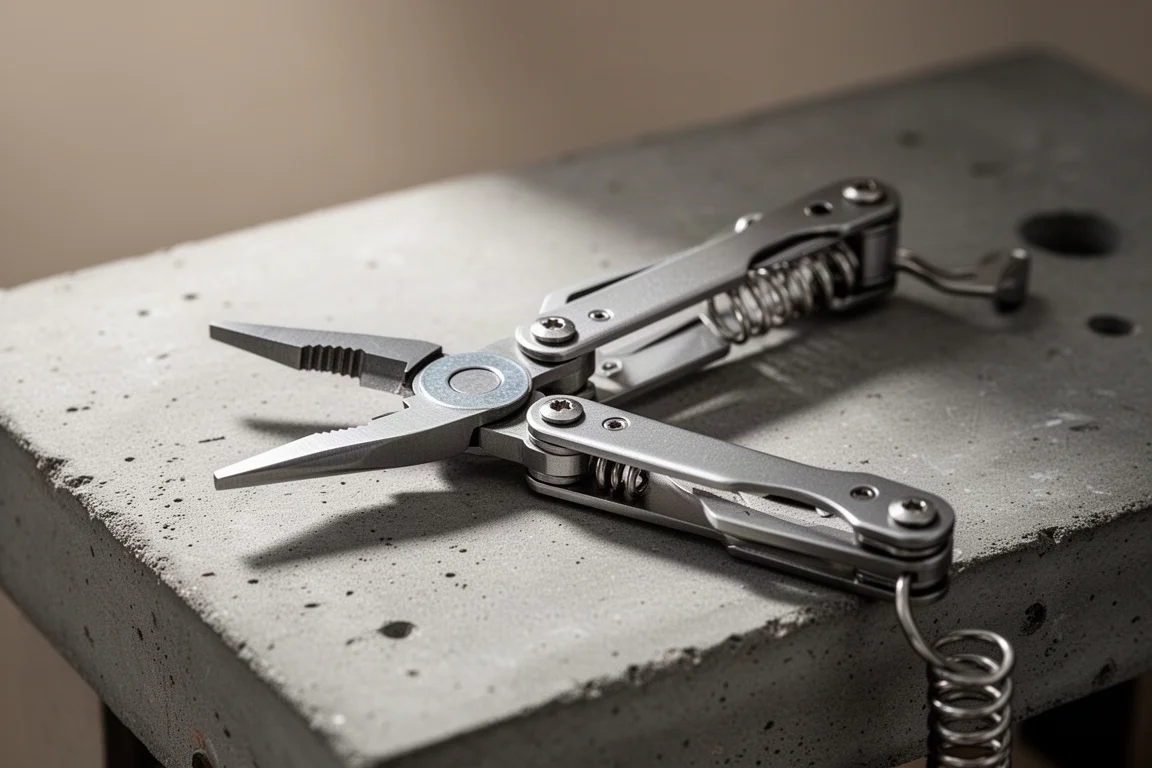
The pliers are spring-loaded, and that spring does more than you might expect. When you squeeze the handles hard, the handle flex you feel is actually the spring loading up pressure and redistributing it back into the plier head. It is a genuinely neat design, and it means that flex in the handle, which is common on outboard-accessible tools of this style, is nothing to worry about.
A few practical details round things out. The M3 screw tension is important for keeping the tool closed, and you can adjust it with the included two millimetre Allen key, or a T8 in a pinch. A washer sits between the frame and the plier, so even when tightened down significantly the action stays smooth. The cutters are replaceable with the same two millimetre screw, and because they are hardened steel with three usable edges per cutter, they can simply be rotated to a fresh edge rather than replaced. Realistically, they should last a very long time, and you could plausibly break the plier before ever needing new cutters.
The First Fix You Should Make
Here is the single most important tweak, and it should be done the moment your tool arrives. In stock configuration, deploying the blade one-handed tends to pull out both the locking bar and the bit holder along with it. That clumping is a natural consequence of the modular design, since there are no spacers between tools, and the side-mounted magnet for the bit driver pushes it even harder against the blade.
The fix is simple: undo the lock bar completely, rotate the pivot out, and swap the craft blade holder with the straight blade so they occupy each other’s positions. This arrangement solves multiple problems at once. With the bit driver open, the cutout in the craft blade holder gives you enough space to press the lock bar down, and when any other tool is deployed, pressing on the longer centre implements gives you enough leverage to flex the lock bar and disengage it. Concerns about this arrangement failing under a squeeze are unfounded, because the longer implement on the opposite side does not push down on the lock, and you have to press far out on the edge to disengage anything.
This is also a good moment to mention handedness. By swapping tools between sides, the GOAT Tool converts from a right-handed to a left-handed tool very quickly, with no additional purchases. One caveat: the swap works with the saw and the straight blade, but not with the scissors, which are slightly wider and include a spacer. The pocket clip can also be moved to any of four locations. Being left-hand capable out of the box is genuinely uncommon in this market.
Bit Compatibility Is Excellent
The tool does not ship with extra bits, and the blade deployment lacks a nail nick, which is a deliberate trade for strength rather than an oversight. Once deployed, the bit driver sits much more in line with the handle than many competing multi-tools, which makes it noticeably more comfortable to use.
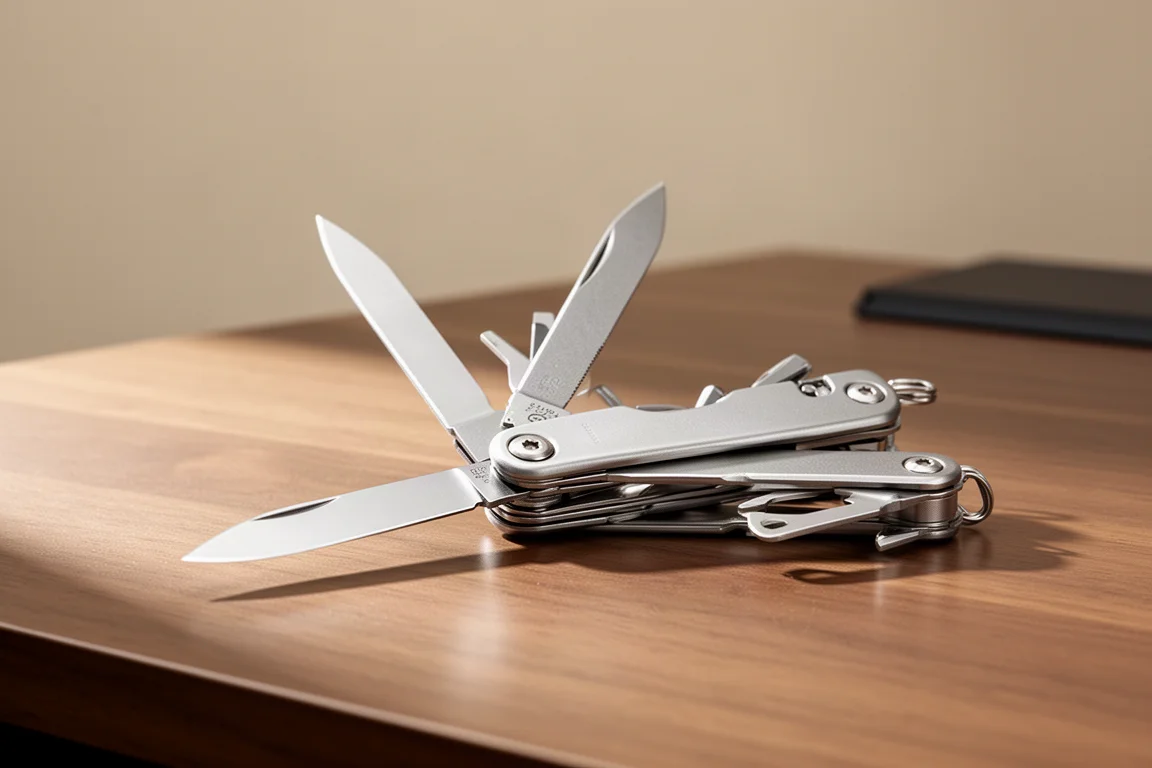
The magnet engages bits from the side rather than the back, which sounds odd but works brilliantly. It means heavy side pressure will not crack the magnet, and it lets the driver accept an unusually wide range of bits: standard double-sided bits, hex bits, four millimetre converters, quarter-inch socket adapters with hex bit collars, Leatherman ratcheting extensions, and Leatherman’s own double-sided bits. Pretty much anything you already own will work with this system.
Blade and Inner Implements
The straight blade is 440C steel, a modest but real step up in edge retention from 420HC, and it comes in under three inches total. You can also order it in a non-locking variety, which is a thoughtful option for places that do not permit locking blades. It calls to mind the original Leatherman Wave blade in character.
The inner side holds four implements. The reamer has a curved shape that should make it very good at striking a ferro rod, and it doubles as a two millimetre hex key for adjusting the tool’s own screws. The flathead is generously sized and useful for things like camera equipment, though it carries a standard hex hole that somewhat undercuts its usability; that niche addition gives up a little too much of a very good flathead, and it is one of the few design decisions worth questioning.
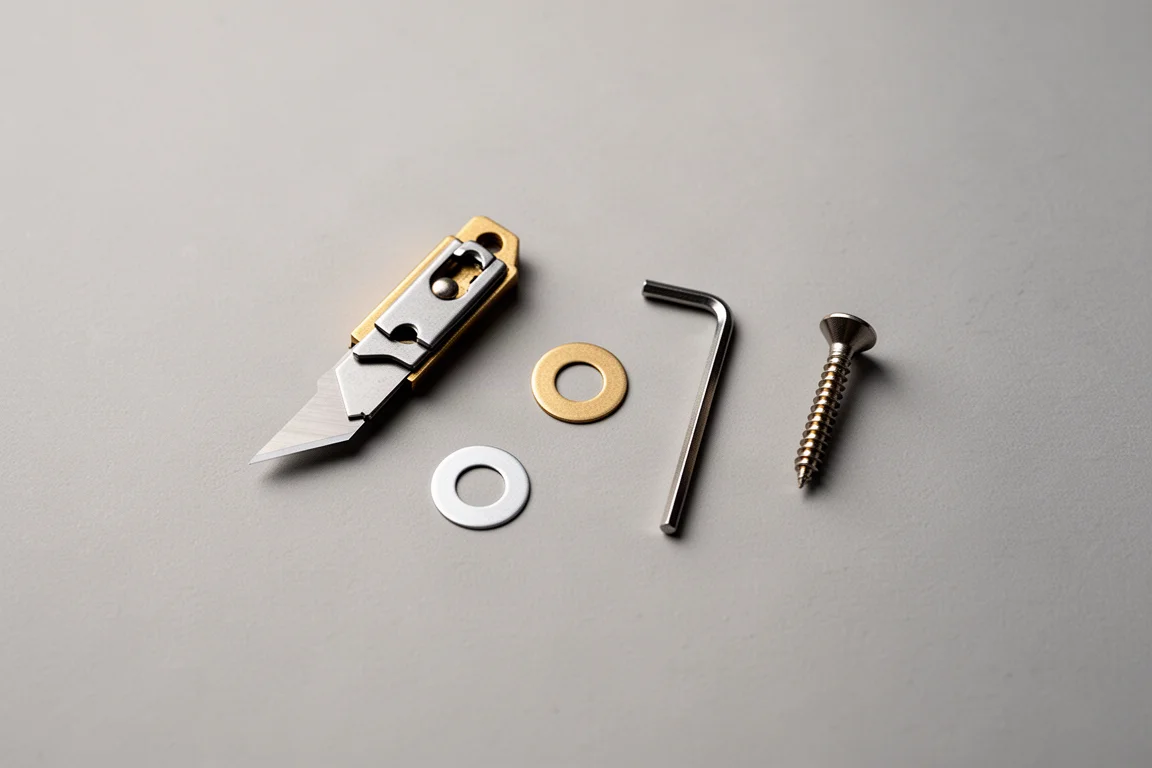
The saw is a pull-cut design with big, relatively sharp teeth and a proper taper toward the back, and the newest version seems slightly improved again. The craft blade holder may be the favourite surprise of the whole tool: remove it and you can make precision cuts in a pen-like orientation without holding the entire tool. It is a genuinely clever addition.
Modifications Worth Making
One honest quirk: pulling out an inner implement often deploys the lock bar along with it, because everything sits flush together. Changing the locking geometry to require more effort to engage would help, and thanks to the modular design it would not be difficult. There is also a little up-and-down play in the tools and lock bar channel that seems inherent to the open-pivot design. It does not appear to be a safety concern, but you will notice it.
If clumping bothers you, thin brass washers between tools let you deploy the blade without dragging neighbors out with it, at the cost of one middle implement. Even that loss is recoverable: replacing the two millimetre Allen key with an M3 Phillips head screw means the bit driver itself can adjust the tool’s tension. Alternatively, five millimetre inner, eight millimetre outer shim washers at just 0.2 millimetres thick are thin enough to add a fourth tool back while still preventing friction. Polishing the inner face of the lock bar and the blade contact areas would also reduce friction, and that is a modification the tool’s own community could reasonably make.
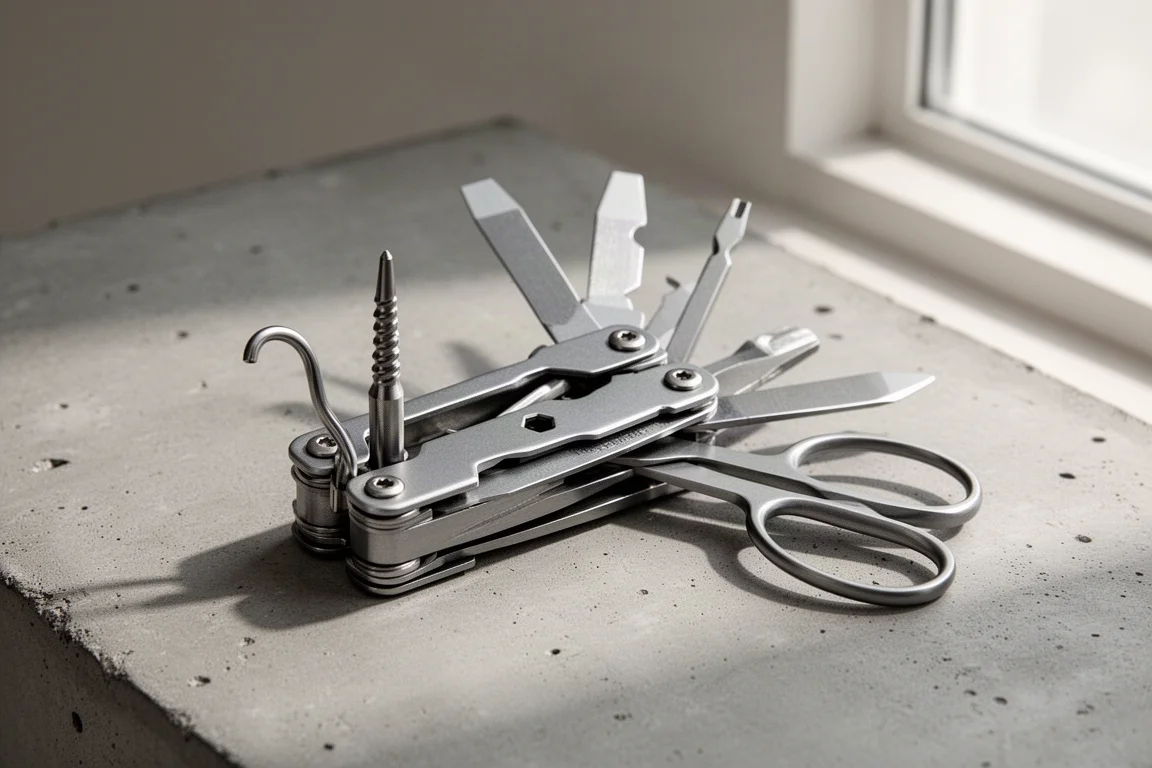
One more thing worth appreciating: because components are sold individually, problems are addressed by swapping parts rather than sending the whole tool away. The company is relaxed about users modifying their tools, which suits the product’s philosophy perfectly.
Add-Ons and Upgrades
Beyond the standard package, a couple of add-ons stand out. The S35VN replacement blades are reasonably priced, under thirty dollars, and give you the option of either carrying two blades or upgrading to a better steel without buying another tool entirely. The safety cutter is another smart pick: because it is not an exposed blade, it falls under different rules, effectively giving you a complementary cutting tool to whatever folding knife you carry. Spare cutters are probably unnecessary given the three cutting edges per cutter, but the option is there.
Inner Implements and Scissors
The scissors are stout at the tip, which limits fine precision cuts, and the tip lacks the stability for tasks like cutting paracord. That said, the cutting geometry is good, and with thinner materials they should handle the job without problems. Overall, they are pleasantly competent rather than exceptional, which is a fair summary of the inner tool set as a whole: very good, with a couple of decisions worth second-guessing and easy to change.
Who This Tool Is For
The GOAT Tool is not a replacement for a Leatherman Wave or a Swiss Tool. It is for a specific group of people: those who like to manipulate their tools, design them as they see fit, customize with different scales, and even design their own components. The potential for personalization is great, but it will not be for everyone, and it is worth accepting that upfront.
It also will not come out of the box perfectly sorted for an outdoor adventure without a little understanding of how it works. Expect small quirks, apply the blade-swap fix on day one, and consider the washer trick if clumping bothers you. If you enjoy tinkering, this is exactly the kind of tool that rewards the effort, and the modular design means every little problem discovered along the way has had a pretty immediate solution.
Conclusion
The GOAT Tool succeeds on its own terms: a genuinely modular multi-tool with strong bit compatibility, a comfortable in-line bit driver, usable pliers with replaceable hardened cutters, and rare left-hand capability without extra purchases. Its quirks, clumping tools, lock bar behavior, and a slightly compromised flathead, are mostly fixable with simple swaps the design actively encourages. Buy it if customization is what you want in a multi-tool; skip it if you want a polished out-of-the-box classic.
Product link
View more details for GOAT Tool
This product is mentioned in the review. Check the specifications, options, and compatibility before buying.
View more details for GOAT ToolFurther reading
Related Reviews
Multi-Tools
Leatherman Wave Plus Review: A Pliers-First Multitool for Bike Trips
Why a pliers-first multitool earns permanent space in a touring kit, and what to weigh before paying for the Leatherman Wave Plus.
Multi-Tools
Best Budget Multi-Tools Under $50: Four Picks Worth Considering
A compact SOG original and three value-focused clones, with honest notes on which ones deliver real value and where to draw the price line.
Multi-Tools
Best Multitools for Hard Wire Cutting: Which Pliers Actually Survive the Test
We put a lineup of classic and modern multitools up against a simple challenge: cutting coat hanger wire cleanly without damaging the cutters.