Cookware
Best Titanium Pans Tested: Five Skillets, Five Very Different Builds
We put five titanium pans through egg, pancake, scratch, and corrosion tests alongside regular stainless steel to see which claims hold up.
Introduction
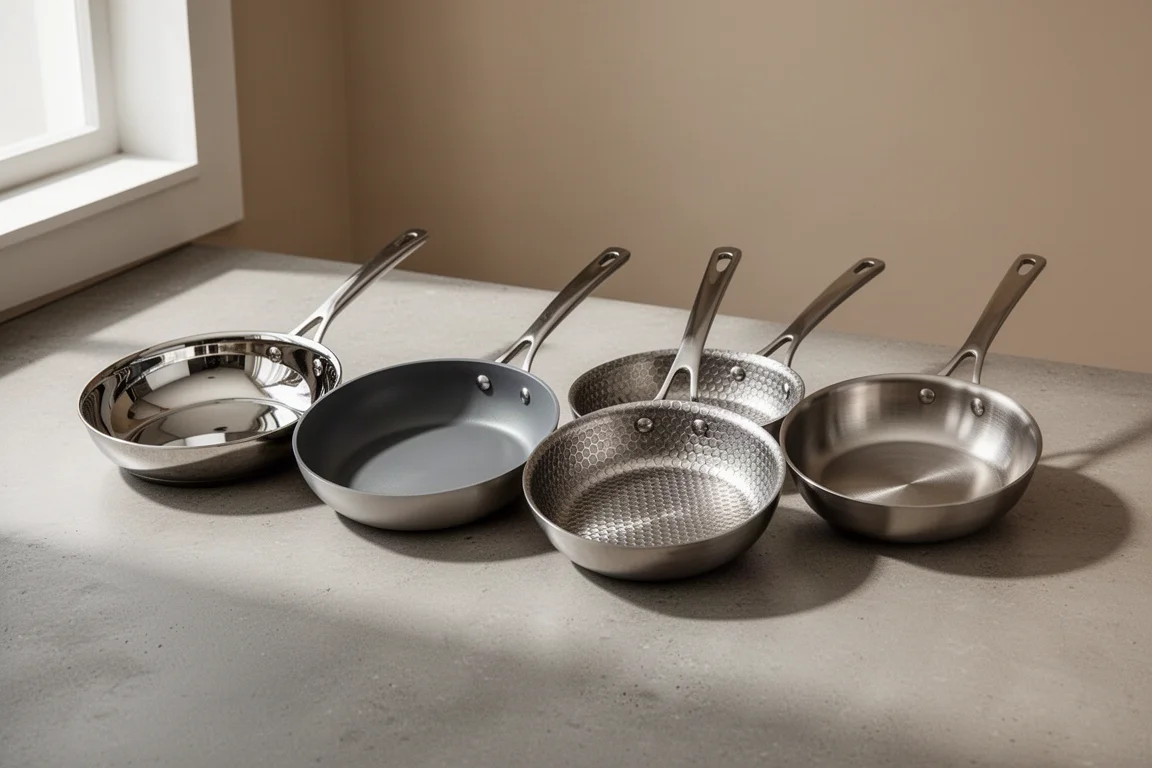
Titanium pans are marketed as a sweet spot: non-stick-like release with durability that outclasses stainless steel. To find out how much of that is real, five of the most popular titanium pans on the market went through a hands-on gauntlet. Eggs and pancakes were cooked with and without fat, surfaces were scraped with weighted metal ladles, spatulas, and a serrated steak knife, a whisk was ground against each cooking surface, and an aggressive salt corrosion test checked whether titanium really resists pitting better than stainless steel. A regular stainless steel pan ran the exact same tests for side-by-side comparison.
The short version: some of these pans are genuinely impressive, one has a real-world flaw that matters more than its surface, and the label “titanium” hides very different construction methods that directly affect performance.
How the Five Pans Use Titanium
All five pans have titanium in the name, but they use it in very different ways, and that matters more than the marketing suggests.
Hestan NanoBond is a stainless steel pan with an aluminum core. Titanium is vaporized in a high-heat vacuum chamber and bonded to the surface in a layer as thin as a human hair. Hestan claims this makes the surface four times harder than regular stainless steel, which supposedly means resistance to scratching, staining, and sticking.
Viking PureGlide Pro is also stainless steel with an aluminum core, but Viking heats titanium to around 30,000 degrees and sprays it onto the cooking surface. The result is a matte gray surface that honestly looks like a non-stick coating. Viking customer service confirmed it is not Teflon or ceramic: it is pure titanium. Viking claims the surface is three times harder than stainless steel and can withstand 5,000 cycles with a pizza cutter.
The Our Place Titanium Always Pan Pro has a stainless steel exterior, an aluminum core, and a cooking surface made entirely of pure titanium. It looks similar to HexClad, but the darker spots are oxidation from the curing process, not a coating. Our Place says the textured pattern creates airflow between food and pan, which is what prevents sticking.
Taima also uses a stainless steel exterior, aluminum core, and pure titanium cooking surface with a textured pattern that the brand claims makes it non-stick and impossible to corrode.
Heritage Steel takes a different approach entirely. Its cooking surface is 316Ti stainless steel, an alloy reinforced with titanium. Heritage Steel does not claim non-stick performance, only that the titanium in the alloy makes it more resistant to salt pitting and corrosion.
Non-Stick Performance: Eggs and Pancakes
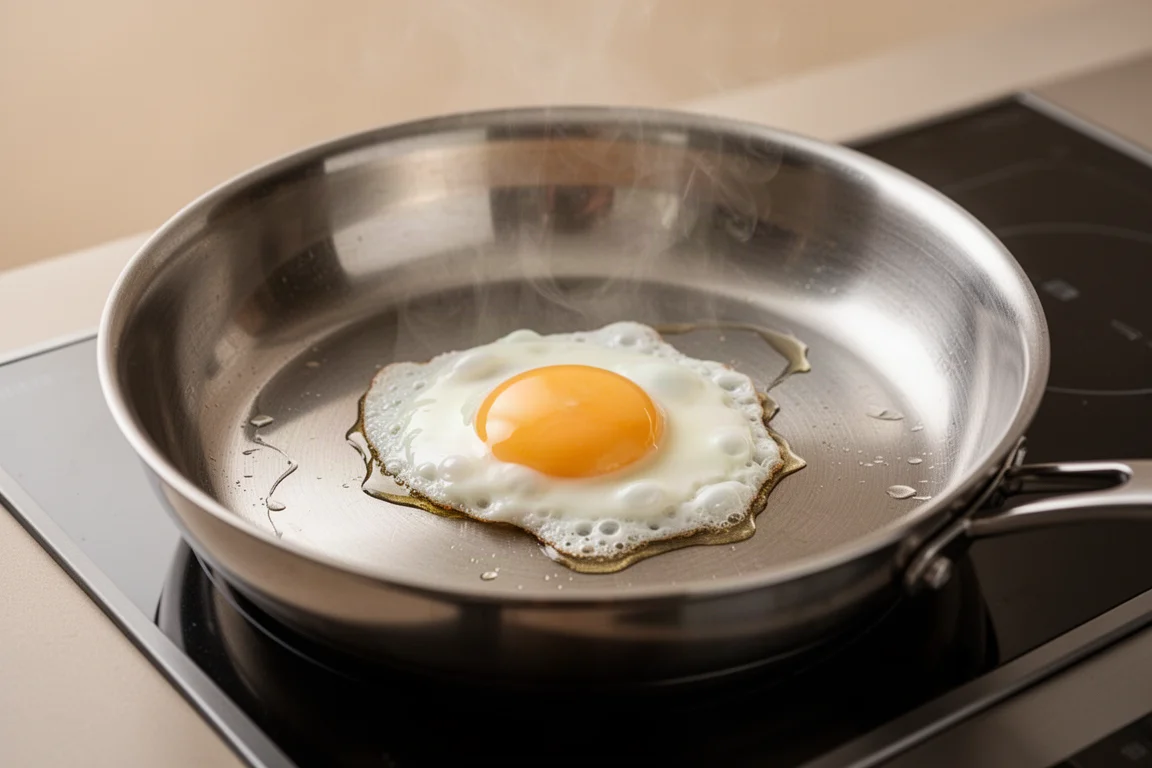
The egg test started with each pan preheated on medium-low until the cooking surface reached 325 degrees, then half a teaspoon of oil and 2 grams of butter spread around before cooking an egg.
Viking performed just like a non-stick pan: the egg slid around with a shake of the pan, no spatula nudge needed. Taima, Our Place, and Heritage Steel also showed no sticking. Hestan NanoBond got a little too hot and browned the egg more than intended, but the non-stick performance was still good and the egg flipped easily without breaking the yolk. Plain stainless steel needed a spatula to loosen the egg but still released fine.
The no-fat egg test separated the field. The egg stuck badly to Hestan, Heritage Steel, and Taima. Viking performed surprisingly well with only a little sticking in a few areas, and the egg could still be flipped without ripping. The biggest surprise was Our Place: even with no oil or butter, the egg did not stick. It required care with the spatula, but once underneath, the egg lifted cleanly. Until now, only fairly new traditional non-stick pans had managed that in this kind of testing.
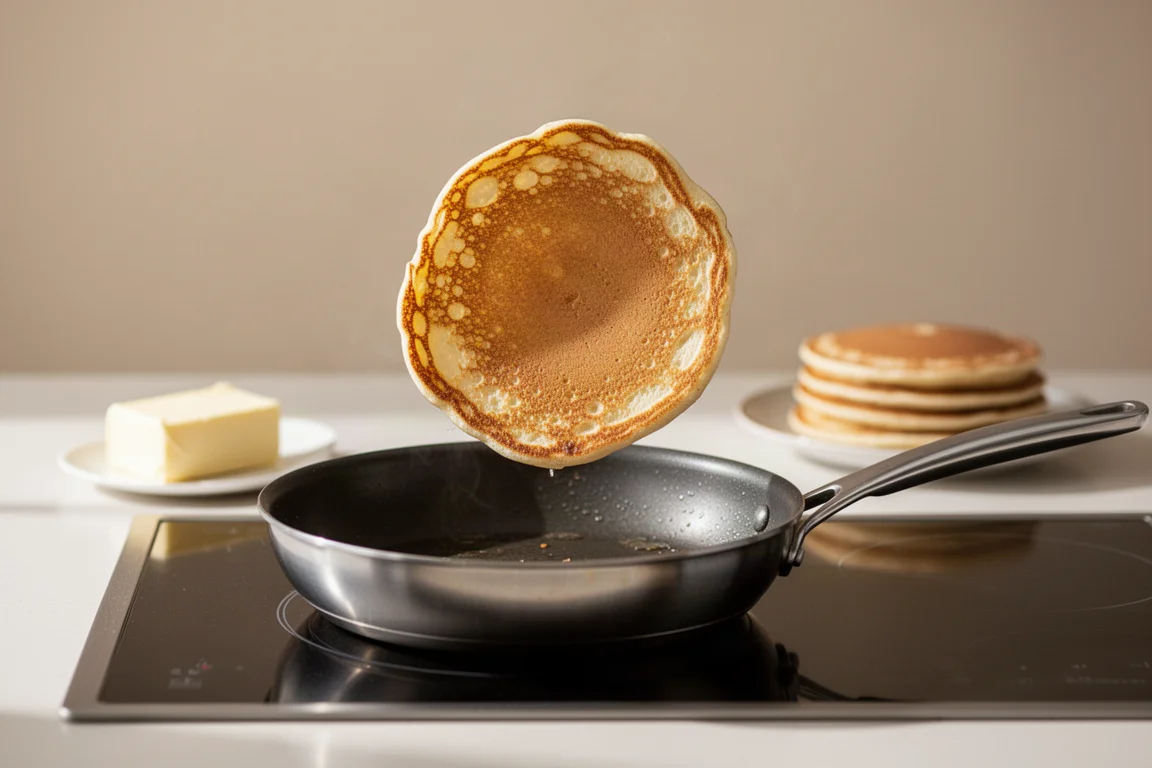
Pancakes told a similar story. With a thin layer of butter, every pan passed without sticking. In a second round with no butter at all, Viking, Our Place, and Taima performed great. Pancakes stuck a little to the Hestan pan, but not much. Heritage Steel and plain stainless steel stuck the most, though the pancakes still came out fine.
Scratch and Metal Utensil Testing
Metal-utensil safety is another big titanium claim, so each pan went through five scratch tests.
First, a 5 lb weight attached to a metal ladle was scraped across each pan 50 times, then repeated with a metal spatula. Viking and Our Place showed white marks that looked alarming, but they turned out to be metal dust transferred from the ladle and wiped right off with no permanent damage. Plain stainless steel had noticeable scratches that could be felt with a fingernail. Hestan and Heritage Steel had similar-looking marks that were completely smooth to the touch, with no grooves or real damage. Taima showed no noticeable marks at all.
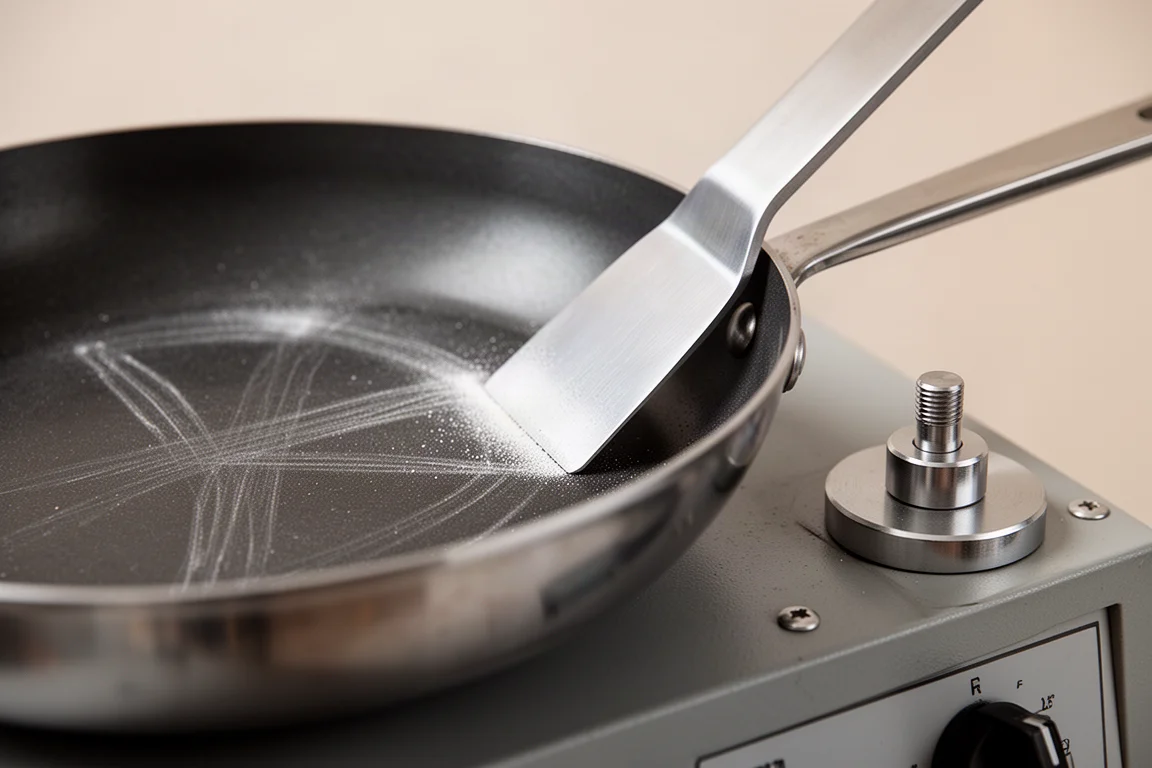
Next, a serrated steak knife with two magnets totaling 130 grams was rubbed across each pan 15 times. Viking had zero scratches or damage. Hestan showed minor rub marks over a completely smooth surface, and the knife was noticeably quieter on it, almost gliding across the hardened surface. Our Place had a slight scratch mark but nothing major. Heritage Steel and Taima did not hold up as well: both had significant scratches. For comparison, the same test on a traditional non-stick pan cut right through the coating.
Then a heavy-duty Scotch-Brite sponge, green side down, with a 5 lb weight on top was pushed back and forth 20 times. Viking, Hestan, and Our Place came away undamaged. Heritage Steel, Taima, and stainless steel all picked up noticeable scratches.
Finally, a stand mixer with a metal whisk making firm contact ran on low for 30 seconds against each surface. Viking and Our Place again had scary-looking white marks that turned out to be whisk dust and wiped off. Our Place also made a loud grinding sound during the test, which was alarming but caused no real damage. Hestan, Heritage Steel, and Taima had noticeable circular rub marks but no actual scratches. Stainless steel ended up with deep circular scratches felt with a finger.
Crucially, after all that abuse, the egg test was rerun. Every pan still performed well: Viking, Our Place, Heritage Steel, and Taima with no sticking at all, Hestan with a barely noticeable tiny stuck spot, and even stainless steel released fine. None of the marks made a meaningful difference in cooking.
Corrosion and Salt Pitting
All five pans claim corrosion resistance, and Hestan and Heritage Steel specifically say titanium makes them more resistant to salt pitting than regular stainless steel.
The test was deliberately brutal: 20 grams of non-iodized salt and 20 grams of filtered water sat in each pan for an hour, then the pan went on high heat until the water evaporated, sat for another hour, and was washed and inspected. That cycle ran three times per pan.
After the first round, all five titanium pans looked completely fine. The stainless steel pan developed small dark spots that vinegar and Bar Keepers Friend could not remove: early pitting. After the second and third rounds, more spots appeared, and zooming in showed the spots actually eating into the steel, with indentations you could feel with a fingernail. The titanium pans showed no signs of pitting at all.
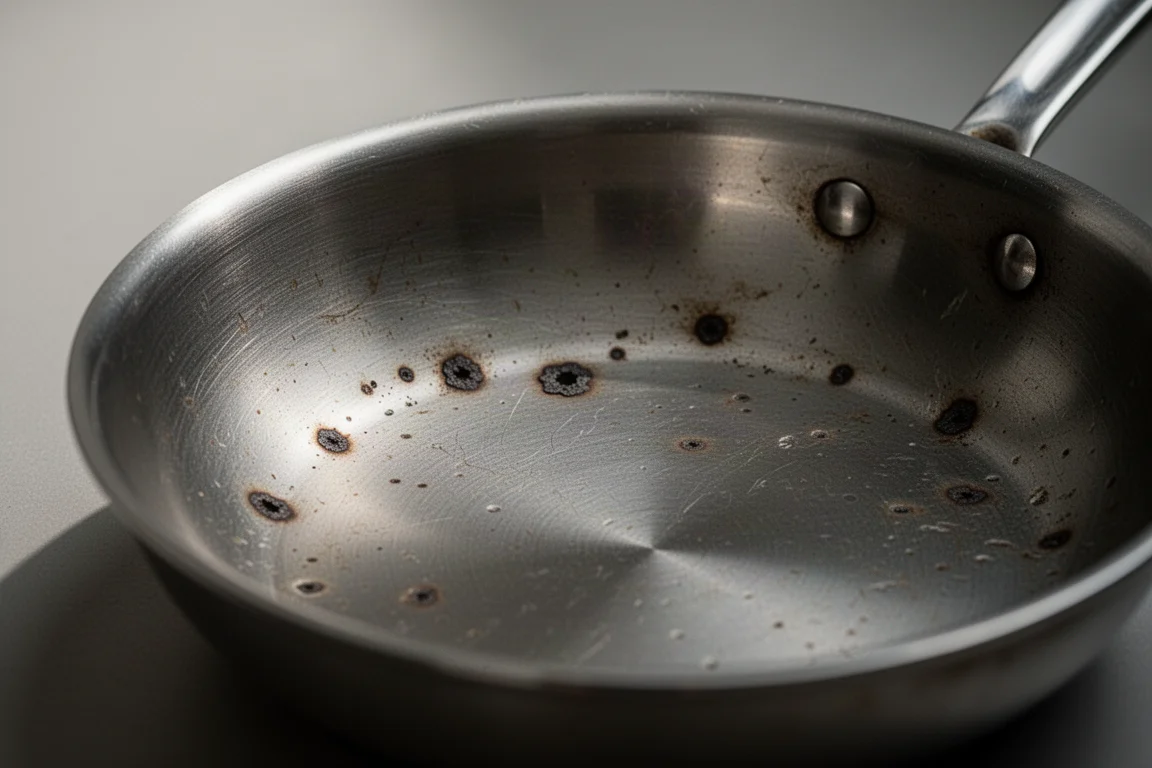
To be fair, this is an extreme test. Letting salt sit in cold water in a cold pan is about the worst thing you can do to stainless steel. If you add salt after the water boils and never leave salty food sitting in pans overnight, pitting should not be an issue. But the titanium pans handled the abuse without damage, while stainless steel started to pit.
Which Titanium Pan Should You Buy?
So are titanium pans worth buying? It really depends on the pan.
The Viking PureGlide Pro is the standout. It looks like a non-stick pan, it cooks like a non-stick pan, and it came through every scratch test undamaged. In everyday cooking outside the tests it performed perfectly every time with very little grease, and it is genuinely hard to believe the surface is not a non-stick coating.
Hestan NanoBond also lives up to its claims. The surface is incredibly hard and highly polished, making it slicker and more scratch resistant than standard stainless steel, with fantastic long-term performance.
Our Place Titanium Always Pan Pro has an unusual-looking surface, but the performance is hard to argue with, and its non-stick properties are impressive.
Heritage Steel Titanium performed well but cooks more like a regular stainless steel pan, which makes sense because the titanium is in the alloy, not on the surface. If pitting is your main concern, it is a good alternative to regular stainless steel. Worth noting: Heritage Steel also makes a non-titanium line, the Eater Series, which some cooks prefer for its handle design.
Taima lived up to most of its claims, but its main issue is thickness. Measured at 2 mm, it warped after a few uses and spun on the cooktop, which matters more than any surface claim.
The broader advice on titanium cookware: read the fine print. Pans advertised as titanium can be constructed very differently, and that directly affects performance. Titanium is also just one factor; handle design, thickness, weight, and heat performance matter just as much when choosing the right pan.
Conclusion
Titanium pans are not one category. A vapor-bonded surface like Hestan NanoBond delivers real hardness and slickness, Viking PureGlide Pro behaves convincingly like non-stick while surviving metal utensils, and Our Place delivered the best no-fat egg release of the group. Heritage Steel is a corrosion-focused alloy play rather than a non-stick one, and Taima’s thin build undermines otherwise solid surface performance. Match the construction to how you actually cook, and the titanium label becomes a useful signal instead of marketing noise.
Product link
View more details for Hestan NanoBond
This product is mentioned in the review. Check the specifications, options, and compatibility before buying.
View more details for Hestan NanoBondFurther reading
Related Reviews
Cookware
Best Carbon Steel Pans Tested: Which Brands Deliver Real Value
We tested eight popular carbon steel pans with controlled durability, heat, and cooking tests. Here's which ones perform best and which to avoid.
Cookware
Best Cast Iron Pans 2026: Five Options from Budget to Premium
A practical breakdown of five cast iron skillets, from affordable Mueller to premium Our Place, with clear strengths and trade-offs for different cooking needs.
Cookware
Best 12-Inch Cast Iron Skillets: Premium Craftsmanship vs. Reliable Budget Option
Two standout 12-inch cast iron skillets tested for heat retention, surface finish, and durability. One premium choice and one budget-friendly alternative that both deliver.