Tools & Measuring
Best Laser Distance Measurers for Job Site Estimates: Three Models Compared
A hands-on comparison of the Klein 93LDM 100C, Leica Disto E7100i, and Bosch Blaze laser distance measurers, including a real-world side-by-side accuracy test.
Introduction
If you have ever needed to measure a room for carpet, concrete, or fill dirt, a laser distance measurer is one of those tools that quietly replaces a whole lot of fumbling. Instead of hooking a tape end, stretching it across a space, and hoping it stays straight, you point, press a button, and read a number.
The catch is that these devices are marketed for estimation, not for cutting tolerances. In most job site situations, that is plenty good enough. Below are three models that cover very different needs and budgets: the simple and affordable Klein 93LDM 100C, the feature-packed Bosch Blaze, and the Leica Disto E7100i, which has served as the benchmark against which the others get compared.
How Laser Distance Measurers Work (And Why Early Ones Were Quirky)
Modern laser measurers are simpler than they look. The small visible laser is not doing the measuring; it only shows you where the device is pointed. The actual distance calculation comes from the infrared light emitted from the aperture, which bounces back and is timed with millisecond precision.
Older ultrasonic models worked differently and had real limitations. One early design emitted a clicking sound, then went quiet to listen for the echo. Because it could not hear the echo while it was still chirping, it had a built-in minimum distance, and if the sound did not return before the next click, the measurement simply failed. Modern laser units do not have these constraints, which is a big part of why they are so much more reliable.
The Three Models at a Glance
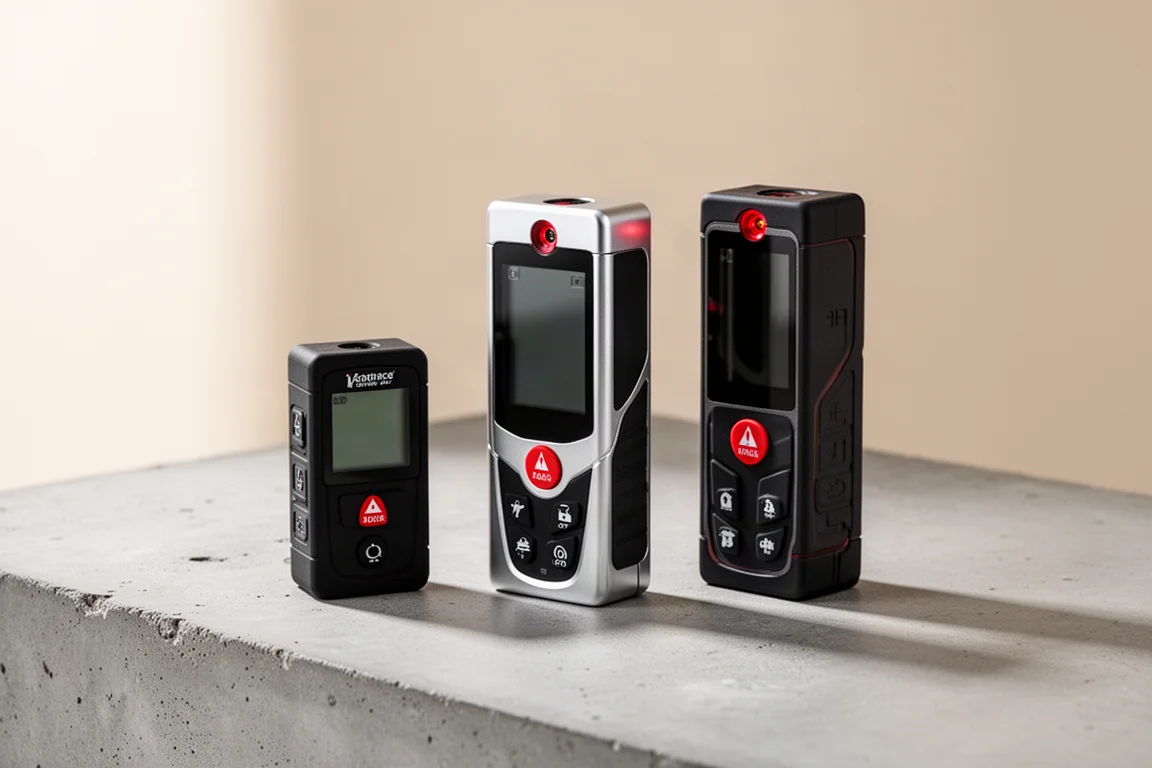
Before diving into each one, here is the quick rundown. These devices range from a one-button point-and-shoot unit to a Bluetooth-connected Swiss-made precision tool, and the price gaps between them reflect those differences.
Best Budget Pick: Klein 93LDM 100C
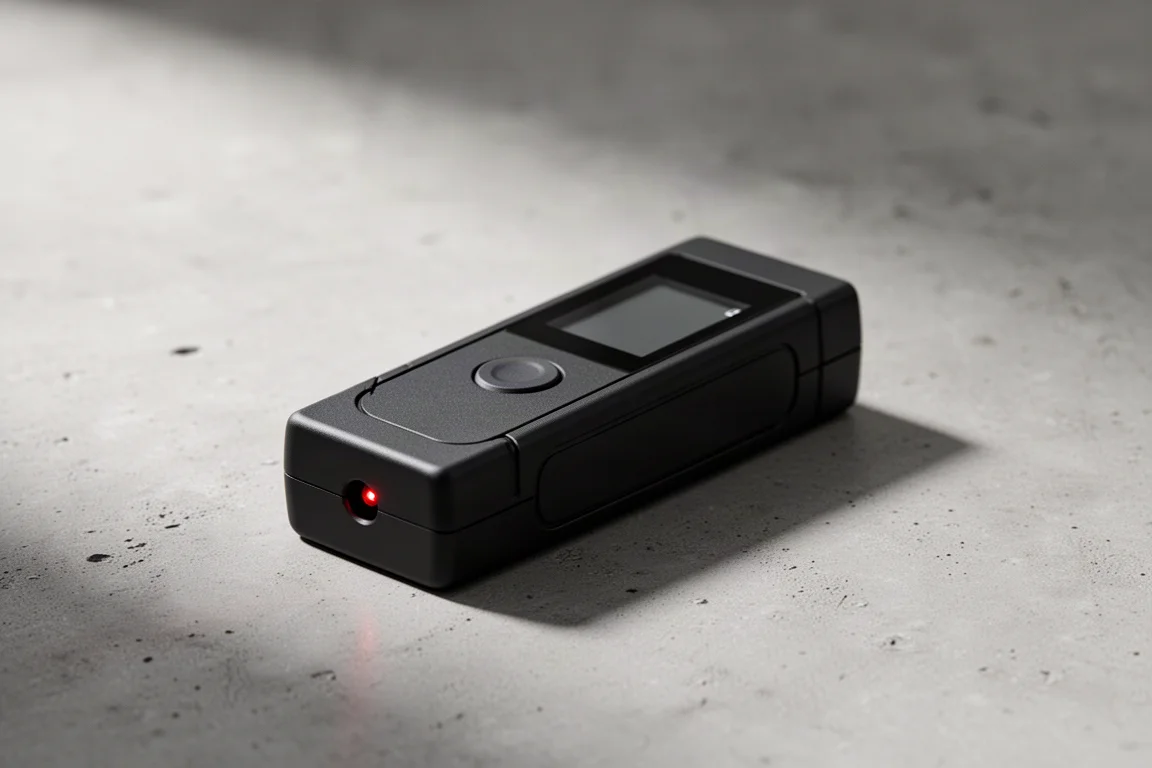
The Klein 93LDM 100C is the simplest of the bunch. It has a small set of settings, a modest display, and one button doing most of the work. Priced around $37 at Lowe’s, it is positioned squarely at job site estimation, and for that role it is genuinely good enough.
The main quirk is sensitivity. Holding the button down for a second or two switches the measurement unit, and it is easy to end up in the settings menu or back in meters by accident. With just one button, everything routes through that single control, which occasionally gets in the way. Still, it beats comparable compact competitors and has proven more likeable than similar tiny alternatives.
Best Feature Set: Bosch Blaze
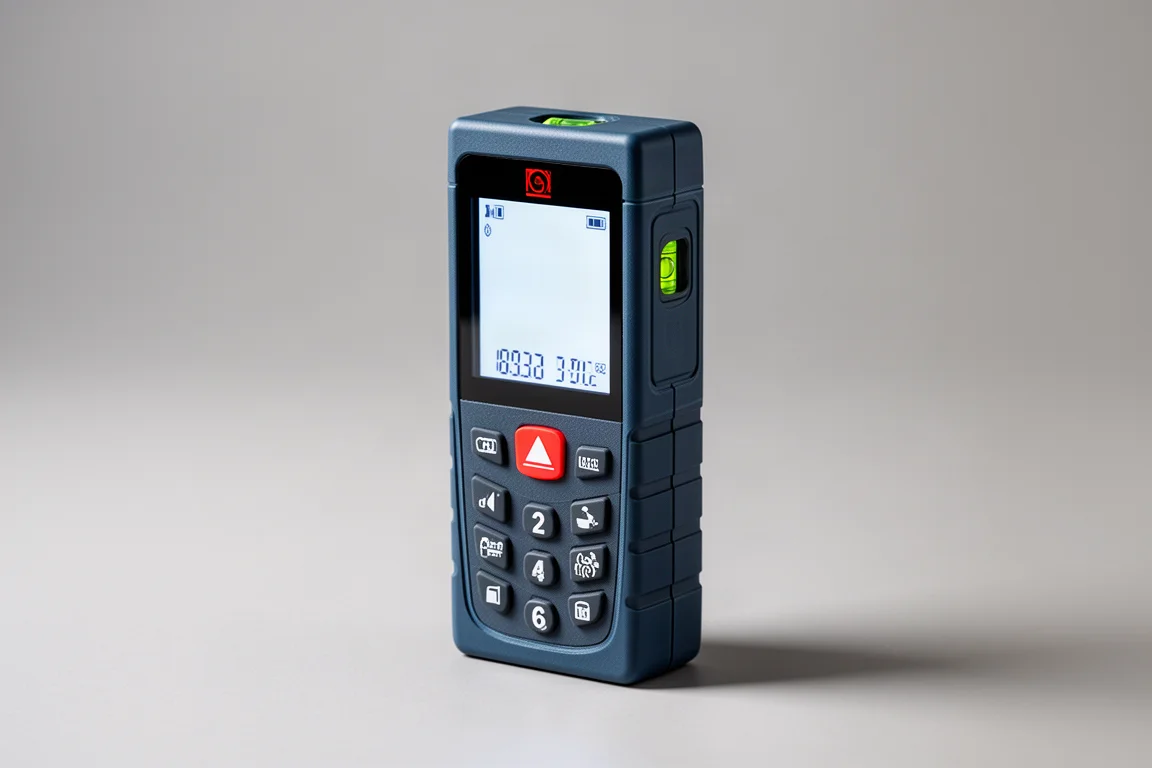
The Bosch Blaze has been in regular use for years, and it does a lot more than the basics. It includes a built-in level, a larger display, and a fuller feature set than most users will ever need. That extra capability comes at a cost: it sells for around $100.
In the side-by-side accuracy test, the Blaze read 0.561 meters on a fixed reference distance, putting it within 3 mm of the top performer. The two units read so closely that it would not be surprising if their engineering teams shared notes. If you want a middle path between budget simplicity and premium precision, this is the one to look at.
Best Precision Benchmark: Leica Disto E7100i
The Leica Disto E7100i is the gold standard in this comparison. The design is simple, the build quality is consistently top-notch, and the readings go out to four decimal places. It also includes Bluetooth connectivity, and the overall design language is clean and refined.
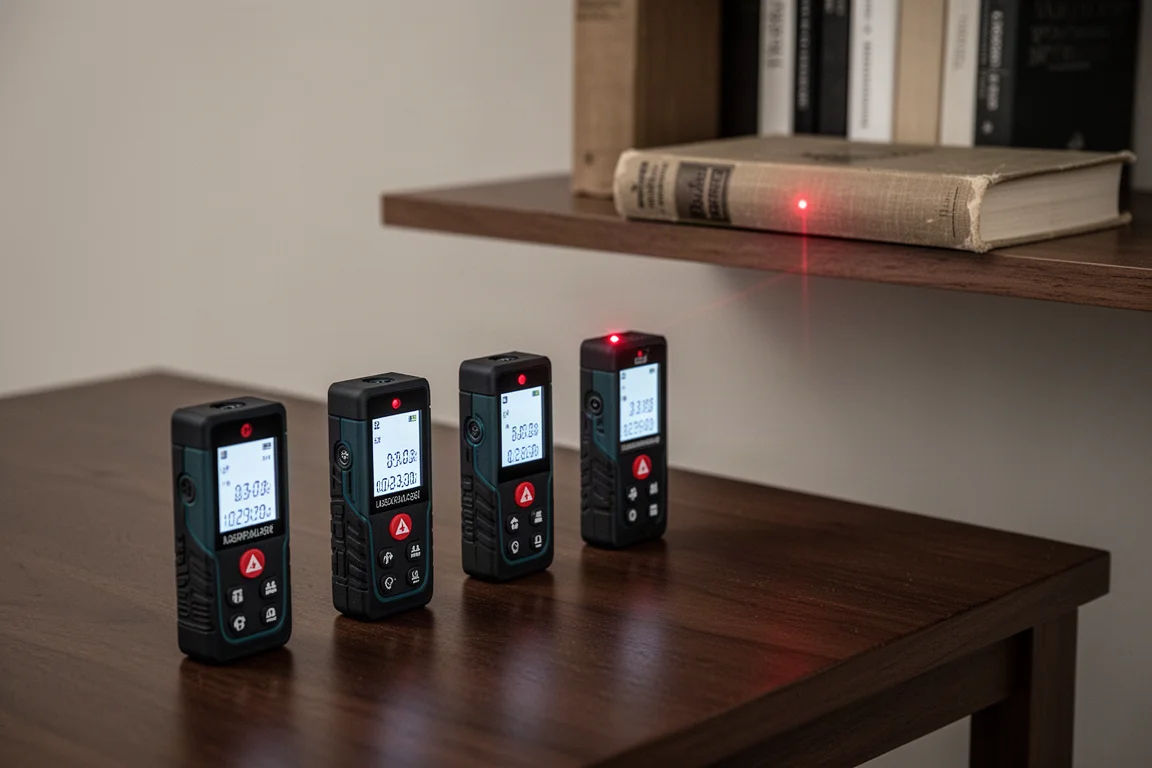
The trade-offs are price and button count. With four buttons, it is more complex than the single-button Klein, though far easier to navigate than some feature-heavy rivals. In the reference test it read 0.5627 meters, essentially matching the Bosch within a fraction of a millimeter. If precision matters more than portability or price, this is the one worth stretching for.
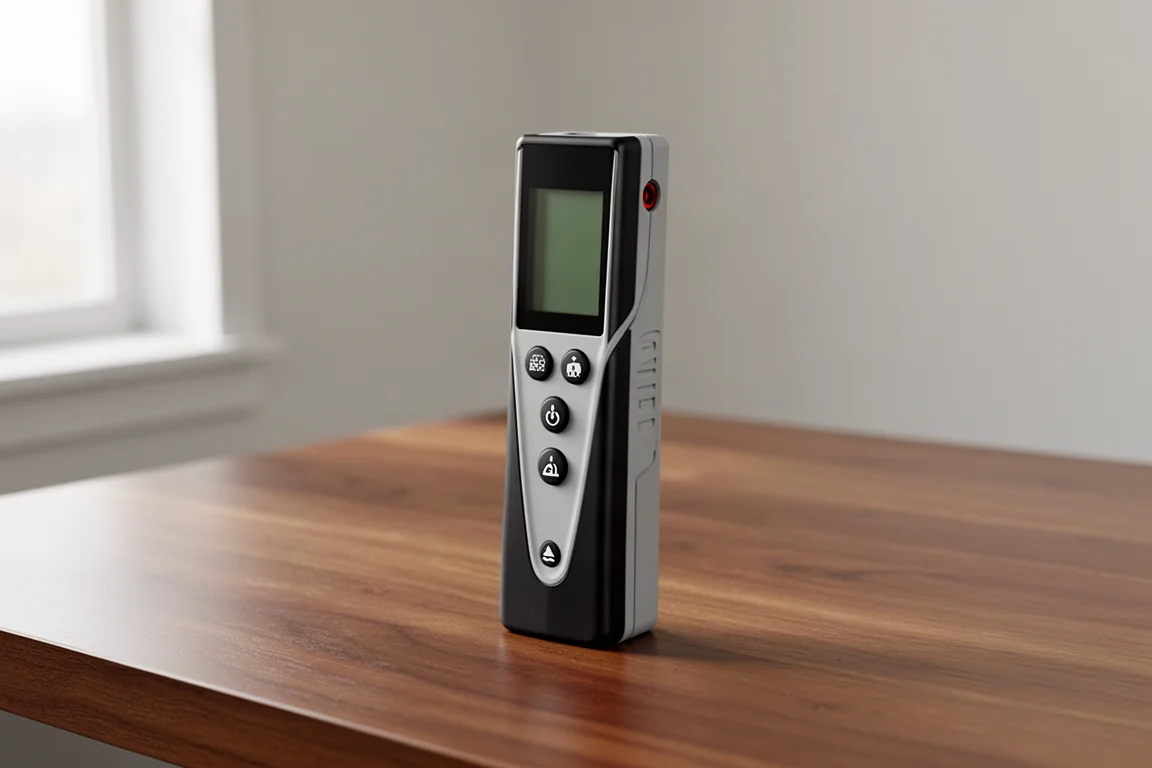
Side-by-Side Accuracy Test
With all three units set to read from their base and lined up against the same reference point, the readings came out as follows: Klein at 0.545 meters, Bosch at 0.561 meters, and Leica at 0.5627 meters, with a follow-up Klein reading of 0.569 meters on a second pass.
The gap between the Klein and the other two was about 16 mm, or 1.6 cm, which is noticeable but not disqualifying for estimation work. The Bosch and Leica were within roughly 3 mm of each other, a difference about half the width of a 6 mm blade. These numbers will shift slightly depending on surface texture, distance, atmospheric conditions, and reflective or absorbent materials, so repeated measurements are always worth a second look.
Things to Consider Before Buying
Accuracy expectations matter most. These tools are recommended for estimating, not finish carpentry. If your goal is ordering materials or checking room dimensions, the budget options are fine. If you need repeatable precision, the premium tier earns its price.
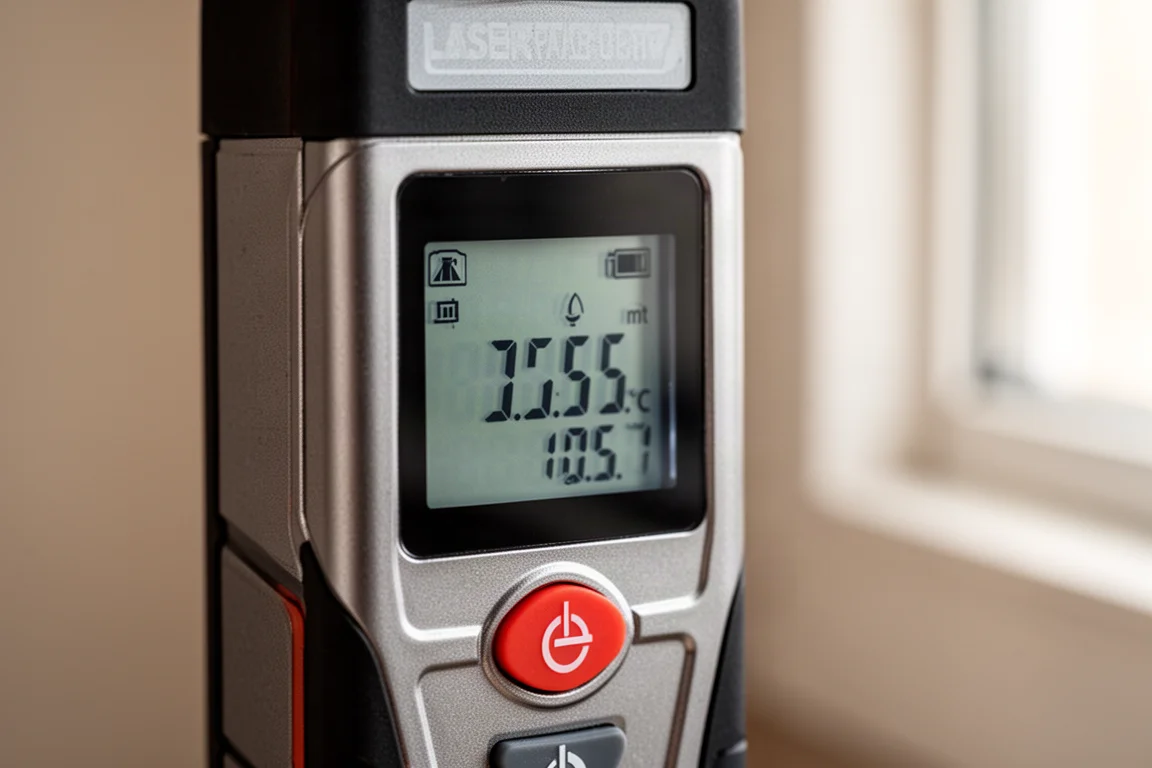
Button layout is another practical concern. A single-button design keeps things minimal but can make accidental unit switching annoying. More buttons give you direct control but add a small learning curve. Think about how often you will switch between metric and imperial, or between modes, before choosing.
Buying Advice
If you just want a quick reference, something to shoot across a room and get a ballpark number, a budget model like the Klein 93LDM 100C is the easiest entry point. It is affordable, light, and simple.
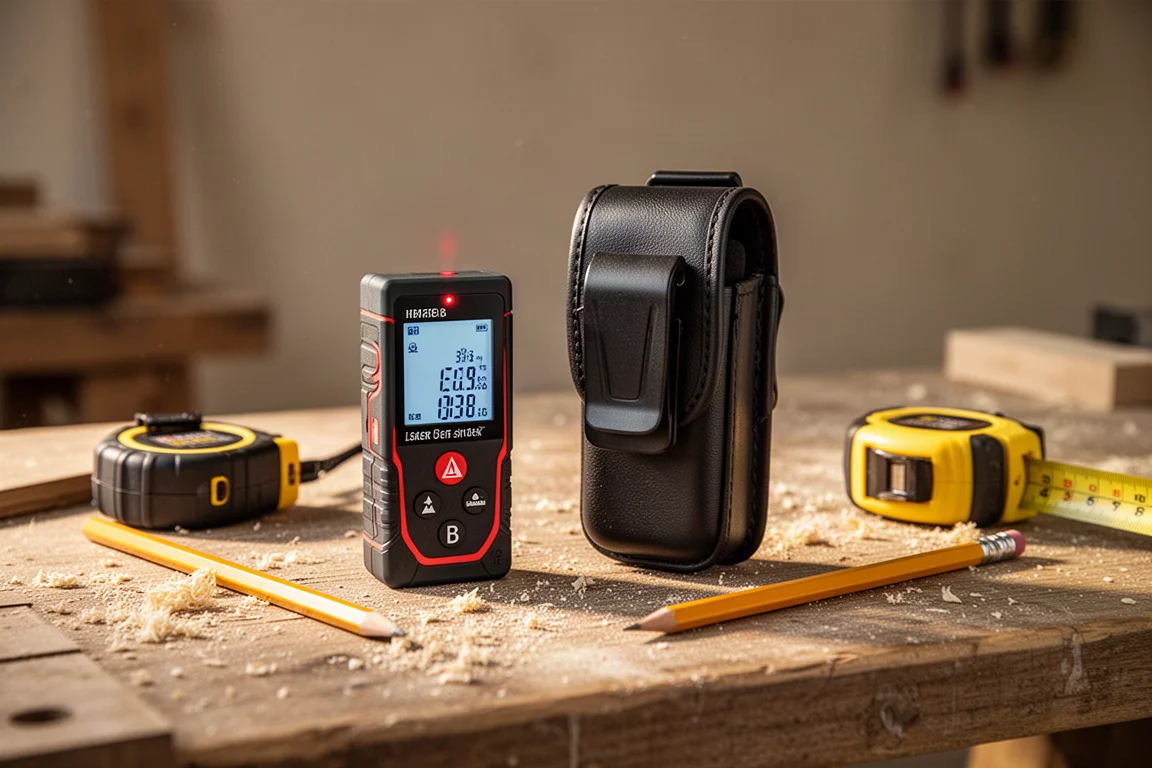
The belt-clip case design on the Klein is worth mentioning. The clip sits on the front of the case, so you can wear it on a belt, use the device while it stays in the holster, or snap it down to protect the front of the unit where the more fragile components live. It is a small detail, but it makes the tool more practical for daily carry on a job site.
If you want more features and do not mind paying around $100, the Bosch Blaze adds a level, a bigger display, and a broader feature set. If you want the most refined build and the tightest readings, the Leica Disto E7100i justifies its higher price with Bluetooth and four-decimal precision.
Conclusion
Laser distance measurers have come a long way from the early ultrasonic designs. All three models here are capable, and the right choice depends on whether you prioritize simplicity, features, or precision. For most people doing rough measurements around a home or job site, the Klein 93LDM 100C is the most practical starting point. For those who need tighter readings and more capability, the Bosch Blaze and Leica Disto E7100i are the steps up worth considering.
Further reading
Related Reviews
Tools & Measuring
Hoso Design Neo Ruler Review: A Smart Ruler and Digital Caliper in One
A premium smart ruler with a full-color LCD, Bluetooth app support, and an optional caliper attachment that makes measuring and unit conversion remarkably quick.
Tools & Measuring
INKIRMA DM262 Review: A Bilateral Laser Measure That Does More Than Point and Shoot
The INKIRMA DM262 is a bilateral laser measure with dual lasers, tilt sensing, and area, volume, and Pythagorean modes built in. Here is what it can do and who it suits.
Tools & Measuring
Mileseey Tools S50C Review: A Laser Measure With an Onboard Camera That Changes How You Aim
The S50C pairs a millimeter-accurate laser measure with up to 8x camera zoom, making long-distance and tight-spot targeting far easier than a green dot alone.