In-Ear Monitors
7Hz Salnotes Dioko Review: Planar Magnetic Clarity at $99
A close look at the 7Hz Salnotes Dioko, a $99 planar magnetic in-ear monitor with strong midrange clarity, a wide soundstage, and a bright treble tuning that rewards equalization.

Introduction
The 7Hz Salnotes Dioko is a planar magnetic in-ear monitor built in collaboration with a widely followed writer on in-ear monitors. At $99, it sits well below the 7Hz Timeless, the planar model that established much of this brand’s reputation in the category and that is priced north of $200.
That price gap is the headline. The Dioko keeps the planar magnetic driver approach and a clean, well-separated presentation, but its tuning leans bright. How much you enjoy it will depend heavily on what you listen to and whether you have access to an equalizer.
Planar magnetic in-ears remain a small niche, and the Dioko is one of the more affordable ways into it. That alone makes it worth a closer look if you have been curious about the technology but did not want to spend flagship money to find out.
Who the 7Hz Salnotes Dioko Is For
This is a good fit for listeners who prioritize midrange clarity and separation over bass weight. It suits acoustic material, vocal-driven recordings, and classic rock, where individual instruments need room to breathe.
It is a less natural match for anyone chasing deep sub-bass, heavy punch, or the dense low end of metal and bass-forward electronic music. Those listeners will need significant equalization work to get what they are after.
Main Strengths: Midrange Clarity and Separation
Midrange clarity is where the Dioko earns its place. On well-recorded acoustic and classic rock material, instruments separate cleanly and vocals sit forward with detail intact. Brass and string parts arrive as distinct lines rather than a blended mass, and backing percussion is easy to pick out.
The soundstage is larger than average for an in-ear monitor, which gives well-recorded material a more immersive feel. Layered productions benefit most, because the Dioko keeps elements apart instead of crowding them together.
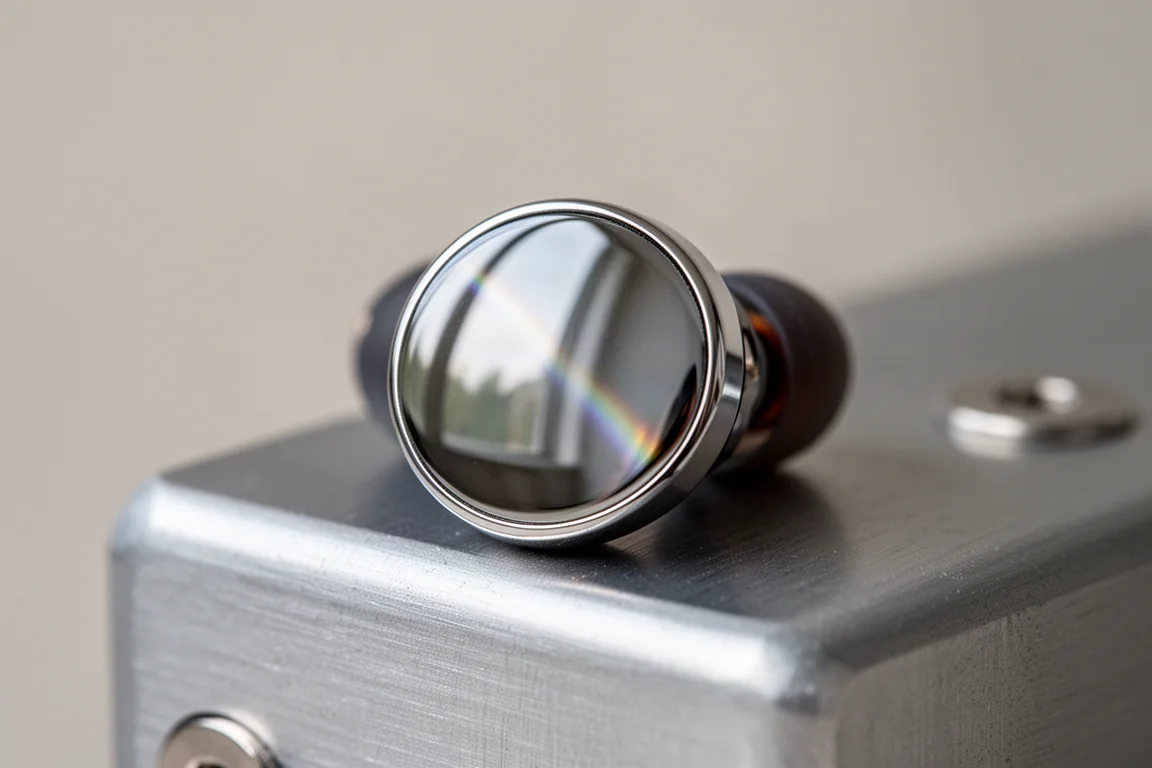
Build quality also holds up at this price. The shells are two pieces pressed together with a glossy, polished faceplate, and there are three vent holes on the rear of the housing. The included braided cable uses a two-pin connector that seats firmly, and the package adds a set of ear tips plus a zippered case with a textured finish and contrast stitching.
Things to Consider Before Buying
Two tuning traits shape the experience, and both are worth understanding before you commit.
Treble Emphasis and Sibilance
There is a clear emphasis somewhere in the 6 to 8 kHz region. Cymbal attacks arrive hard and fast, and on some tracks the cymbals read more like a burst of white noise than a metallic instrument. Sibilance is a real possibility, and the effect shows up on electronic percussion as well as acoustic drums.

The tonality of cymbals is the weakest part of the presentation. Even on electronic material, where the drums are programmed rather than played, the initial attack is pushed well forward of the rest of the mix. Listeners who are sensitive to bright treble should plan on equalizing, or consider a different tuning altogether.
Bass Extension and Dynamics
Bass extension rolls off early. On material with genuinely deep sub-bass notes, the lowest octave simply drops away, and the punch that gives bass drums and low synth lines their weight is largely absent. The Dioko can hint at the pedal striking the drum head, but it will not deliver the physical thump.
Dynamics are limited overall as well. Quiet-to-loud swings feel compressed, which flattens the drama of heavily dynamic recordings. With a 10-band equalizer, a low shelf of roughly 6 dB at 30 Hz and cuts in the 6 to 8 kHz range made a meaningful difference, alongside modest reductions around 1 kHz and 2 kHz. Even then, some material stayed bright enough that further trimming was needed.
Buying Advice
The Dioko makes the most sense as a specialist. If your library is built on acoustic recordings, singer-songwriter material, classic rock, and southern rock, it delivers clarity and separation that are hard to find at this price. The Timeless remains the reference point for sharpness and clarity in this family, but it is a more expensive and more intense listen.
If you want bass slam, deep extension, and lively dynamics without touching an equalizer, this is not the in-ear for you. If you are comfortable with equalization and want a clean, spacious, midrange-focused planar in-ear for a modest outlay, the Dioko is a reasonable entry point.
Budget time for ear tips as well. Fit changes the treble response noticeably on in-ears, and the included selection is a starting point rather than a final answer. Find a seal that keeps the upper midrange and treble in check before deciding the tuning is not for you.
Conclusion
The 7Hz Salnotes Dioko is a $99 planar magnetic in-ear with excellent midrange clarity, strong separation, and an above-average soundstage for its class. Its bright treble and rolled-off bass make it a specialist rather than an all-rounder, and it rewards anyone willing to spend time with an equalizer.
Product link
View more details for 7Hz Salnotes Dioko
This product is mentioned in the review. Check the specifications, options, and compatibility before buying.
View more details for 7Hz Salnotes DiokoFurther reading
Related Reviews

In-Ear Monitors
7Hz Timeless Review: A Planar IEM With Uncommon Presence
A planar in-ear monitor with a boosted low end, standout percussion and tonality, and a few traits worth weighing carefully before you buy.

In-Ear Monitors
BLON JoJo Review: A Punchy Budget IEM That Keeps Its Composure
The BLON JoJo pairs a 10 mm dynamic driver with a lively, clean tuning that holds together on dense, layered tracks. Here is what to know before buying.

In-Ear Monitors
Kiwi Ears Cadenza Review: A $35 IEM With a Single Beryllium Driver
A $35 in-ear monitor built around a single 10mm beryllium driver, with a relaxed but detailed tuning and a two-pin cable. Here is what to know before buying.