Polski · Outdoor Safety Gear
RECCO Reflector Review: A Passive Backup for Being Found Outdoors
A tiny, battery-free reflector that helps search teams locate you when your electronics are dead, provided you travel where detectors exist.
Introduction
A RECCO reflector is one of the lightest and least expensive pieces of safety equipment you can add to a backcountry kit. It weighs only a couple of grams, it has no battery, no subscription and no maintenance, and it can sit clipped to a backpack strap or sewn into a jacket for years without asking anything of you.
It is also widely misunderstood. It is not a distress beacon, and it does not replace a satellite messenger or a personal locator beacon. It is a passive harmonic reflector that was designed in the 1980s to help search teams find people buried by avalanches, and it is still used for that purpose today alongside a growing range of other search scenarios.
This guide covers what the reflector actually does, where it makes sense to carry one, what it cannot do for you, and how to judge whether the roughly $38 asking price is worth it for the trips you take.

The short version is that the reflector is a last line of defence. It helps most in the situation nobody plans for, when the person who needs finding cannot press a button, or when every device in the pack has already run out of power.
Who This Reflector Is For
This is a sensible purchase for anyone who travels in regions where search and rescue teams already carry detectors. Coverage is the deciding factor. Where detectors exist, a reflector costs almost nothing in weight or money and adds a genuine second chance. Where they do not exist, it changes very little.
It also suits people who already carry a satellite messenger or a personal locator beacon and want a backup for the scenario where those devices fail, run out of battery, or cannot be activated at all. The reflector is designed to work alongside that gear, not instead of it.
It is less useful for someone whose trips stay inside a coverage gap, or for someone who is still deciding between a reflector and a proper emergency beacon. If only one piece of safety gear fits the budget, the beacon comes first.
How a RECCO Reflector Works
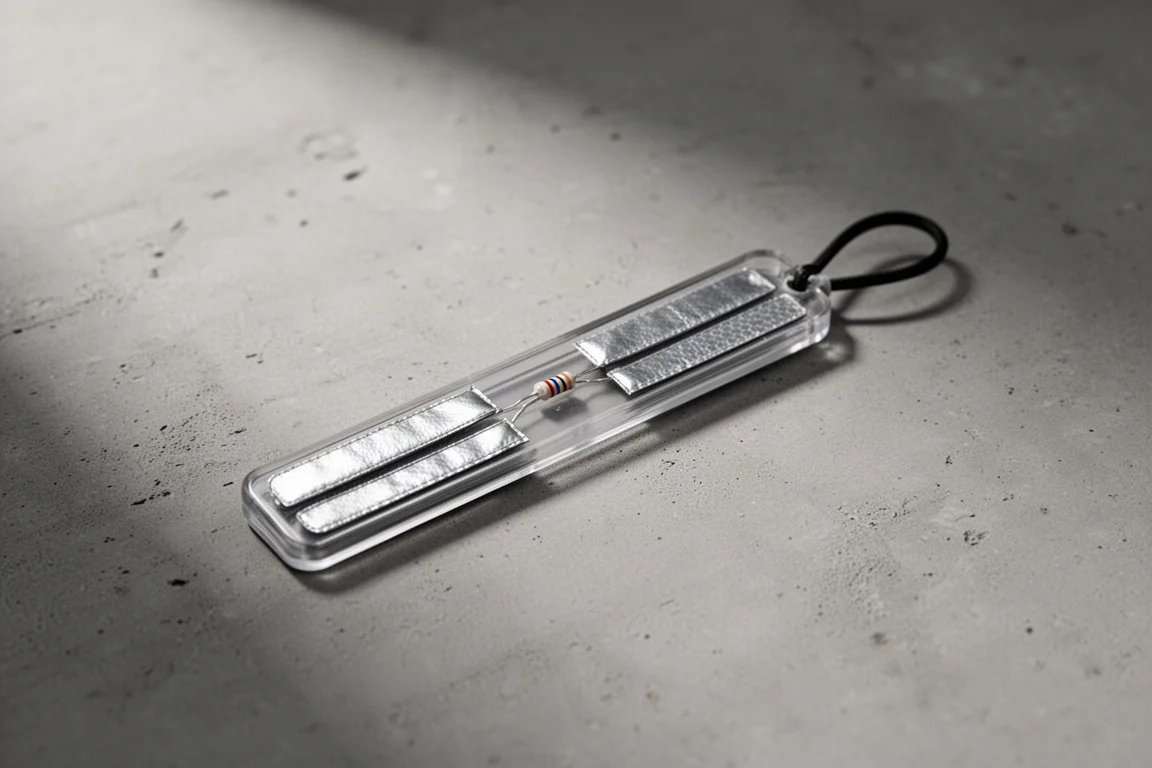
The device itself is remarkably simple. Inside the housing are two foil antennas connected by a diode, which together form a passive harmonic reflector. It is not an RFID chip and it contains no electronics, no power source and no moving parts.
Rescuers transmit toward it using one of two tools: a handheld detector or an aircraft-mounted unit with a range of about 100 metres. The transmitter broadcasts at a frequency that matches the reflector, and the reflector returns the signal at double the wavelength. That return creates a very distinct chirp in the rescuer’s equipment, and the stronger the chirp becomes, the closer the rescuer is to the person carrying the reflector.
Testing has shown that metallic items such as phones and other gear can produce false hits, but the chirp returned by a genuine reflector is stronger and more distinct than those stray signals, which is how teams tell the difference.

Because there is nothing to charge, switch on or update, the reflector keeps working in exactly the conditions where electronics are most likely to fail: after days in the field, in deep cold, or when a device has been damaged in a fall.
Main Strengths
The strongest argument for the reflector is that it is entirely passive. There is no battery to die, no subscription to renew and no maintenance schedule to follow. It can sit in a pack for a decade and still do its job, which makes it a genuine backup rather than another device that depends on power.
Search and rescue professionals who train with the system describe it as a potentially significant addition to their toolkit. Camera and infrared technology cannot see through vegetation, but a detector can pick up a reflector beneath snow or inside dense brush where other search methods struggle. Teams that use it see it as a way to raise their success rate as more of the public starts wearing one.
It also comes built into a large amount of gear. Snow sports equipment makes up most of that list, along with some backpacks and, more recently, some trail runners. It is worth checking what you already own, because you may be carrying a reflector without knowing it.
Things to Consider Before Buying
The most important limitation is coverage. Detector availability depends on which rescue teams have been equipped with handheld or aircraft transmitters, and that map is far from universal. New sheriff’s departments and search and rescue teams do adopt the system over time, and some agencies have trained with it for years, but the rollout is not fast. If your local teams do not carry detectors, the reflector is unlikely to help you.
The second thing to understand is what the reflector is not. It cannot send a distress signal. There is no button to press and no message that reaches anyone. It only answers a signal that a rescuer is already transmitting, which means somebody has to be out looking for you first.
There is also an honest caveat about outcomes. Body recoveries in snow sports do happen with the system, and a well known case involved the climber Marc-André Leclerc, who died in Alaska and was located with the help of a reflector search. There is no confirmed outdoor recovery of a living person using the system to date, although there is no technical reason the same signal that locates a body could not locate a living person, and some anecdotal accounts suggest it may already have happened.
A few practical details matter too. Dense material between the reflector and the transmitter dilutes the return signal, which is why a body lying on top of a pack-mounted reflector, or a space blanket wrapped over it, can reduce effectiveness.

Finally, there is the price. Around $38 is a lot for two foil antennas and a diode, and a determined tinkerer could assemble something similar from a diode and antenna wire. What that money buys is a tested unit that already fits a working rescue ecosystem.
Mounting and Everyday Use
There are two schools of thought on where the reflector should live. The first is high on the backpack, which is the mounting the manufacturer illustrates. The reasoning is that if you fall or become unconscious, your body will not be lying on top of the reflector, and the signal will not be diluted by the mass of a pack or a person.
The second approach is to carry it on your person, such as on a belt loop, so that it stays with you if you become separated from your pack. Some people carry two reflectors to cover both cases. The two grams of weight make that a reasonable choice rather than an extravagance.
If you do carry one, mention it in the emergency notes attached to your satellite messenger or locator beacon. Should you go missing and searchers begin a grid search, knowing a reflector is on you lets them bring the appropriate detectors to bear.
It is worth pairing the reflector with habits that do not depend on hardware at all. Leaving a plan with someone at home, even something as simple as a trail link and an expected return time, means help gets called sooner. Live tracking over satellite leaves a breadcrumb trail that family and rescuers can follow, and fall detection on a modern smartwatch can trigger automatically. All of those depend on power, which is exactly why a passive device belongs in the same kit.
Buying Advice
At around $38, sometimes discounted, the reflector is easy to justify if you spend time in covered terrain. The materials inside are worth a fraction of that, but the value is in a finished, tested product that search teams already know how to find. Building your own may work in theory, yet it introduces variables you cannot verify, and the whole point of this device is that it works when nothing else does.
The decision really comes down to two questions. Do the rescue teams in the places you travel carry detectors? And do you already carry a way to call for help? If the answer to both is yes, the reflector is a cheap, weightless addition that covers the gap between sending a distress call and actually being found.
For anyone whose trips take them into avalanche terrain, remote alpine routes, or deep vegetation, the reflector is best understood as insurance rather than equipment you will ever notice. It asks nothing of you, and in the worst case it gives a search team one more way to bring you, or your family, some resolution.
Conclusion
The RECCO reflector is not a beacon and not a substitute for one. It is a passive, battery-free device that answers a specific signal from a specific kind of rescue equipment, and in the right coverage area that makes it a genuinely useful layer of protection. It weighs almost nothing, costs about as much as a modest piece of clothing, and never needs charging.
Buy it if you travel where detectors are in service and you already carry a way to call for help. Skip it if your terrain is not covered, and put the money toward a satellite messenger or locator beacon first. Carried in the right place and mentioned in your emergency notes, it is one of the simplest safety items you can add to a pack.
Link do produktu
Zobacz więcej szczegółów: RECCO Reflector
Ten produkt jest wymieniony w tej recenzji. Przed zakupem sprawdź specyfikację, dostępne warianty i kompatybilność.
Zobacz więcej szczegółów: RECCO ReflectorWięcej do przeczytania
Powiązane recenzje
Outdoor Safety Gear
Recco Backpack Rescue Reflector – recenzja: drobny element bezpieczeństwa, który warto przypiąć
Lekki pasywny reflektor ratunkowy, który przypina się do plecaka lub czapki i dodaje kilka gramów dodatkowej wykrywalności w terenie.
Outdoor Safety Gear
RECCO Reflector Review: A Passive Backup for Backcountry Search and Rescue
Praktyczne spojrzenie na RECCO reflector: jak działa pasywny reflektor harmoniczny, gdzie naprawdę pomaga, a gdzie zasięg detektorów ogranicza jego wartość.
Backpacking Gear
Najbardziej wpływowy sprzęt backpackingowy: sześć rzeczy, wokół których warto planować
Sześć produktów backpackingowych, które kształtują to, jak naprawdę wygląda wyprawa, obejmujących planowanie trasy, komunikację bezpieczeństwa, komfort snu i kompletny system warstw.