Polski · Wireless Speakers
Marantz Grand Horizon Review: A Striking Luxury Wireless Speaker With Real Trade-Offs
The Marantz Grand Horizon pairs eight custom drivers and 370 watts of GaN FET amplification with a bold cabinet, but tuning consistency, app-only control, and a $5,500 price need careful thought.
Introduction
The Marantz Grand Horizon is the largest speaker in Marantz’s Horizon wireless series, and it is built to make an impression before a single note plays. Eight Marantz-made drivers handle the work: a single 8-inch woofer, four 3-inch wideband drivers, and three 1-inch tweeters. Power comes from Marantz’s own GaN FET amplifier with a total rating of 370 watts under the current FTC standard. The reported frequency response spans 28 Hz to 20 kHz, an 18 Hz bass extension is quoted at 10 dB below reference, and maximum output is reported at 111 dB.
It is a wireless, HEOS-enabled speaker first, but Marantz has packed in a full set of physical connections and Dolby Atmos decoding. At $5,500 it sits firmly in luxury territory, and that price invites close comparison with more established premium alternatives. This review covers what the Grand Horizon does well, where it asks for patience, and who should seriously consider it.
Who the Marantz Grand Horizon Is For
This is a speaker for listeners who want one substantial, furniture-grade object to anchor a large room, rather than a pair of boxes and a rack of electronics. It streams over Wi-Fi, Bluetooth 5.4, AirPlay 2, and Spotify Connect, and through the HEOS app it reaches Tidal, Amazon Music, Pandora, Spotify, Deezer and more, plus music stored on a home network or network attached storage. High-resolution files, including DSD, are supported.
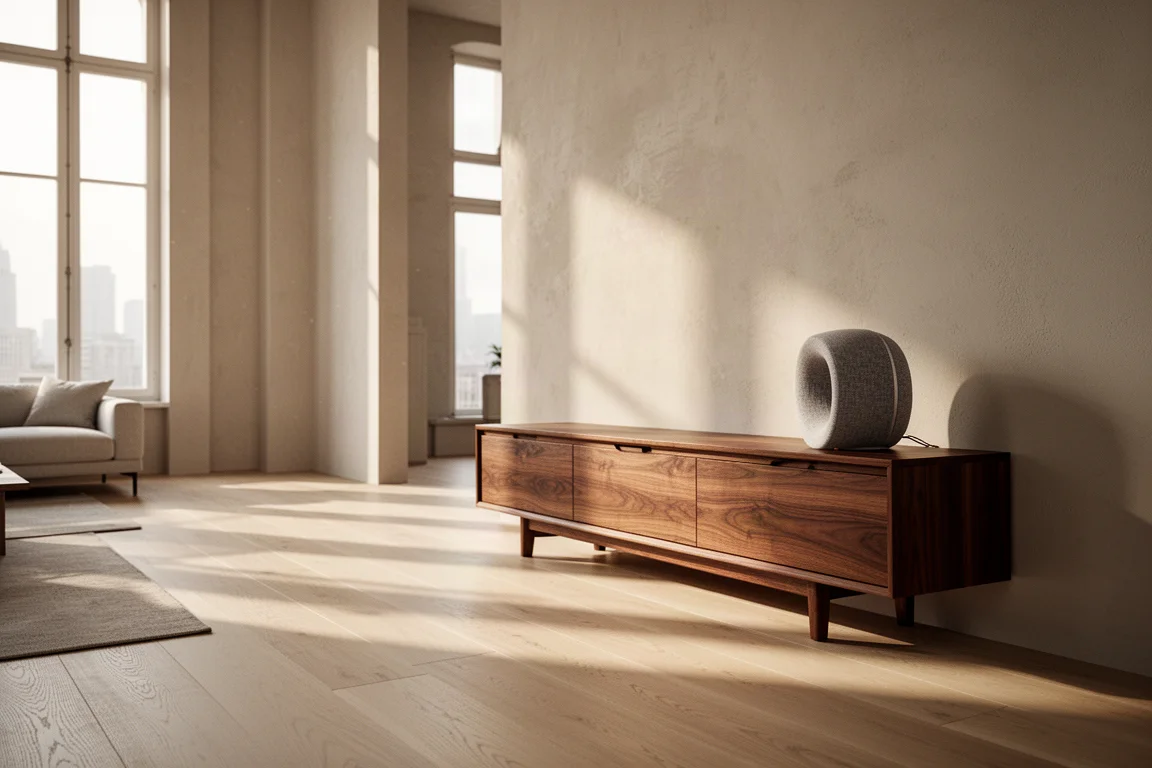
It also suits buyers who enjoy tuning a system rather than setting and forgetting it. The Grand Horizon rewards attention to placement and bass settings, and the more adjustable My Mirage profile is where that work pays off.
It is a poor match for anyone who wants a physical remote, because the speaker does not include one, or who expects a single unit to deliver precise stereo imaging. Buyers who need flexible television integration should read the placement notes further down before committing.
Design and Build Quality
The Grand Horizon is a genuinely striking product in any of its three finishes. Mixed materials, fabrics, and a chunky marble-like base give it a sense of class, and the build quality sits above most luxury wireless speakers. It is also heavy: nearly 50 lb, standing just under two feet tall with a diameter of roughly 19 inches.
The smaller Horizon is easier to place at a little over 15 inches tall, 14 inches in diameter, and 27 lb. If the tripod stand in Marantz’s product images appeals to you, note that the American Walnut stand is an optional extra and fits only the smaller Horizon, so Grand Horizon owners need their own sturdy surface or stand.
Connectivity, Control, and Setup
Wired options are unusually complete for a wireless speaker: analog audio inputs, an optical input, an Ethernet port, a USB-C port, and HDMI with ARC and eARC support. The Grand Horizon can decode Dolby Atmos, which on paper makes it a candidate for soundbar duty. Wireless connectivity covers Wi-Fi, Bluetooth 5.4, AirPlay 2, and Spotify Connect.
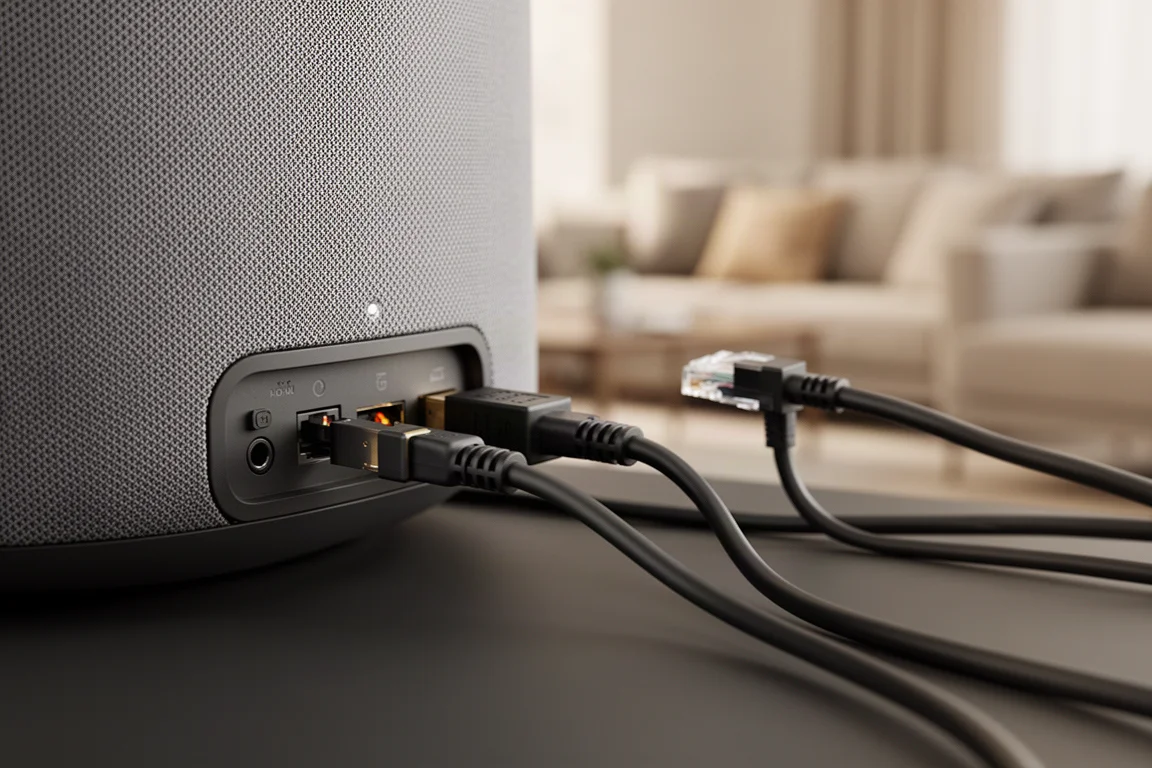
Setup begins with connecting the speaker to your network through the HEOS app. Onboard controls are limited to touch-sensitive buttons for volume, play and pause, and track skip, so the app handles streaming, sound profiles, and adjustments. The app has improved considerably in recent years, but if you dislike controlling a speaker from a phone or tablet, this is not the product for you.
Sound Performance and Tuning
Measured at one meter in open space with no boundary reinforcement, the Grand Horizon reaches roughly 25 Hz on its own in the Sound Master profile, the tuning voiced by Marantz. Bass energy between 30 Hz and 200 Hz sits below the 75 dB reference used for those measurements, with a peak between 200 Hz and 300 Hz before a predictable downward slope. The quoted 18 Hz and 20 Hz figures were not reached in practice.
The Auto profile adds a little more bass weight and can sound fuller, though it can also measure lean depending on placement. The My Mirage profile is the most adjustable option, and it allowed a more linear bass response and better consistency across the full range, including in open spaces.
Consistency is the real story here. Some material sounds balanced, alive, and quick, with bass that fills a large room convincingly. Other tracks arrive with light bass in places and slightly boomy, one-note bass elsewhere, a leaner midrange than expected, and treble that lands more aggressively than the measured rolloff would suggest. Several Horizon units showed some version of this behavior. The My Mirage profile, combined with careful boundary and bass adjustments, produced the most reliable results, and the speaker sounds best when placed where subwoofers tend to measure well.
Spaciousness controls add a sense of air, but the effect can feel artificial. Vocals and lyrics tend to radiate from the center of the cabinet, and the speaker remains fairly directional without spatial processing.
Living With It: Placement, Stereo, and TV Use
Placement matters more here than with most lifestyle speakers. Bass tuning is the pivot point for everything else, and once it is dialed in for the room, the midrange and treble fall into better balance across volume levels.
Pairing two Grand Horizons wirelessly in the HEOS app produces stereo, but the result is vague imaging and a drifting center image for a setup costing around $11,000. Stereo pairing is also limited to HEOS streaming and does not work when the speakers are fed through an input such as HDMI.
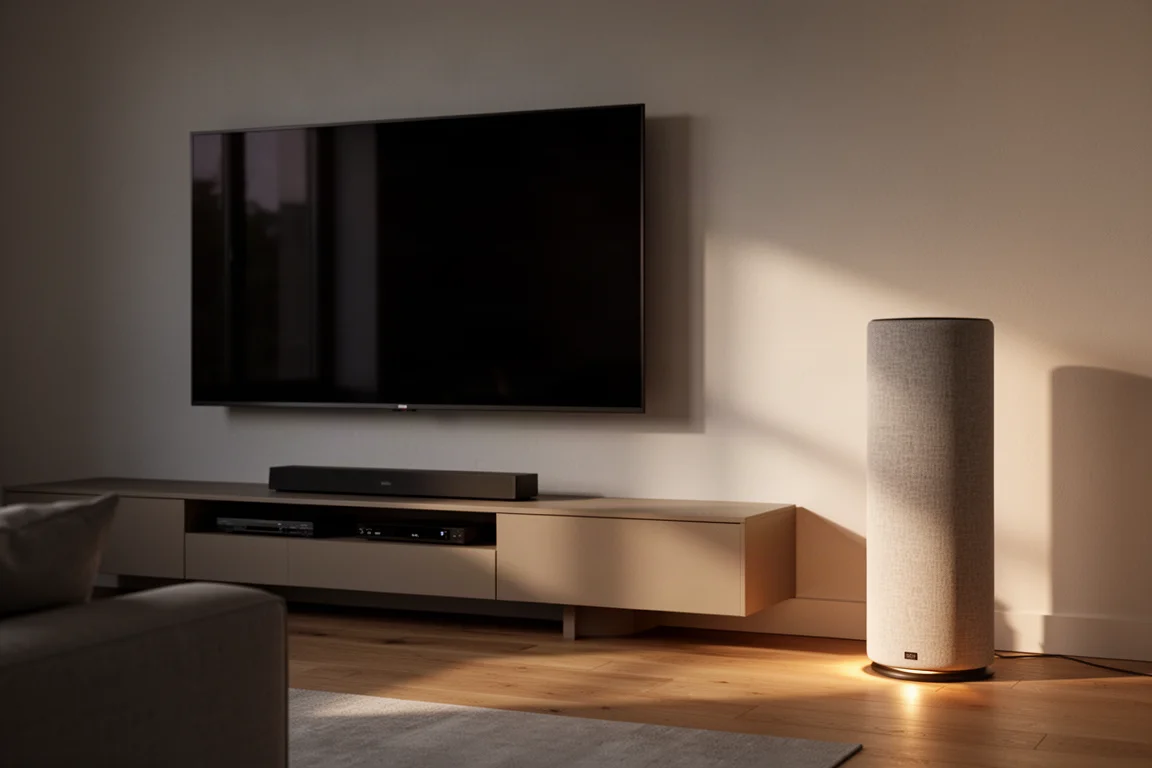
Used as a soundbar over HDMI with the Auto or My Mirage profile, the Grand Horizon delivers a large wall of sound with solid scale and intelligible dialogue. It is not a surround experience, but it is bold and focused. The practical problem is placement: the speaker is too tall to sit below most televisions without covering part of the screen, and placing it off to the side does not work well because of its directional character and the HDMI stereo limitation. Marantz has said it is working on more flexible stereo pairing and improved HDMI functionality, but no timeline has been given.
How It Compares on Price and Value
At $5,500, the Grand Horizon faces strong alternatives. The Bang & Olufsen Beosound A9 starts at $3,900, is easier to place and set up, includes a built-in stand, offers an optional wall mount at $150, and supports interchangeable grilles, leg finishes, and an app with auto room calibration, EQ, and user presets. A pair of A9 speakers also costs less than a pair of Grand Horizons.
The Bang & Olufsen Beosound Balance costs $2,200 less, offers auto room correction, and can be bought as a pair for roughly the price of a single Grand Horizon. The KEF LS60 Wireless is $500 less than one Grand Horizon and delivers a stronger music and movie solution with more versatility, though a pair takes up more space. The KEF LS50 Wireless II is $2,000 for the pair.
Within the Horizon line, the smaller Marantz Horizon at $3,500 sounded more coherent from top to bottom more of the time in direct comparison, and it is easier to live with, though its tripod stand adds $700. A designer-oriented speaker that doubles as a soundbar starts at $3,500. A pair of bookshelf or tower speakers driven by the Marantz Model M1 amplifier, which also uses HEOS, could outperform the Grand Horizon for considerably less money.
Things to Consider Before Buying
- There is no physical remote, so daily control runs through the HEOS app.
- The quoted bass extension did not hold up in measured testing at one meter in open space.
- Sound quality varied noticeably between tracks and between sound profiles.
- Stereo pairing works only with HEOS streaming, not with an HDMI input.
- At nearly 50 lb and roughly 19 inches across, it needs a sturdy surface, and the optional tripod stand fits only the smaller Horizon.
- Using it as a soundbar is limited by its height and directional output.
Buying Advice
The Grand Horizon can sound genuinely impressive. It fills large rooms, handles high-resolution streaming, and offers more physical inputs than most wireless speakers. It simply asks more of the owner than its price suggests it should. Budget time for placement, use the My Mirage profile, and adjust the boundary and bass controls before judging it.
If your priority is a design-led centerpiece for music and you are willing to tune it, the Grand Horizon is worth an audition, ideally with a return window so you can test it in your own room. If your priority is value, easy placement, or a dual-purpose music and film system, the smaller Horizon and the alternatives above deliver more for less. Either way, listen before you commit, because the only opinion that ultimately matters is your own.
Conclusion
The Marantz Grand Horizon is a bold, beautifully built flagship with real technical ambition: eight custom drivers, 370 watts of GaN FET amplification, HDMI with Dolby Atmos decoding, and broad streaming support. Its weaknesses are just as real, from app-only control and limited stereo pairing to sound that shifts between excellent and underwhelming depending on the track and profile. For the right room and the right owner it can justify its place. For everyone else, the alternatives make a stronger case.
Link do produktu
Zobacz więcej szczegółów: Marantz Grand Horizon
Ten produkt jest wymieniony w tej recenzji. Przed zakupem sprawdź specyfikację, dostępne warianty i kompatybilność.
Zobacz więcej szczegółów: Marantz Grand Horizon