Polski · Stereo Amplifiers
Fosi Audio ZA3 Review: A Compact Stereo Amplifier With Serious Power
A close look at the Fosi Audio ZA3, a compact TPA3255 stereo amplifier that runs bridged mono, drives difficult speakers, and sells for around $150.
Introduction
Compact amplifiers have quietly become one of the best value stories in hi-fi, and the Fosi Audio ZA3 is a strong argument that you do not need a large chassis or a large budget to get real power and real refinement. It is a small, solid aluminum stereo amplifier built around the Texas Instruments TPA3255 chip, and it can be used either as a conventional two-channel amplifier or bridged into a mono block.
Pricing is straightforward. The ZA3 is $150 with the 48V 5A power supply, or around $125 with the 32V 5A supply. Coupons for this family of products appear regularly, and a 10 to 15 percent discount is common enough that the 48V version can land closer to $135.
What makes it interesting is not one headline number but the combination: two inputs including a balanced connection, removable op-amps, a trigger input, a subwoofer output, and enough current delivery to drive speakers that are genuinely difficult loads. This article walks through who it suits, where it shines, and the few details worth knowing before you buy.
Who This Amplifier Is For
The ZA3 fits anyone building a first serious two-channel system on a controlled budget. You can start with a single unit in stereo, drive a pair of speakers, and stop there if that is all you need.
It also suits listeners who like to grow a system in stages. A second ZA3 can be added later and bridged into mono, which turns a modest outlay into a pair of mono blocks with substantially more power on tap. Because the amplifier accepts both single-ended RCA and balanced input, it works with a phono stage on one input and a DAC or streamer on the other without cable swapping.
Finally, it suits tinkerers. The op-amps are socketed and removable, so you can roll them the way some listeners roll tubes. That is a hobbyist-friendly feature you rarely see at this price.
Sound Quality and Power
In stereo, the ZA3 delivers 180 watts per channel into 4 ohms with the 48V 5A supply, and 235 watts into 4 ohms in bridged mono. If you choose the 32V 5A supply instead, you still get 95 watts per channel into 4 ohms in stereo and 110 watts into 4 ohms in mono, which is enough for most speakers in most rooms.
That power translates into a sound that feels big and wide rather than small and boxed in. It stayed composed when pushed hard into a demanding pair of standmount speakers, with peaks above 95 dB in a nearfield setup and the volume control at full travel, and it did not clip or harden at that point.
Compared with the Fosi Audio V3, the ZA3 keeps the same clarity but adds noticeably more weight at the bottom end, and the difference grows in mono operation. Compared with the BT20A Pro, it offers more bass and a cleaner, more revealing window into the recording. Against the Aiyima A07 Max it is a close call, with the ZA3 edging ahead slightly while offering better heat dissipation and better speaker terminals.
Stereo performance is good, but mono is where the amplifier really opens up: more dynamic headroom, a more solid center image, and a sense of scale that does not feel like a small desktop amp.
Build Quality and Connectivity
The chassis is matte-finish aluminum with a two-tone front panel and vents along the sides. The larger footprint compared with compact rivals leaves more room for heat sinks and airflow, which matters when an amplifier is run hard for long sessions.
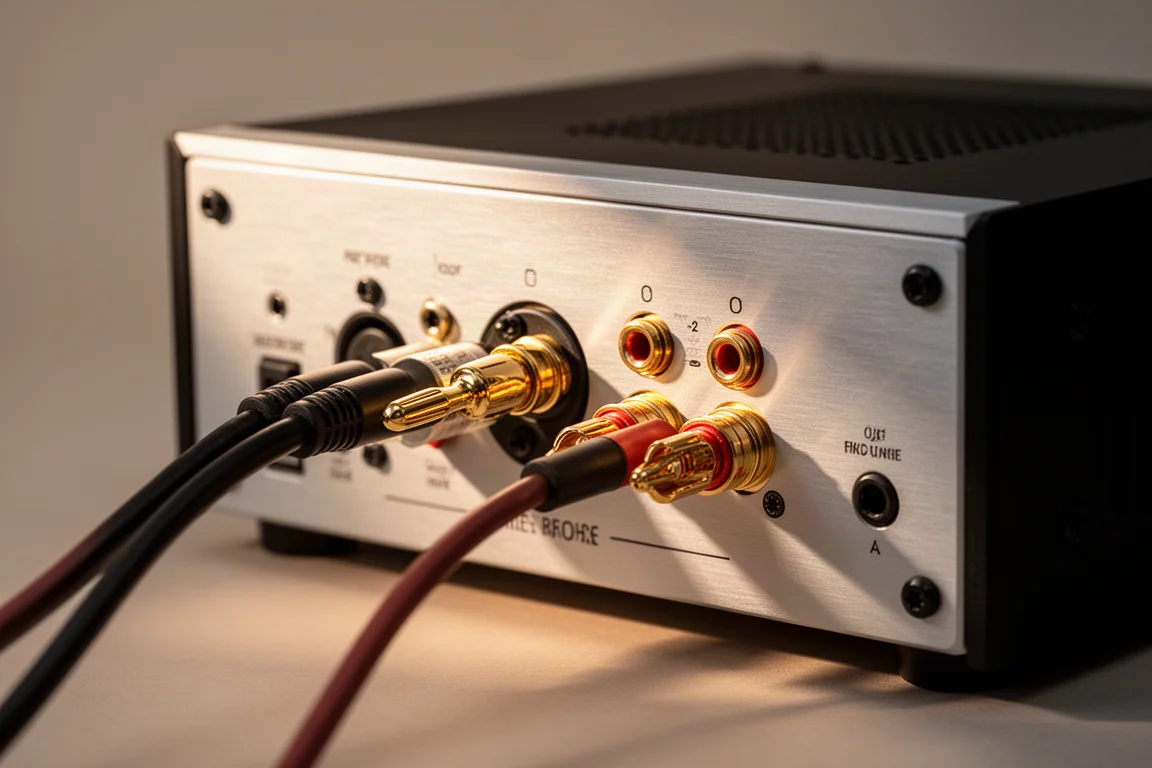
The power and volume control is a single signature orange knob: press it in to power on, release it, and rotate through stepped positions. Around the back you get two inputs, one balanced and one single-ended RCA, plus a trigger input so a preamplifier can switch the amplifier on remotely, and a subwoofer output.
Bridging is refreshingly simple. Route both channels into the right input, connect the speaker to the right output, engage the mono switch, and the amplifier is running as a mono block. Repeat with a second unit for the other channel and you have a pair of mono blocks.
Main Strengths
The first strength is value. A single unit at the 48V price delivers 180 watts per channel into 4 ohms, and a pair at roughly double that delivers genuine mono block power. That is a lot of usable output for the money.
The second is the parts selection. Inside you find Japanese NCC and Elna capacitors, German WIMA capacitors, Japanese Sumida inductors, and the Texas Instruments TPA3255 amplifier chip. Implementation matters as much as the chip itself, and this one is implemented well.
The third is flexibility. Two inputs, balanced and single-ended, a trigger input, a subwoofer output, socketed op-amps, and switchable stereo or mono operation cover a wide range of setups without forcing a rebuild later.
Things to Consider Before Buying
The speaker binding posts are the weakest part of the package. They feel inexpensive relative to the rest of the build, and they are the one component that does not match the quality of everything around them.
There is no remote control. For a two-channel system that is arguably a benefit, because two amplifiers with one remote makes it easy to disturb a carefully set center image. But it does mean the ZA3 is best treated as a power amplifier with a volume control rather than a fully remote-controlled integrated.
That leads to the other wish: a switch to bypass the volume control entirely. Without it, you are relying on a preamplifier for level control and leaving the ZA3’s own volume in a fixed position. A bypass switch would make the amplifier cleaner to integrate into a preamp-based system.
One practical note: the amplifier runs at its best with the 48V 5A supply, so if you plan to bridge a pair later, buying the higher-voltage supply from the start avoids paying for it twice.
Buying Advice
Start with one ZA3 and the 48V 5A power supply if your budget allows, even if you only plan to run stereo at first. The 32V version is cheaper and still drives most speakers, but the 48V supply costs less to buy now than to buy twice, and it unlocks the full 180 watts per channel and the full 235 watts in mono.
If you are feeding it from a preamplifier or a DAC with volume control, set the ZA3’s knob and leave it there. If you want to experiment, the socketed op-amps make it easy to try alternatives, and better op-amps can refine an already clean sound.
For anyone building toward mono blocks, the plan is simple: buy one, add a second when funds allow, bridge both, and use a preamplifier for level control.
Conclusion
The Fosi Audio ZA3 is one of the most complete compact amplifiers available at its price. It pairs a well-implemented TPA3255 design with a genuinely useful feature set, drives difficult speakers without strain, and scales from a simple stereo setup into a pair of mono blocks.
The reservations are small and specific: inexpensive binding posts and the absence of a volume bypass switch. Everything else, from the chassis and cooling to the two inputs and the trigger, is thoughtfully done.
If you want maximum power per dollar and a system you can grow, this is an easy recommendation.
Link do produktu
Zobacz więcej szczegółów: Fosi Audio ZA3
Ten produkt jest wymieniony w tej recenzji. Przed zakupem sprawdź specyfikację, dostępne warianty i kompatybilność.
Zobacz więcej szczegółów: Fosi Audio ZA3