Telescopes
Sky-Watcher Virtuoso 130 Review: A Go-To Starter Scope That Travels Well
A collapsible 130mm computerized telescope with go-to tracking, solid optics, and a few quirks worth knowing before you buy.
Introduction
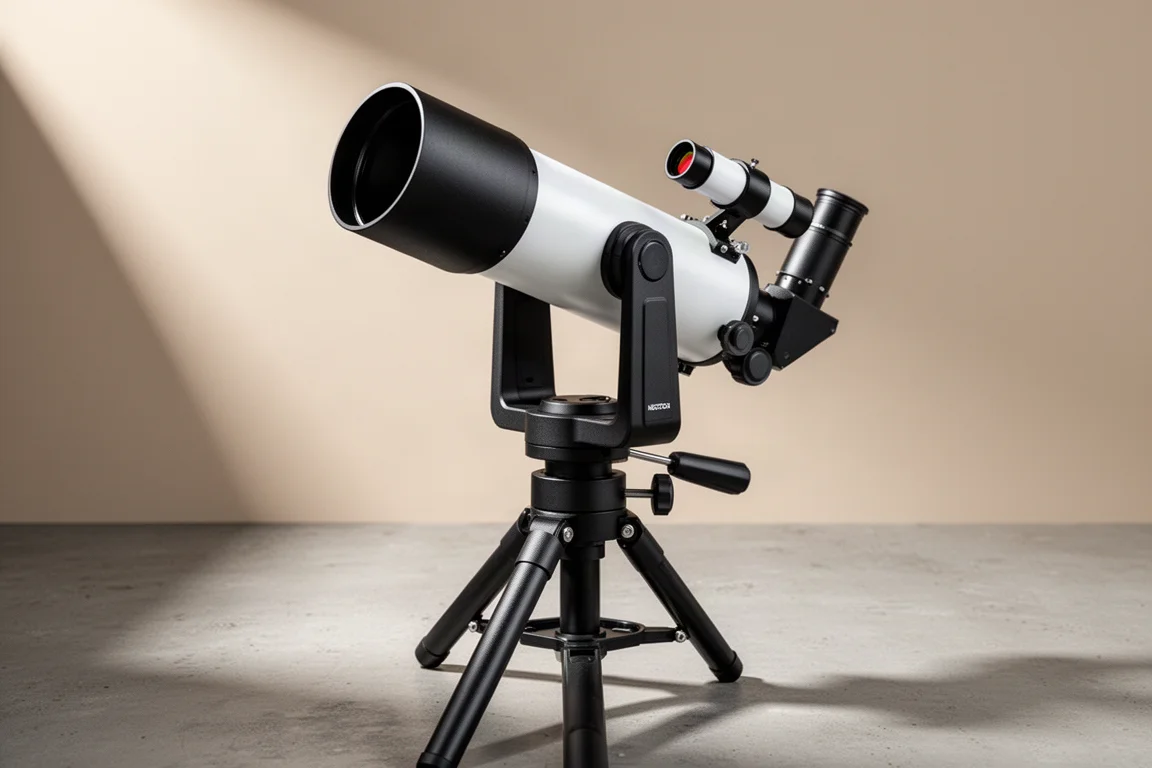
The Sky-Watcher Virtuoso 130 is a motorized, computerized go-to telescope built on the collapsible Heritage series design, and it aims squarely at beginners who want a moderate-aperture scope that finds and tracks objects on its own. Starting at around $400, it packs a lot of capability into a very small package.
After roughly two weeks with the telescope, the picture that emerges is clear: excellent optics and genuine convenience, with a few quirks around the manual, the focuser, and light baffling that buyers should plan for.
First Impressions and Design
The defining feature is the collapsible tube. This is by far the smallest 5-inch telescope you are likely to encounter, which makes it genuinely easy to collapse, pack, and toss into the trunk for a camping trip. Portability is one of the biggest selling points here.
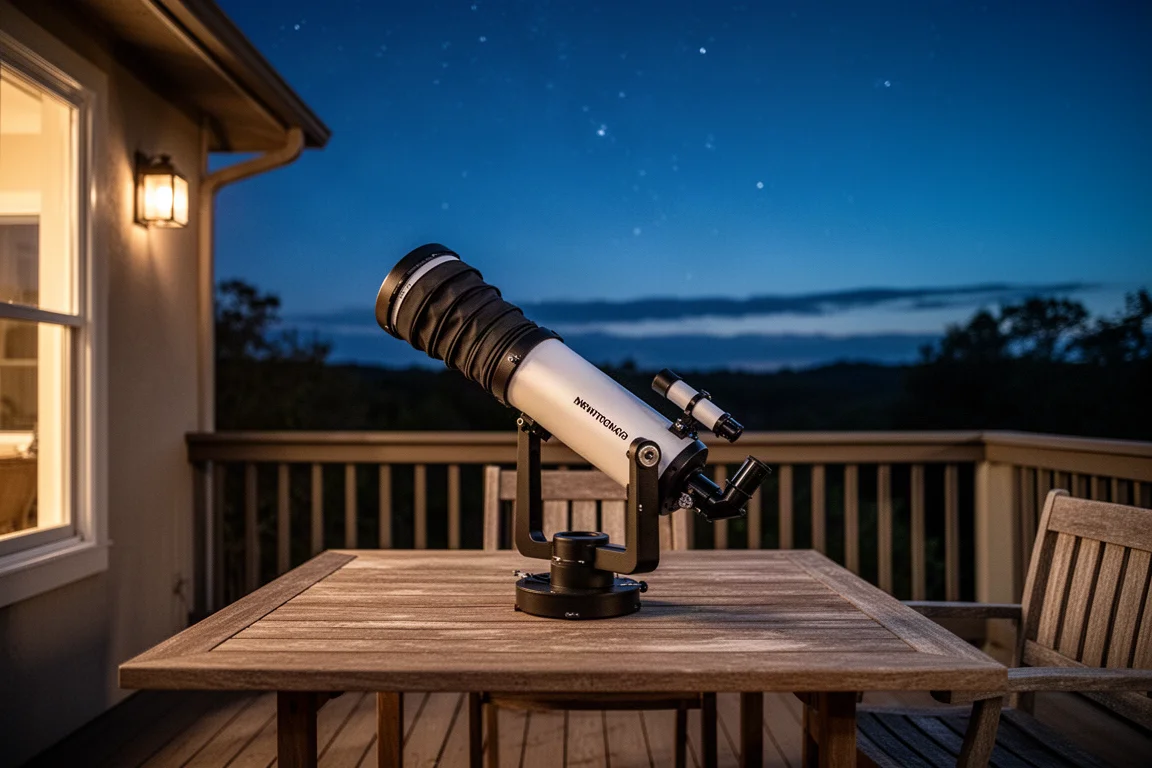
The tube includes a Vixen-style dovetail, an extremely common standard, so you could pair this optical tube with other mounts or put other telescopes on this mount. The dovetail bracket also lets you slide the tube up and down to balance it, which matters whenever you swap between a light and a heavy eyepiece or attach a camera adapter. Release the clutch and the scope should hold position only when perfectly balanced; get it wrong and the tube will flop up or down.
Optics, Focuser, and Eyepieces
The 130mm mirror (about 5 inches) puts this in the mid-size range. From dark skies, all the popular deep-sky objects fall within reach. Aperture is the most important quality in any telescope: it determines how much light is collected, how detailed objects appear, and how much magnification you can use before image quality degrades. The focal length is 650mm.
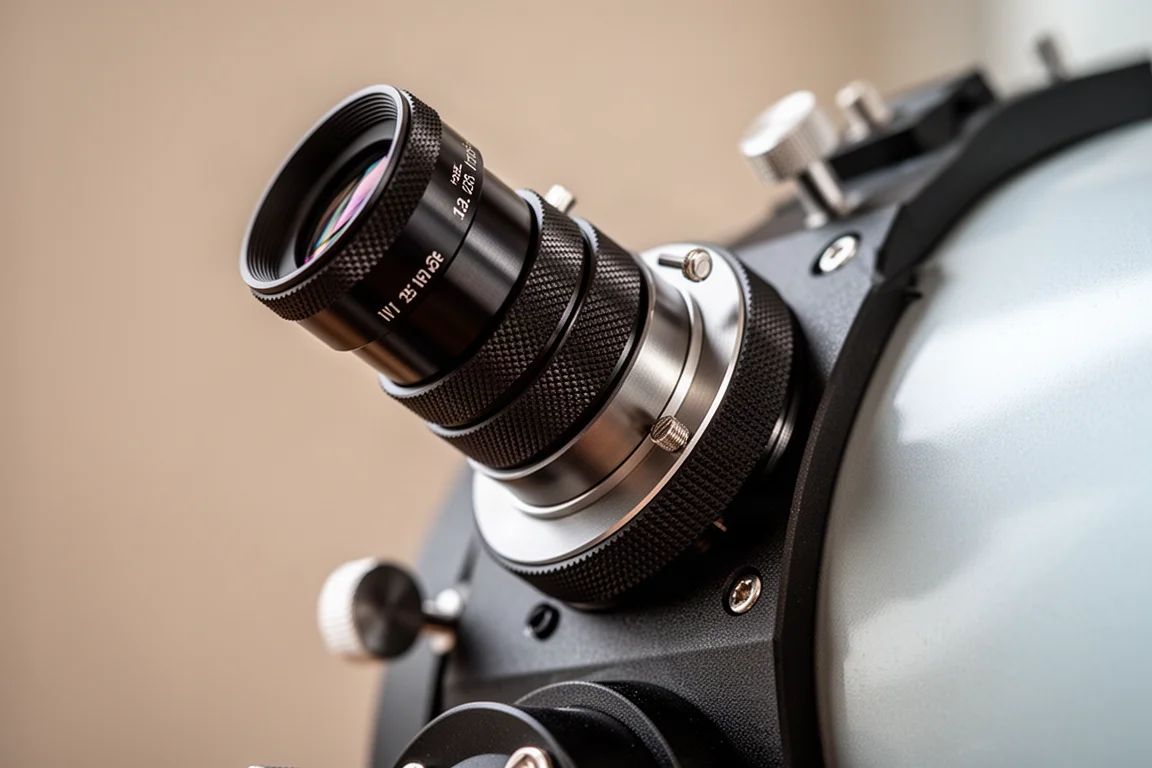
The helical focuser is the most unusual part of the design. You focus by twisting the eyepiece within the focusing assembly, which means refocusing every time you change eyepieces, and sometimes when a different observer takes over, since focus is tied to each person’s vision.
The scope ships with two eyepieces: a 25mm giving 26x magnification and a 10mm giving 65x. Expect to use the 25mm most of the time for finding targets and viewing deep-sky objects, reserving the 10mm for closer looks at planets, lunar craters, or something like the Ring Nebula. In practice, the included 25mm is the weakest link; switching to a premium eyepiece made a very noticeable difference at the eyepiece.
Setup, Alignment, and the App Experience
Power comes from eight AAA batteries, though a 12V power tank works well and saves you from hunting for batteries. The telescope creates its own Wi-Fi hotspot, and you control it through the SynScan app on your phone. There is no hand controller included; Sky-Watcher expects you to use your phone or buy the hand controller separately for about $150, so the secondhand market may be worth a look.
Alignment is straightforward once you know the flow. You pick two bright stars you can identify, confirm the mount is level and pointed north using your phone’s compass, and the telescope slews to where it thinks the first star is. From there you center each star in the finder, then in the eyepiece, hit okay, and repeat for the second star. The key prerequisite is having the finder and the main tube pointed at exactly the same spot, which is best done in daylight using a distant target like a phone tower.
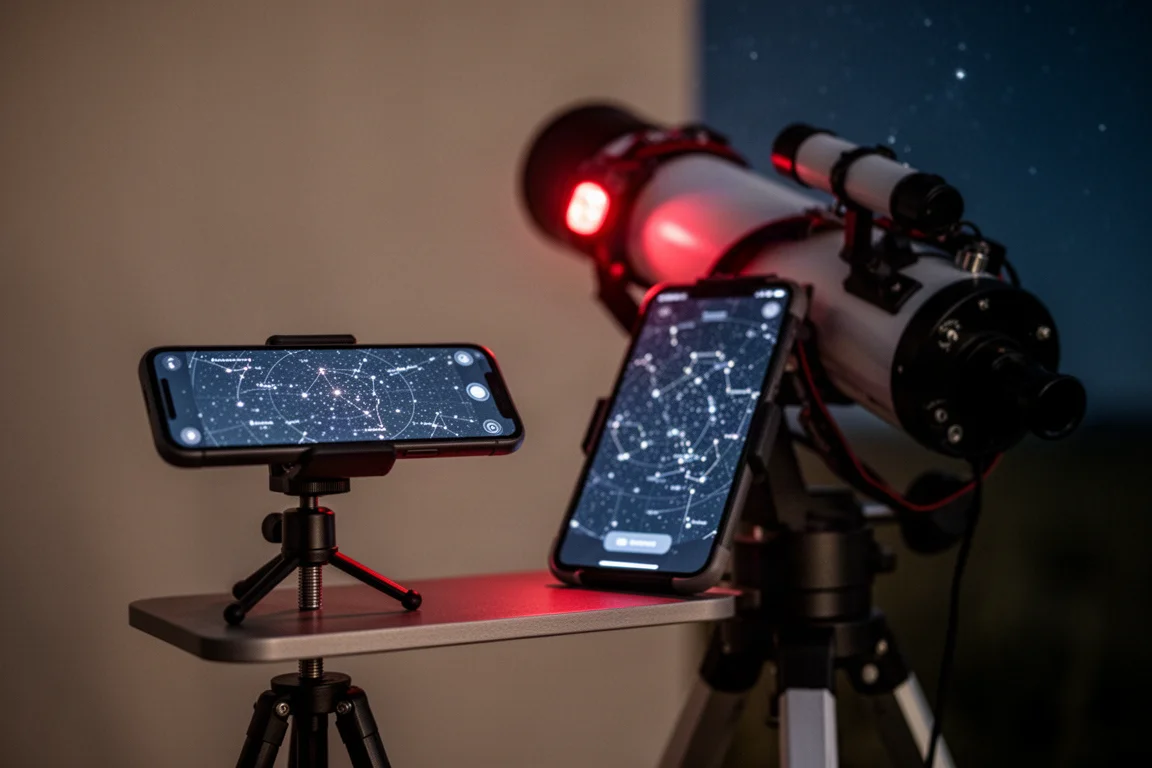
One honest complaint echoed widely about this telescope is the manual: it contains no screen captures of the app walking you through alignment, just text. The SynScan app itself also has no sky map; you literally have to know the Messier number or catalog designation of what you want. The solution is to integrate Sky Safari, a paid app usually available for around $10 and frequently on sale. Once connected through the SynScan link preset, you get a full sky map: tap Betelgeuse, hit go-to, and the telescope slews there, with fine control from on-screen arrows.
A genuinely clever feature is the dual encoders. Once aligned and tracking, you can push the telescope manually by hand and it maintains its alignment, resuming tracking wherever you point it. The trade-off is ergonomic: driving with on-screen arrow keys while your eye is at the eyepiece means you cannot feel where your fingers are, which is exactly where the optional hand controller earns its price.
Collimation: A Quick Primer
Collimation is simply the alignment of the mirrors, and if it is off, views will look distorted. Check the secondary mirror at the front of the tube: the image of the primary should appear centered in the field of view. For the primary, look into the focuser and confirm the reflection of the secondary is centered, using the mirror clips as a guide.
You can collimate with the included collimation cap (just a cap with a hole in it), or far faster with a laser collimator, which costs about $20 online. Adjust the secondary with a size 2 Allen wrench in three holes until the primary is centered, then use the three locking screws and three adjustment knobs at the rear of the scope to center the secondary’s reflection.
Observing Under the Stars
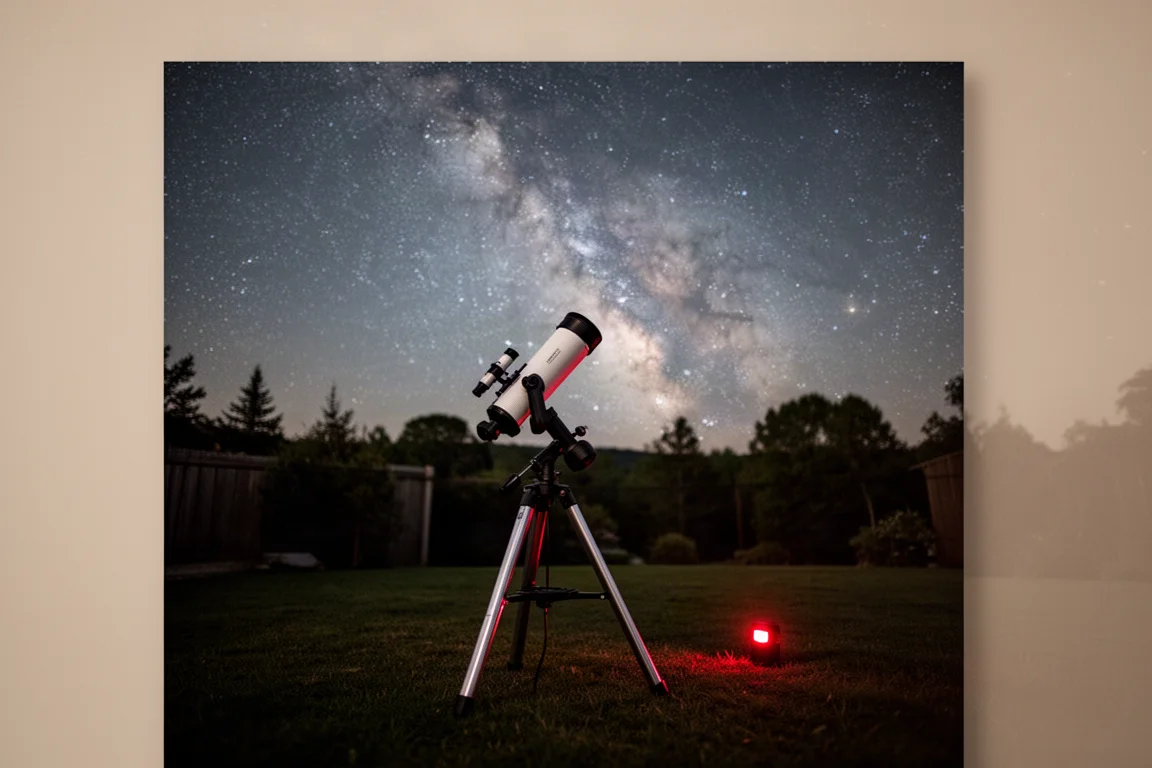
On a real night out around 11 pm, the scope proved a lot of fun. Targets included the globular cluster M4, Albireo, and the Ring Nebula, all reached with minimal stress thanks to the go-to system. The motorized tracking makes it easy to fly through the season’s most popular targets.
The light baffle issue became obvious quickly: any background light, whether from a filming light or a porch lamp, leaks into the open tube and clouds the view through the eyepiece. In a dark backyard it is less of a problem, but suburban observers should take note.
Electronically Assisted Observing
The telescope is not designed for astrophotography at all, and tracking is not accurate enough for long exposures: park it on a target for more than a few seconds and star trails appear. But a growing style of observing, electronically assisted observing (EAA), is different. The collapsible tube is the surprising enabler here. With most Dobsonians, a camera cannot get close enough to the primary mirror to reach focus; shortening this tube solves that problem entirely.
Using an ASI air unit with a camera such as the ASI 294 MC Pro, the mount connects over Wi-Fi (IP 192.168.4.1, port 11880 UDP) and can be driven from the ASI air’s sky map. Getting precisely on target typically takes a photo, a plate solve, and a second slew, and the mount has a quirk of narrowing in the opposite direction after reaching a target, so you have to stop the slew manually. The payoff: clean 2-second exposures of the Ring Nebula and the great globular cluster in Hercules, plus a live-view trick using half-second to 1-second focus-mode exposures that lets you steer around the sky in real time. For EAA, this works well. For traditional astrophotography, look elsewhere.
Who This Telescope Is For
This is an easy call. The Virtuoso 130 suits beginners who want go-to convenience without giving up real aperture, and anyone who values portability above almost everything else. There are three clear reasons to choose it over alternatives in this price range: value (few scopes under $500 combine go-to capability with ample aperture), the collapsible tube for easy storage and travel, and the go-to and tracking features that make touring seasonal highlights nearly effortless.
If you are an experienced observer with a permanent setup, or someone hoping to do serious long-exposure astrophotography, this is not the right tool.
Practical Upgrades Worth Considering
Three upgrades make this scope significantly better. First, the eyepiece: a 21mm Baader Hyperion (about half the price of a Tele Vue Panoptic) would give roughly 30x for general observing, and a 5mm would give about 130x for planets. Second, the focuser: wrapping it in Teflon tape or upgrading it entirely smooths out the clunky helical action. Third, a DIY foam light trap to control the light leaks that cloud the view near porch lights.
A fourth small hack: if you regularly adjust the tube length for cameras, add small pipe spacers so you know exactly how far to retract the tube to achieve focus.
Buying Advice
At around $400, the Virtuoso 130 is an amazing package for the price. The optics are great, the scope is easy to use even without the go-to system, and the collapsible design makes it the most travel-friendly 5-inch telescope around. Budget for an eyepiece upgrade, plan on pairing it with Sky Safari so the app’s map replaces the map-less SynScan interface, and consider the collimation and light-baffle improvements early. Do those things and this is one of the most complete beginner packages available.
One final, serious note: never look at the sun with this telescope.
Conclusion
The Sky-Watcher Virtuoso 130 delivers go-to tracking, honest 130mm aperture, and genuine portability at a beginner-friendly price. Its flaws, a text-only manual, a basic focuser, and light leaks, are all fixable with modest upgrades, while its strengths are the kind you cannot add later. For a first computerized telescope that will actually get used, it is a very easy recommendation.
Product link
View more details for Sky-Watcher Virtuoso 130
This product is mentioned in the review. Check the specifications, options, and compatibility before buying.
View more details for Sky-Watcher Virtuoso 130Further reading
Related Reviews

Telescopes
Sightron SJ75 UF and Sky-Watcher HS125: Two Telescopes Worth Watching
A look at two notable telescopes from a recent camera and optics expo: a sharp new astrograph from Sightron Japan and a compact fast reflector from Sky-Watcher.

Telescopes
SV503 102ED Review: A Budget 102mm Refractor That Surprises
The SV503 102ED is an affordable 102mm doublet refractor that delivers surprisingly decent star shapes and a smooth focuser, despite some chromatic aberration and light falloff.

Telescopes
SVBony MK127 Review: A Compact Maksutov-Cassegrain That Surprises
The SVBony MK127 is a 127mm Maksutov-Cassegrain telescope with a unique 0.65x reducer, making it a versatile option for visual astronomy and even some deep-sky imaging.