Power Tools
Makita Blade Sharpener Review: A Rare Tool That Rescues Expensive Saw Blades
An obscure Makita blade sharpener from Japan promises to revive blunt circular saw blades. Here is what it is, how it performs, and who it makes sense for.
Introduction
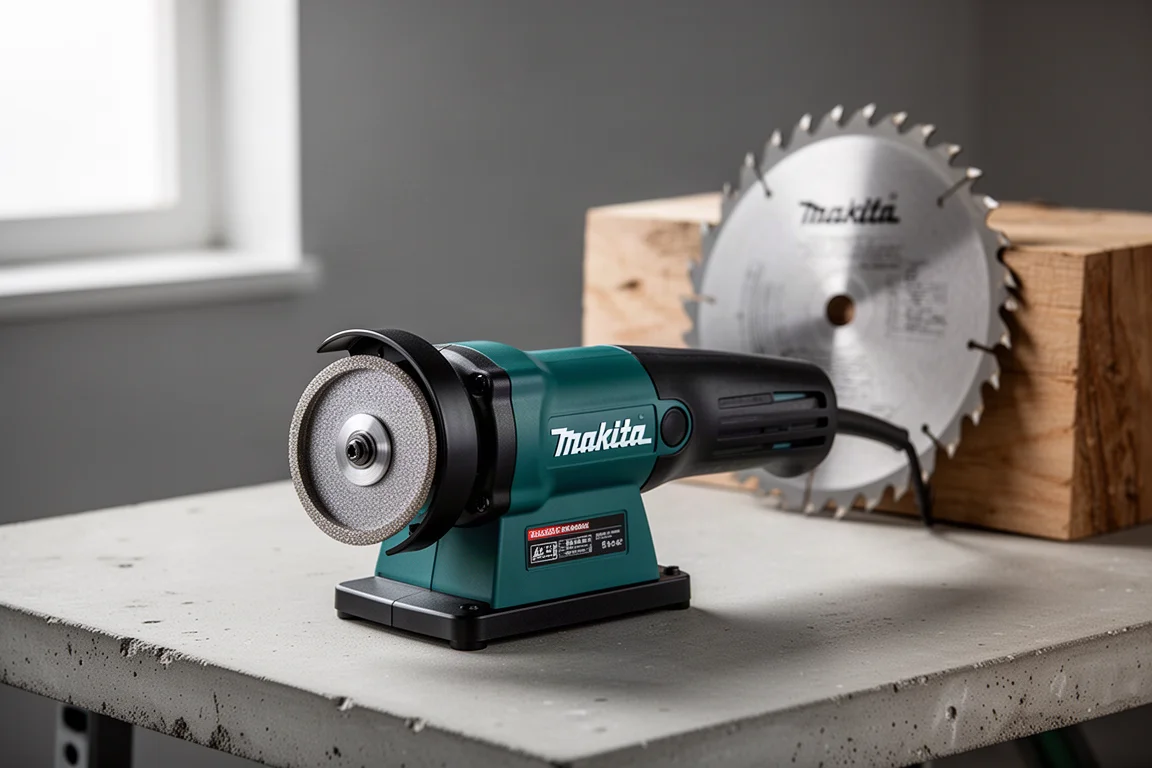
Some tools are everywhere, and some tools make you stop scrolling entirely. This Makita blade sharpener firmly falls into the second category. It is designed to sharpen circular saw blades at home, which sounds almost too good to be true when good blades can cost a serious amount of money.
It is also genuinely rare. Most people, including longtime Makita fans, have never seen one in person. From what is publicly listed, it appears to be sold primarily in Japan, and finding one outside of Japan usually means ordering through Amazon Japan and hoping stock is available. Availability fluctuates, and units seem to appear and disappear, so if you want one it is worth checking regularly rather than assuming it will always be there.
What This Tool Actually Is
At its core, the sharpener is essentially a precision grinder with a small 80 mm diamond wheel on the business end. Interestingly, the diamond coating only covers the edge and face surface of the disc; the rest is aluminum. The stated no-load speed is 5,500 RPM, and the tool is made in Japan.
It is built for real circular saw blades, handling blades from 120 mm up to 500 mm in diameter and up to 4 mm thick. That covers everything from small 125 mm blades through to full-size 305 mm (12 inch) miter saw blades.
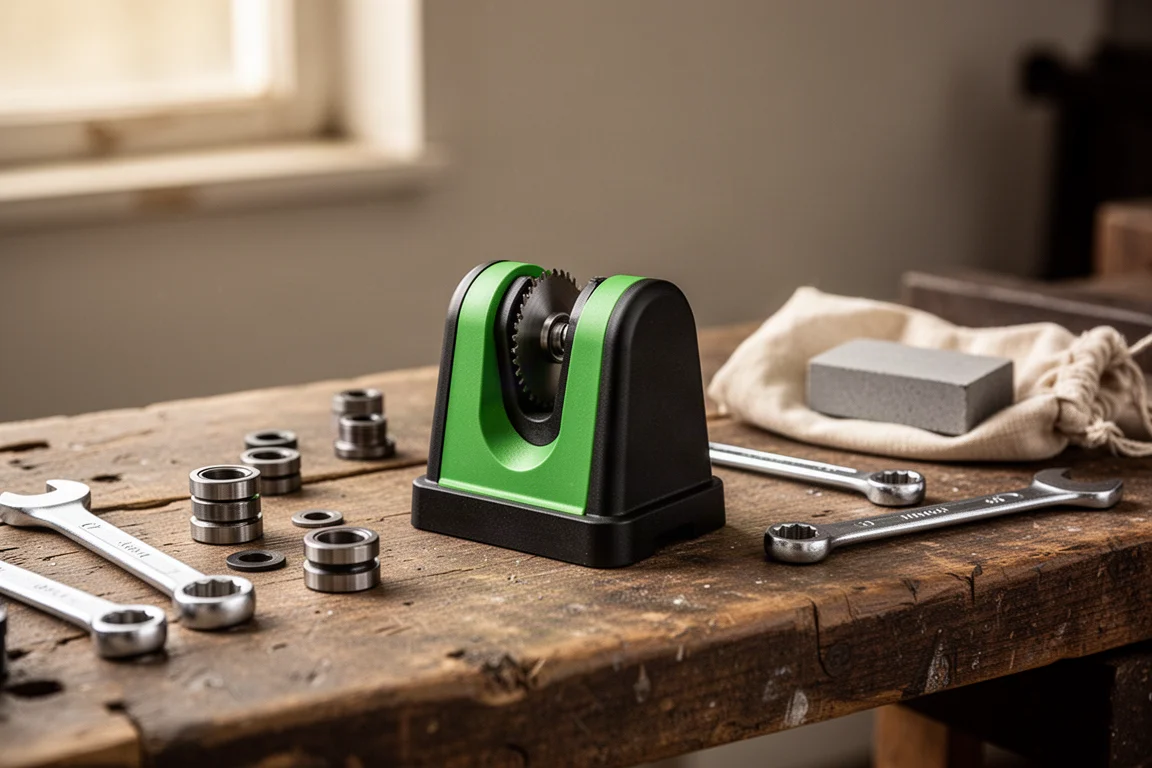
There are a few practical realities to know before buying. First, this is not a battery tool. It runs on 100 V mains power, which is a headache if you live anywhere using 220 to 240 V. A transformer works, but the tool also needs to be properly earthed, and the plug has no earth pin, so you will need to rig up an earth connection yourself. Second, expect a learning curve. There are lots of dials, adjustments, and moving parts, and it takes time to dial everything in for each specific blade.
The tool also ships with a bag of accessories: a range of bushings for different blade arbor sizes, a couple of plates, wrenches, and a dressing stone for the wheel.
Why Blunt Blades Get So Expensive
The reason this tool exists at all comes down to one word: bamboo. Bamboo composite board is notorious for destroying saw blades. It looks innocent, but it is full of abrasive material that blunts carbide teeth incredibly fast. Anyone who tells you to just cut it with your normal blade on a miter saw is setting you up for disappointment.
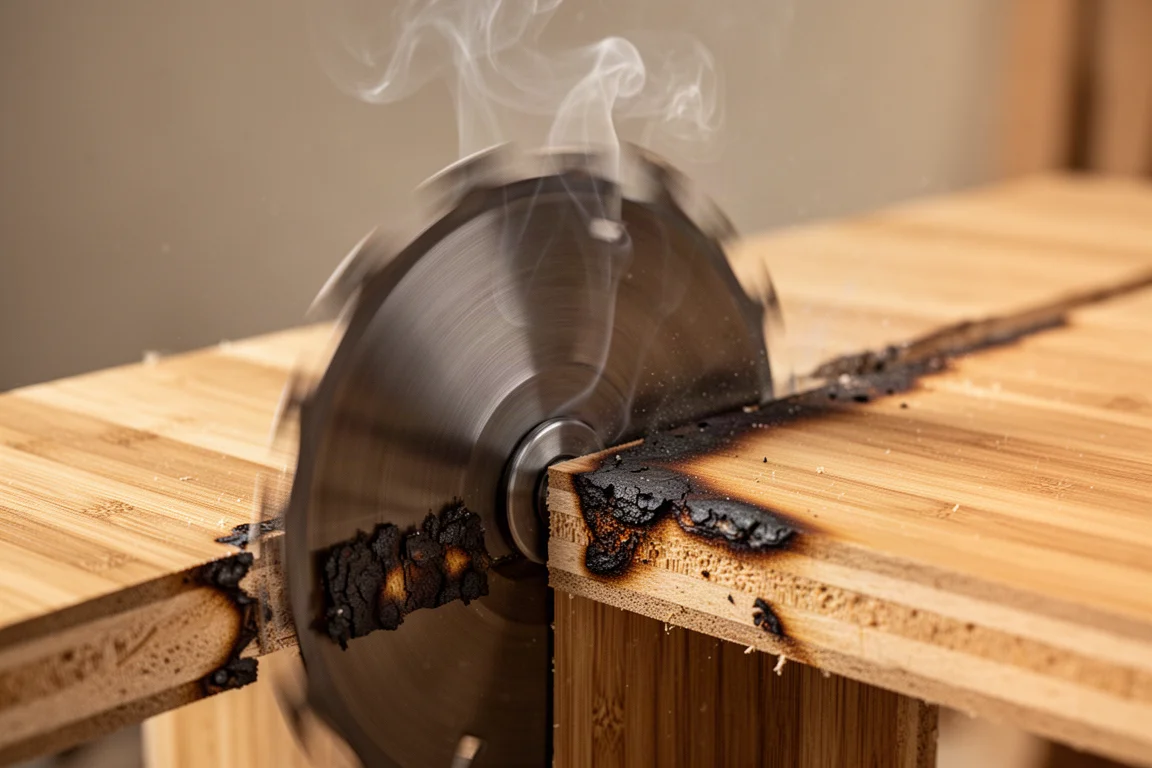
The real-world damage is dramatic. A brand new 12 inch Makita miter saw arrived with a blade that was completely blunt within about half a dozen cuts through bamboo composite. A replacement blade suffered the same fate within a handful of cuts. Even a high quality multi-purpose blade with 81 teeth went very blunt after roughly 20 cuts.
This is where the economics get interesting. Premium blades cost a lot, and burning through them on abrasive material is painful. If a single expensive blade can be sharpened six times, the sharpener has paid for itself. Sharpen a cheaper blade ten times and you are clearly ahead. If you are paying $400 for a blade, this tool will pay for itself very quickly indeed.
Setting It Up and Sharpening the First Blade
Setup takes patience. There are adjustments under the tool, a release mechanism that must be pushed up and down to remove parts for different blade sizes, and a thickness gauge to set for the blade plate. The machine’s angle scale helpfully marks negative rake on one side (black) and positive on the other (red), which matters because modern blades vary enormously: some run a negative 3 degree rake, others a positive 8 to 10 degrees. If you still have the blade packaging, it usually states the rake angle, which removes the guesswork.
A couple of quirks are worth knowing. The included bushings cover many arbor sizes but not 30 mm, which is frustrating since most larger blades use exactly that size; a workaround is using a supplied bushing to step the blade down. Some blade holes smaller than the arbor also need creative shimming to avoid play.
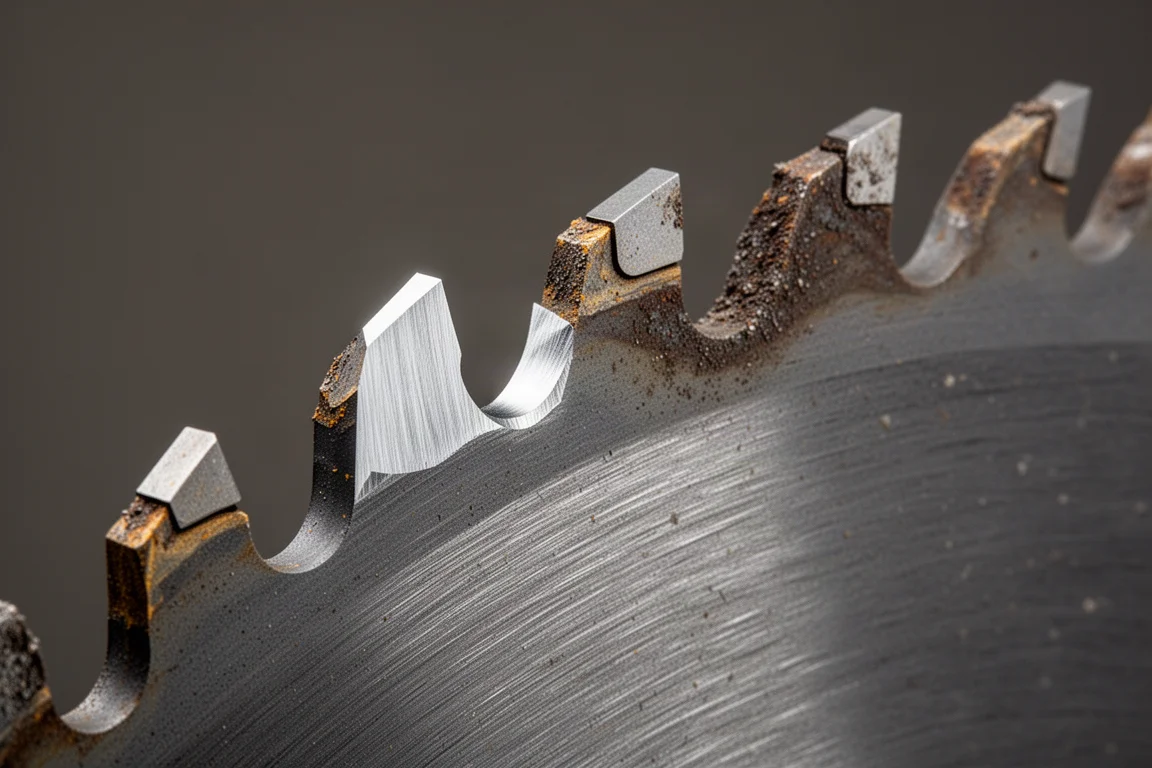
Once dialed in, sharpening itself is rhythmic and almost meditative. You move tooth to tooth, tapping the grinder against each carbide tip. On an 81 tooth blade, that means a lot of taps. The freshly ground teeth are immediately obvious: bright, shiny, and clean against the dull grubby ones you have not touched yet. On blades where the tooth faces are angled in different directions, you may need to sharpen every second tooth, reset the angle, and do the rest in a second pass.
One caution: shallow gullets on densely toothed blades leave very little clearance, so there is a real risk of grinding into the blade body. Blades with deep, generous gullets are much more forgiving, especially for a first attempt.
Results: Was It Worth the Money?
The first test blade, an 81 tooth blade that had been utterly destroyed by bamboo composite, came back noticeably better after sharpening. Cutting was quicker and cleaner than before, though the tester felt the edge could have been taken a little further, and the machine runs louder than ideal.
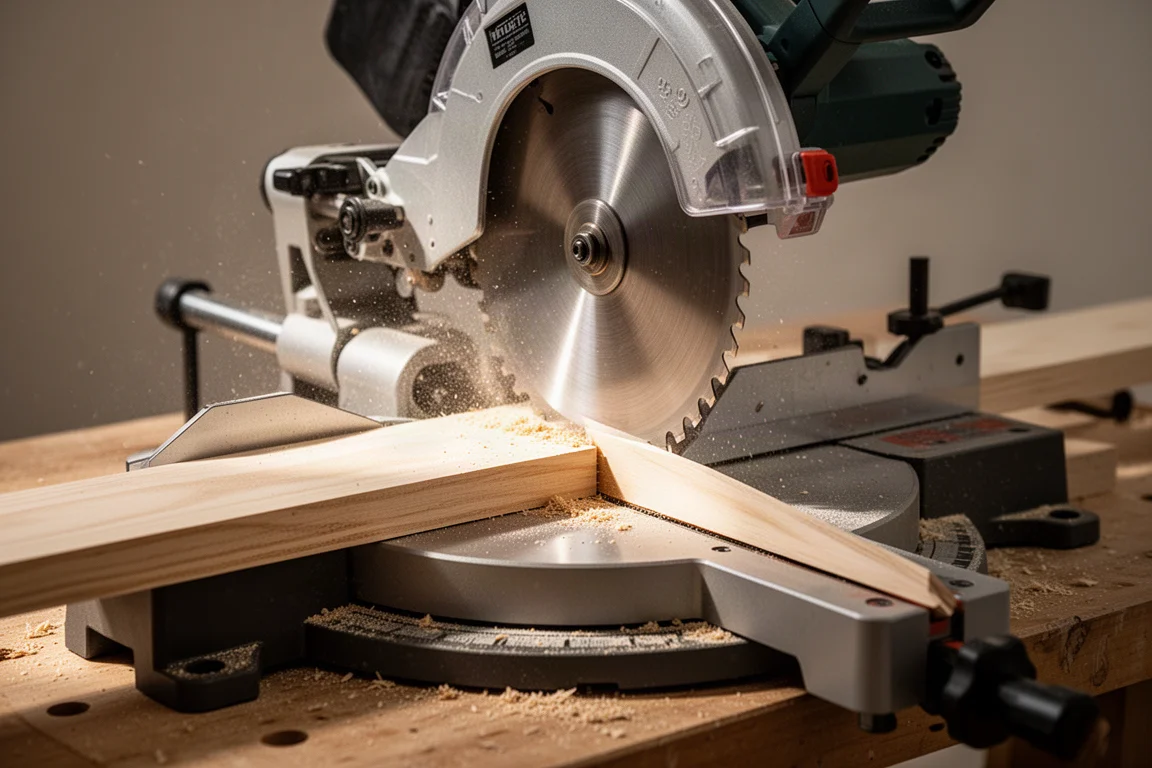
The second test was more convincing. A blunt Diablo blade that had been burning through pine, barely cutting at all and leaving black burnt residue on the wood, came back to life after a proper setup and three to four passes per tooth. It still cut slowly, because an 80 tooth fine-finish blade is not the right choice for rough cutting anyway, but the burn marks were gone and the cut was clean. That is a blade worth well over a hundred dollars saved from the bin.
There is a caveat: even heavily grubby blades that cut acceptably may not need sharpening at all, sometimes just a cleanup. And there is an honest limitation on speed: measured no-load speed ran around 6,200 RPM, slightly above the 5,500 RPM on the nameplate, while the disc is marked with a 6,000 RPM maximum. That fluctuation is worth monitoring.
Buying Advice
This is a niche purchase, and it is honest to say so. It is expensive, hard to find, restricted to 100 V power with an earthing workaround, and fiddly to set up for each new blade. Bushings for common arbor sizes like 30 mm are missing from the kit.
But if you burn through expensive blades regularly, whether from bamboo composite, contaminated timber, or just heavy use, the maths strongly favor it. The ability to restore a $120 to $400 blade several times over transforms the running cost of any workshop doing serious cutting. It also suits anyone with a drawer full of “worthless” blunt blades that could be worth hundreds of dollars again.
If you would rather just replace blades, or drop them off for professional sharpening, that remains a perfectly valid choice. Blades are cheaper than they used to be. But good blades are still expensive, and this tool puts that cost back under your control.
Conclusion
The Makita blade sharpener is one of the most unusual tools the brand has ever made, and one of the rarest to actually find. It is not perfect: the power and earthing requirements, the missing 30 mm bushing, and the learning curve all add friction. Yet it demonstrably brought two genuinely blunt, expensive blades back to useful life, which is exactly the job it promises to do. For anyone who goes through quality circular saw blades quickly, it is a niche tool that earns its place, and one worth grabbing if you spot one in stock.
Product link
View more details for Makita Blade Sharpener
This product is mentioned in the review. Check the specifications, options, and compatibility before buying.
View more details for Makita Blade SharpenerFurther reading
Related Reviews
Power Tools
Best 1-Inch Pistol Impact Wrenches: Three Heavy-Duty Options Compared
We compare three 1-inch pistol impact wrenches, from a budget-friendly Harbor Freight model to a premium Caterpillar unit, to help you choose the right one.
Power Tools
Best 3/4-Inch Impact Wrenches 2026: Five Contenders Compared
We compare five 3/4-inch impact wrenches across price and performance, from a budget Amazon option to Snap-on's most powerful model yet.
Power Tools
Best Budget Cordless Tools 2026: Walmart Finds That Punch Above Their Price
We tested five cordless tools from Walmart, including a high-torque impact wrench that trades blows with Milwaukee and a $35 duster that outperforms its price class.