Kitchen Knives
Hudson Torren Pro Cut Gyuto Review: A New Steel Worth Watching
A Canadian smith's gyuto in the promising Pops Pro Cut steel impresses with a thin edge, tough performance, and standout handle work.
Introduction
Kitchen knives from independent Western smiths keep getting better, and this review focuses on a particularly interesting release: a Pro Cut gyuto from Canadian bladesmith Hudson Torren, made in a brand-new kitchen knife steel called Pops Pro Cut. The steel was developed by Dr. Larrin Thomas, the metallurgist behind MagnaCut and a co-founder of Apex Ultra, which alone makes it worth a closer look.
Pops Pro Cut is a low-alloy carbon steel advertised as a good balance of wear resistance and toughness. It is positioned as tougher than Aogami Super and a more affordable alternative to Apex Ultra, while also being knifemaker friendly in terms of forge, grind, finish, and polish. For bladesmiths who forge their own Damascus, its high nickel content supposedly makes it a great choice for the bright layers.
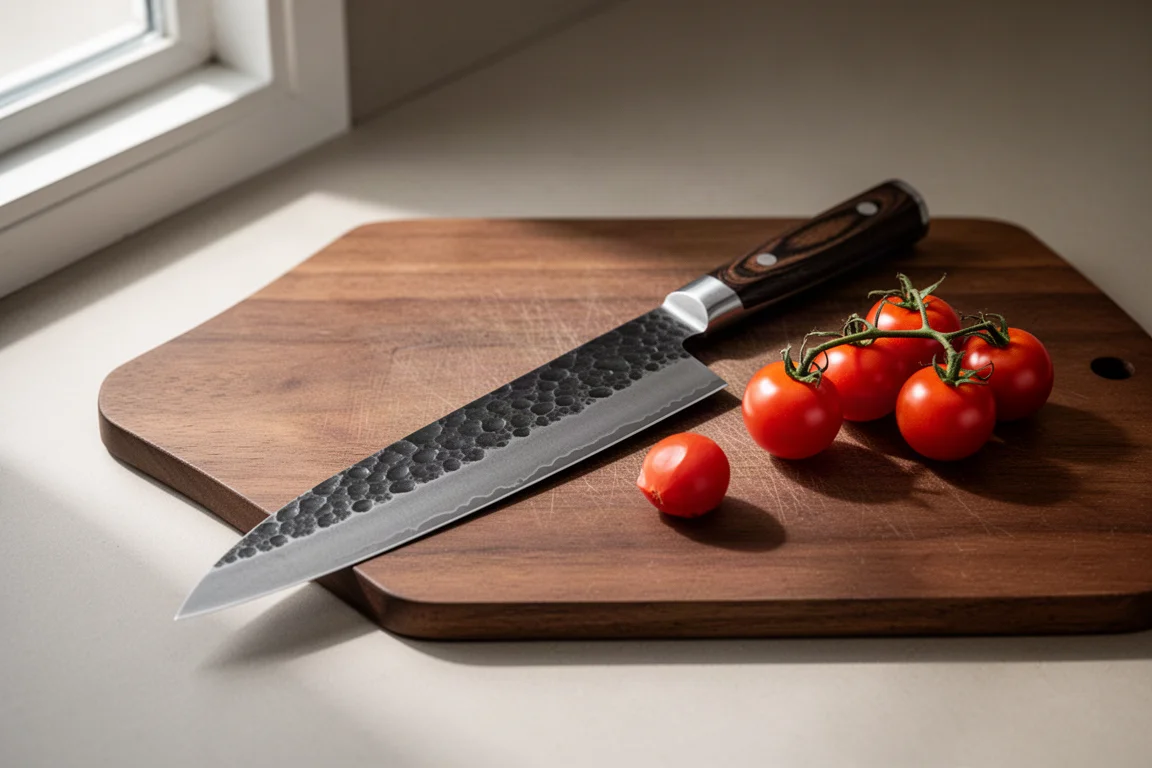
This knife was tested extensively through a full kitchen workout: cherry tomatoes, shallots, onions, potatoes, carrots, celery, and green onions, plus a week of continuous daily use with no stropping. Here is how it all held up.
Who This Knife Is For
This gyuto suits cooks who appreciate a laser-thin, high-performance edge and are comfortable caring for a carbon steel blade. It is also a strong pick for collectors who value distinctive handmade work: dramatic forge-scale textures, deep hollow grinding, and a blade profile with a steep slope from heel to tip and a generous belly height at the heel.
Hudson Torren has been bladesmithing full time for about two years and specializes in culinary knives. In that short period he has traveled widely, attending shows such as Knife Show Austria and the Atlanta Blade Show, and the comparison drawn with the work of the legendary Benjamin Kamon says a lot about the trajectory. If you want one of his knives, the sensible advice is not to wait too long, since many smiths at this stage eventually develop long custom waitlists.
Unboxing and First Impressions
Packaging is intentionally minimal: a box just large enough for the packaging, and packaging just large enough for the knife. That is a sensible approach. Unless a knife is genuinely unique or the box is part of the experience, elaborate boxes are overrated, and this cardboard presentation with a signed insert is a classy touch.
One small nitpick: a tiny staple keeps the cardboard sheet shut, and it is easy to miss on the first attempt to remove the knife, which risks scratching the finish. A piece of painter’s tape would do the same job more visibly.
Handle Work and Fit and Finish
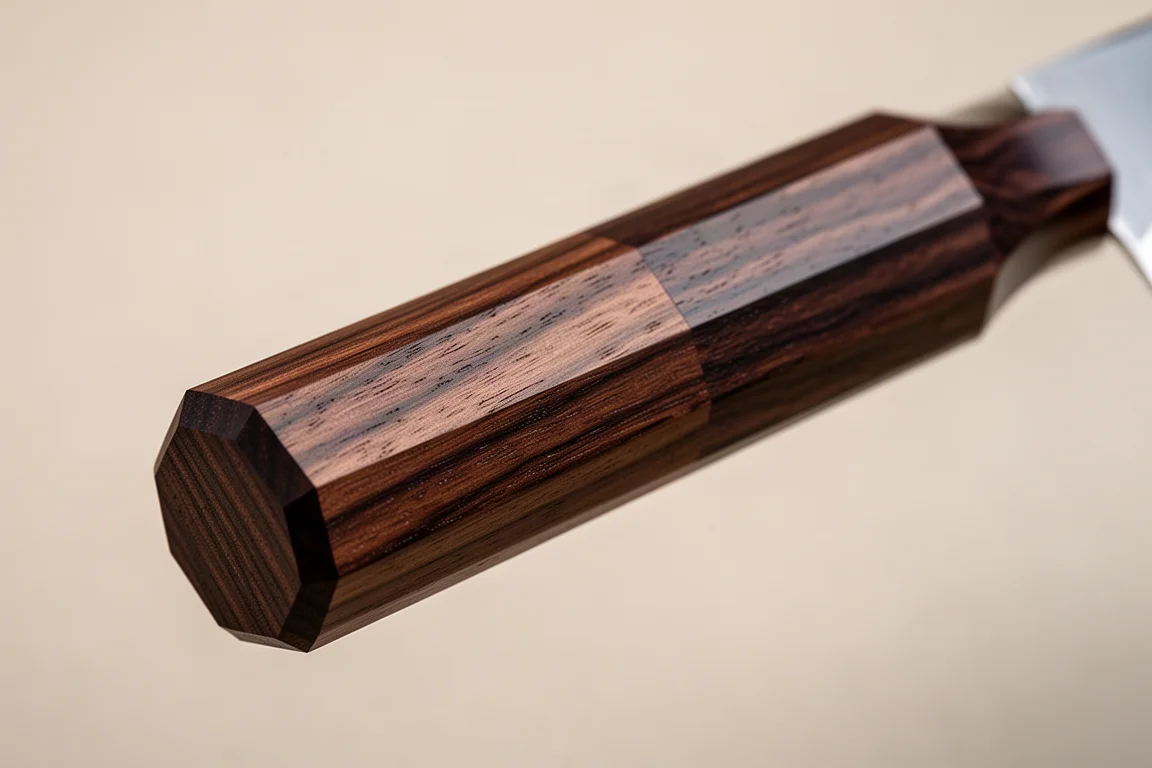
The handle work is a highlight. The octagonal wa handle transitions seamlessly from African Blackwood to cocobolo, with no perceptible transition between the two woods. It is notably narrow in width, which smaller hands will appreciate, and the butt is slightly chamfered and fluted as a finishing touch.
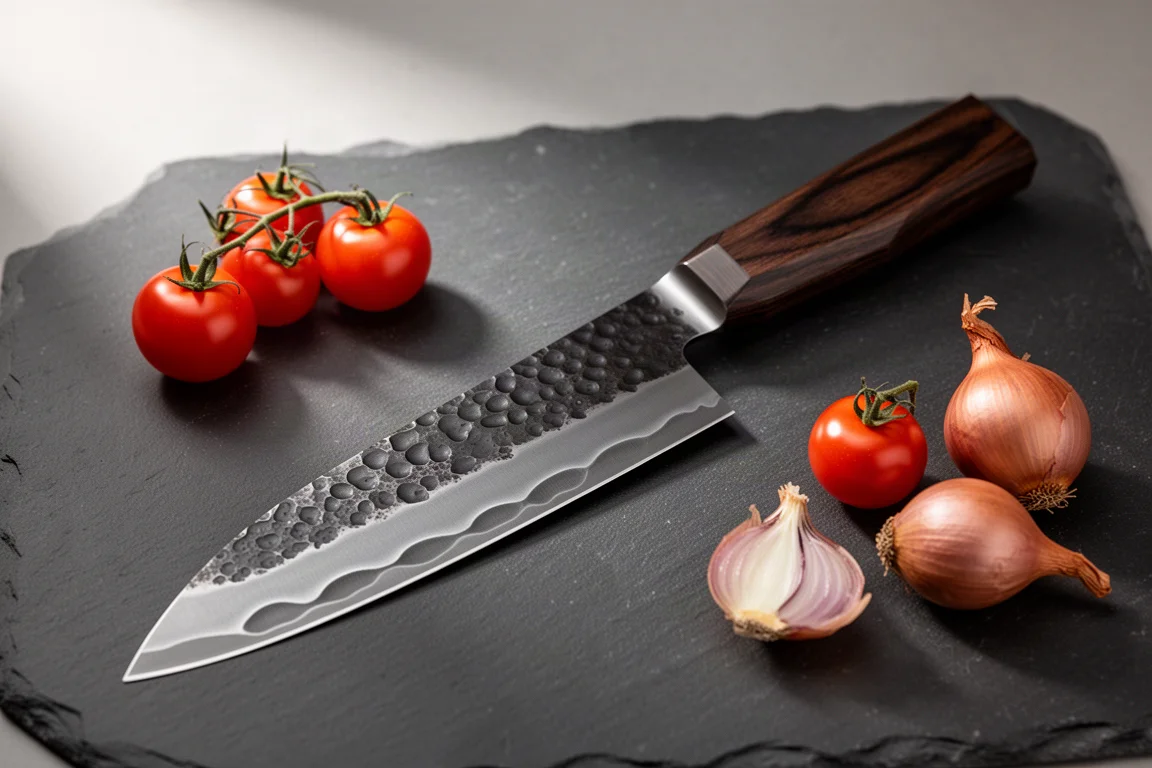
The blade itself is where the visual drama lives. Super thick forge scale with plenty of texture, sitting somewhere between a kurouchi and a shirogami-style finish, contrasted against deep hollows across the blade. The result is genuinely interesting topography. The maker’s mark is tightly executed and well sized, and Hudson places it on the left side of the blade, which is unusual compared to most Japanese kitchen knives and means you see the mark while cutting.
Other details check out: a nicely rounded and polished spine and heel, and a nail-flexing thin tip. At around 600 Canadian dollars, the fit and finish alone make a strong first impression.
Cutting Performance
The cherry tomato test showed an edge with enough bite for clean punctures, likely a finish above 1,000 grit. Lateral cuts through a shallot were effortless, and the thin tip almost sings when drawing back through a cut. Dicing a shallot down to rice-grain size is realistic with this knife.
Larger onions revealed a slight trade-off. Cuts were not as smooth, not because of a dull or thick edge, but because the dramatic belly height and polished edge add drag and stick factor. Pull cuts on a potato confirmed the same: the polish, not the technique or the sharpness, is what makes food cling. As the blade patinas over time, food release should improve, and a kiri finish version would likely cut suction even further.
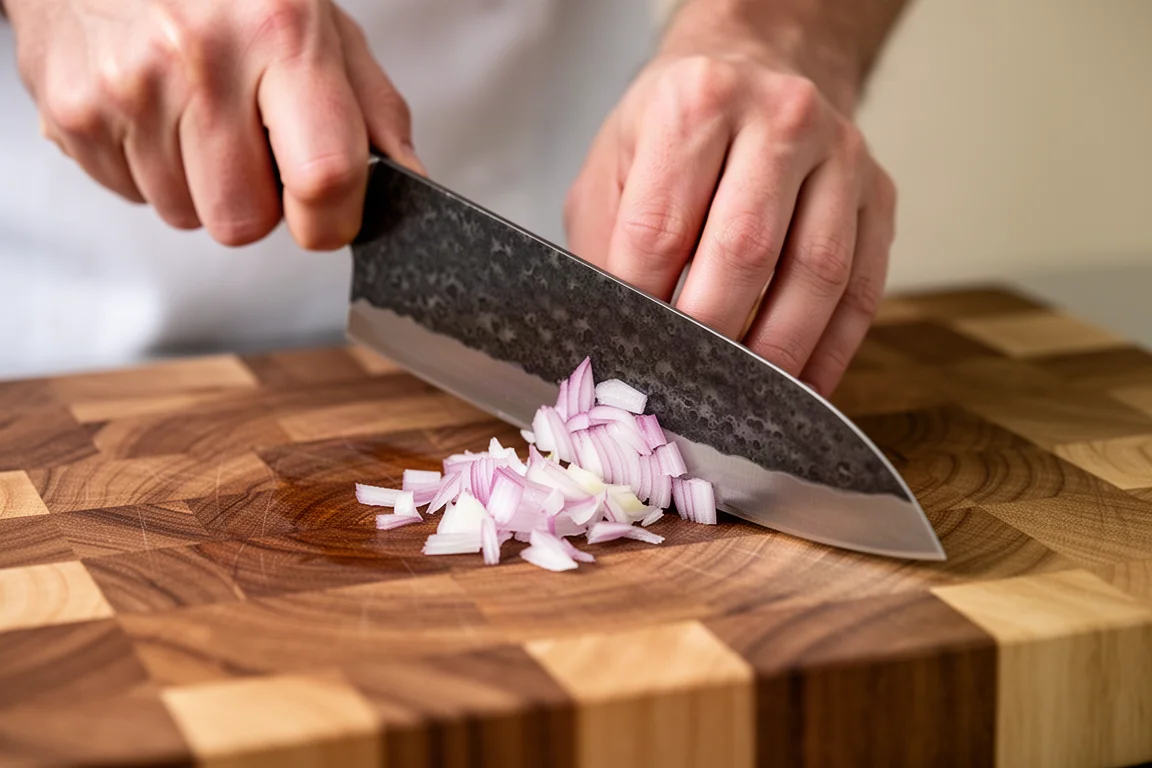
The carrot test demonstrated how thin this knife is from edge to spine, gliding smoothly even on slow cuts. The edge was estimated to be sharpened above 1,000 but under 3,000 grit. Celery cut through its fibers cleanly, showing the edge is sharp enough to pierce tomato skin yet polished enough to slice fibers rather than snap them.
Rock chopping on green onions raised no concerns about edge stability on the board, though the feeling was not especially pleasant, mainly because the thin, sharp edge digs into the board. Owners of very thin knives will recognize this sensation immediately.
Pops Pro Cut Steel in Use
The steel’s corrosion resistance is impressive. A forced patina attempt with a juicy orange produced almost nothing initially. Over three days and then a week, patina did develop, but slowly and with low contrast, reminiscent of a Takamura R2/Chromax blade.
The bigger story is toughness. On a blade with a core steel this thin, tip stability could be a worry, but the edge felt stable and confident throughout testing. After a week of nonstop gyuto duty with no stropping, the knife felt nearly as sharp as it did out of the box. At a hardness of 64 HRC, the steel still feels genuinely tough, which is exactly the balance Pops Pro Cut promises.
Things to Consider Before Buying
The most notable criticism is the finish polish: it is a little uneven, with a visible deep scratch pattern that likely contributes to the higher food suction. If food release matters to you, factor that in or consider asking the smith about a kiri finish on a future blade.
The handle, while beautifully made and comfortable, is quite light. In use, the knife felt slightly tip heavy, and a denser wood with the same octagonal construction would remedy that. Neither issue is a dealbreaker, but both are worth knowing before buying.
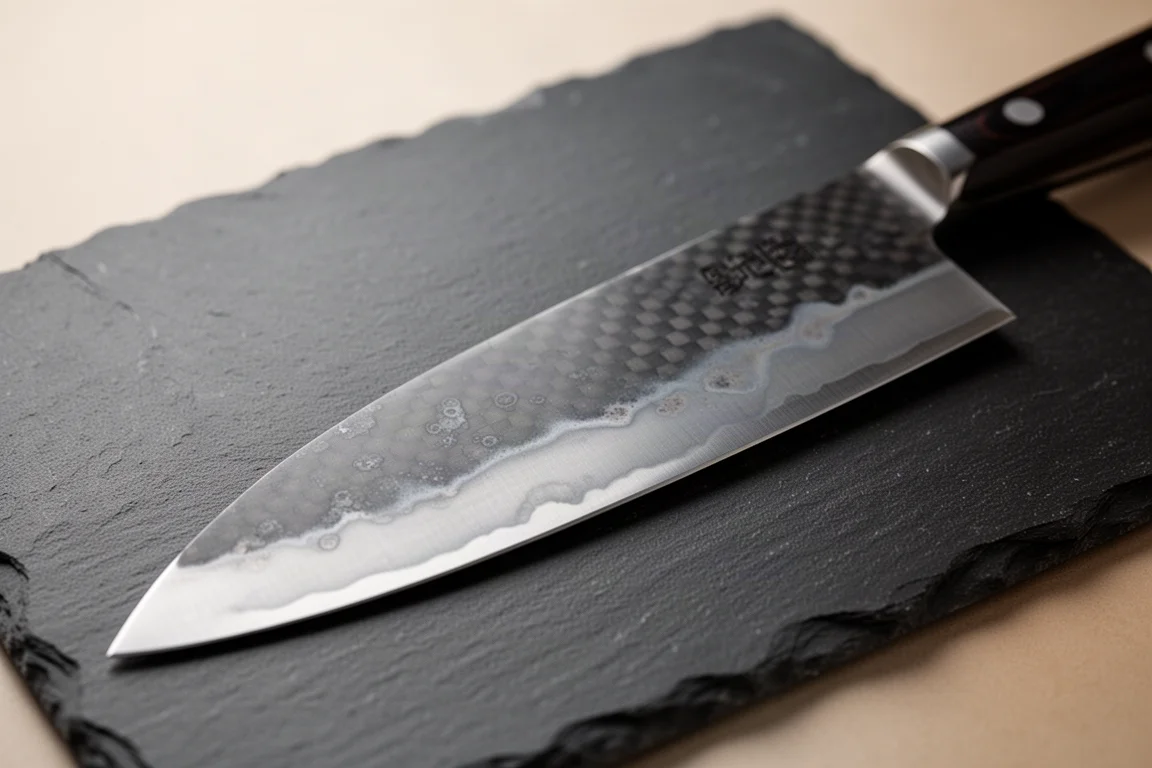
On the steel itself, edge longevity is hard to judge fully this early, and long-term impressions are expected to be shared as testing continues, including how quickly a bur forms when sharpening. What can be said now is that Pops Pro Cut offers great corrosion resistance, takes a very thin and sharp edge, and feels tough even at 64 HRC. Expect this steel to become popular among smiths, and it should look spectacular as the bright layer in Damascus.
Buying Advice
This knife is super reasonably priced for what it delivers: astonishing attention to detail on fit and finish, a stunning and aggressive profile, and performance that backs up the looks. The recommendation is a straightforward yes. If you have been curious about Pops Pro Cut as a steel, this is a compelling first knife to experience it in.
Conclusion
The Hudson Torren Pro Cut Gyuto pairs a promising new steel with genuinely excellent craftsmanship. The edge is thin, sharp, and stable, corrosion resistance is strong for a carbon steel, and the handle and blade textures show a smith already working at a high level. The uneven polish and slightly light handle are honest nitpicks on an otherwise standout handmade gyuto, and they are easy recommendations to make for anyone shopping in this space.
Product link
View more details for Hudson Torren Pro Cut Gyuto
This product is mentioned in the review. Check the specifications, options, and compatibility before buying.
View more details for Hudson Torren Pro Cut GyutoFurther reading
Related Reviews

Kitchen Knives
Best Chef's Knives 2026: 27 Popular Options Tested and Ranked
A comprehensive review of 27 chef's knives ranging from $18 to $380, with honest assessments of handle comfort, blade balance, and real-world performance.

Kitchen Knives
Best Chef's Knives Under $75: Two Tested Recommendations
Two practical 8-inch chef's knives that balance sharpness, comfort, and durability without premium pricing.

Kitchen Knives
Best Chef's Knives 2026: 27 Options Tested and Ranked
A comprehensive review of 27 chef's knives ranging from $18 to $380, with honest assessments of handle design, balance, blade profile, and real-world performance.