Power Tools
HiKOKI 10.8V/12V Circular Saw Review: A Compact Saw With a Trick Up Its Sleeve
A tiny 12V-class circular saw with a reverse bevel feature that lets it cut flush against walls, something most larger saws simply cannot do.
Introduction
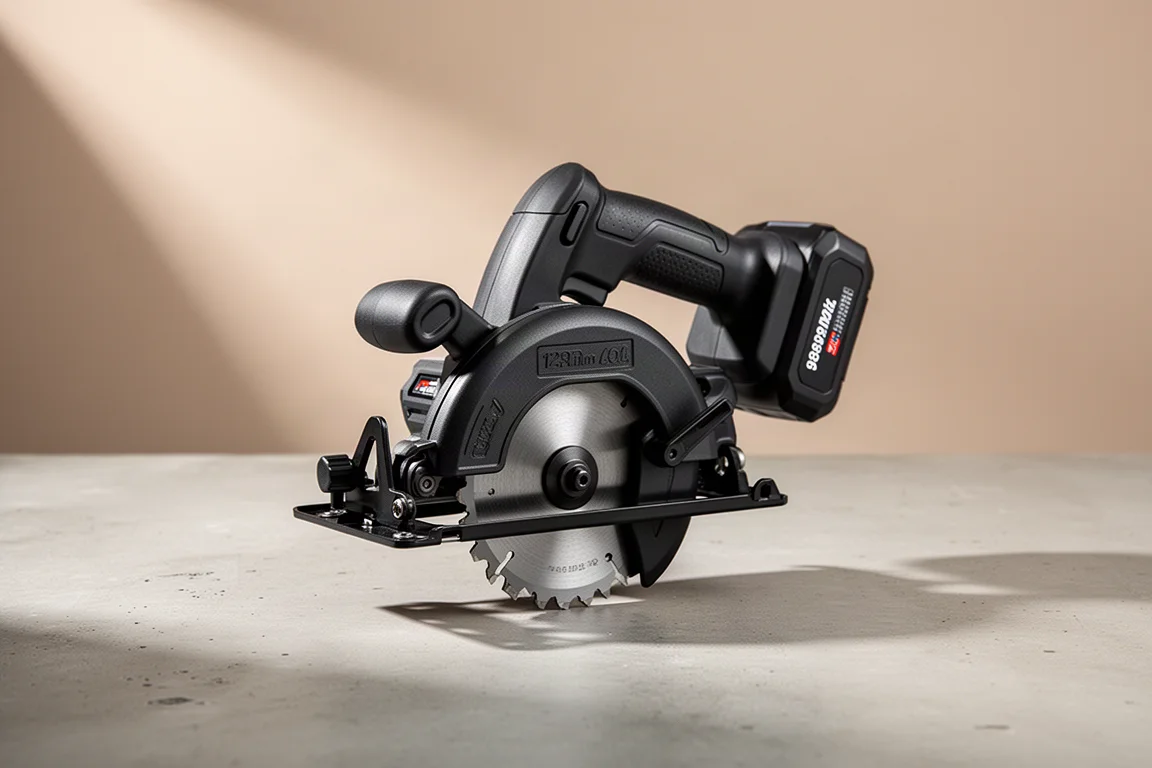
At first glance, the HiKOKI 10.8V/12V circular saw looks like a cute, underpowered novelty. The blade is only 125mm (5 inches), the batteries are tiny, and the whole thing weighs less than 2kg. But this little saw does something that most circular saws cannot, and it earns its place in a workshop on that strength alone.
One thing to know up front: this model appears to be sold only in Japan. The brand is sold as HiKOKI in most of the world and as Metabo HPT in the US. The kit can still work outside Japan, but there are a few things to check before buying, which we cover below.
What Makes This Saw Different
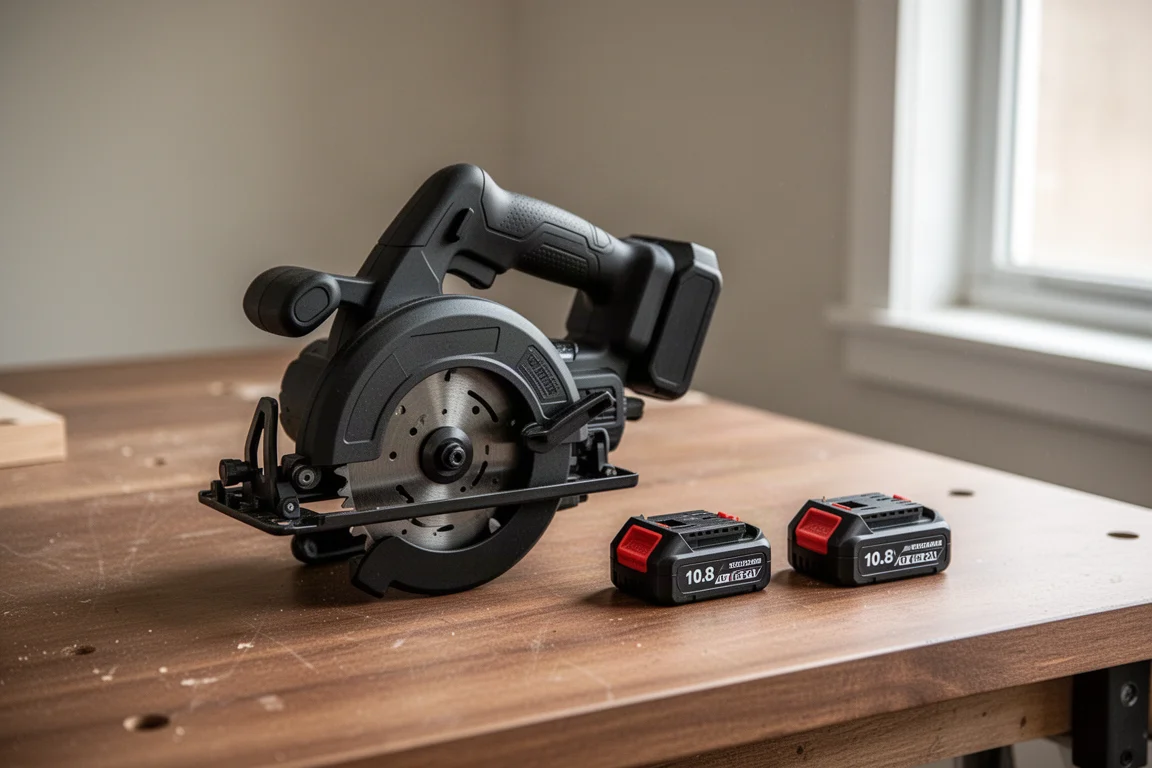
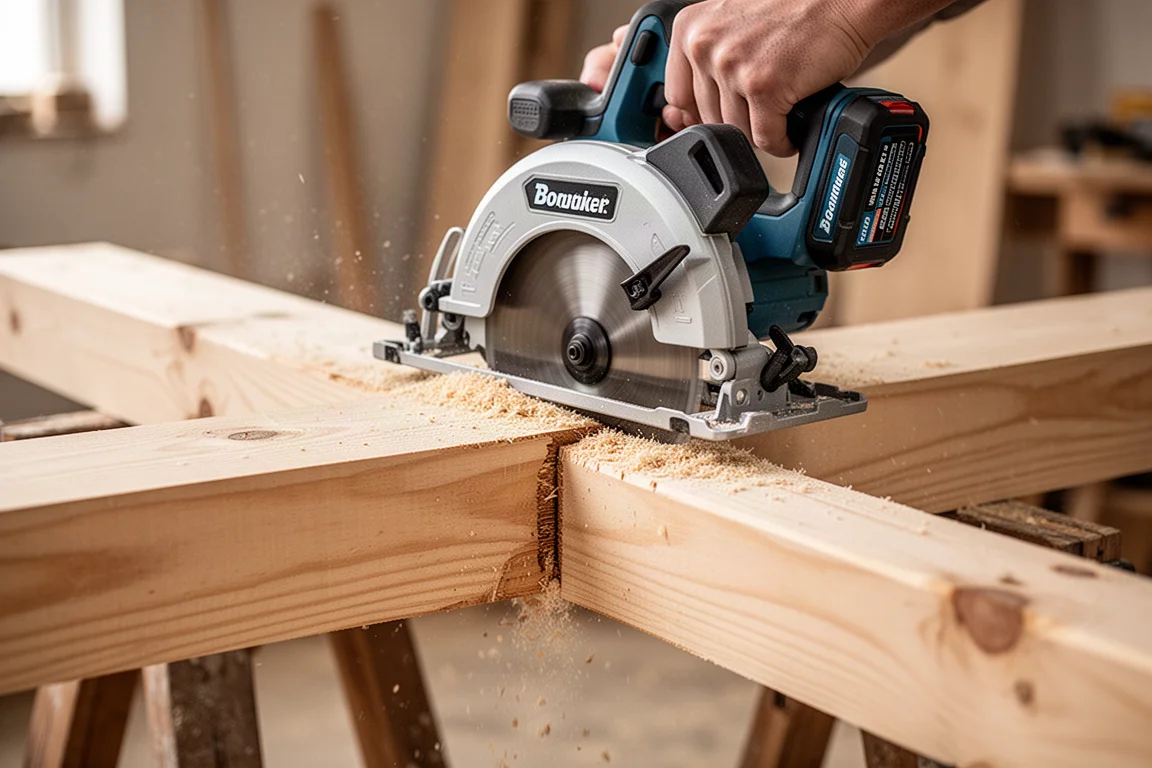
The headline feature is the reverse bevel. Every circular saw bevels in one direction; this one can bevel to the right as usual, and by flicking a lever it can also bevel the other way. But the real trick is what the front of the saw lets you do: the front section of the base retracts, letting the blade run right up against a wall or edge and cut completely flush, and even undercut slightly.
That matters more than you might think. Imagine removing a rotten section of floor hard up against a wall, or cutting off an old shelf that runs underneath cupboards on the other side. With most tools you are stuck fighting a multi-tool, burning through batteries and blades. This saw makes a clean flush cut in a single pass.
Why the Blade on the Right Is a Feature, Not a Flaw
A common objection to saws like this is that the blade sits on the right side instead of the left. For flush-cutting tasks, the opposite is true. If you are right-handed and kneeling on the floor cutting along a wall, you want your body on the tool side of the wall, pushing the saw along. With the blade on the right, that positioning works naturally.
Flip the blade to the left and the same task becomes awkward: you either have to cut in the opposite direction, cut left-handed, or contort your body around a wall. For right-handed users doing flush and undercut work, the blade-on-the-right layout is the sensible choice.
Flush Cutting in Real Use
The demonstration cut told the story well. A shelf left by a previous owner ran underneath cupboards on the far side of the wall, so it had to come off flush. The saw sliced through it pressed hard against the wall, and the result sat perfectly flush with the surrounding surface, without getting anywhere near the concrete block below.
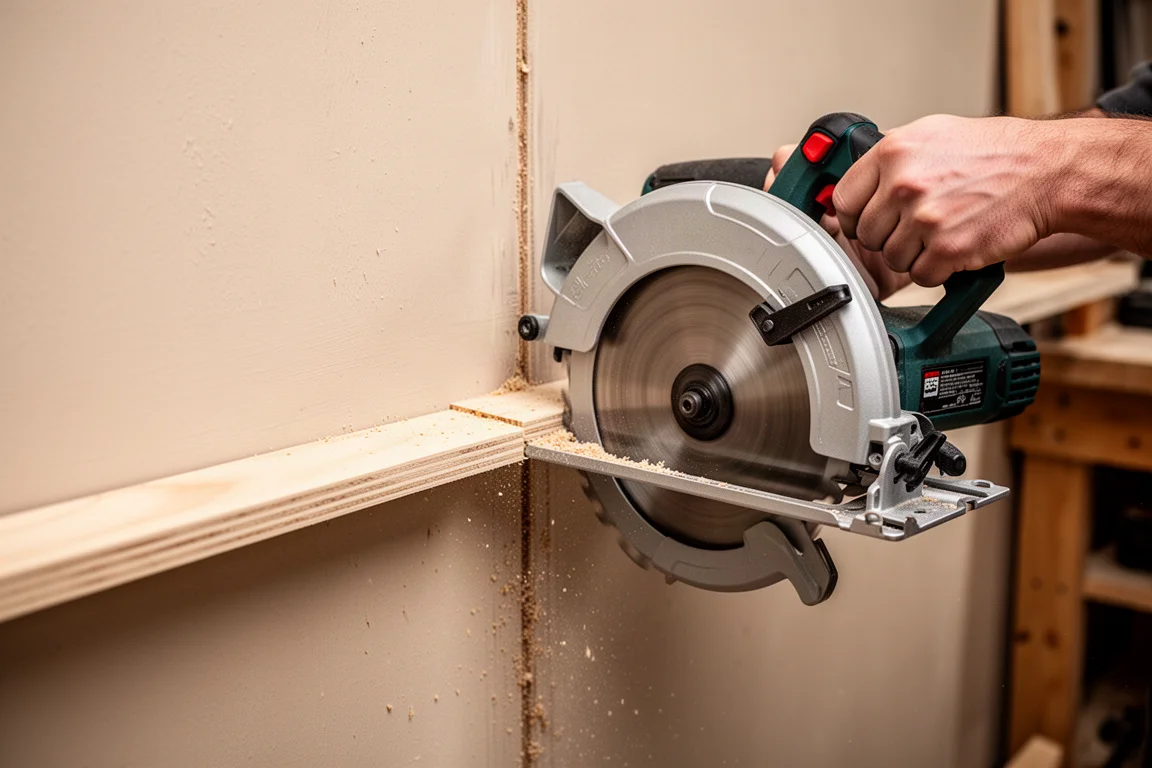
The saw runs reasonably quiet for the task, and with the screw-on dust port hooked to a vacuum, the workspace stays far cleaner than you would expect from a job like this. Note that the small blade-retract lever sits low and flush on purpose so it does not catch the wall; with the dust port attached, it protrudes slightly more and could interfere at very shallow bevel angles, though at the full 15-degree reverse bevel it should clear.
Design and Build Details
Inside the box you get two compact 10.8V batteries (sold as 12V max elsewhere, meaning 10.8V nominal), a screw-on dust port, and onboard storage for the Allen key used for blade changes. The batteries are tiny by circular saw standards, roughly 300g each, built around three 21700 cells, rated 4.0Ah and 44Wh.
The whole saw weighs 1.94kg bare and about 2.25kg with the larger battery attached. A 2.0Ah battery shaves more weight, but for saw duty the 4.0Ah is the sensible pick. The blade claims a 47mm depth of cut, the motor is rated at 4,500 RPM, and bevel adjustment goes to 45 degrees plus the 15-degree reverse bevel. There are adjustment screws on the base for squaring it up, a spring-loaded rip guide post that accepts a small Makita rip guide without fuss, and optional mounting holes for a front handle you almost certainly will not need on a saw this small.
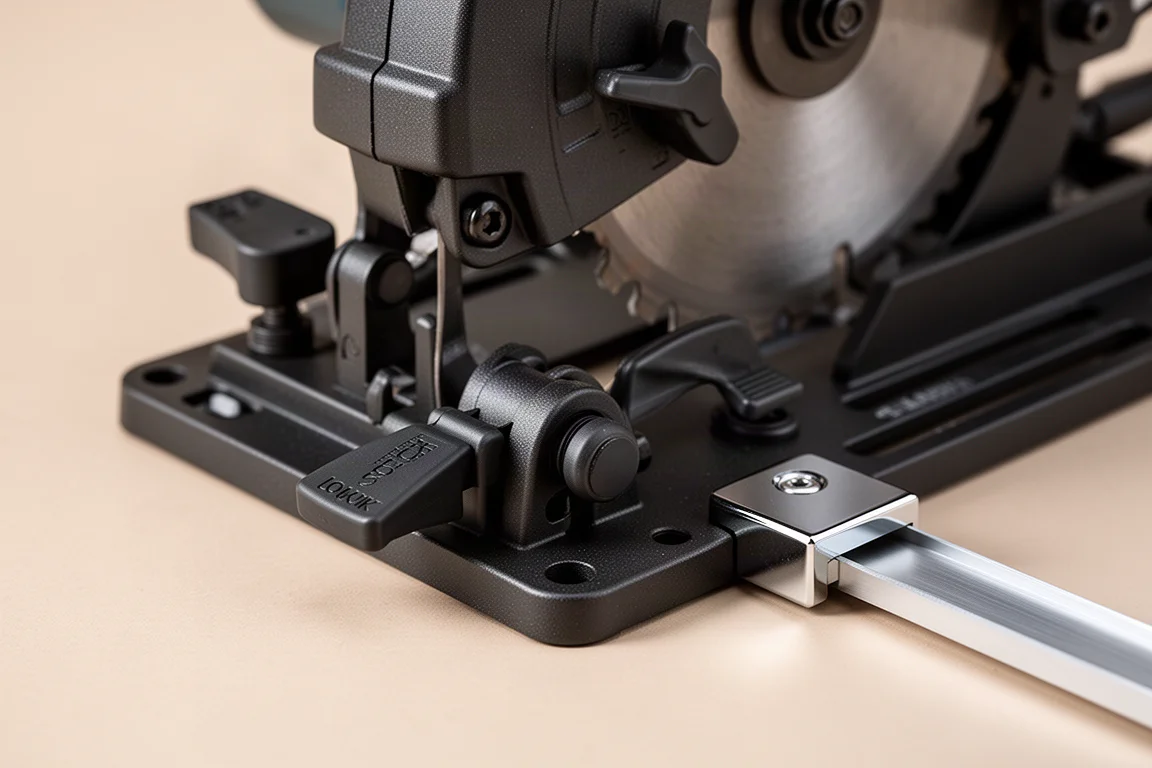
A few parts look like metal but are plastic, including the front base section, so this saw is not built like a metal-chassis flagship. That is part of how it stays light. One small annoyance: the battery gauge’s fourth bar glows half-lit even at full charge, a cosmetic quirk but an irritating one.
Cutting Performance and Power
Do not expect 18V or 36V muscle. The saw sounds modest under load and will stall if you push hard enough. In practice, though, it handled everything thrown at it: 18mm MDF, roughly 22mm pine, hardwood offcuts with nails in the path, and even rip cuts, all while barely denting the charge. After a full rip cut the gauge still showed nearly full bars, which is genuinely surprising for a 10.8V pack.
The real test was standard framing timber, 45mm thick. The saw pushed through it in one pass, right at its claimed 47mm limit. It is marginal at that depth, so expect to take it slowly, but it can be done. The electric brake is another highlight, stopping the blade very quickly after each cut.
Buying Advice
There are two practical considerations for buyers outside Japan. First, the included charger has a Japanese plug and 100V input. In the US, running it on 110V is fine. In 230-240V regions, you will need a step-down transformer, as the saw itself runs on battery but the charger does not. Second, sourcing can be tricky since this model is a Japan-only release, though affiliate links may help you track one down.
If your work regularly involves flush cuts against walls, undercutting floors, or trimming fixed carpentry, this saw is genuinely hard to replace. If you only ever break down sheet goods and rip framing timber, a full-size saw remains the better tool.
Conclusion
The HiKOKI 10.8V/12V circular saw is lightweight, surprisingly capable for its class, and offers a flush-cutting, reverse-bevel ability that no ordinary circular saw matches. It stalls before bigger saws would, it is plastic where competitors use metal, and sourcing one outside Japan takes some effort. But for trim removal, floor repairs, and any task that demands cutting hard up against a wall, it is a clever little tool that punches well above its size.
Product link
View more details for HiKOKI 10.8V/12V Circular Saw
This product is mentioned in the review. Check the specifications, options, and compatibility before buying.
View more details for HiKOKI 10.8V/12V Circular SawFurther reading
Related Reviews

Power Tools
Best 1-Inch Pistol Impact Wrenches: Three Heavy-Duty Options Compared
We compare three 1-inch pistol impact wrenches, from a budget-friendly Harbor Freight model to a premium Caterpillar unit, to help you choose the right one.
Power Tools
Best 3/4-Inch Impact Wrenches 2026: Five Contenders Compared
We compare five 3/4-inch impact wrenches across price and performance, from a budget Amazon option to Snap-on's most powerful model yet.
Power Tools
Best Budget Cordless Tools 2026: Walmart Finds That Punch Above Their Price
We tested five cordless tools from Walmart, including a high-torque impact wrench that trades blows with Milwaukee and a $35 duster that outperforms its price class.