Power Tools
Evolution S355MCS Review: A Metal-Cutting Miter Saw That Cuts Steel Cold
A 14-inch metal-cutting chop saw with a 2,200 W motor that produces clean, burr-free, cool-to-the-touch cuts in steel. Here's what a year of use revealed.
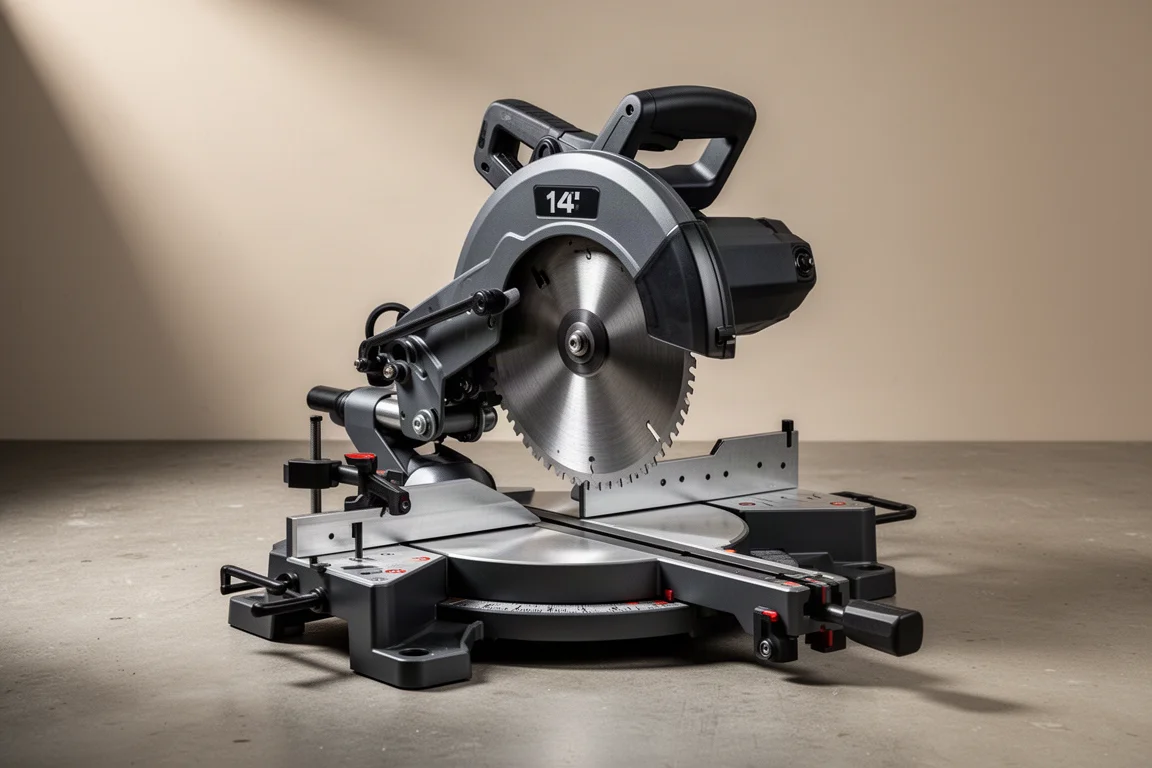
Introduction
Most people’s experience of cutting steel involves an angle grinder and an abrasive disc: showers of sparks, a hot workpiece, and a rough edge that needs cleaning up afterwards. The Evolution S355MCS is nothing like that. It is a heavy-duty metal-cutting chop saw with a 14-inch (355 mm) blade and a 2,200 W motor, and after a year of use it has completely changed what cutting steel feels like.
Despite being marketed as a chop saw, it behaves much more like a miter saw, with a fully functioning miter bed that lets you cut steel at any angle up to and beyond 45 degrees on either side. The maximum crosscut is 180 mm by 95 mm, roughly 7 inches by just under 4 inches, which is not far off the cross-section of a timber sleeper. Except this saw does it in steel.
Who This Product Is For
This saw makes the most sense for anyone who regularly cuts steel: welders fabricating box section and tube, metalworkers making frames, and DIYers tackling chunky steel projects at home. If you currently cut steel with abrasive discs, the difference in cut quality and heat will be immediately obvious.
One point worth noting at the outset: this is the top-of-the-range model and costs not far short of £700. If you do not need the big heavy miter bed and simply want fast, clean cuts, Evolution makes a smaller version with the same motor and blade that does something very similar for less than £300. Both are available on Amazon, which is often even cheaper than the Evolution website.
What Makes It Different From a Timber Miter Saw
A lot of the features are very similar to a timber miter saw, but steel cutting changes a few fundamentals. First, blade position matters: when cutting a small bar right up against the fence, the blade wants to be back, and for something further toward you, the blade wants to be forward. The saw does not slide, but the cutting head position can be released and moved at the rear between front and back positions to match the workpiece.
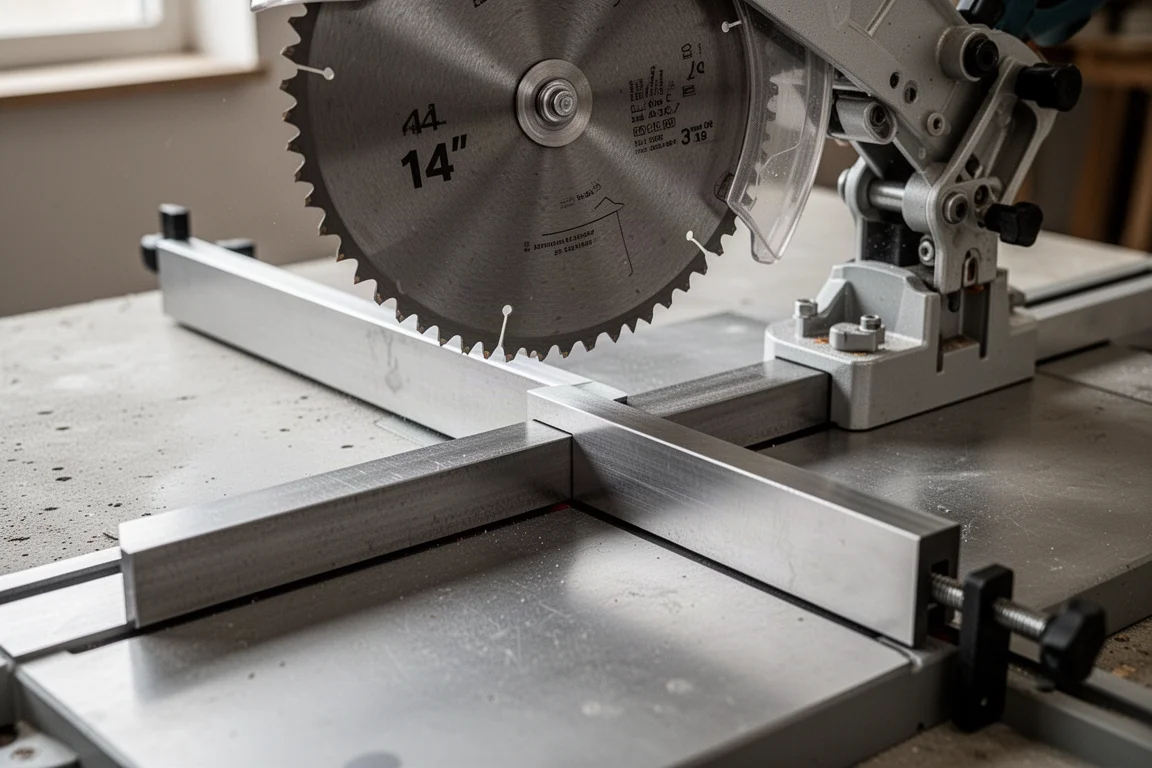
Second, clamping is not optional. With timber you can hold the work by hand and cut with the other hand; with metal, the workpiece needs to be firmly clamped to the bed and fence before you even pull the trigger. The saw handles that with two fairly heavy-duty clamps with quick releases, which is a very nice touch.
Clamping and Work-Holding
The clamps can be moved anywhere along the fence, and the whole carrying bar can be removed entirely if you want it out of the way. In practice, you want it in place, because you should use the clamps on everything, whether it is a pipe or box section.
There are also a couple of attachments that slide onto the front of the clamps and clip in place, with a V-notch section that makes it easy to hold tube, hollow section, or even square section twisted at 45 degrees like a diamond.
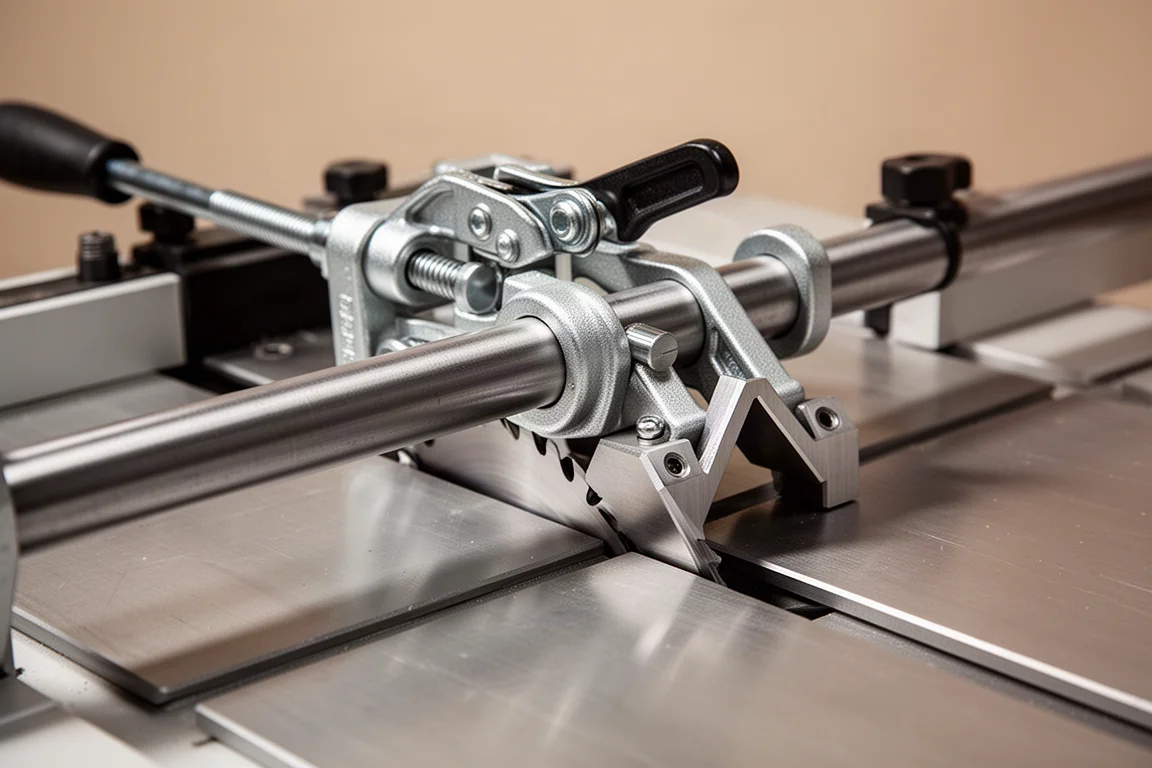
One practical caveat: when clamping in a vertical position, the clamp can get in the way of the motor coming down. You need to think a little about where you clamp. Longer items are fine on the right-hand side, but on the left you are a bit more limited. Sometimes it is simply better to leave one clamp off and make sure the others are well tight.
Miter Angles and Setup
Because this is effectively a miter saw, it handles the most common job in steel fabrication: cutting 45-degree miters for welding two pieces of tubular steel or box section together. The bed turns anything up to 45 degrees, or slightly beyond, on either side, with indents at zero, 30, and 45 degrees, and you can set any other angle by tightening it up. It is a nicely machined, pretty heavy piece of kit.
Zeroing it in for a perfect 90-degree cut works slightly differently from a timber miter saw. The fence comes in two parts rather than being connected at the back, so fine adjustment is not done at the fence. Instead, the adjustment lives on the indents and the base: undo three screws, put it to 90, and check with a square against the fence. It is fairly easy to adjust, just a little different from a standard timber saw.
Cut Quality and Miter Accuracy
This is the real reason this saw is worth a look. Abrasive discs throw sparks everywhere and heat up the workpiece considerably, and plenty of people have grabbed freshly cut steel afterwards and immediately regretted it. The S355MCS is the opposite: the cut comes off cold to the touch, not even warm, so there is no burn risk and no heat distortion.
The cut itself is clean, straight, and essentially burr-free, with an almost polished, silvery edge. Over a year of use, every cut has come out superb. If you are cutting steel to weld, especially miters, that clean straight edge helps the weld enormously. In testing, two pieces of 2-inch (50 mm) square box section with roughly 4 mm walls, each cut at 45 degrees, joined into a very accurate right angle once the blade had been squared up.
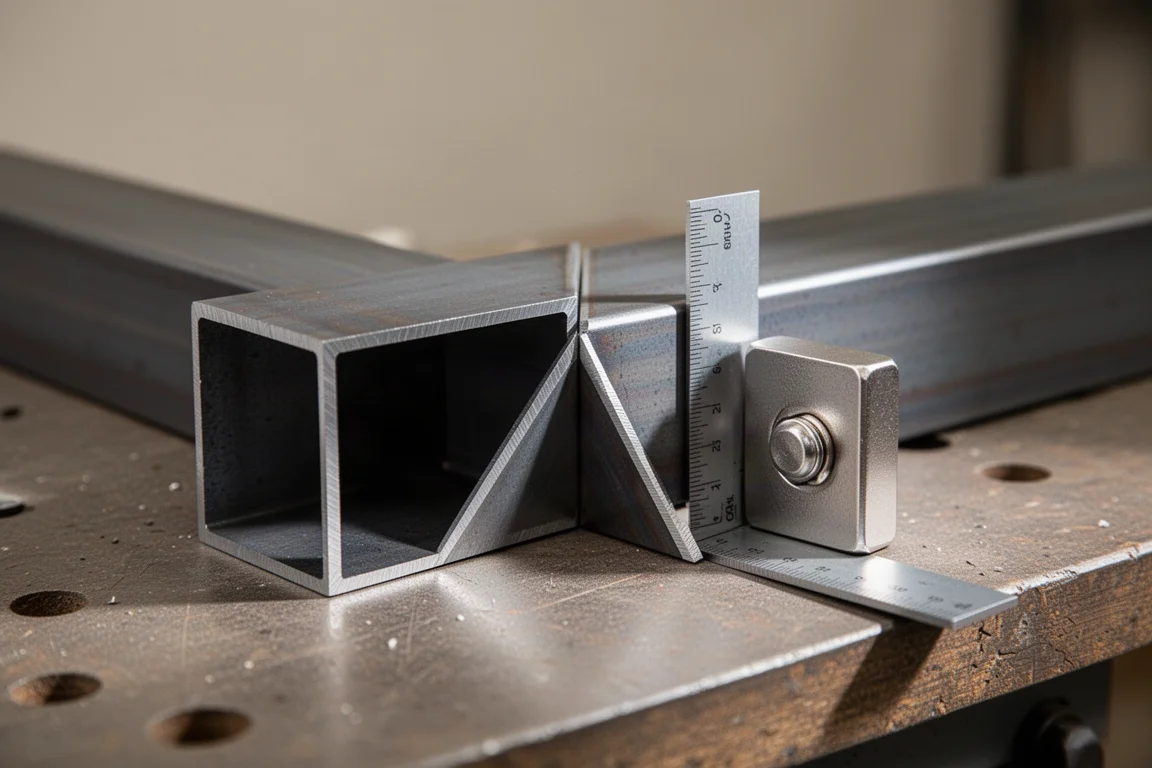
It also gets through steel quickly without forcing it. A light touch is enough; pushing hard would only wear the blade faster, and even gently it does not take long per cut. It is almost easier, and arguably more accurate, than cutting timber.
Cutting Bigger Steel
The 180 mm by 95 mm maximum crosscut means genuinely chunky steel is on the menu. A beam measuring just over 100 mm in each direction, roughly 102 by 102, goes through it without drama. Evolution’s own guidance for the best cut orientation to save blade life is worth following, especially with a rough plasma-cut end where the start of the cut is uneven. It is not the biggest beam in the world, but you would not want to try to get through it with a hacksaw.
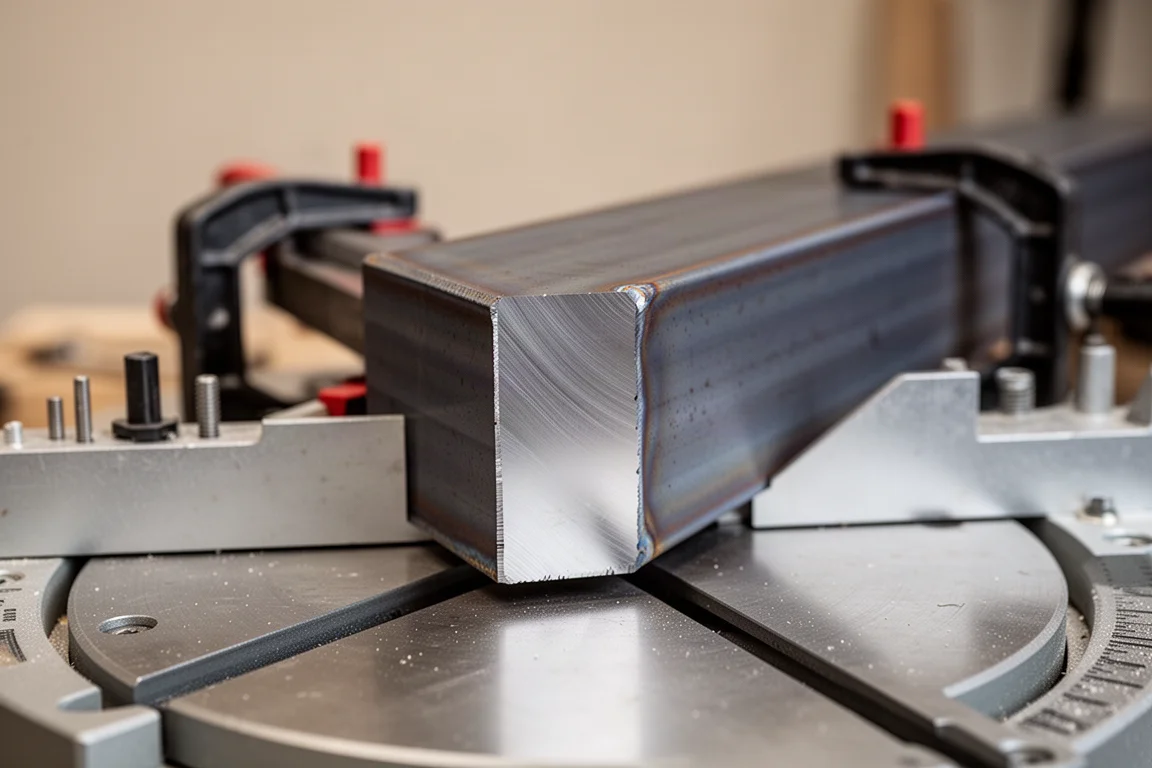
The result is the same as with everything else: a smooth, silvery, genuinely cold cut. These are results that are not difficult to achieve at all.
Things to Consider Before Buying
This is a noisy machine with a large motor, so proper PPE matters. A full-face visor is really what is needed rather than just glasses, because it throws out small steel chips, and it protects your face as well as your eyes.
There is also no dust extraction. The chips end up in a small box at the back, which is fine for steel, but it limits the saw’s wood-cutting trick. You can fit a 355 mm wood blade and cut timber, and for really large items like sleepers it would do the job, but in practice you are probably better off with a dedicated wood-cutting miter saw.
Conclusion
The Evolution S355MCS does exactly what you expect it to, which is rarer than it should be in power tools. Cold cuts, no sparks, clean burr-free edges, and accurate miters make it a genuinely capable steel-cutting machine for welders and serious DIYers alike. It is not cheap at not far short of £700, but if you do not need the miter bed, the smaller sibling with the same motor and blade covers most of the same ground for less than £300. Either way, cutting steel does not have to mean sparks and hot metal.
Product link
View more details for Evolution S355MCS
This product is mentioned in the review. Check the specifications, options, and compatibility before buying.
View more details for Evolution S355MCSFurther reading
Related Reviews
Power Tools
Best 1-Inch Pistol Impact Wrenches: Three Heavy-Duty Options Compared
We compare three 1-inch pistol impact wrenches, from a budget-friendly Harbor Freight model to a premium Caterpillar unit, to help you choose the right one.
Power Tools
Best 3/4-Inch Impact Wrenches 2026: Five Contenders Compared
We compare five 3/4-inch impact wrenches across price and performance, from a budget Amazon option to Snap-on's most powerful model yet.
Power Tools
Best Budget Cordless Tools 2026: Walmart Finds That Punch Above Their Price
We tested five cordless tools from Walmart, including a high-torque impact wrench that trades blows with Milwaukee and a $35 duster that outperforms its price class.