Power Tools
Best Cordless Ratchets 2026: Four Models Compared Under Load
Ridgid's first cordless ratchet takes on Ryobi HP, DeWalt 12V, and Milwaukee M12 Fuel in speed, torque, and real-world access tests.

Introduction
Cordless ratchets have quietly become one of the most useful tools in a mechanic’s drawer, and the category is suddenly getting crowded. Ridgid just launched its first ever cordless ratchet, the R866011, arriving hot on the heels of DeWalt’s first entry in the class. Meanwhile, Ryobi already has a brushless HP extended-length ratchet on the shelves, and Milwaukee’s M12 Fuel High Speed remains the compact benchmark.
To see where each one actually stands, we compared all four on speed under load, torque, handling, and durability, using repeatable tests with nylon lock nuts and calibrated torque measurement. The results split the field in ways the spec sheets do not.
How We Evaluated These Ratchets
The core test is a ratchet gauntlet: running the tool down a bolt loaded with nylon locking nuts, which create roughly 3 to 15 foot-pounds of resistance depending on fastener size. That kind of load mimics rusty or imperfect threads far better than a free-spinning nut, and it exposes which advertised rpm ratings are real under load rather than just a high score.

Torque was also measured on a calibrated dyno in foot-pounds, and each tool was worked hard by hand like a manual ratchet to check for flex and head durability. Lower scores are better on the ranking chart, with weight, head size, price, speed, and torque all factored in.
Ridgid R866011
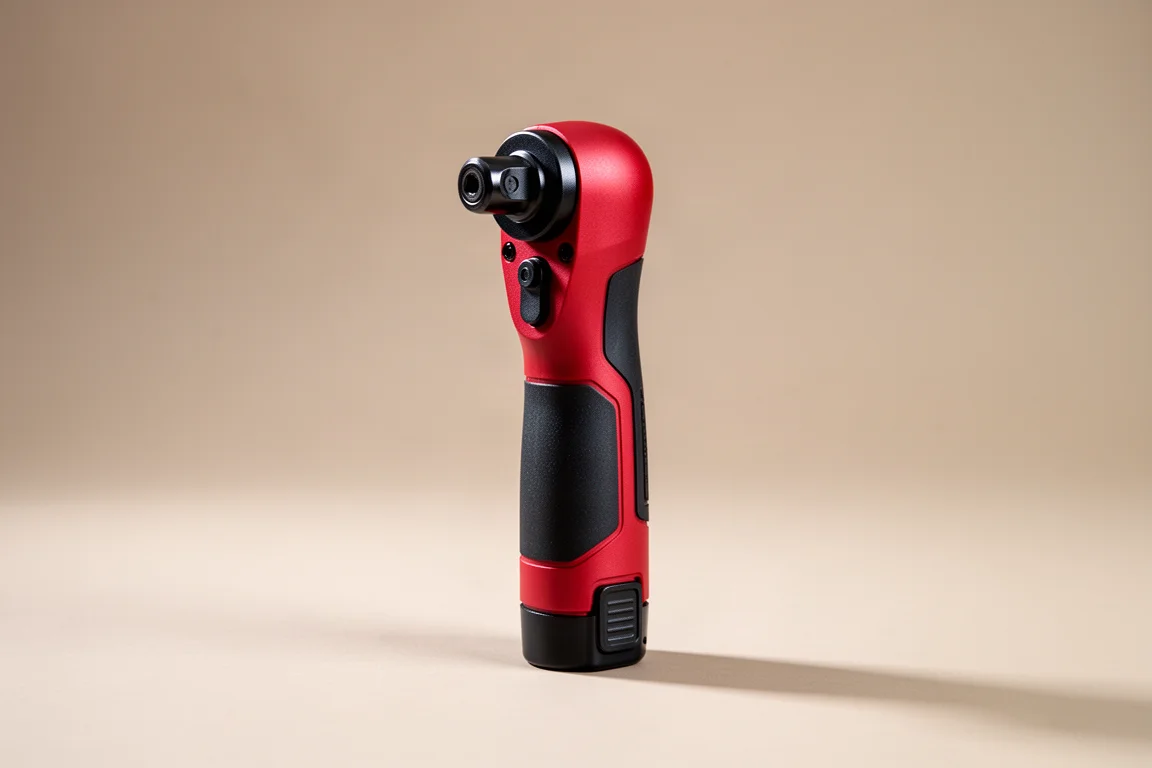
The R866011 is Ridgid’s first cordless ratchet, and notably it is an 18-volt full-size battery platform tool rather than a 12-volt compact. It runs up to 250 rpm, advertises 55 foot-pounds of torque, and costs $179.
In the lock nut gauntlet it finished in 2 minutes 9 seconds, essentially matching DeWalt despite DeWalt’s higher 60 foot-pound rating. On the dyno it saw 58 to 65 foot-pounds depending on battery, and a second trigger pull moved figures up to around 69. There is a caveat: working the tool hard by hand revealed noticeable body flex, particularly around the battery joint, with nothing breaking but the feel inspiring little confidence.
The main trade-off is layout. The battery hangs off the end in line with the body and takes up real footprint, the head meets the body early on the length so you gain less working access than the overall size suggests, and the body diameter is about 10 percent larger than the Ryobi’s. If you already own Ridgid batteries, though, this is a very capable first ratchet for the platform.

Ryobi HP Extended Length Brushless Ratchet
The Ryobi HP is the only brushless HP ratchet from the brand, in an extended-length configuration that costs $159. It spins up to 230 rpm, advertises the same 55 foot-pounds as the Ridgid, and shares the same ratchet head and dimensions since both come from the same manufacturing stable.
On paper the extended length looks like a penalty, but in practice the four-position locking head partly makes up for the awkward battery sticking off the end, and the reach is genuinely useful when you need it. It was heavier than the Ridgid in testing due to that length, and it finished the gauntlet in 2 minutes 17 seconds, one bolt behind, yet it often loosened nuts with a single trigger pull where the Ridgid needed hand help on the last three.

On the dyno it saw up to 65 foot-pounds like the Ridgid, and with a second trigger pull reached 72, matching what a 60-foot-pound-rated tool produced. The clincher is value: it costs less than the Ridgid while offering more reach, less flex, and better handling. If the battery orientation works for your workspace, this is the one we would pick between the two, even at equal pricing.

Speed Under Load: The Lock Nut Gauntlet
This test is where advertised rpm numbers get honest. Milwaukee’s 450 rpm M12 High Speed looks untouchable on a free-running nut, but against fresh nylon lock nuts its pace drops sharply, and with a battery sitting around two bars it simply could not move a new half-inch lock nut at all. A high-speed ratchet without enough torque behind it becomes, effectively, the slowest cordless ratchet ever made, because you end up driving it by hand.
The Ridgid’s 250 rpm and the Ryobi’s 230 rpm slowed less under load, and higher-torque tools in general held their pace better. DeWalt finished the gauntlet 3 seconds ahead of the Ridgid, and both comfortably beat the 190 seconds of the first-generation M12 Fuel. The Ryobi’s 137 seconds still put it well clear of that older Milwaukee, though behind the Ridgid’s 129.

For context on what wins: it is the balance of speed and torque, not raw rpm on the label.
DeWalt 12V Cordless Ratchet
DeWalt’s first ever cordless ratchet is a 12-volt compact that runs at 250 rpm with a 60 foot-pound advertised rating, the highest claimed figure in this group, at $179 like the Ridgid.
In testing it proved to be essentially the benchmark the new Ridgid was built to answer. It edged the Ridgid by three seconds in the gauntlet, and the two performed so similarly that a rerun of either tool would likely produce comparable results. It slots into the top 60 to 80 foot-pound tier of our ranking for now, which makes it the current pick in that bracket.
The compact 12-volt battery keeps the footprint smaller than the Ridgid’s full-size pack, which showed in the head-to-head layout. If you want a genuine all-rounder in this torque class and you already lean toward DeWalt batteries, this is the strongest purchase here.

Milwaukee M12 Fuel High Speed Ratchet
The M12 Fuel High Speed was the top-ranked compact ratchet in testing, and for pure compactness it remains hard to beat. Its 450 rpm makes quick work of low-resistance fasteners, and around the shop it has earned plenty of use.

But the gauntlet exposed its weakness: under real load from stiff lock nuts, the pace drops dramatically, and with lower-charge batteries it can stall outright on fresh half-inch nuts. It remains the reference tool in the top 20 to 40 foot-pound compact tier, and the sensible choice if your work is mostly smaller fasteners where speed and size matter more than maximum torque.
What the Numbers Miss
The Ridgid and Ryobi shared a ratchet head, meaning good compact head dimensions and torque capability that did not need a redesign. The Ryobi earned identical head-size points while costing less, which is why it won our head-to-head on everything the charts struggle to score: body flex, layout, and feel.
The honest takeaway is that the perfect cordless ratchet is still out there. We are still looking for a model delivering 45 to 50 foot-pounds of real torque with no serious compromises. Until then, DeWalt holds our current top pick in the 60 to 80 foot-pound class, and the M12 remains the compact reference.
Buying Advice
If you already own Ridgid batteries, the R866011 is a welcome and competent first ratchet for the platform. If you are choosing fresh, the Ryobi HP extended length does nearly everything the Ridgid does, with less flex and a lower price, making it the better value of the TTI pair.
DeWalt’s 12V is the strongest overall pick in the higher-torque bracket and effectively the tool the Ridgid mirrors. Milwaukee’s M12 Fuel High Speed stays unbeaten for compactness and is ideal if your fasteners rarely push past the 20 to 40 foot-pound range.
Conclusion
Four ratchets, four different answers. The Ridgid R866011 is a solid platform debut with real speed, the Ryobi HP undercuts it on price and feel, the DeWalt 12V remains the benchmark in its torque class, and the Milwaukee M12 Fuel High Speed still owns the compact tier. Match the tool to your fastener range and battery collection, and any of these will earn its place in the drawer.
Further reading
Related Reviews
Power Tools
Best 1-Inch Pistol Impact Wrenches: Three Heavy-Duty Options Compared
We compare three 1-inch pistol impact wrenches, from a budget-friendly Harbor Freight model to a premium Caterpillar unit, to help you choose the right one.
Power Tools
Best 3/4-Inch Impact Wrenches 2026: Five Contenders Compared
We compare five 3/4-inch impact wrenches across price and performance, from a budget Amazon option to Snap-on's most powerful model yet.
Power Tools
Best Budget Cordless Tools 2026: Walmart Finds That Punch Above Their Price
We tested five cordless tools from Walmart, including a high-torque impact wrench that trades blows with Milwaukee and a $35 duster that outperforms its price class.